Philippines Nuts Market Size, Share & Growth Rate
The Philippines Nuts Market was estimated at USD 356 Million in 2025 and is projected to reach USD 472 Million by 2032, growing at a CAGR of 4.1% from 2026 to 2032. This growth trajectory is largely propelled by an increasing consumer inclination toward healthy snacking options, with nuts recognized for their nutritional benefits. Furthermore, the versatility of nuts in culinary applications is expanding their appeal across both traditional and contemporary Filipino cuisine, establishing them as a staple in various diets.
Philippines Nuts Market Year-wise Growth Rate and Key Drivers
This graph highlights how the Philippines Nuts Market has steadily grown over the years, supported by major growth factors.
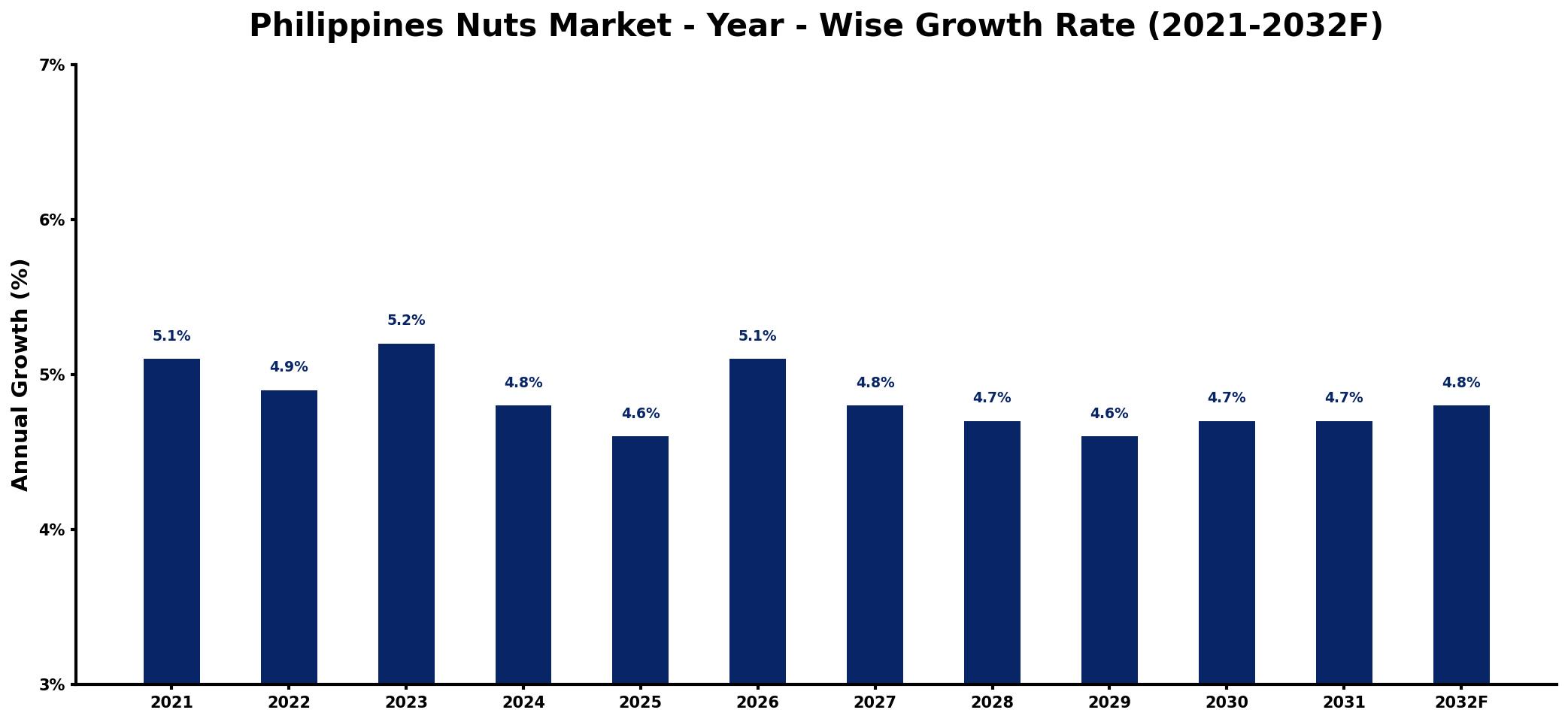
The table below presents the year‑wise growth rates along with the key drivers influencing the market
| Year | Growth Rate | Major Drivers |
| 2021 | 5.1% | Rising health awareness among consumers |
| 2022 | 4.9% | Increased demand for plant-based snacks |
| 2023 | 5.2% | Growing popularity of vegan diets |
| 2024 | 4.8% | Expansion of retail distribution channels |
| 2025 | 4.6% | Surge in online grocery shopping |
| 2026 | 5.1% | Investment in sustainable agriculture practices |
| 2027 | 4.8% | Innovations in food processing technologies |
| 2028 | 4.7% | Strengthening export market opportunities |
| 2029 | 4.6% | Emergence of health-focused brands |
| 2030 | 4.7% | Increased consumer interest in superfoods |
| 2031 | 4.7% | rising infrastructure development spending |
| 2032 | 4.8% | Growing demand for functional foods |
Note: Market size estimations and growth projections presented in this report are based on 6Wresearch's proprietary forecasting methodology, utilizing the latest available industry data, government publications, and primary research inputs.
Philippines Nuts Market Synopsis
Recently, the Philippines nuts market has been witnessing a positive surge, driven by heightened awareness of health and nutrition. This momentum is expected to evolve as local production meets both domestic consumption and export demands, particularly for value-added products. The ongoing adaptation to market dynamics indicates a bright future, as producers increasingly focus on quality and innovation.
As a diverse agricultural nation, the Philippines boasts a variety of nuts, such as cashews and pili nuts, that cater to distinct consumer tastes. This diversity not only enhances the local market but also presents significant opportunities for international trade, underlining the countrys potential as a competitive player in the global nuts industry.
Philippines Nuts Market Key Takeaways
- The Philippines nuts market showcases a robust growth forecast driven by rising health consciousness among consumers.
- Diverse local nut varieties contribute to unique flavor profiles that cater to both domestic and international markets.
- Export opportunities are being amplified by government initiatives aimed at enhancing agricultural exports.
- Investment in processing and packaging innovations is expected to create additional value within the market.
- The growth is also supported by a trend towards plant-based diets and nutritious snacking solutions.
Evaluation of Restraints in Philippines Nuts Market
While the Philippines nuts market is poised for growth, it faces several constraints that could hinder its progress. Competition from both imported and locally sourced varieties intensifies market dynamics, putting pressure on prices and profit margins. Additionally, maintaining consistent quality throughout the supply chain is paramount; challenges such as storage conditions, processing standards, and adherence to safety regulations can impede growth. Ensuring access to international markets while complying with stringent export regulations remains a critical hurdle for local producers aiming to capitalize on global demand.
Philippines Nuts Market Trends
The Philippines nuts market is increasingly influenced by trends emphasizing health and sustainability. Consumers are gravitating towards snacks perceived as wholesome, driving demand for raw and organic nut options. The rise of e-commerce has further reshaped purchasing behavior, facilitating access to a broader range of products. Innovative processing techniques, such as flavored and seasoned nuts, are gaining traction, appealing to younger demographics seeking novel snacking experiences. Additionally, there is a growing interest in sourcing sustainably produced nuts, reflecting global consumer preferences for environmentally friendly options.
Philippines Nuts Market Opportunities
Significant growth opportunities exist in the Philippines nuts market, particularly in the realm of product diversification and value addition. With an increasing focus on health and wellness, brands can develop new product lines targeting specific dietary preferences, such as keto, paleo, or vegan diets. Furthermore, exploring international markets, particularly in Asia and Europe, can open new revenue streams for Filipino nut producers. Local initiatives to enhance agricultural practices and promote nut consumption further enhance the viability of investments in this sector.
Government Initiatives in the Philippines Nuts Market
The Philippine government is actively promoting initiatives to boost the nuts market as part of its broader agricultural development strategy. Policies aimed at enhancing production capabilities through grants and funding for farmers are in place. Moreover, export incentives are being structured to facilitate access to international markets, allowing local producers to capitalize on global demand. Programs focused on improving agricultural practices, alongside public awareness campaigns about the health benefits of nuts, are contributing to the overall growth of this market.
Future Insights of the Philippines Nuts Market
Looking ahead to 2026-2032, the Philippines nuts market is anticipated to continue its upward trajectory, driven by consumer preferences shifting towards healthy and nutrient-rich snacks. The integration of technology in processing and distribution will likely enhance operational efficiencies, allowing producers to meet both local and international demand more effectively. As sustainability becomes a focal point for consumers, those who prioritize eco-friendly practices in nut production will find themselves at a competitive advantage, shaping a progressive landscape for the Philippines nuts market.
Philippines Nuts Market Latest Developments (2025 - 2026)
In the recent months, the Philippines nuts market has seen a renewed focus on sustainability, with several initiatives launched to enhance the production of organic nuts. Local manufacturers are increasingly investing in innovative packaging solutions that emphasize eco-friendliness, aligning with consumer preferences. Additionally, there has been a noticeable rise in collaborations between agricultural cooperatives and technology firms to improve supply chain transparency and efficiency, ensuring that quality is maintained from farm to consumer.
Philippines Nuts Market - Key Attractiveness of the Report
- 10 Years of Market Numbers
- Historical Data Starting from 2022 to 2025
- Base Year: 2025
- Forecast Data until 2032
- Key Performance Indicators Impacting the Market
- Major Upcoming Developments and Projects
Key Highlights of the Report:
- Philippines Nuts Market Outlook
- Market Size of Philippines Nuts Market, 2025
- Forecast of Philippines Nuts Market, 2032
- Historical Data and Forecast of Philippines Nuts Revenues & Volume for the Period 2022-2032F
- Philippines Nuts Market Trend Evolution
- Philippines Nuts Market Drivers and Challenges
- Philippines Nuts Price Trends
- Philippines Nuts Porter's Five Forces
- Philippines Nuts Industry Life Cycle
- Historical Data and Forecast of Philippines Nuts Market Revenues & Volume By Product for the Period 2022-2032F
- Historical Data and Forecast of Philippines Nuts Market Revenues & Volume By Almonds for the Period 2022-2032F
- Historical Data and Forecast of Philippines Nuts Market Revenues & Volume By Peanuts for the Period 2022-2032F
- Historical Data and Forecast of Philippines Nuts Market Revenues & Volume By Cashew for the Period 2022-2032F
- Historical Data and Forecast of Philippines Nuts Market Revenues & Volume By Walnuts for the Period 2022-2032F
- Historical Data and Forecast of Philippines Nuts Market Revenues & Volume By Hazelnuts for the Period 2022-2032F
- Historical Data and Forecast of Philippines Nuts Market Revenues & Volume By Pistachios for the Period 2022-2032F
- Historical Data and Forecast of Philippines Nuts Market Revenues & Volume By Others for the Period 2022-2032F
- Historical Data and Forecast of Philippines Nuts Market Revenues & Volume By Distribution Channel for the Period 2022-2032F
- Historical Data and Forecast of Philippines Nuts Market Revenues & Volume By Offline for the Period 2022-2032F
- Historical Data and Forecast of Philippines Nuts Market Revenues & Volume By Online for the Period 2022-2032F
- Philippines Nuts Import Export Trade Statistics
- Market Opportunity Assessment By Product
- Market Opportunity Assessment By Distribution Channel
- Philippines Nuts Top Companies Market Share
- Philippines Nuts Competitive Benchmarking By Technical and Operational Parameters
- Philippines Nuts Company Profiles
- Philippines Nuts Key Strategic Recommendations






































