Philippines Optical Projector Market Top 5 Importing Countries and Market Competition (HHI) Analysis
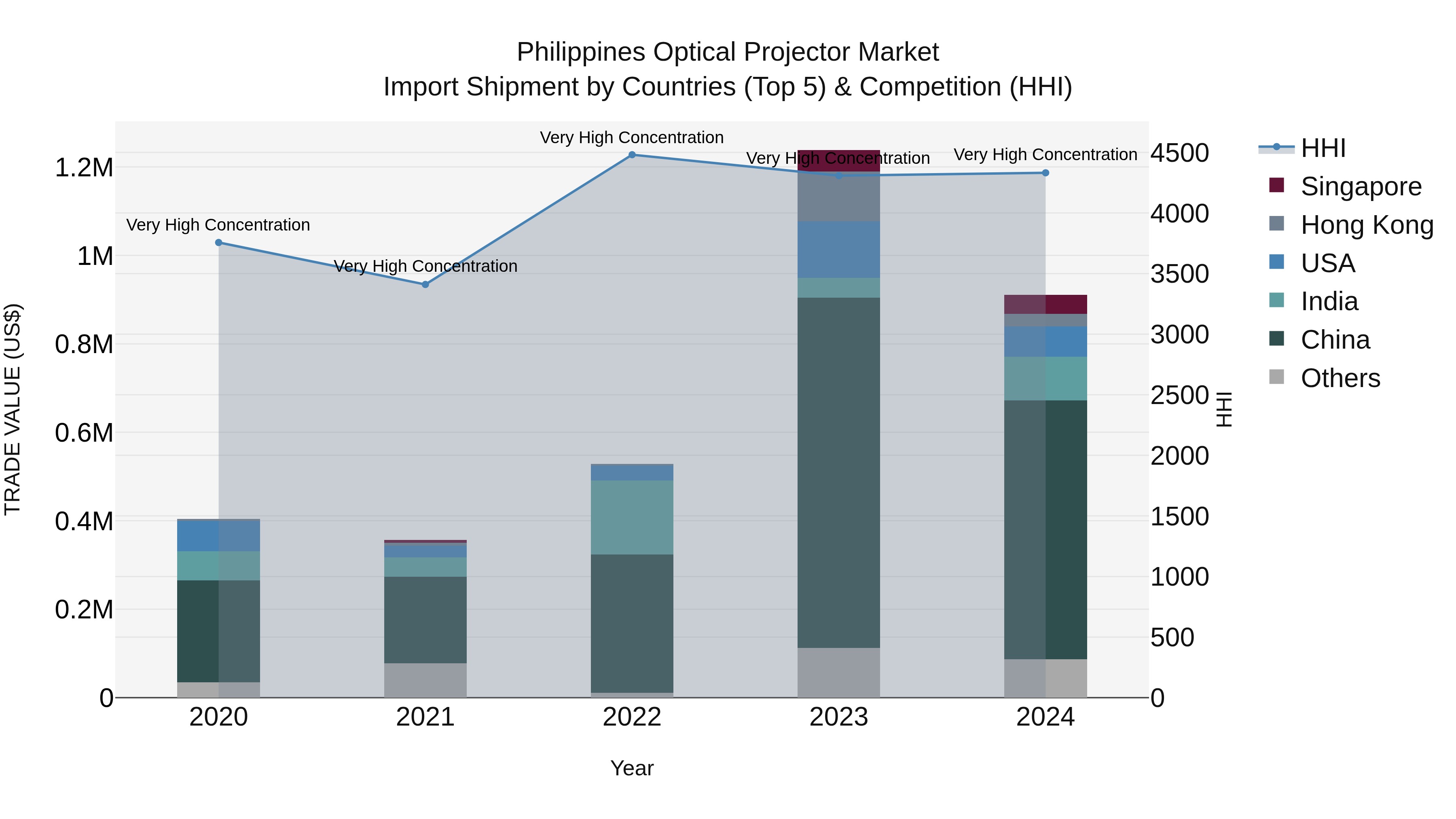
In 2024, the Philippines witnessed a significant influx of optical projectors from top exporting countries such as China, India, USA, Canada, and Singapore. Despite the high Herfindahl-Hirschman Index (HHI) indicating market concentration, the industry demonstrated impressive growth with a Compound Annual Growth Rate (CAGR) of 22.49% from 2020 to 2024. However, there was a slight decline in the growth rate from 2023 to 2024, suggesting a potential shift in market dynamics or temporary market saturation. It will be crucial for stakeholders to monitor these trends closely for strategic decision-making.
philippines photocell market Synopsis
The Philippine photocell market accounted for approximately 1.5% of total revenue generated from lighting control systems globally and this share is further anticipated to increase over the forecast period due to technological advancements leading towards increased adoption among consumers within the country?s residential sector as well as commercial establishments such as offices, hotels, restaurants etc. The photocells segment alone was estimated around US$ 10 Million and it is projected that its value will grow significantly with a CAGR of 7.5%; thereby reaching nearly US$ 14 Million.
Drivers of the Market
The photocell market in the Philippines is expected to experience growth in the coming years due to several key drivers. The increasing adoption of smart lighting systems in both residential and commercial sectors is driving the demand for photocells. These devices play a crucial role in automated lighting control, enhancing energy efficiency and reducing operational costs. Additionally, the growing awareness of environmental sustainability is pushing for the implementation of energy-efficient solutions, further boosting the demand for photocells.
Challenges of the Market
The Philippines photocell market is expected to experience steady growth, driven by the increasing demand for energy-efficient lighting solutions in both residential and commercial sectors. However, challenges such as competition from alternative sensor technologies and the need for continuous technological advancements to enhance accuracy and reliability may pose hurdles for market players.
COVID-19 Impact on the Market
The Philippines photocell market has experienced various challenges due to the COVID-19 pandemic. As restrictions were imposed and economic activities slowed down, the demand for photocell devices, which are commonly used in lighting and sensing applications, was adversely affected. Many construction and infrastructure projects were put on hold, leading to a decline in demand for lighting solutions. However, as the country gradually recovers and resumes normalcy, the photocell market is expected to rebound. The push towards energy-efficient lighting and smart city initiatives could drive the demand for photocells in the long run.
Key Players in the Market
Some of the key players in the market includes Artisan Controls Philippines Corporation, Elmark Lighting, Inc., JKL Components Corp, PLC Solutions & Services, Inc, Powergen Technologies, Inc, and Superlite Electricals and Automations Corp.
Key Highlights of the Report:
- Philippines Optical Projector Market Outlook
- Market Size of Philippines Optical Projector Market, 2024
- Forecast of Philippines Optical Projector Market, 2031
- Historical Data and Forecast of Philippines Optical Projector Revenues & Volume for the Period 2021-2031
- Philippines Optical Projector Market Trend Evolution
- Philippines Optical Projector Market Drivers and Challenges
- Philippines Optical Projector Price Trends
- Philippines Optical Projector Porter's Five Forces
- Philippines Optical Projector Industry Life Cycle
- Historical Data and Forecast of Philippines Optical Projector Market Revenues & Volume By Type for the Period 2021-2031
- Historical Data and Forecast of Philippines Optical Projector Market Revenues & Volume By Digital Light Processing (DLP) for the Period 2021-2031
- Historical Data and Forecast of Philippines Optical Projector Market Revenues & Volume By Liquid Crystal Display (LCD) for the Period 2021-2031
- Historical Data and Forecast of Philippines Optical Projector Market Revenues & Volume By Liquid Crystal on Silicon (LCoS) for the Period 2021-2031
- Historical Data and Forecast of Philippines Optical Projector Market Revenues & Volume By Application for the Period 2021-2031
- Historical Data and Forecast of Philippines Optical Projector Market Revenues & Volume By Residential for the Period 2021-2031
- Historical Data and Forecast of Philippines Optical Projector Market Revenues & Volume By Commercial for the Period 2021-2031
- Historical Data and Forecast of Philippines Optical Projector Market Revenues & Volume By Industrial for the Period 2021-2031
- Philippines Optical Projector Import Export Trade Statistics
- Market Opportunity Assessment By Type
- Market Opportunity Assessment By Application
- Philippines Optical Projector Top Companies Market Share
- Philippines Optical Projector Competitive Benchmarking By Technical and Operational Parameters
- Philippines Optical Projector Company Profiles
- Philippines Optical Projector Key Strategic Recommendations






































