Philippines Payment as a Service Market Size & Growth Rate (2026-2032)
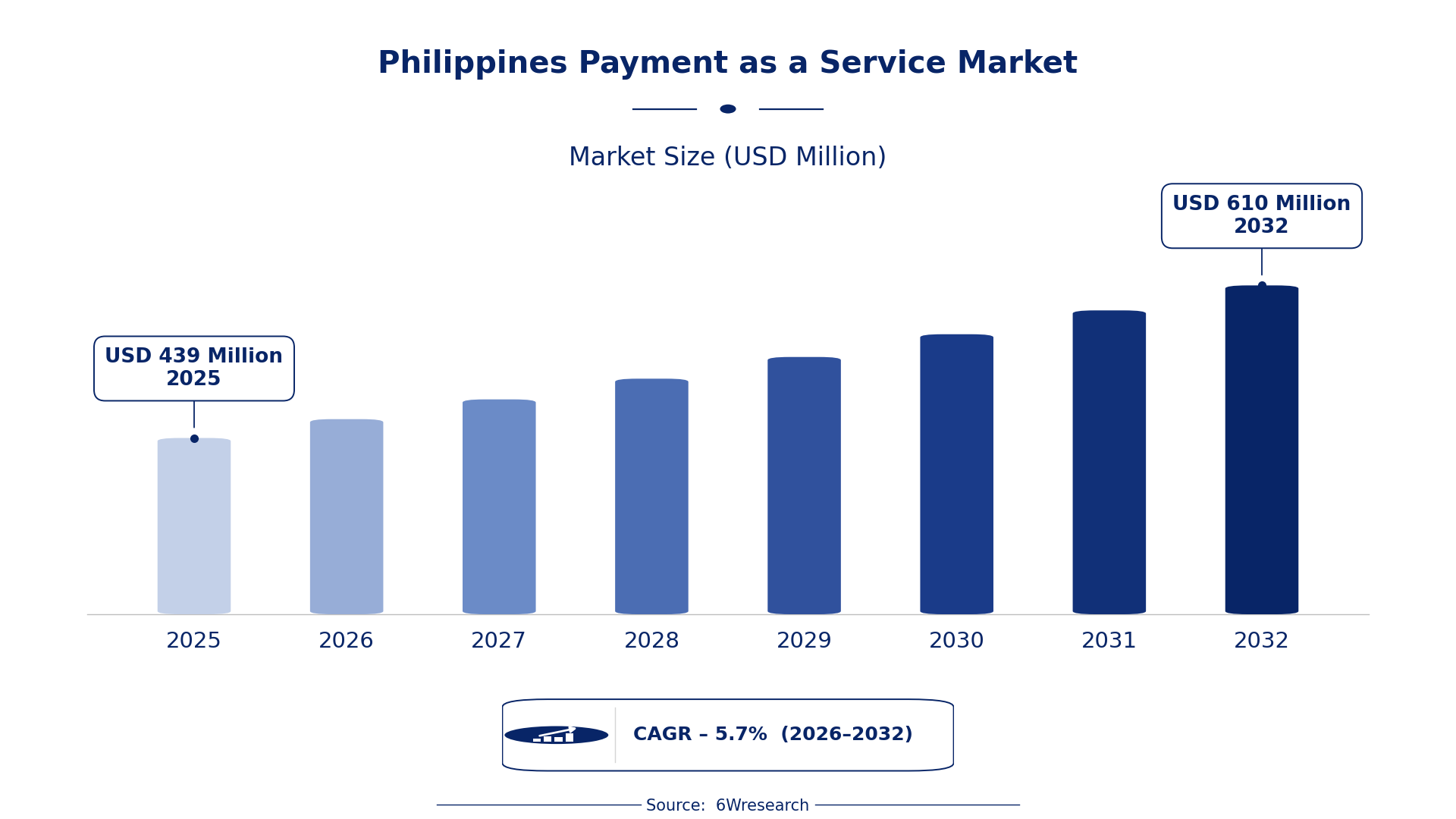
The Philippines Payment as a Service Market was estimated at USD 439 Million in 2025 and is projected to reach USD 610 Million by 2032, growing at a CAGR of 5.7% from 2026 to 2032.
Philippines Payment as a Service Market Synopsis
The Philippines Payment as a Service market is currently experiencing rapid growth, driven by increasing digital transaction adoption among both consumers and businesses. However, as the market matures, it faces challenges related to financial inclusion and the need for more accessible solutions.
As more companies embrace digital payment systems, the demand for innovative and secure payment solutions is expected to rise. This shift represents an opportunity for businesses to enhance their customer experiences and streamline operations, positioning themselves competitively in the market.
Philippines Payment as a Service Market Year-wise Growth Rate and Key Drivers
This graph illustrates the annual growth rates of the Philippines Payment as a Service Market from 2021 to 2032, highlighting a steady upward trajectory and projected expansion over the forecast period.
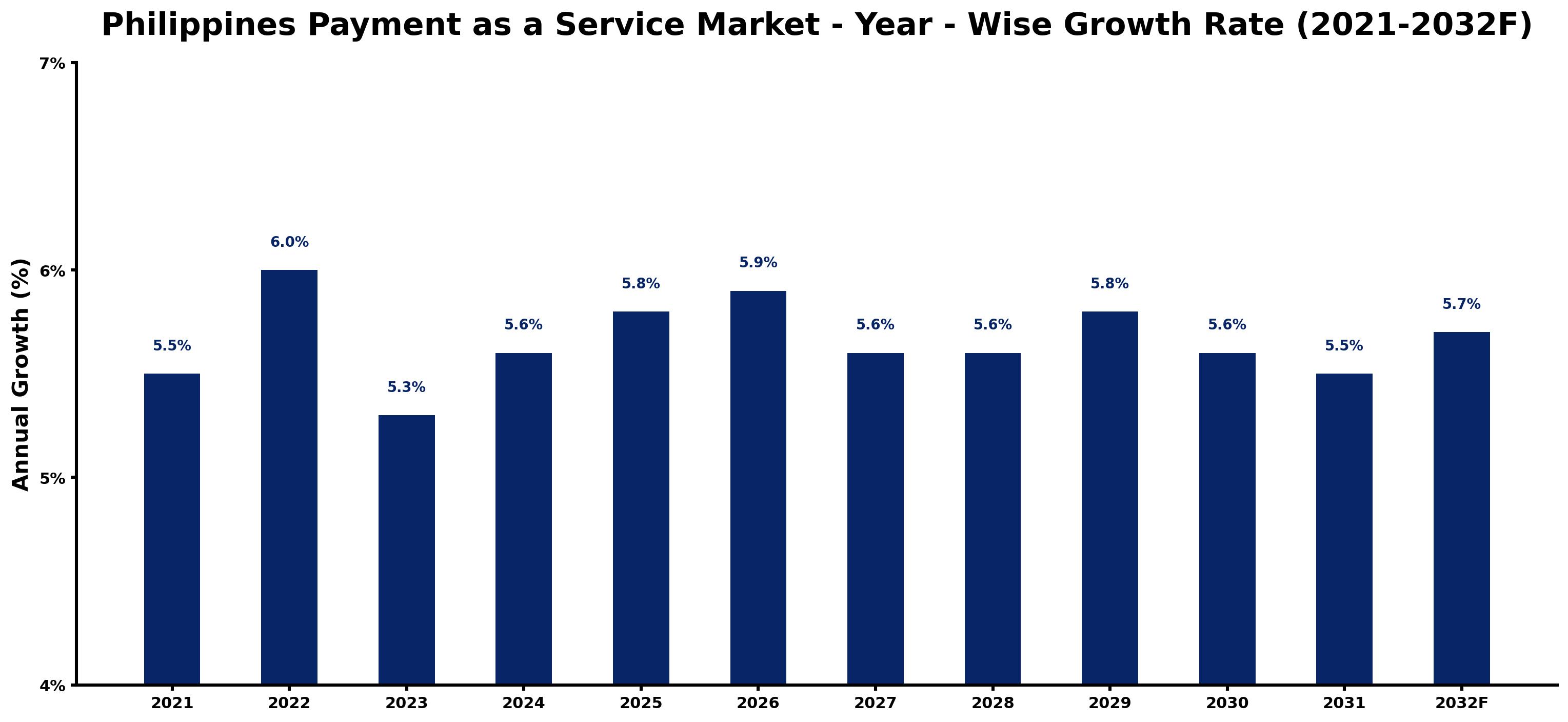
The table below presents the year‑wise growth rates along with the key drivers influencing the market
| Year | Growth Rate | Major Drivers |
| 2021 | 5.5% | Boost from BSP's digital payments transformation roadmap. |
| 2022 | 6.0% | Adoption of e-wallets driven by pandemic purchasing habits. |
| 2023 | 5.3% | Rise in contactless payments during public health initiatives. |
| 2024 | 5.6% | Government support for fintech innovations through regulatory reforms. |
| 2025 | 5.8% | Increase in cross-border e-commerce transactions enhancing payment options. |
| 2026 | 5.9% | Growing smartphone penetration facilitating digital payment solutions. |
| 2027 | 5.6% | Partnerships between banks and fintechs enhancing service accessibility. |
| 2028 | 5.6% | Increased foreign investments in local payment platforms. |
| 2029 | 5.8% | Regulatory clarity boosting consumer confidence in digital transactions. |
| 2030 | 5.6% | Continued growth in remittances driving payment service demand. |
| 2031 | 5.5% | Rise of tech-savvy small businesses adopting digital payments. |
| 2032 | 5.7% | Increased financial literacy initiatives fostering digital payment adoption. |
Note: Market size estimations and growth projections presented in this report are based on 6Wresearch's proprietary forecasting methodology, utilizing the latest available industry data, government publications, and primary research inputs.
Philippines Payment as a Service Market Key Takeaways
Below are some of the specific key takeaways from the market, including:
- The market is driven by the increasing shift towards online and mobile payments.
- COVID-19 accelerated the adoption of digital payment solutions significantly.
- Financial inclusion remains a critical challenge, with many consumers still unbanked.
- Key players are continuously innovating to meet evolving consumer demands.
- Government initiatives are focusing on improving digital infrastructure and payment accessibility.
Evaluation of Restraints in Philippines Payment as a Service Market
Despite notable growth, the Philippines Payment as a Service market faces considerable restraints. A large segment of the population remains unbanked or underbanked, limiting the potential customer base for many PaaS providers. Additionally, there are concerns regarding cybersecurity, as increased online transactions have heightened the risks of fraud. These factors hinder the market's ability to expand uniformly, necessitating targeted strategies to enhance financial inclusion and security measures.
Philippines Payment as a Service Market Trends
Several trends are shaping the Philippines Payment as a Service market. The integration of artificial intelligence and machine learning is enhancing fraud detection and improving customer service. Contactless payments are becoming increasingly popular, driven by consumer demand for convenience and speed. on top of that, the rise of e-commerce is pushing businesses to adopt more versatile payment solutions to cater to their customers’ needs.
Philippines Payment as a Service Market Opportunities
The current market conditions present various growth opportunities. As businesses continue to invest in digital transformation, there is a growing need for comprehensive payment solutions that cater to diverse consumer preferences. Additionally, partnerships between financial institutions and technology companies could facilitate innovative solutions that enhance financial inclusion. Expanding into underserved regions also offers potential for substantial market penetration and customer acquisition.
Government Initiatives in the Philippines Payment as a Service Market
The Philippine government is actively shaping the Payment as a Service market through various initiatives aimed at promoting digital payments and enhancing financial infrastructure. Policies focused on increasing financial literacy and access to payment solutions are vital for fostering a more inclusive economy. As these initiatives progress, they will significantly influence the growth trajectory of the market.
- A national digital payment system was recently launched to streamline transactions across various sectors.
- Current efforts are underway to enhance internet connectivity, particularly in rural areas, to support digital payment adoption.
- Plans for a regulatory framework promoting transparency in digital transactions are expected to be introduced by 2026.
- The government is working on a public-private partnership to establish a comprehensive financial literacy program aimed at unbanked populations.
Future Insights of the Philippines Payment as a Service Market
Looking ahead to 2026-2032, the Philippines Payment as a Service market is expected to continue its upward trajectory. Advancements in technology, alongside government efforts to bolster digital payment ecosystems, will likely play a crucial role in expanding the market. Increased consumer awareness and acceptance of digital payments will also drive growth, paving the way for innovative solutions and partnerships that enhance the overall user experience.
Philippines Payment as a Service Market Latest Developments
In the last year, the Philippines Payment as a Service market has witnessed significant activity as providers adapt to changing consumer demands and regulatory environments. The push for enhanced security and convenience has led to the rollout of new services and technologies across the sector.
- A major technology vendor launched a new payment processing platform in early 2025, aimed at integrating multiple payment methods into a single interface.
- An initiative focused on expanding digital payment access to underserved areas is currently underway, with pilot programs in selected regions.
- A partnership between two leading financial institutions was established to enhance mobile payment solutions, expected to be operational by mid-2026.
- Plans for a nationwide campaign promoting the benefits of digital payments are set to launch in late 2025.
Philippines Payment as a Service Market - Key Attractiveness of the Report
- 10 Years of Market Numbers
- Historical Data Starting from 2022 to 2025
- Base Year: 2025
- Forecast Data until 2032
- Key Performance Indicators Impacting the Market
- Major Upcoming Developments and Projects
Key Highlights of the Report:
- Philippines Payment as a Service Market Outlook
- Market Size of Philippines Payment as a Service Market, 2025
- Forecast of Philippines Payment as a Service Market, 2032
- Historical Data and Forecast of Philippines Payment as a Service Revenues & Volume for the Period 2022-2032F
- Philippines Payment as a Service Market Trend Evolution
- Philippines Payment as a Service Market Drivers and Challenges
- Philippines Payment as a Service Price Trends
- Philippines Payment as a Service Porter's Five Forces
- Philippines Payment as a Service Industry Life Cycle
- Historical Data and Forecast of Philippines Payment as a Service Market Revenues & Volume By Component for the Period 2022-2032F
- Historical Data and Forecast of Philippines Payment as a Service Market Revenues & Volume By Platform for the Period 2022-2032F
- Historical Data and Forecast of Philippines Payment as a Service Market Revenues & Volume By Services for the Period 2022-2032F
- Historical Data and Forecast of Philippines Payment as a Service Market Revenues & Volume By Service for the Period 2022-2032F
- Historical Data and Forecast of Philippines Payment as a Service Market Revenues & Volume By Professional services for the Period 2022-2032F
- Historical Data and Forecast of Philippines Payment as a Service Market Revenues & Volume By Managed services for the Period 2022-2032F
- Historical Data and Forecast of Philippines Payment as a Service Market Revenues & Volume By Vertical for the Period 2022-2032F
- Historical Data and Forecast of Philippines Payment as a Service Market Revenues & Volume By Retail for the Period 2022-2032F
- Historical Data and Forecast of Philippines Payment as a Service Market Revenues & Volume By Hospitality for the Period 2022-2032F
- Historical Data and Forecast of Philippines Payment as a Service Market Revenues & Volume By Media and entertainment for the Period 2022-2032F
- Historical Data and Forecast of Philippines Payment as a Service Market Revenues & Volume By Healthcare for the Period 2022-2032F
- Historical Data and Forecast of Philippines Payment as a Service Market Revenues & Volume By Banking, Financial Services, and Insurance (BFSI) for the Period 2022-2032F
- Historical Data and Forecast of Philippines Payment as a Service Market Revenues & Volume By Others for the Period 2022-2032F
- Philippines Payment as a Service Import Export Trade Statistics
- Market Opportunity Assessment By Component
- Market Opportunity Assessment By Service
- Market Opportunity Assessment By Vertical
- Philippines Payment as a Service Top Companies Market Share
- Philippines Payment as a Service Competitive Benchmarking By Technical and Operational Parameters
- Philippines Payment as a Service Company Profiles
- Philippines Payment as a Service Key Strategic Recommendations






































