Philippines Perfumes And Perfumery Products Market Top 5 Importing Countries and Market Competition (HHI) Analysis
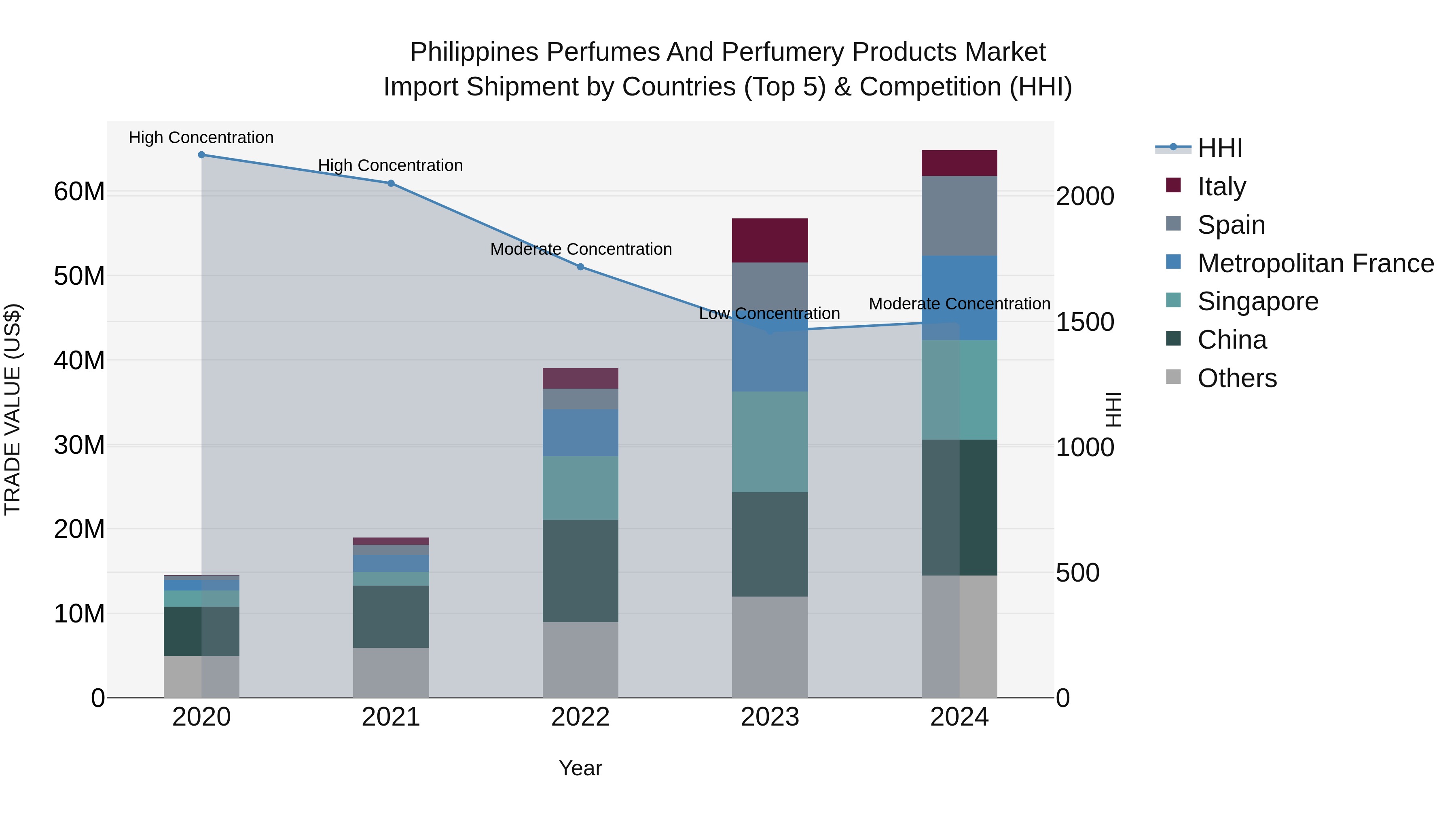
The Philippines perfumes and perfumery products import market saw significant growth in 2024, with top exporters including China, Singapore, Metropolitan France, Spain, and Switzerland. The market concentration, as measured by HHI, shifted from low to moderate in 2024, indicating increased competition among suppliers. The impressive compound annual growth rate (CAGR) of 45.37% from 2020 to 2024 highlights the expanding demand for perfumes in the Philippines. Moreover, the growth rate of 14.27% from 2023 to 2024 signals a continued upward trajectory for the import market, offering opportunities for both local retailers and international suppliers.
Philippines Perfumes and Perfumery Products Market Growth Rate
According to 6Wresearch internal database and industry insights, the Philippines Perfumes and Perfumery Products Market is projected to grow at a compound annual growth rate (CAGR) of 6.8% during the forecast period 2026–2032.
Topics Covered in the Philippines Perfumes and Perfumery Products Market Report
The Philippines Perfumes and Perfumery Products Market report thoroughly covers the market by product, end-user, and distribution channel. It provides an unbiased and detailed analysis of ongoing market trends, opportunities, challenges, and market drivers, helping stakeholders align their strategies with current and future market dynamics.
Philippines Perfumes and Perfumery Products Market Highlights
| Report Name | Philippines Perfumes and Perfumery Products Market |
| Forecast Period | 2026–2032 |
| CAGR | 6.80% |
| Growing Sector | Premium Perfumes |
Philippines Perfumes and Perfumery Products Market Synopsis
The Philippines Perfumes and Perfumery Products Market is undergoing major growth proliferated by rising knowledge of personal grooming, growing disposable income, and the influence of fashion and lifestyle trends. Fragrance products are becoming a crucial part of daily grooming routines among Filipino consumers, particularly among the younger population and working professionals. The market is also getting advantage from the rise of international perfume brands and the introduction of cost-friendly fragrance variants targeting mass consumers.
Evaluation of Growth Drivers in Philippines Perfumes and Perfumery Products Market
Below mentioned are some prominent drivers and their influence on Philippines Perfumes and Perfumery Products Market dynamics:
| Drivers | Primary Segment Affected | Why It Matters (Evidence) |
| Rising Personal Grooming Awareness | Premium Perfumes | Increasing focus on personal hygiene and grooming is encouraging consumers to adopt perfumes as part of their daily routine. |
| Growth of E-Commerce | Online Distribution | Online retail platforms are expanding access to international and local perfume brands. |
| Increasing Disposable Income | Premium Segment | Higher income levels enable consumers to purchase branded and luxury fragrances. |
| Social Media Influence | All Segments | Influencers and celebrities promote perfumes through digital platforms, increasing product awareness. |
| Expansion of Beauty Retail Stores | Offline Channel | Shopping malls and specialty beauty stores are growing perfume obtainability across cities. |
The Philippines Perfumes and Perfumery Products Market is projected to grow at a CAGR of 6.8% from 2026 to 2032. Owing to the increasing popularity of premium fragrances and the expansion of e-commerce platforms, the Philippines Perfumes and Perfumery Products Market Growth is proliferating. Rising urbanization, strong consumer spending on lifestyle products, and the growing influence of fashion trends are further supporting the market expansion. The rising presence of international fragrance brands and aggressive marketing strategies by cosmetic companies are further proliferating the need for perfumes and perfumery products across the Philippines.
Evaluation of Restraints in Philippines Perfumes and Perfumery Products Market
Below mentioned are some major restraints and their influence on Philippines Perfumes and Perfumery Products Market dynamics:
| Restraints | Primary Segment Affected | What This Means (Evidence) |
| High Price Sensitivity | Premium Segment | Many consumers want cost-friendly mass-market perfumes owing to cost considerations. |
| Counterfeit Products | All Segments | Effect on brand reputation owing to presence of fake perfumes. |
| Dependence on Imported Raw Materials | Manufacturers | Many fragrance ingredients are imported, increasing the production costs. |
| Intense Market Competition | All Segments | Numerous international and local brands compete for market share. |
| Limited Local Manufacturing | Premium Brands | Large dependency on imports may limit the growth of domestic perfume production. |
Philippines Perfumes and Perfumery Products Market Challenges
Philippines Perfumes and Perfumery Products Industry goes through numerus challenges consisting of solid competition from international fragrance brands, the presence of counterfeit products, and cost sensitivity among consumers. Rise in production prices and supply chain issues as many companies also depend on imported fragrance ingredients and brands must persistently innovate in fragrance formulations and packaging to remain competitive in a rapidly evolving beauty market. Changing raw material prices and changing consumer preferences for new fragrance trends make further functional performance and strategic challenges for perfume manufacturers in the Philippines.
Philippines Perfumes and Perfumery Products Market Trends
Several notable trends are shaping the Philippines Perfumes and Perfumery Products Market dynamics:
Rise of Natural and Organic Perfumes
Owing to rising awareness of environmental sustainability and skin safety consumers are increasingly wanting perfumes made from natural ingredients.
Influencer-Driven Marketing
Beauty influencers and social media platforms play a major role in promoting fragrance products and influencing purchasing decisions among younger consumers.
Growth of E-Commerce Fragrance Sales
To spur the accessibility of product ,online platforms permit consumers to explore a wide range of perfume brands and cost categories.
Personalized and Niche Fragrances
Consumers are increasingly wanting creative fragrance blends that showcases individual personality.
Investment Opportunities in the Philippines Perfumes and Perfumery Products Industry
Some notable investment opportunities in the Philippines perfume industry are:
Premium Fragrance Brands
Allocation of funds in luxury and niche fragrance brands can appeal affluent consumers wanting exclusive products.
Online Retail Platforms
Digital fragrance retail platforms present robust opportunities due to the swift growth of online shopping.
Local Perfume Manufacturing
Allocation of funds in domestic fragrance production facilities could reduce reliance on imported perfumes and ingredients.
Top 5 Leading Players in the Philippines Perfumes and Perfumery Products Market
Below is the list of prominent companies leading in the Philippines Perfumes and Perfumery Products Market:
L’Oréal Philippines
| Company Name | L’Oréal Philippines |
| Established Year | 1994 |
| Headquarters | Taguig City, Philippines |
| Official Website | Click Here |
L’Oréal Philippines provides a broad range of luxury and designer perfumes through its international fragrance brands and beauty product portfolio.
The Estée Lauder Companies
| Company Name | The Estée Lauder Companies |
| Established Year | 1946 |
| Headquarters | New York, United States |
| Official Website | Click Here |
Estée Lauder gives high-quality fragrance brands and luxury beauty products widely available in department stores and specialty retailers in the Philippines.
Coty Inc.
| Company Name | Coty Inc. |
| Established Year | 1904 |
| Headquarters | New York, United States |
| Official Website | Click Here |
Coty is a leading global fragrance company providing popular designer perfume brands distributed through retail chains and duty-free stores.
Revlon Inc.
| Company Name | Revlon Inc. |
| Established Year | 1932 |
| Headquarters | New York, United States |
| Official Website | Click Here |
Revlon gives a diverse range of perfumes and personal care products catering to both premium and mass-market consumers.
Personal Collection Direct Selling Inc.
| Company Name | Personal Collection Direct Selling Inc. |
| Established Year | 2003 |
| Headquarters | Quezon City, Philippines |
| Official Website | Click Here |
Personal Collection is a major local beauty and personal care company providing cost-friendly fragrance products through direct selling and retail distribution networks.
Government Regulations Introduced in the Philippines Perfumes and Perfumery Products Market
According to Philippine’s government data, regulates perfumes and cosmetic products through the Food and Drug Administration (FDA Philippines) to make sure product safety and quality. Regulations need perfume manufacturers and importers to obey with labelling requirements and safety standards. This is to be done before products can be distributed in the market. The Philippine Department of Trade and Industry (DTI) encourages the growth of the cosmetics sector through policies encouraging local manufacturing and fair trade practices.
Future Insights of the Philippines Perfumes and Perfumery Products Market
The Philippines Perfumes and Perfumery Products Market Growth is expected to increase steadily. It is proliferated by rising consumer awareness of personal grooming, rising disposable income, and the growth of digital retail platforms. High-quality fragrances and niche perfume brands are predicted to get robust requirements among middle-class consumers and the rise of international perfume brands and rising marketing activities through social media and influencer collaborations are predicted to further solidify market development in the Philippines.
Market Segmentation Analysis
The report offers a comprehensive study of the following market segments and their leading categories:
By Product – Mass Perfumes to dominate the market
According to Lakshita, Senior Research Analyst, 6Wresearch, Mass perfumes are expected to lead the Philippines Perfumes and Perfumery Products Market Share due to their affordability and wide availability across retail stores and online platforms and these products appeal to a large consumer base that seeks everyday fragrance solutions at reasonable prices, making them highly popular among young consumers and working professionals.
By End-User – Women to dominate the market
Women are projected to dominate the perfume market as fragrance usage is strongly associated with personal grooming and fashion trends among female consumers. The availability of a wide variety of floral, fruity, and luxury fragrances tailored for women further strengthens this segment’s growth.
By Distribution Channel – Offline to dominate the market
Offline distribution channels such as department stores, beauty specialty stores, and shopping malls are expected to dominate the market. Consumers often prefer to test fragrances before purchasing, which makes physical retail outlets an important sales channel for perfume brands.
Key Attractiveness of the Report
- 10 Years of Market Numbers.
- Historical Data Starting from 2022 to 2025.
- Base Year: 2025.
- Forecast Data until 2032.
- Key Performance Indicators Impacting the Market.
- Major Upcoming Developments and Projects.
Key Highlights of the Report:
- Philippines Perfumes and Perfumery Products Market Outlook
- Market Size of Philippines Perfumes and Perfumery Products Market, 2025
- Forecast of Philippines Perfumes and Perfumery Products Market, 2032
- Historical Data and Forecast of Philippines Perfumes and Perfumery Products Revenues & Volume for the Period 2022-2032F
- Philippines Perfumes and Perfumery Products Market Trend Evolution
- Philippines Perfumes and Perfumery Products Market Drivers and Challenges
- Philippines Perfumes and Perfumery Products Price Trends
- Philippines Perfumes and Perfumery Products Porter's Five Forces
- Philippines Perfumes and Perfumery Products Industry Life Cycle
- Historical Data and Forecast of Philippines Perfumes and Perfumery Products Market Revenues & Volume By Product for the Period 2022-2032F
- Historical Data and Forecast of Philippines Perfumes and Perfumery Products Market Revenues & Volume By Premium for the Period 2022-2032F
- Historical Data and Forecast of Philippines Perfumes and Perfumery Products Market Revenues & Volume By Mass for the Period 2022-2032F
- Historical Data and Forecast of Philippines Perfumes and Perfumery Products Market Revenues & Volume By End-User for the Period 2022-2032F
- Historical Data and Forecast of Philippines Perfumes and Perfumery Products Market Revenues & Volume By Men for the Period 2022-2032F
- Historical Data and Forecast of Philippines Perfumes and Perfumery Products Market Revenues & Volume By Women for the Period 2022-2032F
- Historical Data and Forecast of Philippines Perfumes and Perfumery Products Market Revenues & Volume By Unisex for the Period 2022-2032F
- Historical Data and Forecast of Philippines Perfumes and Perfumery Products Market Revenues & Volume By Distribution Channel for the Period 2022-2032F
- Historical Data and Forecast of Philippines Perfumes and Perfumery Products Market Revenues & Volume By Online for the Period 2022-2032F
- Historical Data and Forecast of Philippines Perfumes and Perfumery Products Market Revenues & Volume By Offline for the Period 2022-2032F
- Philippines Perfumes and Perfumery Products Import Export Trade Statistics
- Market Opportunity Assessment By Product
- Market Opportunity Assessment By End-User
- Market Opportunity Assessment By Distribution Channel
- Philippines Perfumes and Perfumery Products Top Companies Market Share
- Philippines Perfumes and Perfumery Products Competitive Benchmarking By Technical and Operational Parameters
- Philippines Perfumes and Perfumery Products Company Profiles
- Philippines Perfumes and Perfumery Products Key Strategic Recommendations
Market Segmentation
The Market report covers a detailed analysis of the following market segments:
By Product
- Premium
- Mass
By End-User
- Men
- Women
- Unisex
By Distribution Channel
- Online
- Offline






































