Philippines Pickles And Pickle Products Market (2026-2032) | Outlook, Forecast, Revenue, Growth, Companies, Value, Share, Industry, Size, Trends & Analysis
Market Forecast By Product Type (Fruit Pickle, Vegetable Pickle, Meat Pickle, Sea Food Pickle, Relish, Other), By Distribution Channel (Supermarkets/Hypermarkets, Convenience Stores, Online Retailers, Other) And Competitive Landscape
| Product Code: ETC411025 | Publication Date: Oct 2022 | Updated Date: Mar 2026 | Product Type: Market Research Report | |
| Publisher: 6Wresearch | Author: Ravi Bhandari | No. of Pages: 75 | No. of Figures: 35 | No. of Tables: 20 |
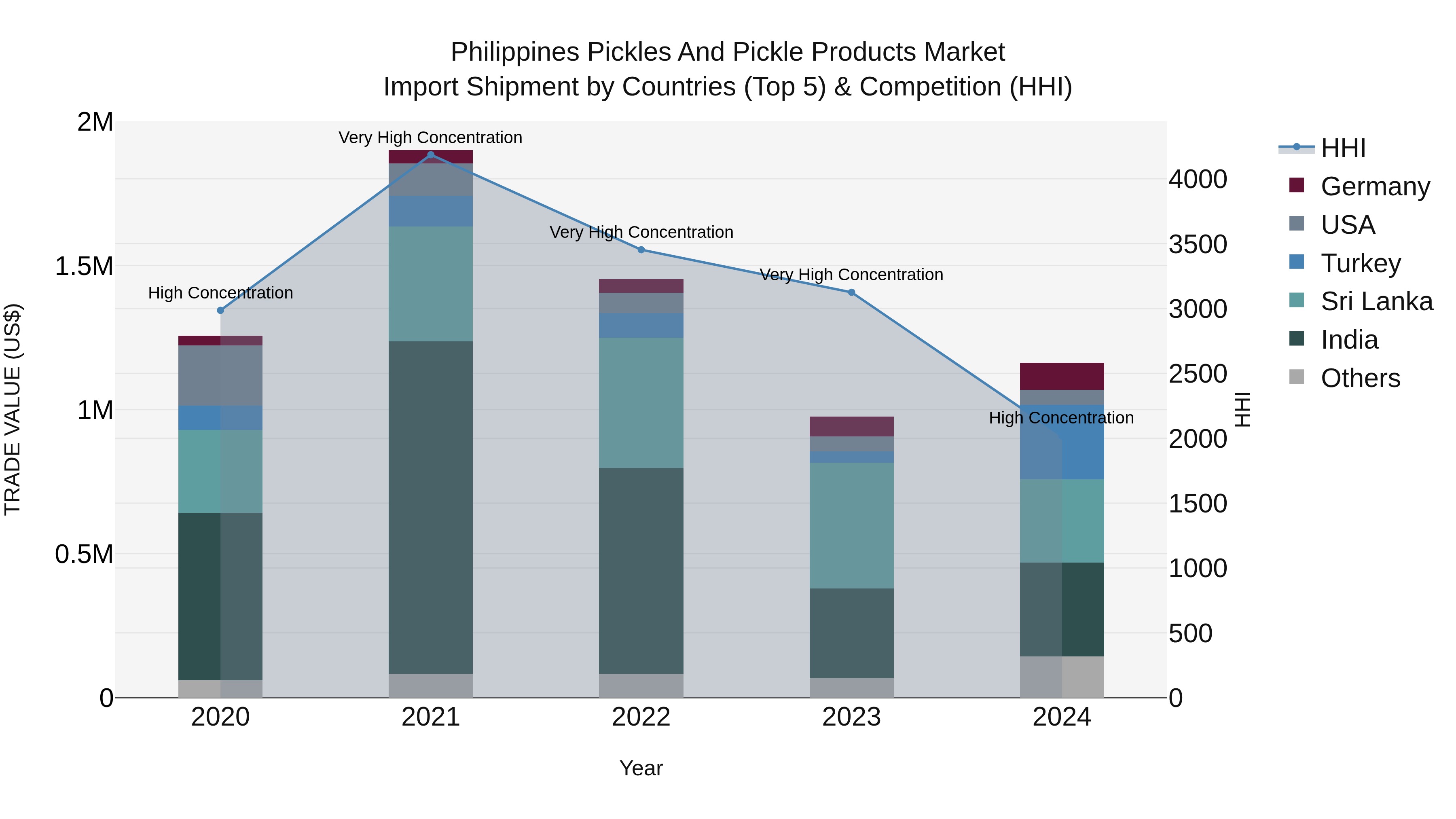
Philippines Pickles And Pickle Products Market Top 5 Importing Countries and Market Competition (HHI) Analysis
Philippines` pickle import market saw a significant shift in concentration in 2024, with top exporters being India, Sri Lanka, Turkey, Germany, and China. Despite a negative CAGR from 2020 to 2024, the industry experienced a notable growth rate of 19.14% from 2023 to 2024. The increasing concentration of import shipments indicates a potential trend towards stronger competition among suppliers. It will be interesting to see how this evolving landscape shapes the future of the Philippines` pickle market and influences consumer choices.
Philippines Pickles and Pickle Products Market Growth Rate
According to 6Wresearch internal database and industry insights, the Philippines Pickles and Pickle Products Market is projected to grow at a compound annual growth rate (CAGR) of 5.1% during the forecast period (2026–2032).
Topics Covered in the Philippines Pickles and Pickle Products Market Report
The Philippines Pickles and Pickle Products Market report thoroughly covers the market by product type and distribution channel. The report provides a detailed analysis of ongoing market trends, opportunities/high-growth areas, and market drivers that will help stakeholders align strategies based on current and future market dynamics.
Philippines Pickles and Pickle Products Market Highlights
| Report Name | Philippines Pickles and Pickle Products Market |
| Forecast period | 2026-2032 |
| CAGR | 5.1% |
| Growing Sector | Gourmet Fruit Pickles and Fermented Relishes |
Philippines Pickles and Pickle Products Market Synopsis
The Philippines Pickles and Pickle Products Market is undergoing a major change as traditional methods of preserving food have turned into fast growing commercial industries. The main driving force behind the growth of this market is "Atchara" which is a cultural staple and has gone from being an accompaniment to becoming a recognized Filipino ethnic export worldwide. In addition to these statistics, the growth of the pickle market is further supported by the increasing westernisation of diets where pickles are now an essential ingredient.
On the other hand, health-conscious trends are also benefiting the market's expansion. The rise of probiotic-rich fermented foods has positioned pickles as functional meal accompaniments rather than just flavor enhancers. Furthermore, the modernization of the food processing industry in economic zones like Clark and Subic has enabled local manufacturers to upgrade their packaging from traditional glass jars to export-ready stand-up pouches, making digital and international trade more efficient.
Evaluation of Growth Drivers in Philippines Pickles and Pickle Products Market
Below are some prominent drivers and their influence on the market dynamics:
| Drivers | Primary Segments Affected | Why It Matters |
| Urbanization & Hectic Lifestyles | By Distribution Channel (Online) | Ready-to-eat condiments are preferred by consumers to reduce the amount of time required for meal preparations. |
| Expansion of Fast-Food Chains | By Product Type (Vegetable Pickle) | Quick-service restaurants drive bulk demand for sliced cucumber pickles. |
| Artisanal & Ethnic Revival | By Product Type (Fruit Pickle) | Demand for premium, small-batch "Burong Mangga" (pickled mango) is rising. |
| Tourism Sector Growth | By Distribution Channel (Other/B2B) | Resorts and hotels use pickles to offer authentic Filipino culinary experiences. |
| Technological Upgrades | By Product Type (Relish) | AI driven technologies help with both sorting and fermentation processes. |
The Philippines Pickles And Pickle Products Market is anticipated to grow at a CAGR of 5.1% during the forecast period 2026-2032. There are a number of major drivers impacting the growth of the pickles and pickle product market in the Philippines. The first major driver of growth is the rise in on-the-go eating; pickles have seen their popularity soar with busy urban consumers who are looking for quick, easily accessible options.
A rising interest among health-conscious consumers for fermented products with probiotic benefits is also driving increased sales of pickles and pickle products. In addition, the growth of organized retailing and online grocery services has made it easier for consumers to access pickles. Finally, the long-standing cultural practices surrounding the consumption of pickles in the Philippines will also continue to support increased sales.
Evaluation of Restraints in Philippines Pickles and Pickle Products Market
Below are some prominent restraints and their influence on the market dynamics:
| Restraints | Primary Segments Affected | What This Means |
| Raw Material Price Volatility | By Product Type (Vegetable/Fruit) | The fluctuating prices of vinaigrette, sugars and seasonal fruit have a significant effect on margins. |
| High Sodium Concerns | By Product Type (Sea Food Pickle) | Health regulations regarding salt content can limit sales to older demographics. |
| Logistical Barriers | By Distribution Channel (Online) | The archipelago's geography makes shipping fragile glass jars expensive. |
| Strict FDA Compliance | By Product Type (Meat Pickle) | Stringent safety standards for meat-based ferments pose entry hurdles for SMEs. |
| Competition from Fresh Foods | By Product Type (Other) | Fresh salsa and dip will continue to be an alternative to consumers purchasing preserved pickles. |
Philippines Pickles and Pickle Products Market Challenges
The Philippines pickles and pickle products market will continue to experience steady growth; however, the fragmentation of the supply chain is one of the key challenges faced by players in the industry. Farmers operating on a small scale often experience difficulty supplying a consistent quality and quantity to pickling factory operations since they do not have the proper infrastructure developed; hence, there are often seasonal shortages of produce to support pickling operations. Stricter regulations on packaging waste in urban areas have also added pressure on food manufacturers to stop using single-use plastics and switch toward more expensive biodegradable alternatives.
Philippines Pickles and Pickle Products Market Trends
Several innovative trends are presently steering the direction of the Philippines Pickles and Pickle Products Market:
- Premiumization of Fruit Pickles: There is a notable shift toward exotic fruit varieties, such as spicy pickled santol and pineapple, which are marketed as "gourmet" accompaniments for wine and cheese pairings.
- Fusion Flavor Innovation: Manufacturers are blending traditional Filipino pickling styles with international profiles, resulting in products like "Kimchi-style Atchara" or "Sriracha-infused pickles."
- Eco-friendly & Jar-less Packaging: The market is seeing an uptick in the use of lightweight, vacuum-sealed pouches that reduce carbon footprints during inter-island transit.
- Focus on Probiotic Labeling: Brands are increasingly highlighting the "natural fermentation" process on their labels to appeal to gut-health-conscious millennials.
Investment Opportunities in the Philippines Pickles and Pickle Products Industry
The following breakdown highlights strategic opportunities present in the Philippines Pickles and Pickle Products Market.
- Export-Processing Facilities/Export-Processing Zones – Investors can take advantage of the contemporary logistics of distribution through an export-processing facility is at the "Clark National Food Hub”
- Low-Sodium Products – There is a large gap in product offerings for low-sodium or heart health pickle categories to service the demand created by an aging population and those who want to be healthy.
- E-commerce D2C Brands – By investing in online retailing of artisanal pickles, D2C brands can operate with a higher margin, as they cut out the traditional retail middleman.
- Cold Chain Agribusiness – Investing in cold storage that supports raw materials such as green papayas or mangoes, provides producers with a consistent production base, allowing for year-round supply of product.
Top 5 Leading Players in the Philippines Pickles and Pickle Products Market
Below is a list of prominent companies leading the Philippines Pickles and Pickle Products Market:
1. Universal Robina Corporation (URC)
| Company Name | Universal Robina Corporation (URC) |
| Established Year | 1954 |
| Headquarters | Quezon City, Metro Manila |
| Official Website | Click Here |
A food and beverage giant that leverages its massive distribution network to supply processed vegetable and fruit-based condiments across the Philippines and Southeast Asia.
2. Del Monte Philippines, Inc.
| Company Name | Del Monte Philippines, Inc. |
| Established Year | 1926 |
| Headquarters | Taguig City, Metro Manila |
| Official Website | Click Here |
Known for its dominant position in fruit processing, Del Monte is a key player in the fruit pickle and relish segments, focusing on premium quality and global food safety standards.
3. CDO Foodsphere, Inc.
| Company Name | CDO Foodsphere, Inc. |
| Established Year | 1975 |
| Headquarters | Valenzuela City, Metro Manila |
| Official Website | Click Here |
While primarily a meat processor, CDO has expanded into the meat and vegetable pickle market, providing high-dwell condiments that complement their core protein products.
4. Nestle Philippines, Inc.
| Company Name | Nestle Philippines, Inc. |
| Established Year | 1911 |
| Headquarters | Makati City, Metro Manila |
| Official Website | Click Here |
A leader in the culinary segment, Nestle provides various relishes and pickle-based additives used extensively in both household cooking and industrial food services.
5. Mama Sita's (Marigold Manufacturing Corp.)
| Company Name | Mama Sita's (Marigold Manufacturing Corp.) |
| Established Year | 1980 |
| Headquarters | Quezon City, Metro Manila |
| Official Website | Click Here |
A specialist in authentic Filipino flavors, Mama Sita’s is the foremost brand for traditional Atchara and ethnic fruit preserves, targeting both the domestic and global Filipino diaspora.
Government Regulations in the Philippines Pickles and Pickle Products Market
The production and marketing of pickles in the Philippines is regulated by agencies which include the Food and Drug Administration (FDA). The recent policies have focused on proper labeling practices to inform consumers on sodium, sugar, and preservatives. For example, the FDA required that pickles have nutritional information on the packaging so consumers can be better informed. Enforcement of food safety standards and industry processes such as Good Manufacturing Practices (GMP) is strict.
Future Insights of the Philippines Pickles and Pickle Products Market
The outlook for the Philippines pickles and pickle products market growth is favorable, with massive demand is expected based on consumer lifestyle changes and greater awareness about health. Opportunities for expansion in the Philippines market exist considering unique opportunities for producing low-sodium, low-sugar pickled products for the health-oriented consumer. Export potential is also expected to expand due to emerging interest in specialty pickles internationally. Sustainability will rise as a motive for manufacturers to switch to environmentally friendly packaging options. Technological changes present opportunities to help storage and transportation minimize spoilage, which will increase profit and market accessibility.
Market Segmentation Analysis
The report offers a comprehensive study of the following market segments and their leading categories:
By Product Type – Fruit Pickle to Lead the Market
According to Monika, Senior Research Analyst, 6Wresearch, the Fruit Pickle segment, specifically dominated by green papaya (Atchara) and fermented mango (Burong Mangga), is anticipated to lead the market. This is due to the deep-rooted cultural preference for these items as a staple accompaniment to grilled meats and seafood. The abundance of tropical fruits in the Philippines ensures a steady supply of raw materials, allowing this segment to maintain a dominant share in both volume and value.
By Distribution Channel – Supermarkets/Hypermarkets to Lead the Market
Supermarkets and Hypermarkets are expected to dominate the distribution share. Retail giants like SM Markets and Puregold have expanded their shelf space for local artisanal brands, providing them with the visibility needed to reach middle-class urban consumers. The "one-stop-shop" convenience and the ability to compare multiple brands in a temperature-controlled environment make this the preferred channel for most Filipino households.
Key Attractiveness of the Report
- 10 Years of Market Numbers
- Historical Data Starting from 2022 to 2025
- Base Year: 2025
- Forecast Data until 2032
- Key Performance Indicators Impacting the Market
- Major Upcoming Developments and Projects
Key Highlights of the Report:
- Philippines Pickles And Pickle Products Market Outlook
- Market Size of Philippines Pickles And Pickle Products Market, 2025
- Forecast of Philippines Pickles And Pickle Products Market, 2032
- Historical Data and Forecast of Philippines Pickles And Pickle Products Revenues & Volume for the Period 2022-2032F
- Philippines Pickles And Pickle Products Market Trend Evolution
- Philippines Pickles And Pickle Products Market Drivers and Challenges
- Philippines Pickles And Pickle Products Price Trends
- Philippines Pickles And Pickle Products Porter's Five Forces
- Philippines Pickles And Pickle Products Industry Life Cycle
- Historical Data and Forecast of Philippines Pickles And Pickle Products Market Revenues & Volume By Product Type for the Period 2022-2032F
- Historical Data and Forecast of Philippines Pickles And Pickle Products Market Revenues & Volume By Fruit Pickle for the Period 2022-2032F
- Historical Data and Forecast of Philippines Pickles And Pickle Products Market Revenues & Volume By Vegetable Pickle for the Period 2022-2032F
- Historical Data and Forecast of Philippines Pickles And Pickle Products Market Revenues & Volume By Meat Pickle for the Period 2022-2032F
- Historical Data and Forecast of Philippines Pickles And Pickle Products Market Revenues & Volume By Sea Food Pickle for the Period 2022-2032F
- Historical Data and Forecast of Philippines Pickles And Pickle Products Market Revenues & Volume By Relish for the Period 2022-2032F
- Historical Data and Forecast of Philippines Pickles And Pickle Products Market Revenues & Volume By Other for the Period 2022-2032F
- Historical Data and Forecast of Philippines Pickles And Pickle Products Market Revenues & Volume By Distribution Channel for the Period 2022-2032F
- Historical Data and Forecast of Philippines Pickles And Pickle Products Market Revenues & Volume By Supermarkets/Hypermarkets for the Period 2022-2032F
- Historical Data and Forecast of Philippines Pickles And Pickle Products Market Revenues & Volume By Convenience Stores for the Period 2022-2032F
- Historical Data and Forecast of Philippines Pickles And Pickle Products Market Revenues & Volume By Online Retailers for the Period 2022-2032F
- Historical Data and Forecast of Philippines Pickles And Pickle Products Market Revenues & Volume By Other for the Period 2022-2032F
- Philippines Pickles And Pickle Products Import Export Trade Statistics
- Market Opportunity Assessment By Product Type
- Market Opportunity Assessment By Distribution Channel
- Philippines Pickles And Pickle Products Top Companies Market Share
- Philippines Pickles And Pickle Products Competitive Benchmarking By Technical and Operational Parameters
- Philippines Pickles And Pickle Products Company Profiles
- Philippines Pickles And Pickle Products Key Strategic Recommendations
Market Segmentation
The Market report covers a detailed analysis of the following market segments:
By Product Type
- Fruit Pickle
- Vegetable Pickle
- Meat Pickle
- Seafood Pickle
- Relish
- Other
By Distribution Channel
- Supermarkets/Hypermarkets
- Convenience Stores
- Online Retailers
- Other
Philippines Pickles And Pickle Products Market (2026-2032): FAQs
The Philippines Pickles and Pickle Products Market is projected to grow at a CAGR of 5.1% during the forecast period 2026–2032.
The demand for pickles is attributed to the rising popularity of the traditional Atchara pickling style, as well as increased consumer interest in fermented foods that support gut health.
Some of the emerging trends in the market include an emphasis on premium-priced fruit pickles, increased use of pouch-style packaging, and an increase in fusion-type flavors.
Some of the major competitors in the marketplace include Universal Robina Corporation, Del Monte Philippines, CDO Foodsphere, Nestle Philippines, and Mama Sita.
6Wresearch actively monitors the Philippines Pickles And Pickle Products Market and publishes its comprehensive annual report, highlighting emerging trends, growth drivers, revenue analysis, and forecast outlook. Our insights help businesses to make data-backed strategic decisions with ongoing market dynamics. Our analysts track relevent industries related to the Philippines Pickles And Pickle Products Market, allowing our clients with actionable intelligence and reliable forecasts tailored to emerging regional needs.
Yes, we provide customisation as per your requirements. To learn more, feel free to contact us on sales@6wresearch.com
| 1 Executive Summary |
| 2 Introduction |
| 2.1 Key Highlights of the Report |
| 2.2 Report Description |
| 2.3 Market Scope & Segmentation |
| 2.4 Research Methodology |
| 2.5 Assumptions |
| 3 Philippines Pickles And Pickle Products Market Overview |
| 3.1 Philippines Country Macro Economic Indicators |
| 3.2 Philippines Pickles And Pickle Products Market Revenues & Volume, 2022 & 2032F |
| 3.3 Philippines Pickles And Pickle Products Market - Industry Life Cycle |
| 3.4 Philippines Pickles And Pickle Products Market - Porter's Five Forces |
| 3.5 Philippines Pickles And Pickle Products Market Revenues & Volume Share, By Product Type, 2022 & 2032F |
| 3.6 Philippines Pickles And Pickle Products Market Revenues & Volume Share, By Distribution Channel, 2022 & 2032F |
| 4 Philippines Pickles And Pickle Products Market Dynamics |
| 4.1 Impact Analysis |
| 4.2 Market Drivers |
| 4.2.1 Increasing demand for convenience food products |
| 4.2.2 Growing awareness about the health benefits of pickles |
| 4.2.3 Rising disposable income leading to higher spending on food products |
| 4.3 Market Restraints |
| 4.3.1 Seasonal availability of certain key ingredients for pickles |
| 4.3.2 Price fluctuations of raw materials impacting production costs |
| 4.3.3 Competition from substitute products in the market |
| 5 Philippines Pickles And Pickle Products Market Trends |
| 6 Philippines Pickles And Pickle Products Market Segmentations |
| 6.1 Philippines Pickles And Pickle Products Market, By Product Type |
| 6.1.1 Overview and Analysis |
| 6.1.2 Philippines Pickles And Pickle Products Market Revenues & Volume, By Fruit Pickle, 2022-2032F |
| 6.1.4 Philippines Pickles And Pickle Products Market Revenues & Volume, By Vegetable Pickle, 2022-2032F |
| 6.1.4 Philippines Pickles And Pickle Products Market Revenues & Volume, By Meat Pickle, 2022-2032F |
| 6.1.5 Philippines Pickles And Pickle Products Market Revenues & Volume, By Sea Food Pickle, 2022-2032F |
| 6.1.6 Philippines Pickles And Pickle Products Market Revenues & Volume, By Relish, 2022-2032F |
| 6.1.7 Philippines Pickles And Pickle Products Market Revenues & Volume, By Other, 2022-2032F |
| 6.2 Philippines Pickles And Pickle Products Market, By Distribution Channel |
| 6.2.1 Overview and Analysis |
| 6.2.2 Philippines Pickles And Pickle Products Market Revenues & Volume, By Supermarkets/Hypermarkets, 2022-2032F |
| 6.2.3 Philippines Pickles And Pickle Products Market Revenues & Volume, By Convenience Stores, 2022-2032F |
| 6.2.4 Philippines Pickles And Pickle Products Market Revenues & Volume, By Online Retailers, 2022-2032F |
| 6.2.5 Philippines Pickles And Pickle Products Market Revenues & Volume, By Other, 2022-2032F |
| 7 Philippines Pickles And Pickle Products Market Import-Export Trade Statistics |
| 7.1 Philippines Pickles And Pickle Products Market Export to Major Countries |
| 7.2 Philippines Pickles And Pickle Products Market Imports from Major Countries |
| 8 Philippines Pickles And Pickle Products Market Key Performance Indicators |
| 8.1 Consumer engagement on social media platforms |
| 8.2 Number of new product launches in the market |
| 8.3 Percentage of repeat customers |
| 8.4 Market penetration in urban vs rural areas |
| 8.5 Customer satisfaction scores on product quality and taste |
| 9 Philippines Pickles And Pickle Products Market - Opportunity Assessment |
| 9.1 Philippines Pickles And Pickle Products Market Opportunity Assessment, By Product Type, 2022 & 2032F |
| 9.2 Philippines Pickles And Pickle Products Market Opportunity Assessment, By Distribution Channel, 2022 & 2032F |
| 10 Philippines Pickles And Pickle Products Market - Competitive Landscape |
| 10.1 Philippines Pickles And Pickle Products Market Revenue Share, By Companies, 2025 |
| 10.2 Philippines Pickles And Pickle Products Market Competitive Benchmarking, By Operating and Technical Parameters |
| 11 Company Profiles |
| 12 Recommendations |
| 13 Disclaimer |
Global Go To Market Strategy - 2030
Export potential enables firms to identify high-growth global markets with greater confidence by combining advanced trade intelligence with a structured quantitative methodology. The framework analyzes emerging demand trends and country-level import patterns while integrating macroeconomic and trade datasets such as GDP and population forecasts, bilateral import–export flows, tariff structures, elasticity differentials between developed and developing economies, geographic distance, and import demand projections. Using weighted trade values from 2020–2024 as the base period to project country-to-country export potential for 2030, these inputs are operationalized through calculated drivers such as gravity model parameters, tariff impact factors, and projected GDP per-capita growth. Through an analysis of hidden potentials, demand hotspots, and market conditions that are most favorable to success, this method enables firms to focus on target countries, maximize returns, and global expansion with data, backed by accuracy.
By factoring in the projected importer demand gap that is currently unmet and could be potential opportunity, it identifies the potential for the Exporter (Country) among 190 countries, against the general trade analysis, which identifies the biggest importer or exporter.
To discover high-growth global markets and optimize your business strategy:
Click Here
Pricing
- Single User License$ 1,995
- Department License$ 2,400
- Site License$ 3,120
- Global License$ 3,795

Leadership Perspectives from Industry Events
Search
Thought Leadership and Analyst Meet





Our Clients








6WResearch In News
- India Air Conditioner Market Set for Strong Rebound in 2026 After Weather-Led Correction and GST-Driven Recovery: 6Wresearch
- ADAS in India: How Automatic Emergency Braking, Blind Spot Detection & Driver Monitoring are Transforming Road Safety
- Doha a strategic location for EV manufacturing hub: IPA Qatar
- Demand for luxury TVs surging in the GCC, says Samsung
- Empowering Growth: The Thriving Journey of Bangladesh’s Cable Industry
- Demand for luxury TVs surging in the GCC, says Samsung
Latest Reports
- Nicaragua RPG Gaming Market (2026-2032)
- New Zealand RPG Gaming Market (2026-2032)
- Netherlands RPG Gaming Market (2026-2032)
- Nauru RPG Gaming Market (2026-2032)
- Namibia RPG Gaming Market (2026-2032)
- Mozambique RPG Gaming Market (2026-2032)
- Montenegro RPG Gaming Market (2026-2032)
- Mongolia RPG Gaming Market (2026-2032)
- Monaco RPG Gaming Market (2026-2032)
- Micronesia RPG Gaming Market (2026-2032)
Industry Events and Analyst Meet

EV India Expo 2026

HIMTEX 2026

India Refining Summit 2026

India EV Show 2026

EV tech India Expo 2026
Whitepaper
- Middle East & Africa Commercial Security Market Click here to view more.
- Middle East & Africa Fire Safety Systems & Equipment Market Click here to view more.
- GCC Drone Market Click here to view more.
- Middle East Lighting Fixture Market Click here to view more.
- GCC Physical & Perimeter Security Market Click here to view more.


