Philippines Pipe Coating Market Top 5 Importing Countries and Market Competition (HHI) Analysis
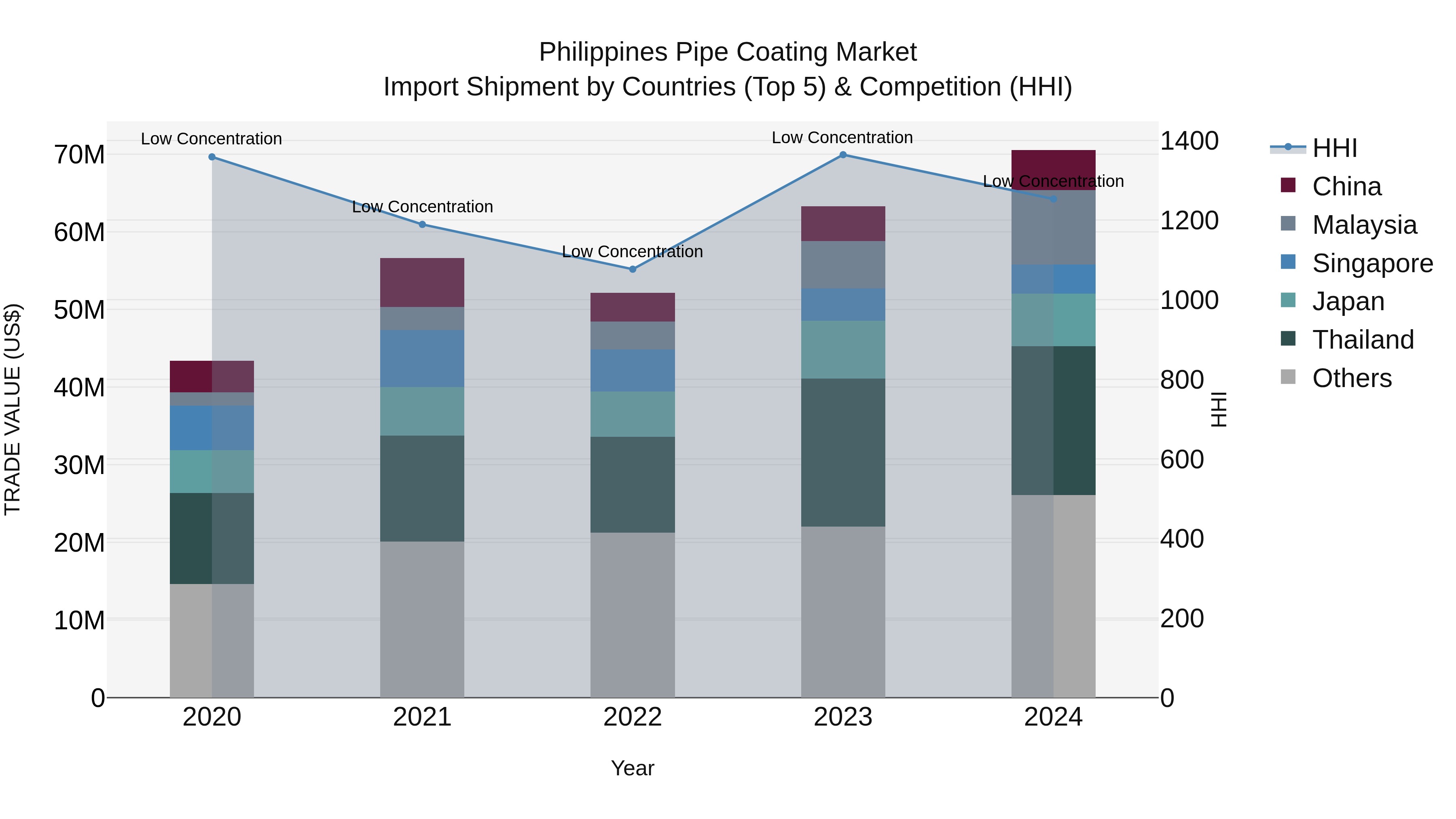
The Philippines pipe coating import market in 2024 saw significant contributions from top exporting countries such as Thailand, Malaysia, Japan, China, and Vietnam. Despite the diverse range of sources, the market exhibited low concentration levels, indicating a competitive landscape. The compound annual growth rate (CAGR) from 2020 to 2024 stood at a robust 12.92%, with a notable growth rate of 11.42% from 2023 to 2024, reflecting sustained momentum and opportunities for further expansion in the coming years.
Philippines Pipe Coating Market Overview
Pipe coatings are critical for extending the lifespan of pipelines by preventing corrosion and wear. In the Philippines, the market is buoyed by ongoing utility upgrades and construction projects that require durable and environmentally resistant coatings for both underground and above-ground piping.
Drivers of the market
Pipe coatings are essential in extending pipeline longevity, and their demand in the Philippines is growing in tandem with water and oil infrastructure projects. Protective coatings like fusion-bonded epoxy and polyurethane are increasingly used in both new installations and maintenance work, ensuring corrosion resistance and flow efficiency.
Challenges of the market
This market is challenged by limited adoption of advanced coating technologies and inadequate awareness about the long-term benefits of corrosion protection. There is a reliance on imported materials, and infrastructure projects often prioritize cost over coating quality, leading to reduced uptake of premium solutions.
Investment opportunities in the Market
As industrial pipelines require corrosion resistance and longevity, the pipe coating market is vital. Investments in advanced coating technologies, supply chain logistics, and partnerships with engineering, procurement, and construction (EPC) firms can provide strong returns as infrastructure investments expand.
Government Policy of the market
The pipe coating market is influenced by environmental and industrial regulations. Coatings used for pipelines must meet corrosion resistance and safety standards, as outlined by DENRs chemical safety and emissions guidelines. Companies involved in coating processes are required to implement pollution control measures and obtain environmental compliance certificates. For pipes used in the energy sector, the DOE and the Energy Regulatory Commission (ERC) may impose additional specifications. The use of eco-friendly coating technologies can attract incentives under green manufacturing schemes supported by DTI and BOI.
Key Highlights of the Report:
- Philippines Pipe Coating Market Outlook
- Market Size of Philippines Pipe Coating Market, 2024
- Forecast of Philippines Pipe Coating Market, 2031
- Historical Data and Forecast of Philippines Pipe Coating Revenues & Volume for the Period 2021- 2031
- Philippines Pipe Coating Market Trend Evolution
- Philippines Pipe Coating Market Drivers and Challenges
- Philippines Pipe Coating Price Trends
- Philippines Pipe Coating Porter's Five Forces
- Philippines Pipe Coating Industry Life Cycle
- Historical Data and Forecast of Philippines Pipe Coating Market Revenues & Volume By Type for the Period 2021- 2031
- Historical Data and Forecast of Philippines Pipe Coating Market Revenues & Volume By Thermoplastic Polymer Coatings for the Period 2021- 2031
- Historical Data and Forecast of Philippines Pipe Coating Market Revenues & Volume By Fusion Bonded Epoxy Coating for the Period 2021- 2031
- Historical Data and Forecast of Philippines Pipe Coating Market Revenues & Volume By Bituminous for the Period 2021- 2031
- Historical Data and Forecast of Philippines Pipe Coating Market Revenues & Volume By Concrete for the Period 2021- 2031
- Historical Data and Forecast of Philippines Pipe Coating Market Revenues & Volume By Others for the Period 2021- 2031
- Historical Data and Forecast of Philippines Pipe Coating Market Revenues & Volume By Form for the Period 2021- 2031
- Historical Data and Forecast of Philippines Pipe Coating Market Revenues & Volume By Liquid for the Period 2021- 2031
- Historical Data and Forecast of Philippines Pipe Coating Market Revenues & Volume By Powder for the Period 2021- 2031
- Historical Data and Forecast of Philippines Pipe Coating Market Revenues & Volume By End Use Industry for the Period 2021- 2031
- Historical Data and Forecast of Philippines Pipe Coating Market Revenues & Volume By Oil & Gas for the Period 2021- 2031
- Historical Data and Forecast of Philippines Pipe Coating Market Revenues & Volume By Water and Waste Water for the Period 2021- 2031
- Historical Data and Forecast of Philippines Pipe Coating Market Revenues & Volume By Chemical Processing for the Period 2021- 2031
- Historical Data and Forecast of Philippines Pipe Coating Market Revenues & Volume By Mining for the Period 2021- 2031
- Historical Data and Forecast of Philippines Pipe Coating Market Revenues & Volume By Agriculture for the Period 2021- 2031
- Historical Data and Forecast of Philippines Pipe Coating Market Revenues & Volume By Others for the Period 2021- 2031
- Philippines Pipe Coating Import Export Trade Statistics
- Market Opportunity Assessment By Type
- Market Opportunity Assessment By Form
- Market Opportunity Assessment By End Use Industry
- Philippines Pipe Coating Top Companies Market Share
- Philippines Pipe Coating Competitive Benchmarking By Technical and Operational Parameters
- Philippines Pipe Coating Company Profiles
- Philippines Pipe Coating Key Strategic Recommendations






































