Philippines Printed Electronics Market Size, Share & Growth Rate
The Philippines Printed Electronics Market was estimated at USD 356 Million in 2025 and is projected to reach USD 491 Million by 2032, growing at a CAGR of 4.7% from 2026 to 2032. This upward trend is fueled by the increasing demand for innovative electronic components across various sectors, including healthcare, automotive, and consumer electronics. Moreover, the countrys push towards modernization and smart manufacturing practices is expected to enhance the adoption of printed electronics technology, paving the way for new applications and growth opportunities.
Philippines Printed Electronics Market Year-wise Growth Rate and Key Drivers
This graph highlights how the Philippines Printed Electronics Market has steadily grown over the years, supported by major growth factors.
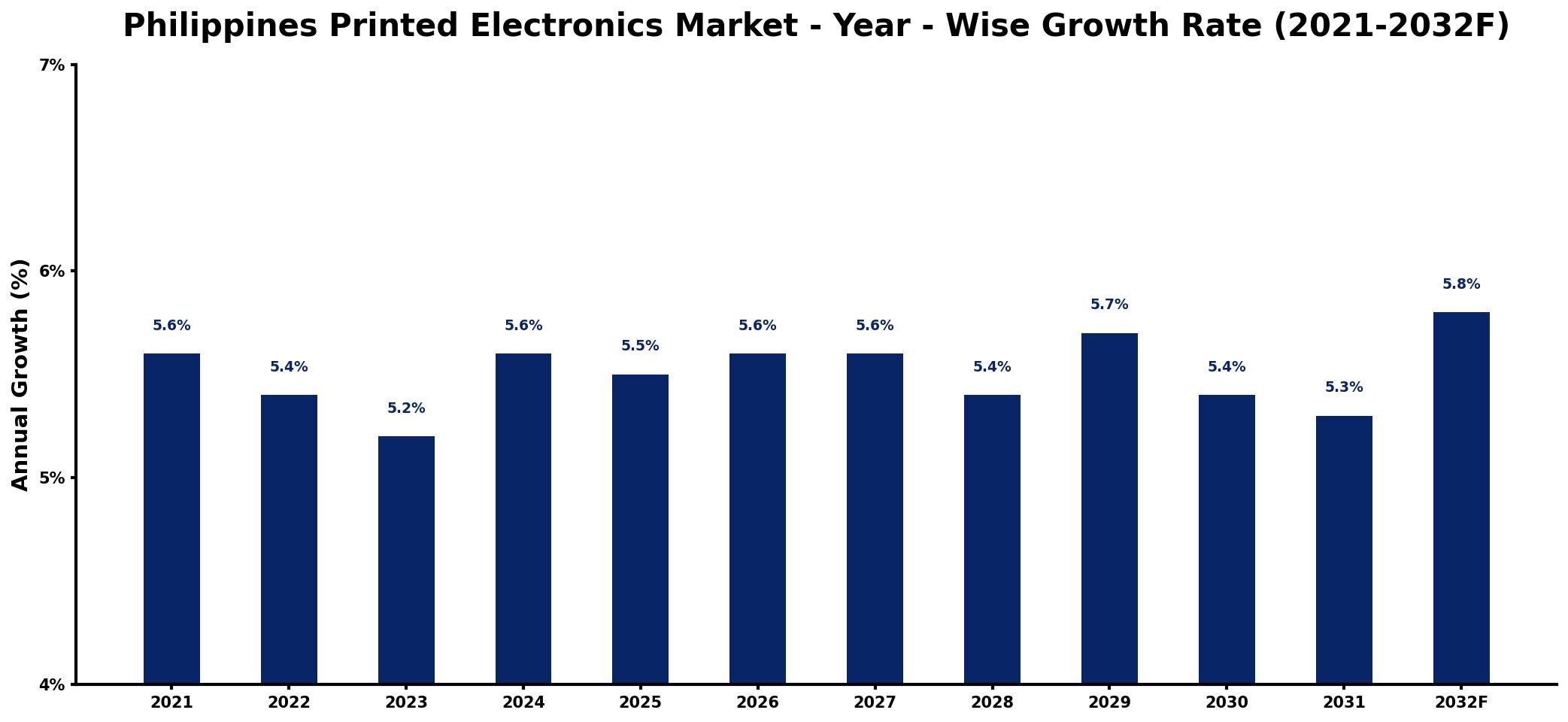
The table below presents the year‑wise growth rates along with the key drivers influencing the market
| Year | Growth Rate | Major Drivers |
| 2021 | 5.6% | Rising demand for smart packaging |
| 2022 | 5.4% | Increased investment in renewable technologies |
| 2023 | 5.2% | Growth in flexible display applications |
| 2024 | 5.6% | Expansion of wearables market segment |
| 2025 | 5.5% | Emergence of sustainable materials usage |
| 2026 | 5.6% | Surge in healthcare monitoring solutions |
| 2027 | 5.6% | Advancements in IoT integration strategies |
| 2028 | 5.4% | Boost in automotive innovations sector |
| 2029 | 5.7% | improved raw material availability |
| 2030 | 5.4% | Development of advanced manufacturing techniques |
| 2031 | 5.3% | Increased collaboration with tech startups |
| 2032 | 5.8% | Rise in educational technology investments |
Note: Market size estimations and growth projections presented in this report are based on 6Wresearch's proprietary forecasting methodology, utilizing the latest available industry data, government publications, and primary research inputs.
Philippines Printed Electronics Market Synopsis
The Philippines Printed Electronics Market is at a crucial juncture, marked by a significant shift towards digital solutions and automation. The market is characterized by advancements in technology that are redefining how electronic components are designed and manufactured, leading to more cost-effective and flexible production methods.
As various industries embrace printed electronics for applications such as smart labels, packaging, and wearable technology, the demand is projected to rise. Increased urbanization and the growth of the Internet of Things (IoT) further act as catalysts for the market, positioning the Philippines as a notable player in the regional landscape.
Philippines Printed Electronics Market Key Takeaways
- Strong growth trajectory driven by technological advancements and industrial demand.
- Increased adoption of printed electronics in healthcare, automotive, and consumer sectors.
- Urbanization and IoT developments are significantly influencing market dynamics.
- Local manufacturing advancements are likely to enhance competitive positioning.
- Government initiatives are focusing on innovation and infrastructure improvements.
Evaluation of Restraints in Philippines Printed Electronics Market
Despite its promising growth, the Philippines Printed Electronics Market faces several challenges that could impact its trajectory. One notable restraint is the relatively nascent stage of local manufacturing capabilities, which may hinder the scalability of production processes. Additionally, the lack of stringent quality control standards raises concerns regarding product reliability and performance consistency. Moreover, competition from international markets, particularly from countries with established printed electronics industries, poses a threat to local enterprises seeking to expand their market share. These factors necessitate strategic interventions to bolster local production and ensure adherence to global quality benchmarks.
Philippines Printed Electronics Market Trends
Emerging trends in the Philippines Printed Electronics Market include the integration of eco-friendly materials and processes, responding to the global emphasis on sustainability. The demand for flexible and lightweight electronic products is on the rise, propelled by advancements in materials science. Additionally, the development of innovative applications in smart packaging and interactive electronics is capturing the interest of various sectors, thereby broadening the market's scope. The increasing collaboration between academia and industry players for R&D further accelerates innovation and technology transfer, enhancing the overall market landscape.
Philippines Printed Electronics Market Opportunities
Opportunities in the Philippines Printed Electronics Market are abundant, particularly in sectors demanding automation and efficiency. The healthcare industrys growing need for diagnostic tools and wearable devices represents a lucrative avenue for printed electronics. Furthermore, as smart packaging becomes increasingly prevalent in consumer goods, companies can leverage printed electronics to offer enhanced user experiences. Investment in research and development for specialized applications can also spur growth, positioning local players to compete effectively in the global market.
Government Initiatives in the Philippines Printed Electronics Market
The Philippine government is actively promoting the development of advanced manufacturing and technology sectors, with specific initiatives aimed at fostering innovation in printed electronics. Public spending is directed towards infrastructure projects that support technological advancements and facilitate industry collaboration. Various programs are designed to incentivize research and development, encouraging local companies to innovate and align with global standards. By enhancing educational and training resources in electronics manufacturing, the government aims to build a skilled workforce ready to tackle the challenges and opportunities within this evolving market.
Future Insights of the Philippines Printed Electronics Market
Looking ahead to the 2026-2032 period, the Philippines Printed Electronics Market is poised for significant growth driven by continued technological advancements and increasing industrial adoption. The shift towards smart technologies across various sectors will create a fertile environment for innovations in printed electronics, such as ultra-thin sensors and flexible displays. Furthermore, as the global market evolves, local players are expected to strengthen their position by capitalizing on niche markets and diversifying their product offerings. The combination of government support and private sector investment will likely accelerate growth, ensuring the Philippines becomes a competitive player in the printed electronics landscape.
Philippines Printed Electronics Market Latest Developments (2025 - 2026)
Recent developments in the Philippines Printed Electronics Market indicate a growing focus on collaboration between research institutions and industry leaders to advance technology. New partnerships have been formed to explore innovative applications of printed electronics in fields like healthcare and consumer products. Additionally, there has been a noticeable uptick in investments aimed at improving local manufacturing capabilities, addressing quality control issues, and enhancing production efficiency. Such initiatives reflect the market's commitment to fostering a robust ecosystem for printed electronics, setting the stage for sustained growth and development.
Philippines Printed Electronics Market - Key Attractiveness of the Report
- 10 Years of Market Numbers
- Historical Data Starting from 2022 to 2025
- Base Year: 2025
- Forecast Data until 2032
- Key Performance Indicators Impacting the Market
- Major Upcoming Developments and Projects
Key Highlights of the Report:
- Philippines Printed Electronics Market Outlook
- Market Size of Philippines Printed Electronics Market, 2025
- Forecast of Philippines Printed Electronics Market, 2032
- Historical Data and Forecast of Philippines Printed Electronics Revenues & Volume for the Period 2022-2032F
- Philippines Printed Electronics Market Trend Evolution
- Philippines Printed Electronics Market Drivers and Challenges
- Philippines Printed Electronics Price Trends
- Philippines Printed Electronics Porter's Five Forces
- Philippines Printed Electronics Industry Life Cycle
- Historical Data and Forecast of Philippines Printed Electronics Market Revenues & Volume By Material for the Period 2022-2032F
- Historical Data and Forecast of Philippines Printed Electronics Market Revenues & Volume By Ink for the Period 2022-2032F
- Historical Data and Forecast of Philippines Printed Electronics Market Revenues & Volume By Substrate for the Period 2022-2032F
- Historical Data and Forecast of Philippines Printed Electronics Market Revenues & Volume By Technology for the Period 2022-2032F
- Historical Data and Forecast of Philippines Printed Electronics Market Revenues & Volume By Screen for the Period 2022-2032F
- Historical Data and Forecast of Philippines Printed Electronics Market Revenues & Volume By Inkjet for the Period 2022-2032F
- Historical Data and Forecast of Philippines Printed Electronics Market Revenues & Volume By Flexographic for the Period 2022-2032F
- Historical Data and Forecast of Philippines Printed Electronics Market Revenues & Volume By Gravure for the Period 2022-2032F
- Historical Data and Forecast of Philippines Printed Electronics Market Revenues & Volume By Device for the Period 2022-2032F
- Historical Data and Forecast of Philippines Printed Electronics Market Revenues & Volume By Displays for the Period 2022-2032F
- Historical Data and Forecast of Philippines Printed Electronics Market Revenues & Volume By Photovoltaic for the Period 2022-2032F
- Historical Data and Forecast of Philippines Printed Electronics Market Revenues & Volume By Lighting for the Period 2022-2032F
- Historical Data and Forecast of Philippines Printed Electronics Market Revenues & Volume By RFID for the Period 2022-2032F
- Historical Data and Forecast of Philippines Printed Electronics Market Revenues & Volume By Others for the Period 2022-2032F
- Philippines Printed Electronics Import Export Trade Statistics
- Market Opportunity Assessment By Material
- Market Opportunity Assessment By Technology
- Market Opportunity Assessment By Device
- Philippines Printed Electronics Top Companies Market Share
- Philippines Printed Electronics Competitive Benchmarking By Technical and Operational Parameters
- Philippines Printed Electronics Company Profiles
- Philippines Printed Electronics Key Strategic Recommendations






































