Philippines Razor Blade Market Top 5 Importing Countries and Market Competition (HHI) Analysis
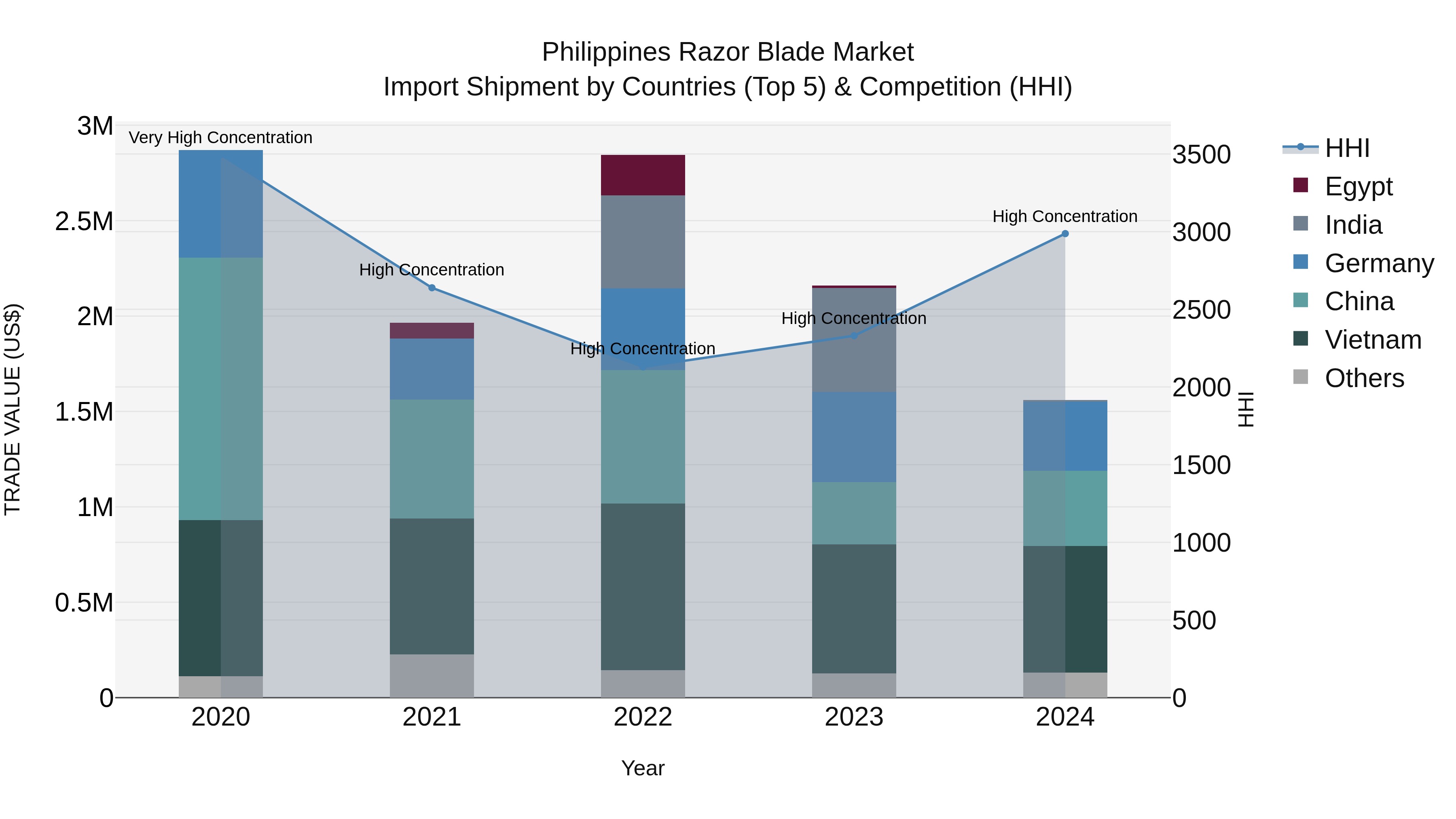
The razor blade import market in the Philippines experienced a decline in 2024, with a negative CAGR of -14.13% from 2020 to 2024. Despite this, the top countries exporting to the Philippines included Vietnam, China, Germany, Japan, and Switzerland. The high Herfindahl-Hirschman Index (HHI) indicates a concentrated market. However, the market witnessed a significant decrease in growth rate from 2023 to 2024 at -27.78%, suggesting potential challenges or shifts in consumer preferences impacting the industry dynamics.
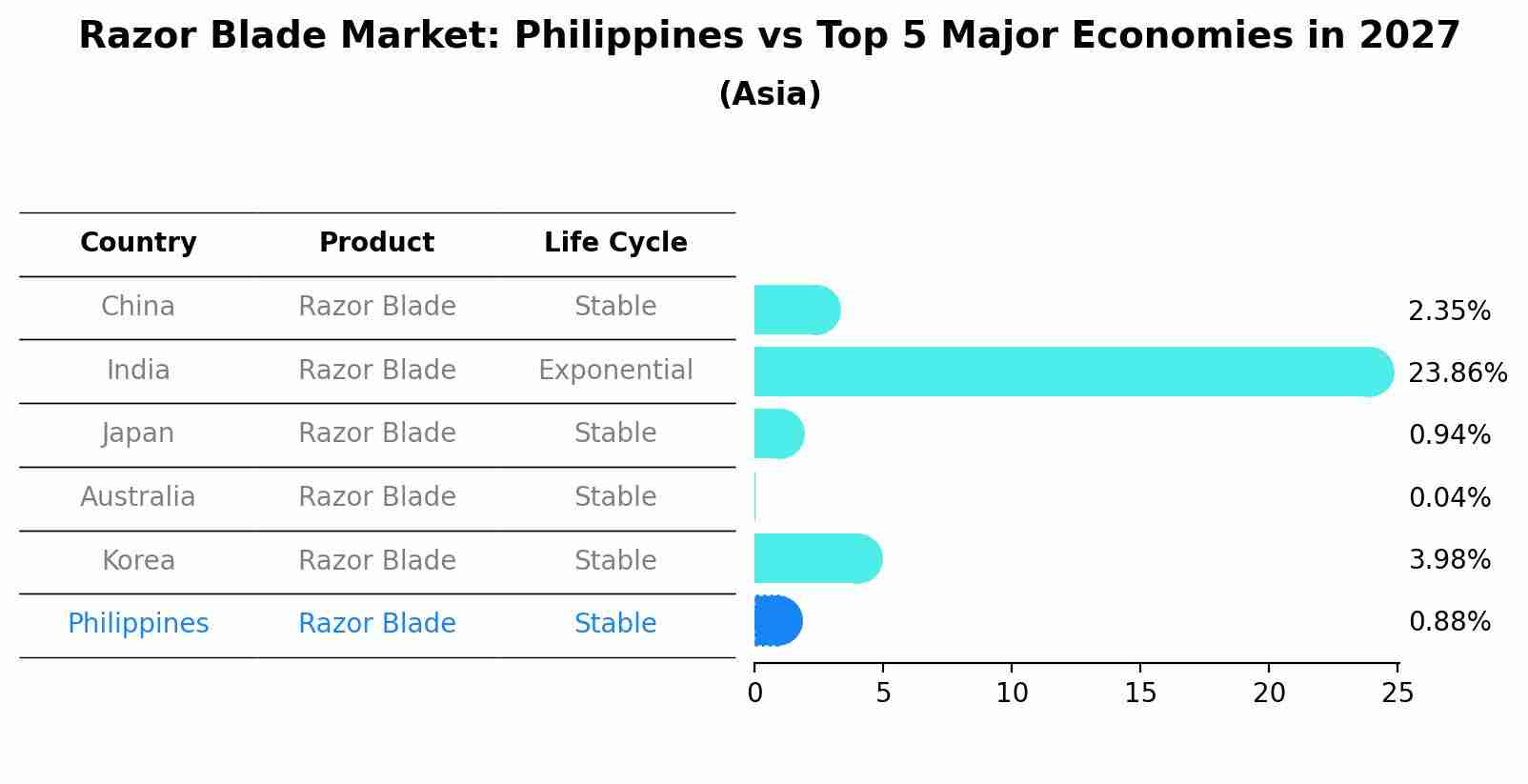
Razor Blade Market: Philippines vs Top 5 Major Economies in 2027 (Asia)
In the Asia region, the Razor Blade market in Philippines is projected to expand at a stable growth rate of 0.88% by 2027. The largest economy is China, followed by India, Japan, Australia and South Korea.
Philippines Razor Blade Market Synopsis
The razor blade market includes products used for shaving purposes. The market`s growth is often driven by population growth, changing grooming habits, and marketing strategies of companies. The CAGR for this market was around 4-6% based on historical data.
Drivers of the Market
The Philippines razor blade market is driven by several factors. Firstly, the increasing focus on personal grooming and hygiene among the population is fueling the demand for razor blades. As disposable income levels rise, more consumers are willing to spend on grooming products, including high-quality razor blades. Additionally, the growing influence of social media and the desire to maintain a well-groomed appearance is pushing the demand further. The market is also boosted by the availability of various razor blade options catering to different preferences, such as safety razors, cartridge razors, and straight razors.
Challenges of the Market
The Philippines razor blade market is a segment of the personal care industry that provides shaving solutions to consumers. Despite the demand for grooming products, this market faces several challenges. One of the prominent challenges is the competition from electric razors and other hair removal methods. Consumers` preferences are shifting towards more convenient and efficient alternatives, affecting the demand for traditional razor blades. Moreover, economic fluctuations in the country can impact consumers` purchasing power, leading to fluctuations in demand for such non-essential products.
COVID-19 Impact on the Market
The Philippines razor blade market faced initial challenges during the pandemic as supply chains were disrupted and manufacturing facilities faced closures. However, as restrictions eased and personal grooming remained essential, the market gradually recovered. The shift towards e-commerce and home grooming also contributed to the market`s revival.
Key Players in the Market
Some key players in the Philippines razor blade market include Gillette, Schick, Wilkinson Sword, BIC, Feather, Dorco, Kai, Supermax, and Personna.
Key Highlights of the Report:
- Philippines Razor Blade Market Outlook
- Market Size of Philippines Razor Blade Market, 2024
- Forecast of Philippines Razor Blade Market, 2031
- Historical Data and Forecast of Philippines Razor Blade Revenues & Volume for the Period 2021-2031
- Philippines Razor Blade Market Trend Evolution
- Philippines Razor Blade Market Drivers and Challenges
- Philippines Razor Blade Price Trends
- Philippines Razor Blade Porter's Five Forces
- Philippines Razor Blade Industry Life Cycle
- Historical Data and Forecast of Philippines Razor Blade Market Revenues & Volume By Type for the Period 2021-2031
- Historical Data and Forecast of Philippines Razor Blade Market Revenues & Volume By Single Edge for the Period 2021-2031
- Historical Data and Forecast of Philippines Razor Blade Market Revenues & Volume By Double Edge for the Period 2021-2031
- Historical Data and Forecast of Philippines Razor Blade Market Revenues & Volume By Blade Material for the Period 2021-2031
- Historical Data and Forecast of Philippines Razor Blade Market Revenues & Volume By Carbon Steel for the Period 2021-2031
- Historical Data and Forecast of Philippines Razor Blade Market Revenues & Volume By Stainless Steel for the Period 2021-2031
- Historical Data and Forecast of Philippines Razor Blade Market Revenues & Volume By End User for the Period 2021-2031
- Historical Data and Forecast of Philippines Razor Blade Market Revenues & Volume By Men for the Period 2021-2031
- Historical Data and Forecast of Philippines Razor Blade Market Revenues & Volume By Women for the Period 2021-2031
- Historical Data and Forecast of Philippines Razor Blade Market Revenues & Volume By Distribution Channel for the Period 2021-2031
- Historical Data and Forecast of Philippines Razor Blade Market Revenues & Volume By Supermarkets/Hypermarkets for the Period 2021-2031
- Historical Data and Forecast of Philippines Razor Blade Market Revenues & Volume By Departmental Stores for the Period 2021-2031
- Historical Data and Forecast of Philippines Razor Blade Market Revenues & Volume By Convenience Stores for the Period 2021-2031
- Historical Data and Forecast of Philippines Razor Blade Market Revenues & Volume By Online for the Period 2021-2031
- Philippines Razor Blade Import Export Trade Statistics
- Market Opportunity Assessment By Type
- Market Opportunity Assessment By Blade Material
- Market Opportunity Assessment By End User
- Market Opportunity Assessment By Distribution Channel
- Philippines Razor Blade Top Companies Market Share
- Philippines Razor Blade Competitive Benchmarking By Technical and Operational Parameters
- Philippines Razor Blade Company Profiles
- Philippines Razor Blade Key Strategic Recommendations






































