Philippines Shaving Foam Market Top 5 Importing Countries and Market Competition (HHI) Analysis
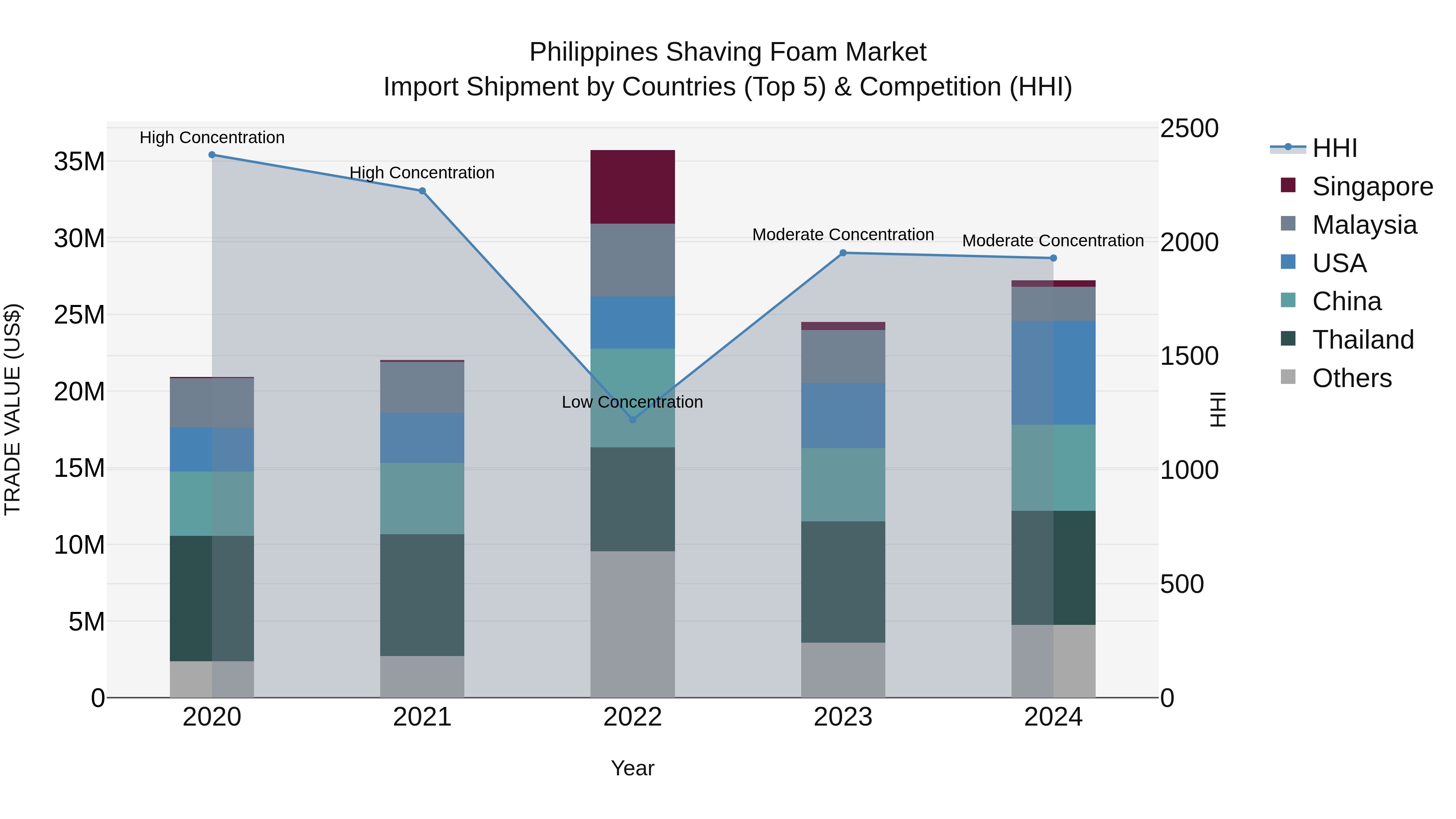
The Philippines continues to see a steady increase in shaving foam import shipments, with top exporters being Thailand, USA, China, Malaysia, and Turkey in 2024. The market shows moderate concentration, indicating a healthy level of competition among suppliers. The compound annual growth rate (CAGR) from 2020 to 2024 is strong at 6.82%, with a notable growth rate of 11.08% in 2024 alone. This data suggests a growing demand for shaving foam in the Philippines, with diverse sources of supply contributing to the market`s expansion.
Philippines Shaving Foam Market Overview
The shaving foam market in the Philippines is experiencing growth due to changing grooming habits and the increasing influence of personal care trends. The demand for shaving foam is driven by the expanding male grooming sector, the rise in disposable income, and the availability of a wide range of products catering to different skin types. The market is also seeing innovation in formulations, such as moisturizing and sensitive-skin-friendly foams. However, competition from shaving gels and electric razors, as well as consumer preference for natural and organic products, presents challenges.
Drivers of the market
The shaving foam market in the Philippines is benefiting from the increasing male grooming trend and growing preference for smooth and irritation-free shaving experiences. Brands are innovating with moisturizing, anti-bacterial, and sensitive skin formulations to attract consumers. The rise of online shopping and grooming subscription services is also expanding market reach.
Challenges of the market
The shaving foam market in the Philippines faces issues such as competition from alternative grooming products, sustainability concerns, and price sensitivity. Many consumers are switching to shaving gels, creams, or electric shavers, reducing demand for traditional foams. The environmental impact of aerosol-based foams has led to calls for more sustainable packaging solutions. Additionally, price-sensitive consumers often opt for cheaper alternatives, challenging premium brands.
Investment opportunities in the Market
As grooming habits evolve, the shaving foam market in the Philippines presents strong investment potential. Companies can introduce sensitive skin-friendly, organic, and moisturizing shaving foams. Expanding distribution through supermarkets, e-commerce, and barbershops can enhance market reach.
Government Policy of the market
The personal care industry, including shaving foam, is regulated by the FDA to ensure product safety. The DTI promotes local cosmetic manufacturing through financial assistance and training programs. Sustainability initiatives encourage the use of biodegradable packaging to align with environmental policies.
Key Highlights of the Report:
- Philippines Shaving Foam Market Outlook
- Market Size of Philippines Shaving Foam Market, 2024
- Forecast of Philippines Shaving Foam Market, 2031
- Historical Data and Forecast of Philippines Shaving Foam Revenues & Volume for the Period 2021- 2031
- Philippines Shaving Foam Market Trend Evolution
- Philippines Shaving Foam Market Drivers and Challenges
- Philippines Shaving Foam Price Trends
- Philippines Shaving Foam Porter's Five Forces
- Philippines Shaving Foam Industry Life Cycle
- Historical Data and Forecast of Philippines Shaving Foam Market Revenues & Volume By Product for the Period 2021- 2031
- Historical Data and Forecast of Philippines Shaving Foam Market Revenues & Volume By Organic for the Period 2021- 2031
- Historical Data and Forecast of Philippines Shaving Foam Market Revenues & Volume By Conventional for the Period 2021- 2031
- Historical Data and Forecast of Philippines Shaving Foam Market Revenues & Volume By Distribution Channel for the Period 2021- 2031
- Historical Data and Forecast of Philippines Shaving Foam Market Revenues & Volume By Hypermarkets/Supermarkets for the Period 2021- 2031
- Historical Data and Forecast of Philippines Shaving Foam Market Revenues & Volume By Departmental Stores for the Period 2021- 2031
- Historical Data and Forecast of Philippines Shaving Foam Market Revenues & Volume By Speciality Stores for the Period 2021- 2031
- Historical Data and Forecast of Philippines Shaving Foam Market Revenues & Volume By Online for the Period 2021- 2031
- Philippines Shaving Foam Import Export Trade Statistics
- Market Opportunity Assessment By Product
- Market Opportunity Assessment By Distribution Channel
- Philippines Shaving Foam Top Companies Market Share
- Philippines Shaving Foam Competitive Benchmarking By Technical and Operational Parameters
- Philippines Shaving Foam Company Profiles
- Philippines Shaving Foam Key Strategic Recommendations






































