Philippines Spandex Market Top 5 Importing Countries and Market Competition (HHI) Analysis
The Philippines continues to rely heavily on spandex imports, with top exporters including China, Japan, Malaysia, Vietnam, and South Korea in 2024. Despite a high concentration of Herfindahl-Hirschman Index (HHI), indicating market dominance by a few key players, the industry experienced a significant decline with a CAGR of -4.13% from 2020 to 2024. The growth rate plummeted even further in 2024, dropping by -26.29% compared to the previous year. This data suggests a challenging landscape for spandex import shipments in the Philippines, potentially impacted by various economic factors.
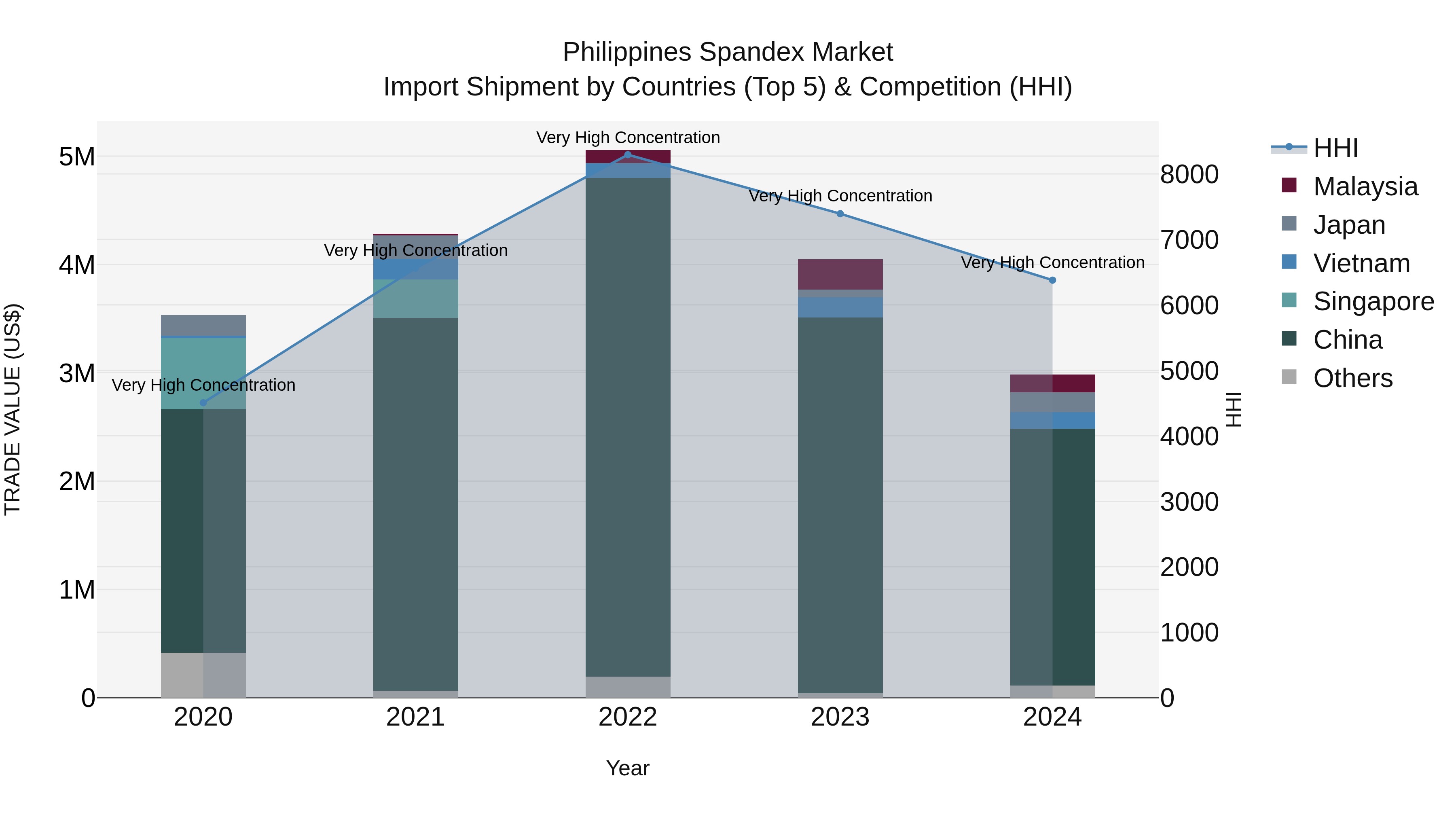
Philippines Spandex Market Overview
The spandex market in the Philippines is growing, fueled by demand from the activewear, innerwear, and medical textiles industries. Rising health consciousness and a shift toward comfort-driven fashion are influencing manufacturers to incorporate stretch fabrics. Imports dominate the market, but local garment manufacturers are increasing the use of spandex blends to stay competitive.
Trends of the market
The spandex market in the Philippines is seeing growth due to the rising demand for stretchy, comfortable, and form-fitting fabrics in the apparel industry. Spandex, known for its high elasticity, is widely used in activewear, performance sportswear, swimwear, and fashion garments. As the fitness and wellness trend continues to gain traction, there is an increasing demand for garments made from spandex blends. The growth of the e-commerce sector and the rising middle class also contribute to the expansion of the spandex market, as consumers look for high-quality, functional, and affordable clothing options.
Challenges of the market
The Spandex Market in the Philippines faces issues related to the high cost of raw materials and reliance on imports. The local textile industry is not adequately equipped to produce spandex fibers, and the market remains vulnerable to fluctuations in global prices. Additionally, awareness about the benefits of spandex in apparel is limited outside the activewear and fashion segments, which hampers broader market penetration.
Investment opportunities in the Market
The spandex market in the Philippines is expanding due to increasing demand in the apparel, sportswear, and medical sectors. Spandex is known for its elasticity and is widely used in clothing, including activewear, swimwear, and performance costumes. Investment opportunities lie in the development of new spandex materials with enhanced durability, comfort, and sustainability features. As the demand for performance and fashion-oriented fabrics grows, the spandex market in the Philippines is set to continue its expansion.
Government Policy of the market
The spandex market, primarily used in textiles and apparel, is governed by DTI regulations concerning imports and consumer product standards. The government supports the domestic garment industry through the Board of Investments (BOI), offering fiscal incentives for companies that manufacture or incorporate spandex in high-performance textiles. Environmental compliance is enforced through the DENR, especially in manufacturing facilities using chemical-based elastomers.
Key Highlights of the Report:
- Philippines Spandex Market Outlook
- Market Size of Philippines Spandex Market, 2024
- Forecast of Philippines Spandex Market, 2031
- Historical Data and Forecast of Philippines Spandex Revenues & Volume for the Period 2021- 2031
- Philippines Spandex Market Trend Evolution
- Philippines Spandex Market Drivers and Challenges
- Philippines Spandex Price Trends
- Philippines Spandex Porter's Five Forces
- Philippines Spandex Industry Life Cycle
- Historical Data and Forecast of Philippines Spandex Market Revenues & Volume By Technology for the Period 2021- 2031
- Historical Data and Forecast of Philippines Spandex Market Revenues & Volume By Solution Dry-Spinning for the Period 2021- 2031
- Historical Data and Forecast of Philippines Spandex Market Revenues & Volume By Wet-Spinning for the Period 2021- 2031
- Historical Data and Forecast of Philippines Spandex Market Revenues & Volume By Others for the Period 2021- 2031
- Historical Data and Forecast of Philippines Spandex Market Revenues & Volume By Application for the Period 2021- 2031
- Historical Data and Forecast of Philippines Spandex Market Revenues & Volume By Clothing for the Period 2021- 2031
- Historical Data and Forecast of Philippines Spandex Market Revenues & Volume By Medical for the Period 2021- 2031
- Historical Data and Forecast of Philippines Spandex Market Revenues & Volume By Others for the Period 2021- 2031
- Philippines Spandex Import Export Trade Statistics
- Market Opportunity Assessment By Technology
- Market Opportunity Assessment By Application
- Philippines Spandex Top Companies Market Share
- Philippines Spandex Competitive Benchmarking By Technical and Operational Parameters
- Philippines Spandex Company Profiles
- Philippines Spandex Key Strategic Recommendations






































