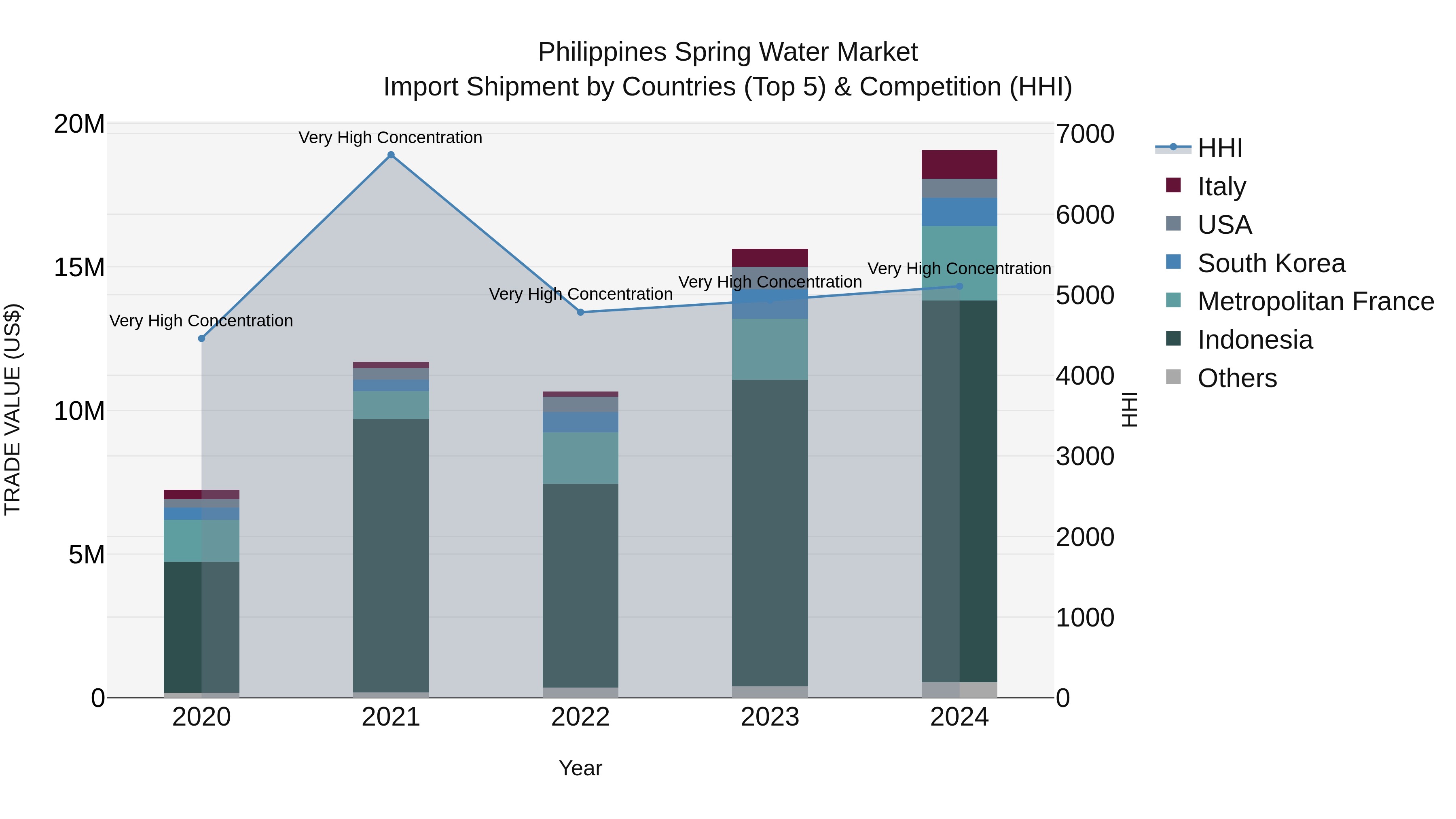
Philippines Spring Water Market Top 5 Importing Countries and Market Competition (HHI) Analysis
The Philippines continues to see a significant demand for imported spring water, with top countries like Indonesia, Metropolitan France, Italy, South Korea, and the USA dominating the market in 2024. Despite the high concentration of market share, the industry shows impressive growth with a CAGR of 27.4% from 2020 to 2024. The growth rate in 2024 at 21.94% indicates a continued upward trend in the import shipments of spring water, reflecting the strong consumer preference for quality bottled water products in the Philippines.
Philippines Spring Water Market Overview
Rising health consciousness and concerns about tap water quality are propelling the spring water market in the Philippines. Consumers are increasingly seeking natural hydration options, with demand growing across both urban and tourist-heavy rural areas. The market benefits from both local spring sources and imported premium water brands.
Trends of the market
The Philippines Spring Water Market is benefiting from the growing demand for natural and healthy bottled water. With increased awareness of the importance of hydration and the desire for clean and pure water, consumers are increasingly turning to spring water over other bottled water options. The market is also supported by a rising number of premium brands offering various flavored and enhanced spring water options. As the market grows, the focus on sustainable sourcing and packaging practices is likely to shape future trends.
Challenges of the market
The spring water market in the Philippines faces challenges related to the contamination of water sources and the need for stringent quality control measures to ensure safe drinking water. Additionally, the high cost of production, especially in terms of packaging and transportation, can hinder the market`s growth. The environmental impact of plastic bottles and growing awareness about sustainability issues also poses a challenge to the market`s long-term prospects.
Investment opportunities in the Market
With the growing demand for bottled water and a rising awareness of healthy hydration, the Philippines spring water market presents significant opportunities. Investment can focus on sourcing high-quality spring water, improving distribution channels, and addressing packaging innovations, including eco-friendly options. Expanding distribution networks, especially in rural areas, would allow companies to tap into untapped segments, offering potential for substantial growth.
Government Policy of the market
Government policies on water extraction, bottling, and sanitation play a significant role in the spring water market. The National Water Resources Board (NWRB) regulates the rights to extract groundwater and spring sources, while the FDA ensures strict compliance with drinking water quality standards. The Department of Environment and Natural Resources (DENR) oversees environmental impact assessments for water bottling facilities, promoting sustainable water resource management.
Key Highlights of the Report:
- Philippines Spring Water Market Outlook
- Market Size of Philippines Spring Water Market, 2024
- Forecast of Philippines Spring Water Market, 2031
- Historical Data and Forecast of Philippines Spring Water Revenues & Volume for the Period 2021- 2031
- Philippines Spring Water Market Trend Evolution
- Philippines Spring Water Market Drivers and Challenges
- Philippines Spring Water Price Trends
- Philippines Spring Water Porter's Five Forces
- Philippines Spring Water Industry Life Cycle
- Historical Data and Forecast of Philippines Spring Water Market Revenues & Volume By Container for the Period 2021- 2031
- Historical Data and Forecast of Philippines Spring Water Market Revenues & Volume By Bottled for the Period 2021- 2031
- Historical Data and Forecast of Philippines Spring Water Market Revenues & Volume By Canned for the Period 2021- 2031
- Historical Data and Forecast of Philippines Spring Water Market Revenues & Volume By Distribution Channel for the Period 2021- 2031
- Historical Data and Forecast of Philippines Spring Water Market Revenues & Volume By Business to Business for the Period 2021- 2031
- Historical Data and Forecast of Philippines Spring Water Market Revenues & Volume By Business to Consumer for the Period 2021- 2031
- Philippines Spring Water Import Export Trade Statistics
- Market Opportunity Assessment By Container
- Market Opportunity Assessment By Distribution Channel
- Philippines Spring Water Top Companies Market Share
- Philippines Spring Water Competitive Benchmarking By Technical and Operational Parameters
- Philippines Spring Water Company Profiles
- Philippines Spring Water Key Strategic Recommendations






































