Philippines Stone Mining And Quarrying Market Size, Share & Growth Rate
The Philippines Stone Mining And Quarrying Market was estimated at USD 473 Million in 2025 and is projected to reach USD 635 Million by 2032, growing at a CAGR of 4.3% from 2026 to 2032. This growth trajectory is primarily driven by the increasing demand for construction materials, fueled by ambitious infrastructure projects and urbanization across the nation. As the construction sector expands, so does the necessity for reliable sourcing of stone and aggregates, highlighting the industry's critical role in economic development.
Philippines Stone Mining And Quarrying Market Year-wise Growth Rate and Key Drivers
This graph highlights how the Philippines Stone Mining And Quarrying Market has steadily grown over the years, supported by major growth factors.
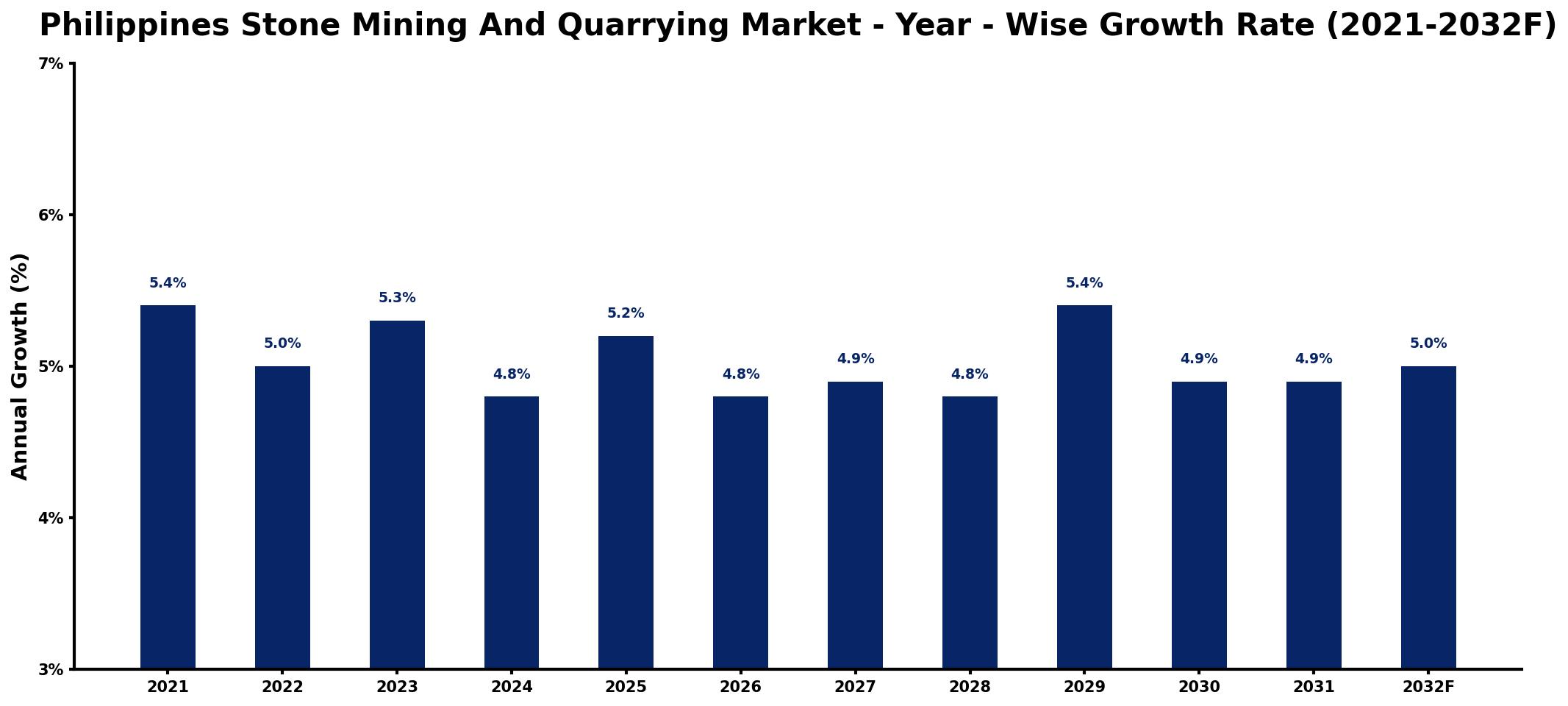
The table below presents the year‑wise growth rates along with the key drivers influencing the market
| Year | Growth Rate | Major Drivers |
| 2021 | 5.4% | Infrastructure projects drive demand growth |
| 2022 | 5.0% | Increased construction activities boost investments |
| 2023 | 5.3% | Rising urbanization fuels material needs |
| 2024 | 4.8% | Government initiatives support sector expansion |
| 2025 | 5.2% | Sustainable practices attract new investments |
| 2026 | 4.8% | Technological advancements enhance operational efficiency |
| 2027 | 4.9% | Rising exports open new markets |
| 2028 | 4.8% | Public-private partnerships stimulate sector growth |
| 2029 | 5.4% | Increased residential projects drive consumption |
| 2030 | 4.9% | Renewable energy projects require materials |
| 2031 | 4.9% | Tourism developments increase demand significantly |
| 2032 | 5.0% | Regulatory support encourages industry investments |
Note: Market size estimations and growth projections presented in this report are based on 6Wresearch's proprietary forecasting methodology, utilizing the latest available industry data, government publications, and primary research inputs.
Philippines Stone Mining And Quarrying Market Synopsis
At the heart of the Philippines Stone Mining and Quarrying Market lies the burgeoning construction sector, serving as the strongest force shaping its current landscape. This sector not only contributes significantly to employment but also supports the nations GDP, highlighting its essential role in fostering economic stability and growth.
The industry benefits from a rich reserve of dimension stones, including marble, granite, and limestone, estimated to hold a total reserve value exceeding USD 50 billion. With over 90 active quarries across ten provinces, the market is well-positioned to leverage its natural resources to meet growing demand.
Philippines Stone Mining And Quarrying Market Key Takeaways
- The market is projected to grow from USD 473 Million in 2025 to USD 635 Million by 2032.
- A significant portion of employment in the Philippines derives from the stone mining and quarrying sector.
- Active quarries across ten provinces indicate a diversified resource base.
- Sustainable practices and technological advancements are increasingly vital to market operations.
- Government infrastructure projects are a primary driver for growth in the industry.
Evaluation of Restraints in Philippines Stone Mining And Quarrying Market
The stone mining and quarrying market in the Philippines faces real limitations primarily rooted in regulatory challenges. Navigating the complex web of permits and land use regulations can result in prolonged delays for operational activities. Furthermore, the pressing need for sustainable mining practices introduces a dual obligation for companies to balance production demands with environmental stewardship, posing a continuous challenge to the market's growth potential.
Philippines Stone Mining And Quarrying Market Trends
Emerging trends within the Philippines Stone Mining and Quarrying Market indicate a growing shift toward sustainable mining practices. Companies are increasingly adopting technology to monitor and reduce environmental impact, improving overall operational efficiency. Additionally, with advancements in extraction technologies, there is a notable rise in the demand for precision and efficiency, which further enhances the competitiveness of the local market on a global scale.
Philippines Stone Mining And Quarrying Market Opportunities
The landscape presents numerous opportunities for investment, particularly in developing new quarry sites and enhancing existing operations with modern technologies. The government's ongoing emphasis on infrastructure development, including roads, bridges, and public buildings, continues to stimulate demand for stone materials. Stakeholders who invest in sustainable practices and innovative technologies will likely capture significant market share as the industry evolves.
Government Initiatives in the Philippines Stone Mining And Quarrying Market
The Philippine government is keen on promoting growth within the stone mining and quarrying sector through various initiatives. Policies aimed at improving infrastructure development, along with incentives for environmentally responsible mining practices, showcase the administration's commitment to fostering a sustainable mining environment. Ongoing public spending on construction projects creates a conducive atmosphere for industry growth and stability.
Future Insights of the Philippines Stone Mining And Quarrying Market
Looking ahead, the Philippines Stone Mining and Quarrying Market is anticipated to witness a period of transformation from 2026 to 2032. Continuous investment in infrastructure and urban development will play a pivotal role in driving demand for stone. The focus on sustainability will shape operational practices, as stakeholders align with global standards to reduce environmental impact. This convergence of growth factors paints a promising picture for the future of the market.
Philippines Stone Mining And Quarrying Market Latest Developments (2025 - 2026)
Recent developments in the Philippines Stone Mining and Quarrying Market indicate a strong push towards sustainability and innovation. The industry has seen an uptick in the adoption of advanced technologies aimed at improving extraction processes and minimizing environmental footprints. Additionally, the government's commitment to expanding public infrastructure continues to provide a steady pipeline of demand, reflecting the strategic importance of the sector within the broader economic context.
Philippines Stone Mining And Quarrying Market - Key Attractiveness of the Report
- 10 Years of Market Numbers
- Historical Data Starting from 2022 to 2025
- Base Year: 2025
- Forecast Data until 2032
- Key Performance Indicators Impacting the Market
- Major Upcoming Developments and Projects
Key Highlights of the Report:
- Philippines Stone Mining And Quarrying Market Outlook
- Market Size of Philippines Stone Mining And Quarrying Market, 2025
- Forecast of Philippines Stone Mining And Quarrying Market, 2032
- Historical Data and Forecast of Philippines Stone Mining And Quarrying Revenues & Volume for the Period 2022-2032F
- Philippines Stone Mining And Quarrying Market Trend Evolution
- Philippines Stone Mining And Quarrying Market Drivers and Challenges
- Philippines Stone Mining And Quarrying Price Trends
- Philippines Stone Mining And Quarrying Porter's Five Forces
- Philippines Stone Mining And Quarrying Industry Life Cycle
- Historical Data and Forecast of Philippines Stone Mining And Quarrying Market Revenues & Volume By Stone for the Period 2022-2032F
- Historical Data and Forecast of Philippines Stone Mining And Quarrying Market Revenues & Volume By Marble for the Period 2022-2032F
- Historical Data and Forecast of Philippines Stone Mining And Quarrying Market Revenues & Volume By Granite for the Period 2022-2032F
- Historical Data and Forecast of Philippines Stone Mining And Quarrying Market Revenues & Volume By Limestone for the Period 2022-2032F
- Historical Data and Forecast of Philippines Stone Mining And Quarrying Market Revenues & Volume By Sandstone for the Period 2022-2032F
- Historical Data and Forecast of Philippines Stone Mining And Quarrying Market Revenues & Volume By Others for the Period 2022-2032F
- Historical Data and Forecast of Philippines Stone Mining And Quarrying Market Revenues & Volume By Type for the Period 2022-2032F
- Historical Data and Forecast of Philippines Stone Mining And Quarrying Market Revenues & Volume By Dimension Stone Mining for the Period 2022-2032F
- Historical Data and Forecast of Philippines Stone Mining And Quarrying Market Revenues & Volume By Crushed Stone Mining for the Period 2022-2032F
- Philippines Stone Mining And Quarrying Import Export Trade Statistics
- Market Opportunity Assessment By Stone
- Market Opportunity Assessment By Type
- Philippines Stone Mining And Quarrying Top Companies Market Share
- Philippines Stone Mining And Quarrying Competitive Benchmarking By Technical and Operational Parameters
- Philippines Stone Mining And Quarrying Company Profiles
- Philippines Stone Mining And Quarrying Key Strategic Recommendations






































