Philippines Tapioca Market Top 5 Importing Countries and Market Competition (HHI) Analysis
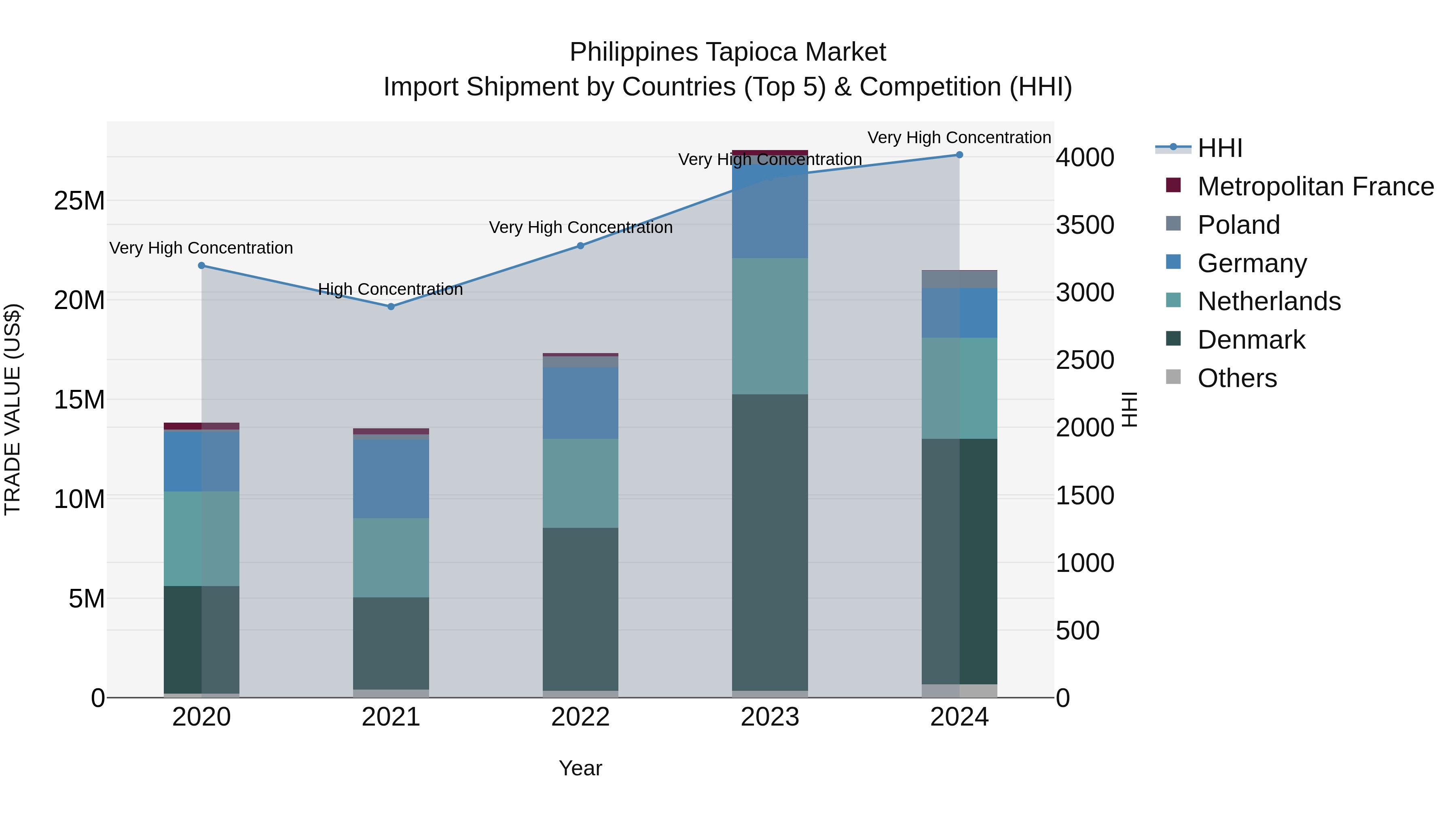
In 2024, the Philippines continued to witness a significant influx of tapioca imports, with top exporting countries including Denmark, Netherlands, Germany, Poland, and Japan. Despite the high concentration indicated by the Herfindahl-Hirschman Index (HHI), the market saw a notable compound annual growth rate (CAGR) of 11.65% from 2020 to 2024. However, there was a slight decline in the growth rate from 2023 to 2024 at -21.96%, suggesting potential shifts in market dynamics. This data highlights the continued importance of tapioca imports for the Philippines and the evolving landscape of this market.
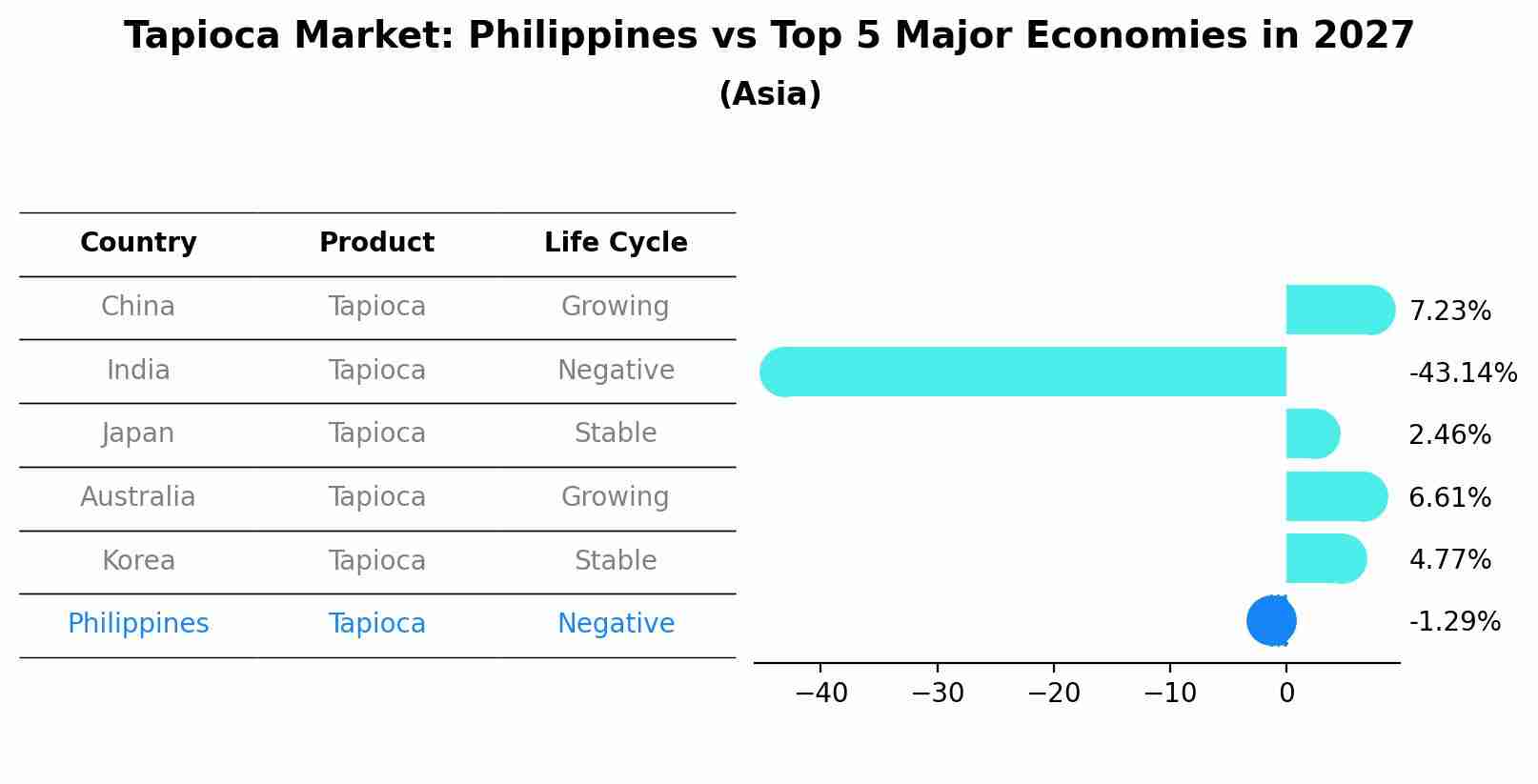
Tapioca Market: Philippines vs Top 5 Major Economies in 2027 (Asia)
The Tapioca market in Philippines is projected to grow at a negative growth rate of -1.29% by 2027, highlighting the country's increasing focus on advanced technologies within the Asia region, where China holds the dominant position, followed closely by India, Japan, Australia and South Korea, shaping overall regional demand.
Philippines Tapioca Market Growth Rate
According to 6Wresearch internal database and industry insights, the Philippines Tapioca Market is projected to grow at a compound annual growth rate (CAGR) of 5.7% during the forecast period 2026–2032.
Topics Covered in the Philippines Tapioca Market Report
The Philippines Tapioca Market report thoroughly covers the market by product type, function, form, and end-use. It provides an unbiased and detailed analysis of ongoing market trends, opportunities, challenges, and market drivers, helping stakeholders align their strategies with current and future market dynamics.
Philippines Tapioca Market Highlights
| Report Name | Philippines Tapioca Market |
| Forecast Period | 2026–2032 |
| CAGR | 5.7% |
| Growing Sector | Food and Beverage Processing Industry |
Philippines Tapioca Market Synopsis
The Philippines Tapioca Market is expected to witness steady growth. It is accelerated by the need for tapioca-based beverages, desserts, and processed food products. Owing to its gluten-free properties and dynamic applications, tapioca is broadly used as a thickening and binding ingredient in food manufacturing. The growth of bubble tea chains and dessert cafés has majorly raised the intake of tapioca pearls across the country. Owing to its natural and biodegradable properties tapioca starch is getting popularity in pharmaceutical and industrial applications. Government support for agricultural production and increasing cassava cultivation are further solidifying the supply of raw materials for tapioca processing.
Evaluation of Growth Drivers in Philippines Tapioca Market
Below mentioned are some prominent drivers and their influence on Philippines Tapioca Market dynamics:
| Drivers | Primary Segment Affected | Why It Matters (Evidence) |
| Growth of Bubble Tea Industry | Tapioca Pearl / Sabudana | Rising popularity of bubble tea beverages has significantly increased demand for tapioca pearls. |
| Rising Demand for Gluten-Free Ingredients | Tapioca Flour | Food manufacturers prefer tapioca flour as a gluten-free alternative in bakery and processed foods. |
| Expansion of Food Processing Industry | Tapioca Starch | To proliferate the need for starch as a thickening agent there is an increase production of processed foods. |
| Growth of Pharmaceutical Applications | Tapioca Starch | Tapioca starch is broadly utilised as a binding and stabilizing agent in pharmaceutical tablets. |
| Agricultural Development Programs | All Segments | Government initiatives encouraging cassava farming assist to improve the supply of tapioca raw materials. |
The Philippines Tapioca Market is projected to grow at a CAGR of 5.7% from 2026 to 2032. Owing to the increasing demand for tapioca-based beverages, desserts, and processed food ingredients the Philippines Tapioca Market Growth is expanding steadily. Growth in the bubble tea industry and increasing use of tapioca starch in pharmaceutical and industrial applications are also supporting market development. The market presents strong opportunities for both domestic processors and international ingredient suppliers. Rising cassava cultivation in the Philippines is also contributing to the steady supply of raw materials for tapioca production.
Evaluation of Restraints in Philippines Tapioca Market
Below mentioned are some major restraints and their influence on Philippines Tapioca Market dynamics:
| Restraints | Primary Segment Affected | What This Means (Evidence) |
| Fluctuation in Cassava Supply | Tapioca Starch | Limited cassava cultivation can affect raw material availability. |
| Price Volatility | Food Industry | Rise in production costs for tapioca processors owing to alterations in cassava cost. |
| Competition from Alternative Starches | Tapioca Flour | Corn starch and potato starch caters substitute options for food manufacturers. |
| Processing Infrastructure Limitations | All Segments | Large-scale production capacity may get affected owing to lack of processing resources. |
| Supply Chain Constraints | Industrial Applications | Well-timed supply to manufacturing industries can get affected owing to distribution challenges. |
Philippines Tapioca Market Challenges
The Philippines Tapioca Industry goes through several challenges. It consists of changes in cassava production, which directly impacts the supply of raw materials needed for tapioca processing. market growth can get restricted in certain industrial applications owing to competition from substitute starch products such as corn starch and potato starch. Small-scale farmers often go through limitations in adopting modern agricultural techniques, which can affect productivity levels. To overcome these challenges and ensure stable market growth and solidifying cassava cultivation practices and augmenting processing infrastructure will be important.
Philippines Tapioca Market Trends
Several notable trends are shaping the Philippines Tapioca Market dynamics:
- Growth of Bubble Tea Culture: Rising popularity of bubble tea beverages has majorly boosted demand for tapioca pearls across urban areas.
- Rising Demand for Gluten-Free Ingredients: Tapioca flour is broadly used in bakery and processed food products owing to its gluten-free properties.
- Expansion of Food Processing Industry: Food processing industries are utilising Tapioca starch in large numbers.
- Industrial Applications: Owing to their biodegradable characteristics tapioca derivatives are getting in demand in textile and paper industries.
Investment Opportunities in the Philippines Tapioca Industry
Some notable investment opportunities in the Philippines Tapioca Industry are:
- Tapioca Pearl Manufacturing: Rising need for bubble tea creates opportunities for large-scale pearl production and the quick growth of bubble tea outlets across urban areas is further increasing demand for tapioca pearls.
- Cassava Farming Development: Fund allocation in cassava cultivation can solidify the raw material supply chain and augmented farming practices and higher cassava yields can encourage stable tapioca production.
- Food Processing Applications: Expanding tapioca starch processing facilities can support growing industrial demand.
Top 5 Leading Players in the Philippines Tapioca Market
Below is the list of prominent companies leading in the Philippines Tapioca Market:
1. Universal Robina Corporation
| Company Name | Universal Robina Corporation |
|---|---|
| Established Year | 1954 |
| Headquarters | Pasig City, Philippines |
| Official Website | Click Here |
Universal Robina Corporation is a dominant food manufacturer in the Philippines that utilizes starch-based ingredients, including tapioca derivatives, in several of its food and snack products. The company operates multiple food processing facilities and continues to expand its product portfolio across domestic and international markets.
2. D&L Industries Inc.
| Company Name | D&L Industries Inc. |
|---|---|
| Established Year | 1963 |
| Headquarters | Quezon City, Philippines |
| Official Website | Click Here |
D&L Industries Inc. develops specialty food ingredients and customized solutions for food manufacturers. The company produces starch-based ingredients and related products used in food processing, industrial manufacturing, and other applications across Southeast Asian markets.
3. Thai Wah Public Company Limited
| Company Name | Thai Wah Public Company Limited |
|---|---|
| Established Year | 1947 |
| Headquarters | Bangkok, Thailand |
| Official Website | Click Here |
Thai Wah Public Company Limited is a leading producer of tapioca starch and starch-based ingredients. The company supplies tapioca products to food manufacturers and industrial users across Southeast Asia, including the Philippines, supporting food processing, biodegradable materials, and other applications.
4. Ingredion Incorporated
| Company Name | Ingredion Incorporated |
|---|---|
| Established Year | 1906 |
| Headquarters | Illinois, United States |
| Official Website | Click Here |
Ingredion Incorporated provides a wide range of starch-based ingredient solutions, including tapioca derivatives used in food, pharmaceutical, and industrial applications. The company focuses on ingredient innovation and customized formulations to support global food and beverage manufacturers.
5. Tate & Lyle PLC
| Company Name | Tate & Lyle PLC |
|---|---|
| Established Year | 1921 |
| Headquarters | London, United Kingdom |
| Official Website | Click Here |
Tate & Lyle PLC is a global supplier of specialty food ingredients, including tapioca starch used in various food manufacturing and industrial applications. The company focuses on developing innovative ingredient solutions that enhance texture, stability, and nutritional value in processed foods.
Government Regulations Introduced in the Philippines Tapioca Market
According to Philippine’s government data, several initiatives support the growth of cassava farming and tapioca production. To create the supply of raw materials for tapioca processing solid, augmented farming techniques and increased cassava productivity are encouraged. They are supported an encouraged by the Department of Agriculture Cassava Development Program. The Philippine Food and Drug Administration (FDA) mandates food safety standards for starch-based ingredients used in food manufacturing and government support programs for agricultural modernization also assist farmers in deploying augmented cassava cultivation practices.
Future Insights of the Philippines Tapioca Market
The Philippines Tapioca Market is expected to grow continuously driven by rising demand for tapioca pearls in beverages, expanding food processing industries, and growing industrial applications of tapioca starch. Increasing consumer preference for gluten-free ingredients and natural food additives will further support market expansion. Investment in cassava cultivation and modern processing facilities will strengthen the supply chain and enhance production capabilities in the coming years. Growing industrial use of tapioca starch in sectors such as paper, textiles, and adhesives is expected to create additional market opportunities.
Market Segmentation Analysis
The report offers a comprehensive study of the following market segments and their leading categories:
By Product Type – Tapioca Pearl / Sabudana to dominate the market
According to Lakshita, Senior Research Analyst, 6Wresearch, Tapioca Pearl / Sabudana is expected to lead the Philippines Tapioca Market Share owing to its extensive use in bubble tea beverages and dessert preparations.
By Function – Thickening to dominate the market
The Thickening segment is anticipated to lead the Philippines Tapioca Market as tapioca starch is widely used as a thickening agent in food products such as soups, sauces, and desserts and food manufacturers prefer tapioca-based thickeners due to their neutral taste, smooth texture, and ability to improve product consistency.
By Form – Dried to dominate the market
Dried Tapioca is expected to dominate the Philippines Tapioca Market owing to its longer shelf life and ease of storage and transportation and food manufacturers and beverage outlets prefer dried tapioca products as they can be easily stored and processed when needed.
By End-use – Food & Beverages to dominate the market
The Food & Beverages segment is expected to lead the Philippines Tapioca Market due to the widespread use of tapioca starch and pearls in beverages, desserts, bakery products, and processed foods and the expansion of bubble tea outlets and dessert chains has further increased the consumption of tapioca ingredients in the food industry.
Key Attractiveness of the Report
- 10 Years of Market Numbers.
- Historical Data Starting from 2022 to 2025.
- Base Year: 2025.
- Forecast Data until 2032.
- Key Performance Indicators Impacting the Market.
- Major Upcoming Developments and Projects.
Key Highlights of the Report:
- Market Size of Philippines Tapioca Market, 2025
- Forecast of Philippines Tapioca Market, 2032
- Historical Data and Forecast of Philippines Tapioca Revenues & Volume for the Period 2022-2032
- Philippines Tapioca Market Trend Evolution
- Philippines Tapioca Market Drivers and Challenges
- Philippines Tapioca Price Trends
- Philippines Tapioca Porter's Five Forces
- Philippines Tapioca Industry Life Cycle
- Historical Data and Forecast of Philippines Tapioca Market Revenues & Volume By Product Type for the Period 2022-2032
- Historical Data and Forecast of Philippines Tapioca Market Revenues & Volume By Tapioca Starch for the Period 2022-2032
- Historical Data and Forecast of Philippines Tapioca Market Revenues & Volume By Tapioca Thippi for the Period 2022-2032
- Historical Data and Forecast of Philippines Tapioca Market Revenues & Volume By Tapioca milk residue for the Period 2022-2032
- Historical Data and Forecast of Philippines Tapioca Market Revenues & Volume By Tapioca Pearl / Sabudana for the Period 2022-2032
- Historical Data and Forecast of Philippines Tapioca Market Revenues & Volume By Tapioca Flour for the Period 2022-2032
- Historical Data and Forecast of Philippines Tapioca Market Revenues & Volume By Black Tapioca Pearl for the Period 2022-2032
- Historical Data and Forecast of Philippines Tapioca Market Revenues & Volume By Function for the Period 2022-2032
- Historical Data and Forecast of Philippines Tapioca Market Revenues & Volume By Bodying for the Period 2022-2032
- Historical Data and Forecast of Philippines Tapioca Market Revenues & Volume By Thickening for the Period 2022-2032
- Historical Data and Forecast of Philippines Tapioca Market Revenues & Volume By Binding for the Period 2022-2032
- Historical Data and Forecast of Philippines Tapioca Market Revenues & Volume By Stabilizer for the Period 2022-2032
- Historical Data and Forecast of Philippines Tapioca Market Revenues & Volume By Form for the Period 2022-2032
- Historical Data and Forecast of Philippines Tapioca Market Revenues & Volume By Fresh for the Period 2022-2032
- Historical Data and Forecast of Philippines Tapioca Market Revenues & Volume By Dried for the Period 2022-2032
- Historical Data and Forecast of Philippines Tapioca Market Revenues & Volume By End-use for the Period 2022-2032
- Historical Data and Forecast of Philippines Tapioca Market Revenues & Volume By Food & beverages for the Period 2022-2032
- Historical Data and Forecast of Philippines Tapioca Market Revenues & Volume By Pharmaceutical for the Period 2022-2032
- Historical Data and Forecast of Philippines Tapioca Market Revenues & Volume By Animal Feed for the Period 2022-2032
- Historical Data and Forecast of Philippines Tapioca Market Revenues & Volume By Textiles Industry for the Period 2022-2032
- Historical Data and Forecast of Philippines Tapioca Market Revenues & Volume By Industrial for the Period 2022-2032
- Philippines Tapioca Import Export Trade Statistics
- Market Opportunity Assessment By Product Type
- Market Opportunity Assessment By Function
- Market Opportunity Assessment By Form
- Market Opportunity Assessment By End-use
- Philippines Tapioca Top Companies Market Share
- Philippines Tapioca Competitive Benchmarking By Technical and Operational Parameters
- Philippines Tapioca Company Profiles
- Philippines Tapioca Key Strategic Recommendations
Market Covered
The report offers a comprehensive study of the following Philippines Tapioca Market segments:
By Product Type
- Tapioca Starch
- Tapioca Thippi
- Tapioca Milk Residue
- Tapioca Pearl / Sabudana
- Tapioca Flour
- Black Tapioca Pearl
By Function
- Bodying
- Thickening
- Binding
- Stabilizer
By Form
- Fresh
- Dried
By End-use
- Food & Beverages
- Pharmaceutical
- Animal Feed
- Textiles Industry
- Industrial






































