Philippines Tiles Market Top 5 Importing Countries and Market Competition (HHI) Analysis
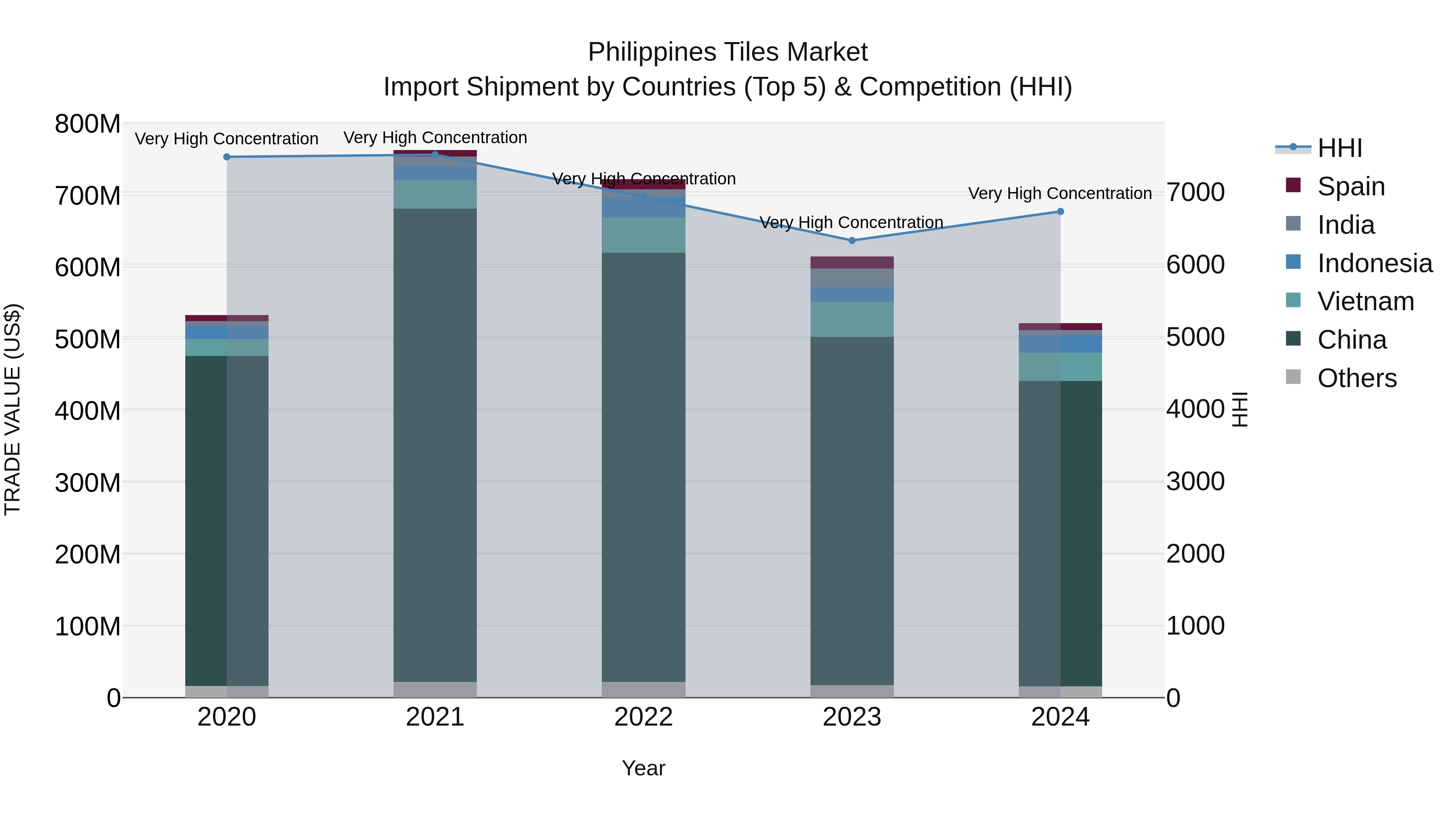
In 2024, China, Vietnam, Indonesia, Spain, and India emerged as the top countries exporting tiles to the Philippines. Despite a high concentration with a Herfindahl-Hirschman Index (HHI), the market experienced a negative Compound Annual Growth Rate (CAGR) of -0.54% from 2020 to 2024. The growth rate further declined by -15.17% from 2023 to 2024, indicating challenges in the industry. Continued monitoring of market dynamics and potential strategies for revitalization may be necessary for stakeholders in the tiles import sector in the Philippines.
Philippines Tiles Market Overview
The tiles market in the Philippines is experiencing steady growth, fueled by the construction boom in residential, commercial, and infrastructure projects. Consumers prefer ceramic and porcelain tiles due to their durability and aesthetic appeal. Rising disposable income and exposure to global design trends are shaping purchasing patterns. Technological advancements, such as digital printing on tiles, are further diversifying product offerings.
Drivers of the market
The tiles market in the Philippines is experiencing growth due to rising construction activities in residential, commercial, and infrastructure projects. Demand for aesthetically appealing and durable flooring solutions is increasing. Technological advancements in tile manufacturing and the availability of eco-friendly options are further enhancing market expansion. Additionally, rising disposable income and urbanization are influencing consumer preferences for high-quality tile products.
Challenges of the market
The tiles market in the Philippines struggles with intense competition from imported tiles, particularly from China and other Southeast Asian countries. Local manufacturers find it difficult to compete on price while maintaining quality. The rising cost of raw materials, coupled with logistical challenges, affects overall pricing and availability. Additionally, changing consumer preferences and design trends require continuous innovation, which can be expensive for manufacturers.
Investment opportunities in the Market
The construction and renovation sectors provide lucrative opportunities for tile manufacturers and suppliers. The demand for premium, anti-slip, and customizable tiles is on the rise. Investments in advanced manufacturing techniques and import-substitution strategies can strengthen local market presence.
Government Policy of the market
Government policies in the Philippines regulate the tiles market through trade, quality standards, and environmental initiatives. The BPS enforces product certification requirements to ensure tile durability and safety. The DTI supports local tile manufacturers through tax incentives and development programs, fostering industry growth. Import regulations and tariffs impact the availability of foreign-made tiles, while environmental policies encourage the use of sustainable and recycled materials in tile production.
Key Highlights of the Report:
- Philippines Tiles Market Outlook
- Market Size of Philippines Tiles Market, 2024
- Forecast of Philippines Tiles Market, 2031
- Historical Data and Forecast of Philippines Tiles Revenues & Volume for the Period 2021- 2031
- Philippines Tiles Market Trend Evolution
- Philippines Tiles Market Drivers and Challenges
- Philippines Tiles Price Trends
- Philippines Tiles Porter's Five Forces
- Philippines Tiles Industry Life Cycle
- Historical Data and Forecast of Philippines Tiles Market Revenues & Volume By Type for the Period 2021- 2031
- Historical Data and Forecast of Philippines Tiles Market Revenues & Volume By Ceramic and Porcelain Tile for the Period 2021- 2031
- Historical Data and Forecast of Philippines Tiles Market Revenues & Volume By Glass Tile for the Period 2021- 2031
- Historical Data and Forecast of Philippines Tiles Market Revenues & Volume By Quarry Tile for the Period 2021- 2031
- Historical Data and Forecast of Philippines Tiles Market Revenues & Volume By Stone for the Period 2021- 2031
- Historical Data and Forecast of Philippines Tiles Market Revenues & Volume By Application for the Period 2021- 2031
- Historical Data and Forecast of Philippines Tiles Market Revenues & Volume By Wall for the Period 2021- 2031
- Historical Data and Forecast of Philippines Tiles Market Revenues & Volume By Floor for the Period 2021- 2031
- Historical Data and Forecast of Philippines Tiles Market Revenues & Volume By Ceiling for the Period 2021- 2031
- Historical Data and Forecast of Philippines Tiles Market Revenues & Volume By Roofing for the Period 2021- 2031
- Historical Data and Forecast of Philippines Tiles Market Revenues & Volume By Countertop for the Period 2021- 2031
- Philippines Tiles Import Export Trade Statistics
- Market Opportunity Assessment By Type
- Market Opportunity Assessment By Application
- Philippines Tiles Top Companies Market Share
- Philippines Tiles Competitive Benchmarking By Technical and Operational Parameters
- Philippines Tiles Company Profiles
- Philippines Tiles Key Strategic Recommendations






































