Philippines Wetsuit Market Top 5 Importing Countries and Market Competition (HHI) Analysis
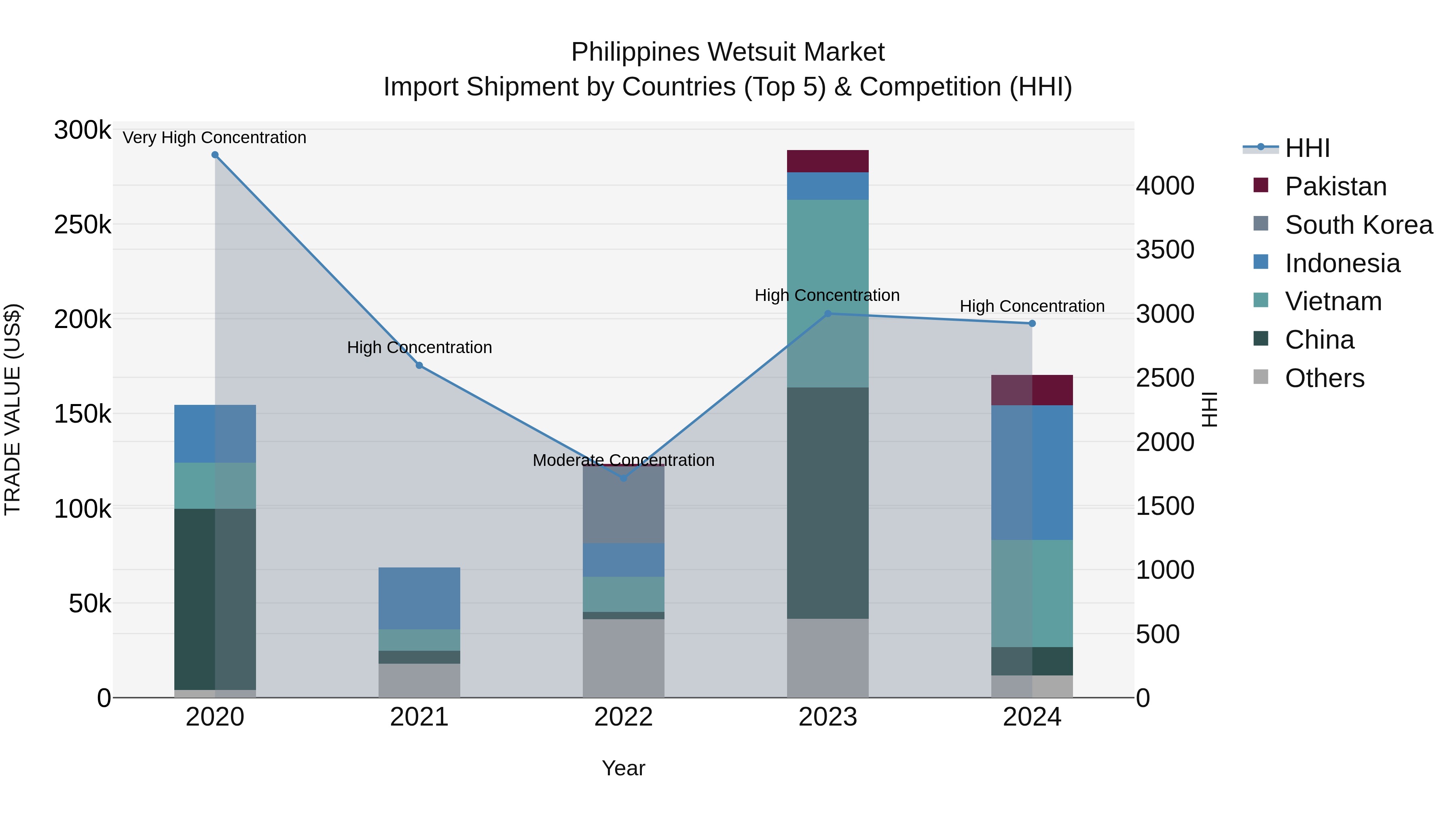
Despite a significant decrease in growth rate from 2023 to 2024, the Philippines continues to rely on imports for wetsuits, with top exporters being Indonesia, Vietnam, Pakistan, China, and Italy. The high Herfindahl-Hirschman Index (HHI) indicates a concentrated market in 2024. With a modest compound annual growth rate (CAGR) of 2.49% from 2020 to 2024, stakeholders should monitor market dynamics closely to capitalize on emerging opportunities and navigate challenges effectively in the competitive wetsuit import industry.
Philippines Wetsuit Market Overview
The wetsuit market in the Philippines is niche but growing due to increasing water sports activities such as surfing, diving, and triathlon events. Tourism growth and rising participation in aquatic sports drive demand. Market development is supported by local retailers and international brand availability. Climate and water temperature variations influence product preferences.
Trends of the market
The wetsuit market in the Philippines is niche but growing steadily, supported by the countryâs expanding water sports and diving tourism sectors. Increasing interest in surfing, diving, and other aquatic activities among locals and tourists drives demand. Quality and affordable wetsuit options remain key factors for market growth.
Challenges of the market
The wetsuit market in the Philippines is constrained by limited demand, as water sports and diving are still niche activities with seasonal popularity. High manufacturing and import costs translate to expensive retail prices, limiting accessibility for casual users. The tropical climate reduces the need for wetsuits compared to colder regions, further restricting demand. Additionally, competition from lower-cost alternatives and counterfeit products impact market growth.
Investment opportunities in the Market
The wetsuit market in the Philippines, supported by growing water sports, diving, and surfing activities, presents niche investment opportunities. Importing high-quality wetsuits or establishing local manufacturing focused on climate-appropriate designs can capture demand from recreational and professional users. Collaborations with diving schools, surf shops, and tourism operators can enhance market penetration.
Government Policy of the market
The wetsuit market is influenced by trade and industry policies set by the DTI. The government supports the textile and apparel industry through incentives and export promotion programs. Quality standards are enforced to ensure that wetsuits meet performance and safety requirements for both domestic and international markets.
Key Highlights of the Report:
- Philippines Wetsuit Market Outlook
- Market Size of Philippines Wetsuit Market, 2024
- Forecast of Philippines Wetsuit Market, 2031
- Historical Data and Forecast of Philippines Wetsuit Revenues & Volume for the Period 2021- 2031
- Philippines Wetsuit Market Trend Evolution
- Philippines Wetsuit Market Drivers and Challenges
- Philippines Wetsuit Price Trends
- Philippines Wetsuit Porter's Five Forces
- Philippines Wetsuit Industry Life Cycle
- Historical Data and Forecast of Philippines Wetsuit Market Revenues & Volume By Product for the Period 2021- 2031
- Historical Data and Forecast of Philippines Wetsuit Market Revenues & Volume By Wind Sports for the Period 2021- 2031
- Historical Data and Forecast of Philippines Wetsuit Market Revenues & Volume By Surfing for the Period 2021- 2031
- Historical Data and Forecast of Philippines Wetsuit Market Revenues & Volume By Scuba Diving for the Period 2021- 2031
- Historical Data and Forecast of Philippines Wetsuit Market Revenues & Volume By Triathlon for the Period 2021- 2031
- Philippines Wetsuit Import Export Trade Statistics
- Market Opportunity Assessment By Product
- Philippines Wetsuit Top Companies Market Share
- Philippines Wetsuit Competitive Benchmarking By Technical and Operational Parameters
- Philippines Wetsuit Company Profiles
- Philippines Wetsuit Key Strategic Recommendations






































