Philippines Wi Fi Range Extender Market Top 5 Importing Countries and Market Competition (HHI) Analysis
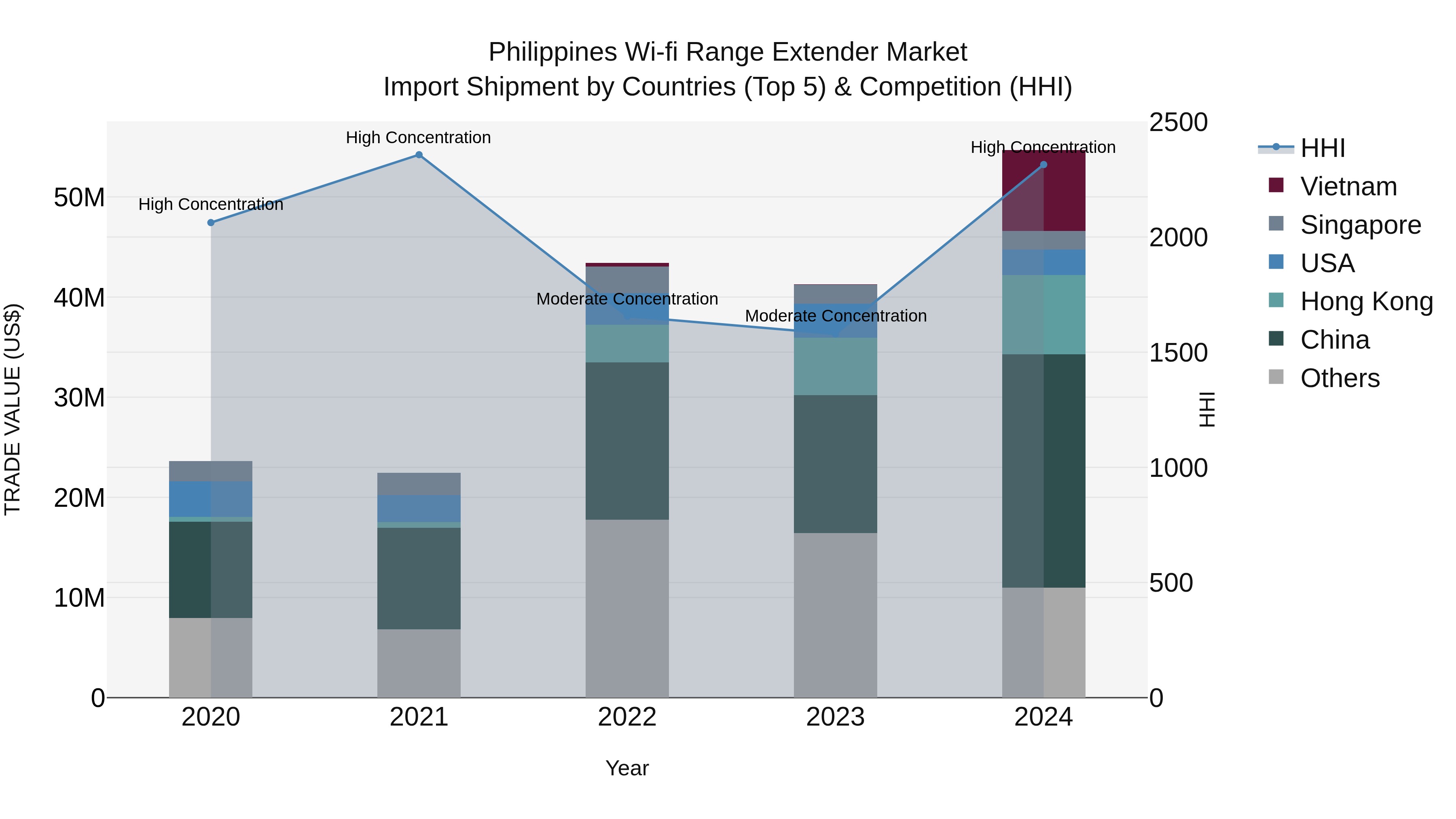
The Philippines wi-fi range extender import market saw a significant increase in concentration levels in 2024, with top exporters being China, Vietnam, Hong Kong, USA, and Taiwan. The high Herfindahl-Hirschman Index (HHI) indicates a more consolidated market. The impressive compound annual growth rate (CAGR) of 23.33% from 2020 to 2024 demonstrates robust expansion, with a notable growth rate of 32.45% from 2023 to 2024. This data suggests a thriving market for wi-fi range extenders in the Philippines, driven by strong demand and a diverse range of suppliers.
Philippines Wi-Fi Range Extender Market Overview
Wi-Fi range extenders are popular for improving network coverage in homes and small offices. As consumers face dead zones in multi-story or wide-spaced properties, plug-and-play extenders offer an affordable and convenient connectivity boost.
Trends of the market
The Wi-Fi range extender market in the Philippines is growing in response to the increasing reliance on internet connectivity across households, commercial spaces, and small offices. As the demand for seamless internet coverage intensifies, especially in larger homes and multi-floor buildings, consumers are seeking affordable solutions like range extenders to eliminate dead zones. The shift to hybrid work and online learning environments has further accelerated adoption. Price sensitivity remains a factor in product choice, but growth is being supported by the availability of competitively priced devices from global and regional vendors.
Challenges of the market
Market growth is limited by consumer unfamiliarity with range extenders and perceived complexity of installation. The availability of affordable, high-quality products is uneven, and imported devices face competition from integrated router solutions offering extended coverage. Connectivity issues in remote regions also limit effectiveness.
Investment opportunities in the Market
Wi-Fi range extenders address connectivity gaps in homes and offices, a common issue in the Philippines due to building layouts and urban density. Investment in supplying affordable, high-performance extenders and providing installation services presents an opportunity in the expanding home networking market.
Government Policy of the market
Range extenders, integral to expanding wireless coverage, fall under telecommunications device regulations enforced by the NTC. Quality standards and compliance testing ensure reliable performance. The governmentâs digital infrastructure plans promote the use of such devices to improve connectivity in underserved areas.
Key Highlights of the Report:
- Philippines Wi-Fi Range Extender Market Outlook
- Market Size of Philippines Wi-Fi Range Extender Market, 2024
- Forecast of Philippines Wi-Fi Range Extender Market, 2031
- Historical Data and Forecast of Philippines Wi-Fi Range Extender Revenues & Volume for the Period 2021- 2031
- Philippines Wi-Fi Range Extender Market Trend Evolution
- Philippines Wi-Fi Range Extender Market Drivers and Challenges
- Philippines Wi-Fi Range Extender Price Trends
- Philippines Wi-Fi Range Extender Porter's Five Forces
- Philippines Wi-Fi Range Extender Industry Life Cycle
- Historical Data and Forecast of Philippines Wi-Fi Range Extender Market Revenues & Volume By Type for the Period 2021- 2031
- Historical Data and Forecast of Philippines Wi-Fi Range Extender Market Revenues & Volume By Wi-Fi Range Extender for the Period 2021- 2031
- Historical Data and Forecast of Philippines Wi-Fi Range Extender Market Revenues & Volume By Wireless AP Router for the Period 2021- 2031
- Historical Data and Forecast of Philippines Wi-Fi Range Extender Market Revenues & Volume By Application for the Period 2021- 2031
- Historical Data and Forecast of Philippines Wi-Fi Range Extender Market Revenues & Volume By Household for the Period 2021- 2031
- Historical Data and Forecast of Philippines Wi-Fi Range Extender Market Revenues & Volume By Commercial Use for the Period 2021- 2031
- Philippines Wi-Fi Range Extender Import Export Trade Statistics
- Market Opportunity Assessment By Type
- Market Opportunity Assessment By Application
- Philippines Wi-Fi Range Extender Top Companies Market Share
- Philippines Wi-Fi Range Extender Competitive Benchmarking By Technical and Operational Parameters
- Philippines Wi-Fi Range Extender Company Profiles
- Philippines Wi-Fi Range Extender Key Strategic Recommendations






































