Philippines Wine Glass Market Top 5 Importing Countries and Market Competition (HHI) Analysis
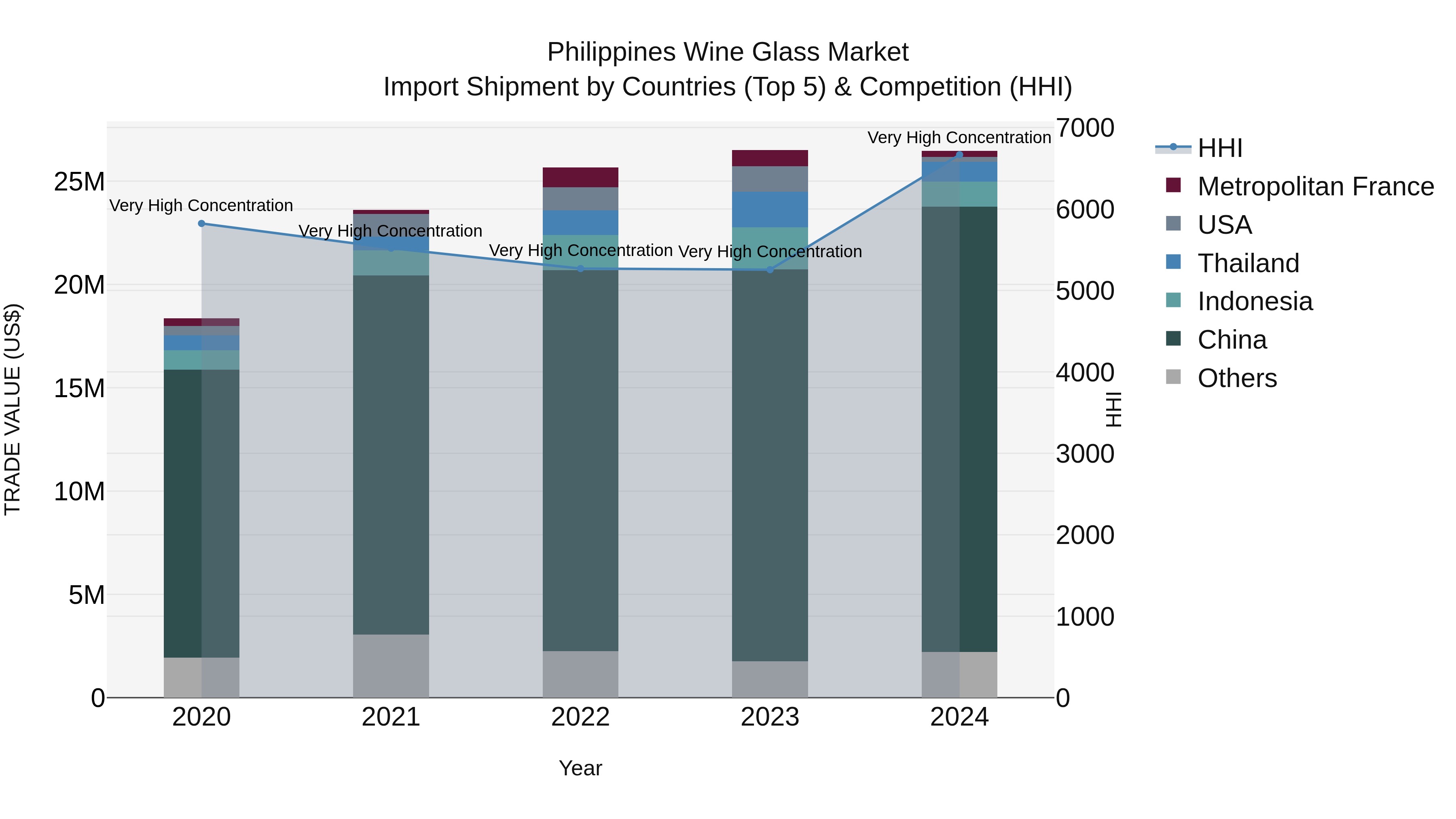
Despite a slight decline in growth rate from 2023 to 2024, the Philippines wine glass import market continues to thrive with a high Herfindahl-Hirschman Index (HHI) indicating a concentrated market. Key exporting countries such as China, Indonesia, and Italy are driving the growth with a strong compound annual growth rate (CAGR) of 9.56% from 2020 to 2024. This data suggests a consistent demand for wine glasses in the Philippines, highlighting opportunities for further market expansion and partnerships with top exporting countries.
Philippines Wine Glass Market Overview
The wine glass market is experiencing steady growth, driven by rising wine culture and hospitality trends. Restaurants, bars, and home consumers contribute to demand for both functional and elegant glassware, often imported from global brands.
Trends of the market
The wine glass market in the Philippines is expanding in parallel with the increasing popularity of wine drinking culture among middle-income and affluent consumers. Hospitality industry growth, wine bars, and home entertaining trends are stimulating demand for quality wine glassware. E-commerce platforms and specialty kitchenware stores are key distribution channels in this evolving market.
Challenges of the market
The wine glass market is constrained by limited local wine consumption, reducing demand. Imported premium glassware faces high tariffs and shipping costs, making products expensive for most consumers. There is also a lack of widespread appreciation for specialized glassware, affecting market growth potential.
Investment opportunities in the Market
As wine consumption rises in urban centers, so does the demand for quality wine glasses. Investment opportunities exist in importing premium glassware and producing locally crafted wine glasses targeting restaurants, bars, and households. Custom branding and collaborations with wine brands can add value to products.
Government Policy of the market
The wine glass market is regulated primarily through import and consumer safety policies. Imported glassware must meet health and safety standards enforced by the FDA. Environmental policies also affect packaging and waste management practices in the production and distribution of glassware. The governmentâs import tariff regime impacts the pricing and availability of premium wine glasses.
Key Highlights of the Report:
- Philippines Wine Glass Market Outlook
- Market Size of Philippines Wine Glass Market, 2024
- Forecast of Philippines Wine Glass Market, 2031
- Historical Data and Forecast of Philippines Wine Glass Revenues & Volume for the Period 2021- 2031
- Philippines Wine Glass Market Trend Evolution
- Philippines Wine Glass Market Drivers and Challenges
- Philippines Wine Glass Price Trends
- Philippines Wine Glass Porter's Five Forces
- Philippines Wine Glass Industry Life Cycle
- Historical Data and Forecast of Philippines Wine Glass Market Revenues & Volume By Type for the Period 2021- 2031
- Historical Data and Forecast of Philippines Wine Glass Market Revenues & Volume By Glass for the Period 2021- 2031
- Historical Data and Forecast of Philippines Wine Glass Market Revenues & Volume By Crystal for the Period 2021- 2031
- Historical Data and Forecast of Philippines Wine Glass Market Revenues & Volume By Others for the Period 2021- 2031
- Historical Data and Forecast of Philippines Wine Glass Market Revenues & Volume By Application for the Period 2021- 2031
- Historical Data and Forecast of Philippines Wine Glass Market Revenues & Volume By Personal Consumption for the Period 2021- 2031
- Historical Data and Forecast of Philippines Wine Glass Market Revenues & Volume By Commercial Consumption for the Period 2021- 2031
- Philippines Wine Glass Import Export Trade Statistics
- Market Opportunity Assessment By Type
- Market Opportunity Assessment By Application
- Philippines Wine Glass Top Companies Market Share
- Philippines Wine Glass Competitive Benchmarking By Technical and Operational Parameters
- Philippines Wine Glass Company Profiles
- Philippines Wine Glass Key Strategic Recommendations






































