Poland Commercial Flour Market (2026-2032) | Growth, Forecast, Companies, Industry, Size & Revenue, Analysis, Share, Value, Segmentation, Outlook, Trends, Competitive Landscape
Market Forecast By Type (Wheat Flour, Corn Flour, Rye Flour, Rice Flour, Others), By Nature (Organic, Conventional), By End-use (HoReCa, Food Industry) And Competitive Landscape
| Product Code: ETC8859808 | Publication Date: Sep 2024 | Updated Date: Apr 2026 | Product Type: Market Research Report | |
| Publisher: 6Wresearch | Author: Sumit Sagar | No. of Pages: 75 | No. of Figures: 35 | No. of Tables: 20 |
Poland Commercial Flour Market: Import Trend Analysis
In 2024, Poland import trend for the commercial flour market experienced a decline, with a growth rate of -14.96% compared to the previous year. However, the compound annual growth rate (CAGR) from 2020 to 2024 stood at 11.48%. This could be attributed to shifts in demand patterns or changes in trade policies impacting market stability.
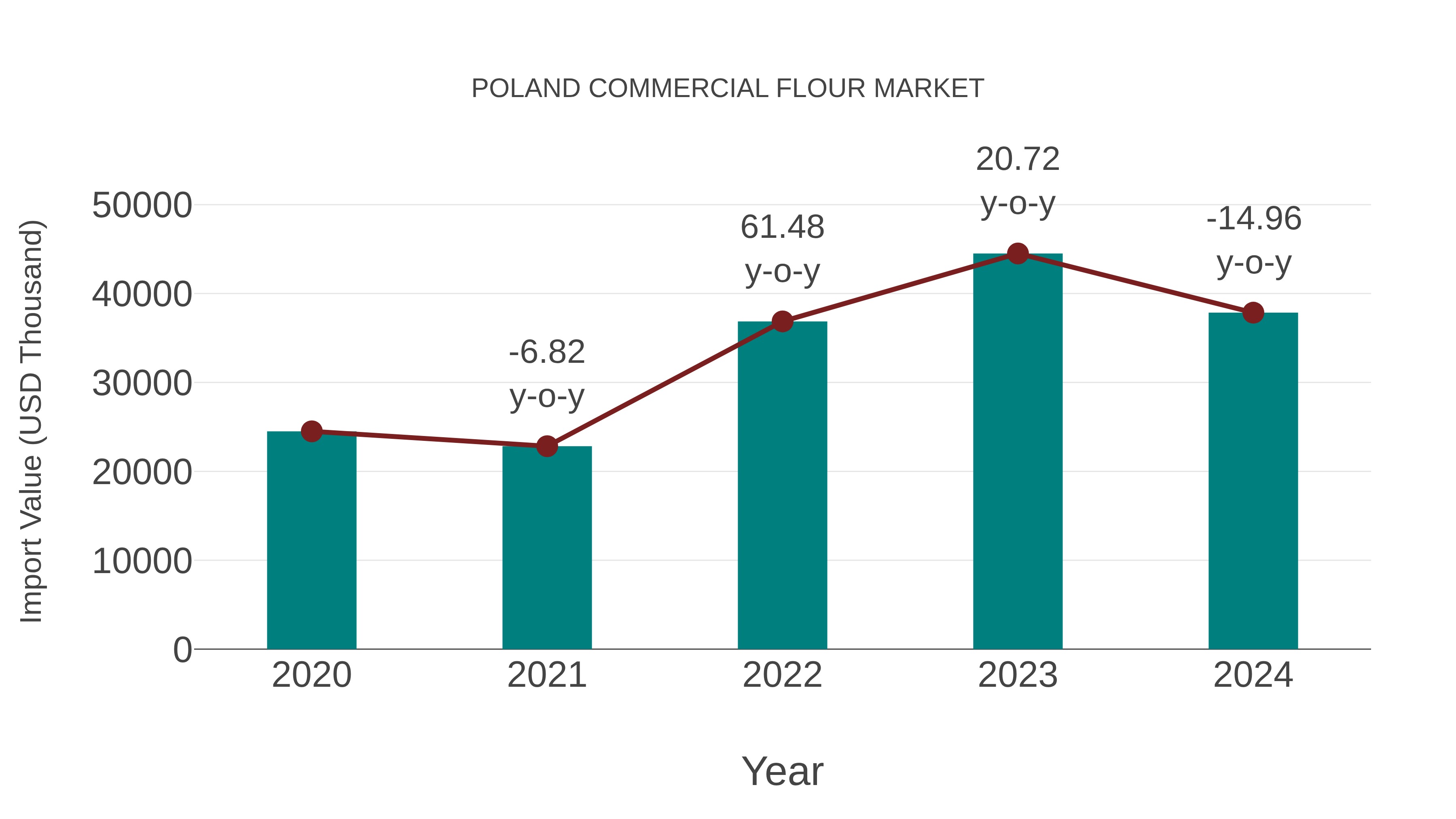
Poland Commercial Flour Market Growth Rate
According to 6Wresearch internal database and industry insights, the Poland Commercial Flour Market is growing at a compound annual growth rate (CAGR) of 4.75% during the forecast Forecast period (2026-2032).
Topics Covered in the Poland Commercial Flour Market Report
Poland Commercial Flour Market report thoroughly covers the market by type, nature, and end-use. The market report provides an unbiased and detailed analysis of ongoing market trends, opportunities/high growth areas, and market drivers, which would help stakeholders devise and align their market strategies according to the current and future market dynamics.
Poland Commercial Flour Market Highlights
| Report Name |
Poland Commercial Flour Market |
| Forecast period | 2026-2032 |
| CAGR | 4.75% |
| Growing Sector |
HoReCa (Hotel, Restaurant, and Catering) |
Poland Commercial Flour Market Synopsis
The Poland Commercial Flour Market is predicted to see a strong growth led by an increasing demand for flour in the bakery, snack, and food service industries. The shift towards organic and gluten-free flour is also gaining attraction as consumer preferences evolve. Government policies supporting local agriculture and sustainable flour production contribute to the market's expansion. Additionally, the growth of e-commerce and the food service sector (HoReCa) further along drives the demand for commercial flour in Poland.
Evaluation of Growth Drivers in the Poland Commercial Flour Market
Below mentioned are some growth drivers and their impact on market dynamics:
| Drivers | Primary Segments Affected | Why It Matters |
| Government Support & Agriculture Growth | Type, End-use | Strengthens local flour production, reduces dependency on flour imports, and improves food security by ensuring a strong, domestic supply. |
| Rising Demand for Processed Food Products | Type (Wheat, Rye, Rice) | Rise of flour consumption across various food and bakery industries which fuels to market expansion and diversifying food product offerings. |
| Consumer Shift Towards Organic Options | Type (Wheat Flour, Corn Flour) | Encourages the adoption of organic and healthier flour alternatives, coordinates with health-conscious consumer trends and promotes to eco-friendly agricultural practices. |
| Growth in Bakery & HoReCa Sectors | End-use (HoReCa, Food Industry) | Leading to a rising need for flour in bakery and HoReCa sectors, expanding variety of baked goods and food services available to consumers. |
| Technological Advancements in Milling | Type, End-use | Improve of milling efficiency drives to a better-quality flour with consistent properties, while decreasing operational costs and waste in flour production. |
The Poland Commercial Flour Market is projected to grow steadily, with a CAGR of 4.75% during the forecast Forecast period of 2026-2032. The boost is driven by a greater demand for flour in the bakery and snack industries, coupled with the growth of the HoReCa sector and a growing preference for organic and gluten-free alternatives. Government backing for domestic flour milling, along with policies promoting agricultural sustainability, also bolsters the market. Furthermore, advancements in flour milling technology are leading to improved flour quality and more streamlined operations, which in turn supports market expansion.
Evaluation of Restraints in the Poland Commercial Flour Market
Below are some major restraints and their influence on market dynamics:
| Restraints | Primary Segments Affected | What This Means |
| High Raw Material Costs | Type | Places pressure on pricing and profit margins for producers, making it more difficult to maintain competitive pricing while ensuring profitability. |
| Dependency on Imported Grains | All Segments | Impacts supply stability by making flour production vulnerable to disruptions in international grain markets, driving to higher costs and potential supply shortages. |
| Competition from Substitute Products | Application (Bakery, Food Industry) | Decrease demand for flour as consumers choose alternatives like low-carb or gluten-free products, potentially shrinking the flour market share in the main sectors. |
| Fluctuations in Demand | All Segments | Leads to challenges in production planning and inventory management, takes to inefficiencies and potential wastage during Forecast periods of low demand or missed opportunities during high demand. |
| Environmental & Regulatory Challenges | Type (Organic) | Increase of production costs for organic flour due to the need to comply with stricter environmental and guideline standards, which may also limit to supply availability. |
Poland Commercial Flour Market Challenges
The Poland Commercial Flour Market faces challenges like shifting of raw material prices, dependency on imported grains, and competition from gluten-free and low-carb alternatives. Additionally, environmental guidelines on organic production raise costs for producers. The market also faces demand fluctuation, particularly in food service sectors, which drives to challenges in inventory management and production planning.
Poland Commercial Flour Market Trends
Some major trends contributing to the Poland Commercial Flour Market Growth are:
- Organic Flour Growth: The demand for organic flour is growing owing to the rising number of health-conscious consumers preferring natural and chemical-free products.
- Gluten-Free Flour Options: A rise of demand for gluten-free products, especially in the food and bakery industries, is affecting flour production trends.
- E-commerce Flour Sales: Online retail platforms are developing access to flour products, offering convenience and home delivery services.
Investment Opportunities in the Poland Commercial Flour Market
Here are some investment opportunities in the Poland Commercial Flour Industry:
- Local Flour Milling Facilities: Boosting the domestic milling infrastructure offers a way to reduce dependence on imports, strengthening supply chain resilience.
- Organic Flour Production: Investing organic flour products meets the growing demand for healthier food options, especially in urban areas.
- E-commerce Flour Distribution: Rising online sales platforms for flour distribution caters to the increasing demand for convenience and home delivery.
Top 5 Leading Players in the Poland Commercial Flour Market
Here are some top companies contributing to the Poland Commercial Flour Market Share:
1. GoodMills Polska
| Company Name | GoodMills Polska |
|---|---|
| Established Year | 1999 |
| Headquarters | Stradunia, Poland |
| Official Website | Click Here |
GoodMills Polska is the Polish division of Europe’s largest milling group. They are a powerhouse in both the industrial and retail sectors, most famous for their premium Puszysta brand.
2. Gdańskie Młyny
| Company Name | Gdańskie Młyny |
|---|---|
| Established Year | 1948 |
| Headquarters | Gdańsk, Poland |
| Official Website | Click Here |
Leveraging its strategic location at the Port of Gdańsk, Gdańskie Młyny is a massive player in the export and domestic industrial markets. With a tradition spanning over 70 years, they specialize in high-volume wheat and rye milling.
3. Młyny Szczepanki
| Company Name | Młyny Szczepanki |
|---|---|
| Established Year | 1992 |
| Headquarters | Szczepanki, Poland |
| Official Website | Click Here |
Młyny Szczepanki is one of the largest family-owned milling enterprises in the country. Known for rapid modernization and significant daily milling capacity (800+ tonnes), they balance traditional family values with cutting-edge technology.
4. PZZ w Krakowie (Polskie Zakłady Zbożowe)
| Company Name | PZZ w Krakowie (Polskie Zakłady Zbożowe) |
|---|---|
| Established Year | 1948 |
| Headquarters | Kraków, Poland |
| Official Website | - |
The PZZ network consists of various regional legacy players, with the Kraków branch being one of the most prominent. These "Polish Cereal Plants" were historically state-owned and have evolved into highly efficient, modernized commercial entities.
5. Polski Młyn
| Company Name | Polski Młyn |
|---|---|
| Established Year | 1948 |
| Headquarters | Warsaw, Poland |
| Official Website | - |
Polski Młyn is one of the largest flour producers in Poland, supplying wheat, rye, and corn flour to a variety of industries. Their focus on quality control and logistics ensures wide market reach.
Government Regulations Introduced in the Poland Commercial Flour Market
According to Polish government data, the development of the Poland Commercial Flour Market is strongly influenced by guidelines. The Polish Food Safety and Quality Control (PFSQC) ensures that the flour products meet national and European Union standards. Some government initiatives such as the National Agriculture and Food Processing Policy encourage local flour milling and production, which improves self-sufficiency and reducing dependence on imports. Moreover, the growing market for organic flour aligns with policies that promote organic farming and sustainable agricultural practices.
Future Insights of the Poland Commercial Flour Market
The outcome for the Poland Commercial Flour Market is positive, with strong growth led by the growing demand for processed and packaged food products. The market is rising owing to growth in the bakery, food service, and e-commerce sectors. In addition, the increasing demand for organic and gluten-free flour is creating product innovation in the industry. Government support for local agriculture and food security programs further strengthens the market’s prospects.
Market Segmentation Analysis
The report offers a comprehensive study of the subsequent market segments and their leading categories.
Wheat Flour to Dominate the Market - By Type
According to Kanak Phartiyal, Senior Research Analyst at 6Wresearch, wheat flour dominates the market due to its widespread use in bakery products, pasta, and other food applications. It is the most adaptable flour type, offering a high-quality nutritional benefits and better processing characteristics, making it the preferred choice for most commercial food products.
Organic Flour to Dominate the Market – By Nature
The organic flour segment is predicted to dominate the market as the demand for organic products rises among health-conscious consumers. Organic flour, which is produced without the use of synthetic fertilizers or pesticides is mostly suitable in baked goods and food products owing to its perceived health benefits and sustainability.
HoReCa to Dominate the Market – By End-use
The HoReCa (Hotel, Restaurant, and Catering) sector is poised to take the lead, driven by the market due to an increasing demand for bakery items and processed food in restaurants and hotels. Also, flour is a key ingredient in baked goods, pastries, and snacks, contributes to strong growth in the food service industry.
Key attractiveness of the report
- 10 Years Market Numbers.
- Historical Data Starting from 2022 to 2025.
- Base Year: 2025
- Forecast Data until 2032.
- Key Performance Indicators Impacting the Market.
- Major Upcoming Developments and Projects.
Key Highlights of the Report:
- Poland Commercial Flour Market Outlook
- Market Size of Poland Commercial Flour Market, 2025
- Forecast of Poland Commercial Flour Market, 2032
- Historical Data and Forecast of Poland Commercial Flour Revenues & Volume for the Forecast period 2022 - 2032
- Poland Commercial Flour Market Trend Evolution
- Poland Commercial Flour Market Drivers and Challenges
- Poland Commercial Flour Price Trends
- Poland Commercial Flour Porter's Five Forces
- Poland Commercial Flour Industry Life Cycle
- Historical Data and Forecast of Poland Commercial Flour Market Revenues & Volume By Type for the Forecast period 2022 - 2032
- Historical Data and Forecast of Poland Commercial Flour Market Revenues & Volume By Wheat Flour for the Forecast period 2022 - 2032
- Historical Data and Forecast of Poland Commercial Flour Market Revenues & Volume By Corn Flour for the Forecast period 2022 - 2032
- Historical Data and Forecast of Poland Commercial Flour Market Revenues & Volume By Rye Flour for the Forecast period 2022 - 2032
- Historical Data and Forecast of Poland Commercial Flour Market Revenues & Volume By Rice Flour for the Forecast period 2022 - 2032
- Historical Data and Forecast of Poland Commercial Flour Market Revenues & Volume By Others for the Forecast period 2022 - 2032
- Historical Data and Forecast of Poland Commercial Flour Market Revenues & Volume By Nature for the Forecast period 2022 - 2032
- Historical Data and Forecast of Poland Commercial Flour Market Revenues & Volume By Organic for the Forecast period 2022 - 2032
- Historical Data and Forecast of Poland Commercial Flour Market Revenues & Volume By Conventional for the Forecast period 2022 - 2032
- Historical Data and Forecast of Poland Commercial Flour Market Revenues & Volume By End-use for the Forecast period 2022 - 2032
- Historical Data and Forecast of Poland Commercial Flour Market Revenues & Volume By HoReCa for the Forecast period 2022 - 2032
- Historical Data and Forecast of Poland Commercial Flour Market Revenues & Volume By Food Industry for the Forecast period 2022 - 2032
- Poland Commercial Flour Import Export Trade Statistics
- Market Opportunity Assessment By Type
- Market Opportunity Assessment By Nature
- Market Opportunity Assessment By End-use
- Poland Commercial Flour Top Companies Market Share
- Poland Commercial Flour Competitive Benchmarking By Technical and Operational Parameters
- Poland Commercial Flour Company Profiles
- Poland Commercial Flour Key Strategic Recommendations
Market covered
The report subsequently covers the market by following segments and subsegments.
By Type
- Wheat Flour
- Corn Flour
- Rye Flour
- Rice Flour
- Others
By Nature
- Organic
- Conventional
By End-use
- HoReCa
- Food Industry
Poland Commercial Flour Market (2026-2032): FAQs
The Poland Commercial Flour Market is projected to grow at a CAGR of 4.75% during the forecast Forecast period (2026-2032).
The changes in milling technologies are enhancing flour production efficiency, minimizing waste, and improving product consistency.
The growth drivers includes growing demand from the bakery industry, growing consumer choices for organic flour, and government support for local agriculture.
The key challenges include increased raw material costs, competition from gluten-free alternatives, and reliance on imported grains.
6Wresearch actively monitors the Poland Commercial Flour Market and publishes its comprehensive annual report, highlighting emerging trends, growth drivers, revenue analysis, and forecast outlook. Our insights help businesses to make data-backed strategic decisions with ongoing market dynamics. Our analysts track relevent industries related to the Poland Commercial Flour Market, allowing our clients with actionable intelligence and reliable forecasts tailored to emerging regional needs.
Yes, we provide customisation as per your requirements. To learn more, feel free to contact us on sales@6wresearch.com
| 1 Executive Summary |
| 2 Introduction |
| 2.1 Key Highlights of the Report |
| 2.2 Report Description |
| 2.3 Market Scope & Segmentation |
| 2.4 Research Methodology |
| 2.5 Assumptions |
| 3 Poland Commercial Flour Market Overview |
| 3.1 Poland Country Macro Economic Indicators |
| 3.2 Poland Commercial Flour Market Revenues & Volume, 2022 & 2032F |
| 3.3 Poland Commercial Flour Market - Industry Life Cycle |
| 3.4 Poland Commercial Flour Market - Porter's Five Forces |
| 3.5 Poland Commercial Flour Market Revenues & Volume Share, By Type, 2022 & 2032F |
| 3.6 Poland Commercial Flour Market Revenues & Volume Share, By Nature, 2022 & 2032F |
| 3.7 Poland Commercial Flour Market Revenues & Volume Share, By End-use, 2022 & 2032F |
| 4 Poland Commercial Flour Market Dynamics |
| 4.1 Impact Analysis |
| 4.2 Market Drivers |
| 4.2.1 Increasing demand for convenience foods and baked goods in Poland. |
| 4.2.2 Growing awareness about the health benefits of consuming products made from high-quality flour. |
| 4.2.3 Expansion of the foodservice industry in Poland. |
| 4.3 Market Restraints |
| 4.3.1 Fluctuating prices of raw materials such as wheat impacting the cost of flour production. |
| 4.3.2 Competition from substitute products like gluten-free flour alternatives. |
| 4.3.3 Regulatory challenges related to food safety standards and labeling requirements. |
| 5 Poland Commercial Flour Market Trends |
| 6 Poland Commercial Flour Market, By Types |
| 6.1 Poland Commercial Flour Market, By Type |
| 6.1.1 Overview and Analysis |
| 6.1.2 Poland Commercial Flour Market Revenues & Volume, By Type, 2022-2032F |
| 6.1.3 Poland Commercial Flour Market Revenues & Volume, By Wheat Flour, 2022-2032F |
| 6.1.4 Poland Commercial Flour Market Revenues & Volume, By Corn Flour, 2022-2032F |
| 6.1.5 Poland Commercial Flour Market Revenues & Volume, By Rye Flour, 2022-2032F |
| 6.1.6 Poland Commercial Flour Market Revenues & Volume, By Rice Flour, 2022-2032F |
| 6.1.7 Poland Commercial Flour Market Revenues & Volume, By Others, 2022-2032F |
| 6.2 Poland Commercial Flour Market, By Nature |
| 6.2.1 Overview and Analysis |
| 6.2.2 Poland Commercial Flour Market Revenues & Volume, By Organic, 2022-2032F |
| 6.2.3 Poland Commercial Flour Market Revenues & Volume, By Conventional, 2022-2032F |
| 6.3 Poland Commercial Flour Market, By End-use |
| 6.3.1 Overview and Analysis |
| 6.3.2 Poland Commercial Flour Market Revenues & Volume, By HoReCa, 2022-2032F |
| 6.3.3 Poland Commercial Flour Market Revenues & Volume, By Food Industry, 2022-2032F |
| 7 Poland Commercial Flour Market Import-Export Trade Statistics |
| 7.1 Poland Commercial Flour Market Export to Major Countries |
| 7.2 Poland Commercial Flour Market Imports from Major Countries |
| 8 Poland Commercial Flour Market Key Performance Indicators |
| 8.1 Average selling price of commercial flour in Poland. |
| 8.2 Number of new product launches in the commercial flour segment. |
| 8.3 Consumer sentiment towards the quality and variety of commercial flour products available. |
| 9 Poland Commercial Flour Market - Opportunity Assessment |
| 9.1 Poland Commercial Flour Market Opportunity Assessment, By Type, 2022 & 2032F |
| 9.2 Poland Commercial Flour Market Opportunity Assessment, By Nature, 2022 & 2032F |
| 9.3 Poland Commercial Flour Market Opportunity Assessment, By End-use, 2022 & 2032F |
| 10 Poland Commercial Flour Market - Competitive Landscape |
| 10.1 Poland Commercial Flour Market Revenue Share, By Companies, 2025 |
| 10.2 Poland Commercial Flour Market Competitive Benchmarking, By Operating and Technical Parameters |
| 11 Company Profiles |
| 12 Recommendations |
| 13 Disclaimer |
Global Go To Market Strategy - 2030
Export potential enables firms to identify high-growth global markets with greater confidence by combining advanced trade intelligence with a structured quantitative methodology. The framework analyzes emerging demand trends and country-level import patterns while integrating macroeconomic and trade datasets such as GDP and population forecasts, bilateral import–export flows, tariff structures, elasticity differentials between developed and developing economies, geographic distance, and import demand projections. Using weighted trade values from 2020–2024 as the base period to project country-to-country export potential for 2030, these inputs are operationalized through calculated drivers such as gravity model parameters, tariff impact factors, and projected GDP per-capita growth. Through an analysis of hidden potentials, demand hotspots, and market conditions that are most favorable to success, this method enables firms to focus on target countries, maximize returns, and global expansion with data, backed by accuracy.
By factoring in the projected importer demand gap that is currently unmet and could be potential opportunity, it identifies the potential for the Exporter (Country) among 190 countries, against the general trade analysis, which identifies the biggest importer or exporter.
To discover high-growth global markets and optimize your business strategy:
Click Here
Pricing
- Single User License$ 1,995
- Department License$ 2,400
- Site License$ 3,120
- Global License$ 3,795

Leadership Perspectives from Industry Events
Search
Thought Leadership and Analyst Meet





Our Clients








6WResearch In News
- India Export Attractiveness Tracker 2026
- India Air Conditioner Market Set for Strong Rebound in 2026 After Weather-Led Correction and GST-Driven Recovery: 6Wresearch
- ADAS in India: How Automatic Emergency Braking, Blind Spot Detection & Driver Monitoring are Transforming Road Safety
- Doha a strategic location for EV manufacturing hub: IPA Qatar
- Demand for luxury TVs surging in the GCC, says Samsung
- Empowering Growth: The Thriving Journey of Bangladesh’s Cable Industry
Latest Reports
- Nicaragua RPG Gaming Market (2026-2032)
- New Zealand RPG Gaming Market (2026-2032)
- Netherlands RPG Gaming Market (2026-2032)
- Nauru RPG Gaming Market (2026-2032)
- Namibia RPG Gaming Market (2026-2032)
- Mozambique RPG Gaming Market (2026-2032)
- Montenegro RPG Gaming Market (2026-2032)
- Mongolia RPG Gaming Market (2026-2032)
- Monaco RPG Gaming Market (2026-2032)
- Micronesia RPG Gaming Market (2026-2032)
Industry Events and Analyst Meet

EV India Expo 2026

HIMTEX 2026

India Refining Summit 2026

India EV Show 2026

EV tech India Expo 2026
Whitepaper
- Middle East & Africa Commercial Security Market Click here to view more.
- Middle East & Africa Fire Safety Systems & Equipment Market Click here to view more.
- GCC Drone Market Click here to view more.
- Middle East Lighting Fixture Market Click here to view more.
- GCC Physical & Perimeter Security Market Click here to view more.


