Poland Construction Market: Import Trend Analysis
In the Poland construction market, the import trend showed a notable growth rate of 12.14% from 2023 to 2024, with a compound annual growth rate (CAGR) of 14.52% from 2020 to 2024. This increase can be attributed to a surge in demand for construction materials and equipment, reflecting a positive momentum in import activities driven by market stability and robust demand within the industry.
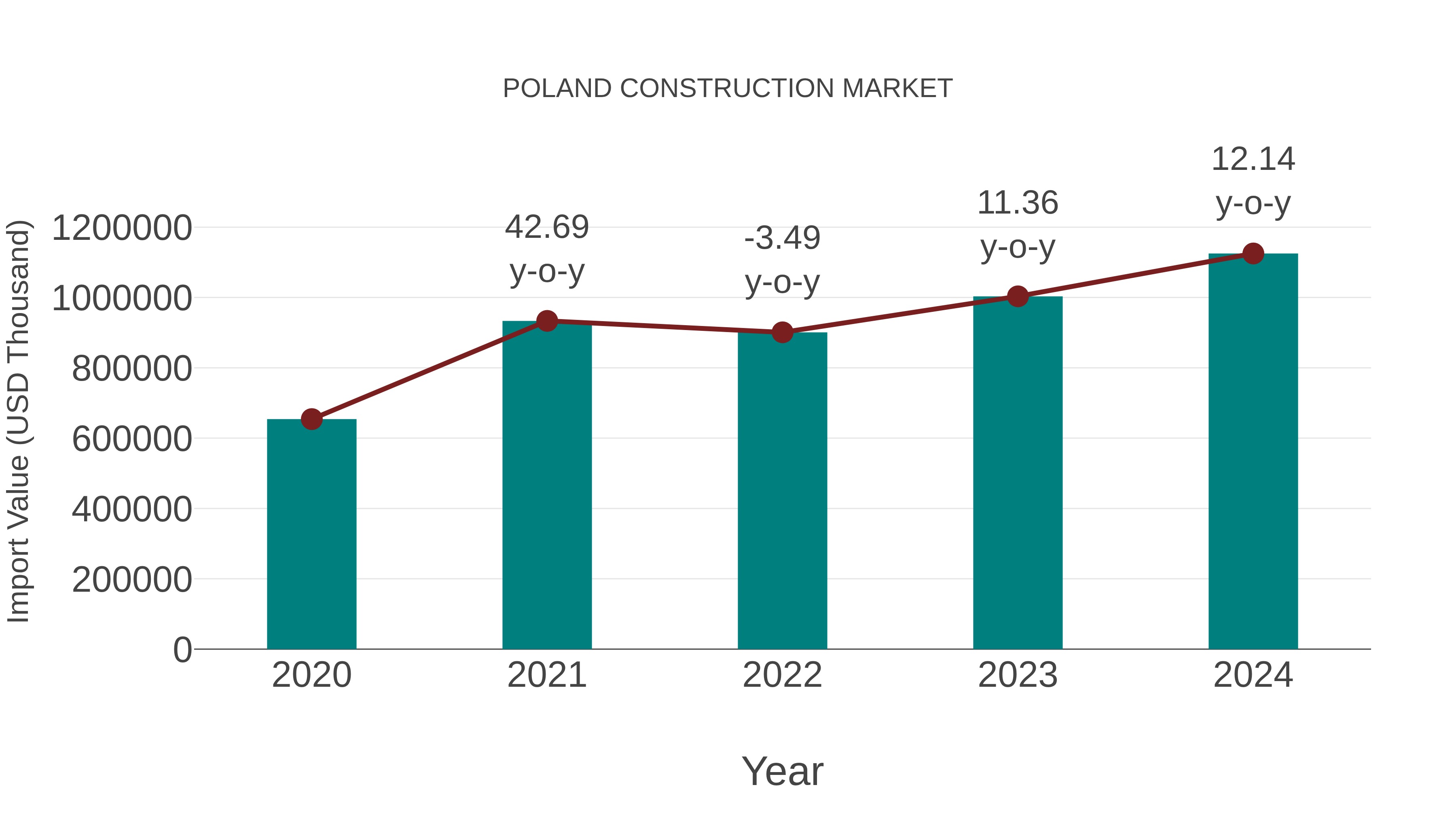
Poland Construction Market Growth Rate
According to 6Wresearch internal database and industry insights, the Poland Construction Market is projected to grow at a compound annual growth rate (CAGR) of 6.5% during the forecast period (2026–2032).
Five-Years Growth Trajectory of the Poland Construction Market with Core Drivers
Below is the evaluation of the year-wise growth rate along with key drivers:
| Years | Estimated Annual Growth (%) | Growth Drivers |
| 2021 | 5.8 | Recovery in residential construction and urbanization trends |
| 2022 | 6 | Increased government infrastructure investments and EU funding |
| 2023 | 6.2 | Growth in housing and commercial construction projects |
| 2024 | 6.3 | Expansion of transportation and logistics infrastructure |
| 2025 | 6.4 | Increased private sector investment in real estate development |
Topics Covered in the Poland Construction Market Report
The Poland Construction Market report thoroughly covers the market by Product Types, Sector, and Category. The report provides a detailed analysis of ongoing market trends, opportunities/high-growth areas, and market drivers that will help stakeholders devise and align strategies according to current and future market dynamics.
Poland Construction Market Highlights
| Report Name | Poland Construction Market |
| Forecast period | 2026-2032 |
| CAGR | 6.5% |
| Growing Sector | Construction |
Poland Construction Market Synopsis
Poland Construction Industry is experiencing steady growth, supported by rising demand for residential, commercial, and large-scale infrastructure projects. Government investment, supported largely by EU funding, is accelerating public sector construction, including roads, bridges, and urban infrastructure. Urbanization, growing real estate investments, and technological advancements in construction processes are contributing to the sector's development. Furthermore, the government's focus on sustainable construction practices and energy-efficient buildings is further supporting market expansion.
Evaluation of Growth Drivers in the Poland Construction Market
Below are some prominent drivers and their influence on the Poland Construction Market dynamics:
| Drivers | Primary Segments Affected | Why it Matters |
| Infrastructure Investments | By Product (Heavy and Civil Engineering) | Government spending on key infrastructure assets, including highways, bridges, and airports, is strengthening market momentum. |
| Real Estate Demand | By Product (General Construction) | Residential and commercial real estate projects are increasing due to urbanization and rising disposable incomes. |
| EU Funding and Government Programs | By Sector (Urban, Rural) | EU and government funding for infrastructure and housing projects, especially in rural areas, supports sector expansion. |
| Technological Advancements in Construction | By Category (New Construction) | Innovation in construction methods, including 3D printing and modular building, is driving faster and more efficient construction. |
The Poland Construction Market Size is projected to grow at a CAGR of 6.5% during the forecast period (2026–2032). The market is propelled by increasing demand for residential and commercial real estate, along with heavy investments in infrastructure development by both the government and private sectors. Rapid urbanization and a growing middle-class population are driving construction activity, while AI-based technologies and sustainability efforts are further strengthening market growth. In addition, favorable regulations and public–private collaborations are improving project execution across major segments. The rising use of smart construction solutions is also boosting efficiency, managing costs, and enhancing long-term competitiveness.
Evaluation of Restraints in the Poland Construction Market
Below are some prominent restraints and their influence on the Poland Construction Market dynamics:
| Restraints | Primary Segments Affected | What this Means |
| Labor Shortages | By Product (General Construction) | An insufficient skilled workforce often results in project delays and higher labor costs. |
| Regulatory and Bureaucratic Barriers | By Sector (Urban, Rural) | Extended approval requirements can hinder progress and postpone construction activities. |
| Material Cost Fluctuations | By Product (Heavy and Civil Engineering) | Increasing material costs, particularly steel and concrete, increase project expenses. |
| Environmental Regulations | By Category (New Construction) | Compliance with stringent environmental regulations can increase construction costs and project timelines. |
Poland Construction Market Challenges
There are several challenges faced by the Poland Construction Industry, such as shortage of skilled labour, fluctuating material costs and increasing regulation on the environment, which all lead to increased costs of projects and delays in timeliness. Companies are addressing these issues by utilising modern construction technology, creating stronger workforce training programs, and implementing sustainable building practices. These strategies improve or increase efficiency, control costs, help conform to government regulations, and contribute to market stability in the long term.
Poland Construction Market Trends
Several key trends are shaping the Poland Construction Market Growth:
- Digitalization in Construction: The adoption of BIM (Building Information Modeling) and AI in construction projects is streamlining the design, planning, and execution phases.
- Sustainable Construction: There has been an increase in emphasis on the use of sustainable materials and energy-efficient materials for both Residential and Commercial Projects.
- Modular and Prefabricated Buildings: There has been a steady increase in Modular andPrefabricated Buildings as there is a greater trend for the construction process to be streamlined and faster due to improved logistics and lower costs, creating a better experience for Building Owners/Contractors.
- The Growth of Smart Cities: As more governments become involved in the establishment of Smart Cities and start using IoT and analytics in construction and the operation of their infrastructure, there has been a marked increase in their interest in how they will improve the efficiency of their daily activities that will be affected by this technology.
Investment Opportunities in the Poland Construction Market
Some notable investment opportunities includes:
- Green Building-Eco-Conscious Design: As people become more aware of their environmental impact, they are beginning to look for ways to create eco-conscious designs of their private homes and office spaces with an emphasis on energy-efficient building materials.
- Infrastructure Projects: The EU funds the majority of Public Infrastructure Projects, including Transportation, Utilities, and other related projects. There are many opportunities available to invest in these types of projects.
- Residential Real Estate: The increasing number of new housing developments due to the growing demand for housing caused by Urbanisation, creates opportunity for Residential Construction Developers.
- Technological Advancements: Investing in 'smart' building technologies and automation will provide an advantage in this very competitive market.
Top 5 Leading Players in the Poland Construction Market
Some leading players operating in the Poland Construction Market Share include:
1 Strabag Sp. z o.o.
| Company Name | Strabag Sp. z o.o. |
|---|---|
| Established Year | 1997 |
| Headquarters | Warsaw, Poland |
| Official Website | Click Here |
Strabag is one of the leading construction companies in Poland, specializing in infrastructure and large-scale civil engineering projects.
2 Budimex SA
| Company Name | Budimex SA |
|---|---|
| Established Year | 1968 |
| Headquarters | Warsaw, Poland |
| Official Website | Click Here |
Budimex is a major Polish construction firm involved in residential, commercial, and infrastructure projects, with a focus on sustainable construction practices.
3 Porr Polska Construction
| Company Name | Porr Polska Construction |
|---|---|
| Established Year | 2002 |
| Headquarters | Warsaw, Poland |
| Official Website | Click Here |
Porr Polska is a leading construction company involved in infrastructure, residential, and commercial development projects across Poland.
4 Warbud SA
| Company Name | Warbud SA |
|---|---|
| Established Year | 1995 |
| Headquarters | Warsaw, Poland |
| Official Website | Click Here |
Warbud is a prominent construction company in Poland that specializes in the design and execution of complex residential, office, and infrastructure projects.
5 Mostostal Warszawa SA
| Company Name | Mostostal Warszawa SA |
|---|---|
| Established Year | 1945 |
| Headquarters | Warsaw, Poland |
| Official Website | Click Here |
Mostostal Warszawa is a major player in the construction industry, with expertise in building infrastructure, industrial facilities, and residential projects.
Government Regulations Introduced in the Poland Construction Market
According to Polish government data, government programs such as the National Housing Program and the construction and infrastructure development fund are strengthening the construction sector. Government support through grants, tax incentives, and transport infrastructure investments is driving sustainable market growth by promoting energy-efficient buildings, green construction methods, and urban development. In addition, the government-private sector collaboration has increased and is thus making project execution and financing more efficient. Besides, the growing acceptance of technological advancements in smart construction is further contributing to the industry long-term competitiveness in terms of productivity, cost control, and quality.
Future Insights of the Poland Construction Market
Steady growth in the Poland Construction Market is being driven by rising activity in housing, commercial projects, and infrastructure development. Supportive government policies promoting sustainable construction and smart city technologies are boosting expansion. Growing urbanization and growing investment in energy-efficient and eco-friendly buildings are reinforcing long-term prospects. These trends, combined with advanced construction practices, are positioning the market to address the changing demands of Poland’s urban development.
Market Segmentation Analysis
The report offers a comprehensive study of the following market segments and their leading categories:
By Product – Heavy and Civil Engineering to Lead the Market
According to Ritika Kalra, Senior Research Analyst at 6Wresearch, Government investments in infrastructure, including roads, bridges, and energy facilities, lead the market in heavy and civil engineering projects.
By Sector – Urban to Lead the Market
Urban construction is a major growth driver due to rapid urbanization and the growing demand for residential, commercial, and retail properties in major cities.
By Category – New to Lead the Market
New construction projects are driving the majority of market growth, particularly in housing and infrastructure development, while renovations contribute to a smaller portion of the market.
Key Attractiveness of the Report
- 10 Years of Market Numbers
- Historical Data Starting from 2022 to 2025
- Base Year: 2025
- Forecast Data until 2032
- Key Performance Indicators Impacting the Market
- Major Upcoming Developments and Projects
Key Highlights of the Report:
- Poland Construction Market Outlook
- Market Size of Poland Construction Market, 2025
- Forecast of Poland Construction Market, 2032
- Historical Data and Forecast of Poland Construction Revenues & Volume for the Period 2022- 2032
- Poland Construction Market Trend Evolution
- Poland Construction Market Drivers and Challenges
- Poland Construction Price Trends
- Poland Construction Porter's Five Forces
- Poland Construction Industry Life Cycle
- Historical Data and Forecast of Poland Construction Market Revenues & Volume By Product for the Period 2022- 2032
- Historical Data and Forecast of Poland Construction Market Revenues & Volume By Heavy and Civil Engineering for the Period 2022- 2032
- Historical Data and Forecast of Poland Construction Market Revenues & Volume By General Construction for the Period 2022- 2032
- Historical Data and Forecast of Poland Construction Market Revenues & Volume By Sector for the Period 2022- 2032
- Historical Data and Forecast of Poland Construction Market Revenues & Volume By Urban for the Period 2022- 2032
- Historical Data and Forecast of Poland Construction Market Revenues & Volume By Rural for the Period 2022- 2032
- Historical Data and Forecast of Poland Construction Market Revenues & Volume By Category for the Period 2022- 2032
- Historical Data and Forecast of Poland Construction Market Revenues & Volume By New for the Period 2022- 2032
- Historical Data and Forecast of Poland Construction Market Revenues & Volume By Renovation for the Period 2022- 2032
- Poland Construction Import Export Trade Statistics
- Market Opportunity Assessment By Product
- Market Opportunity Assessment By Sector
- Market Opportunity Assessment By Category
- Poland Construction Top Companies Market Share
- Poland Construction Competitive Benchmarking By Technical and Operational Parameters
- Poland Construction Company Profiles
- Poland Construction Key Strategic Recommendations
Markets Covered
The report offers a comprehensive study of the following market segments:
By Product Type
- Heavy and Civil Engineering
- General Construction
By Sector
- Urban
- Rural
By Category
- New Construction
- Renovation






































