Poland Energy Security Market Size & Growth Rate (2026-2032)
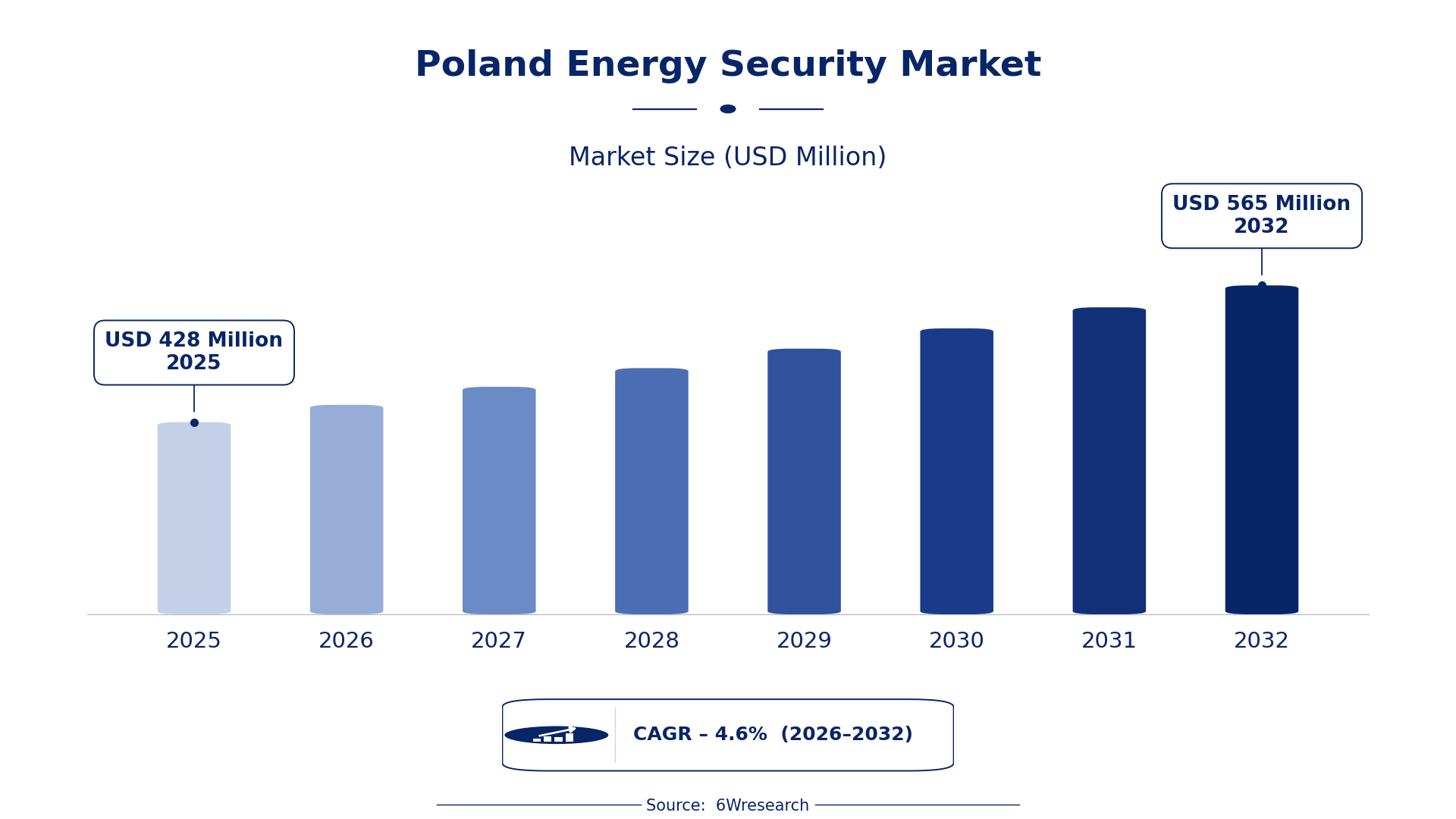
The Poland Energy Security Market was estimated at USD 428 Million in 2025 and is projected to reach USD 565 Million by 2032, growing at a CAGR of 4.6% from 2026 to 2032.
Poland Energy Security Market Synopsis
In recent months, Poland has intensified its efforts to achieve energy security, moving from reliance on traditional fossil fuels to a more diversified energy mix. This shift reflects a growing acknowledgment of the need to enhance national resilience, especially in light of geopolitical tensions and supply chain vulnerabilities.
Looking ahead, the Poland Energy Security Market is set to transform further, fueled by renewable energy initiatives and infrastructure modernization. The government's commitment to reduce carbon emissions will spur investments in green technologies, promoting sustainable energy practices while ensuring a stable supply for future generations.
Poland Energy Security Market Year-wise Growth Rate and Key Drivers
This graph illustrates the annual growth rates of the Poland Energy Security Market from 2021 to 2032, highlighting a steady upward trajectory and projected expansion over the forecast period.
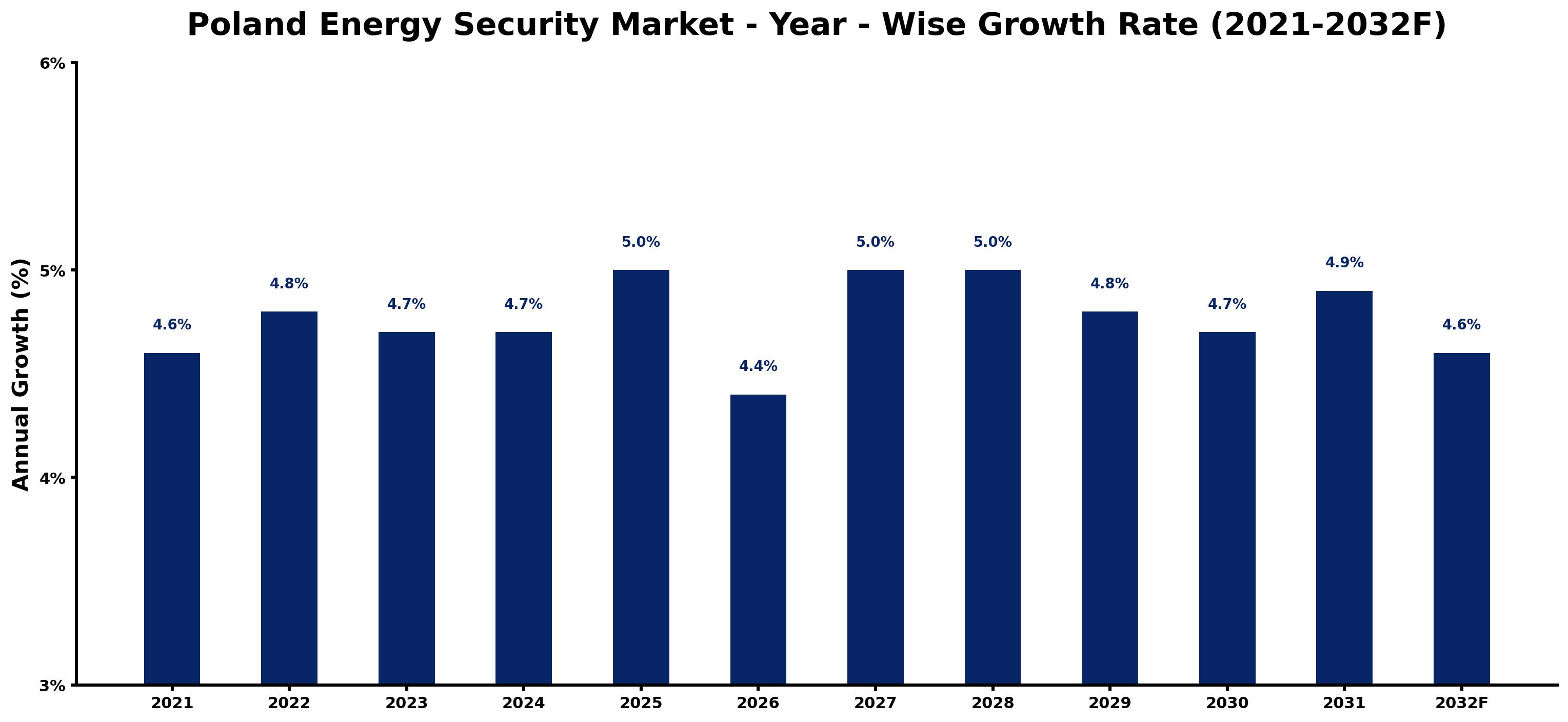
The table below presents the year‑wise growth rates along with the key drivers influencing the market
| Year | Growth Rate | Major Drivers |
| 2021 | 4.6% | Increased regulatory support for renewable energy investments. |
| 2022 | 4.8% | Government initiatives to reduce coal dependency accelerate transition. |
| 2023 | 4.7% | Local energy efficiency programs gaining traction among consumers. |
| 2024 | 4.7% | Growing public awareness on climate change drives demand. |
| 2025 | 5.0% | Incentives for energy diversification fostering new technologies. |
| 2026 | 4.4% | National energy security strategy emphasizes independence from imports. |
| 2027 | 5.0% | Investment in grid modernization supports renewable integration. |
| 2028 | 5.0% | Polish Energy Policy encourages technological innovation in sector. |
| 2029 | 4.8% | Aggressive targets for emission reductions boost sector investment. |
| 2030 | 4.7% | Regional cooperation on energy projects enhances market stability. |
| 2031 | 4.9% | Increased public funding for energy literacy programs nationally. |
| 2032 | 4.6% | Emerging hydrogen initiatives align with EU green policies. |
Note: Market size estimations and growth projections presented in this report are based on 6Wresearch's proprietary forecasting methodology, utilizing the latest available industry data, government publications, and primary research inputs.
Poland Energy Security Market Key Takeaways
Below are some of the specific key takeaways from the market, including:
- Transitioning from coal dependency to renewable energy sources is a primary focus.
- Cybersecurity measures are increasingly critical for protecting energy infrastructure.
- Investment in grid modernization is essential to enhance efficiency and reliability.
- Government policies strongly favor domestic energy production to reduce import reliance.
- Collaboration with international partners is crucial for strengthening energy supply security.
Evaluation of Restraints in Poland Energy Security Market
Despite the forward momentum, several restraints impede the Poland Energy Security Market. A persistent reliance on coal remains a significant barrier, exacerbated by both environmental regulations and market volatility. The aging energy infrastructure, coupled with a slow transition to renewables, poses challenges to achieving the desired energy independence. Without substantial investments in modernization and clean technology, Poland risks falling short of its energy security goals, which could hamper economic growth.
Poland Energy Security Market Trends
The push towards renewable energy is not just a trend; it's a necessity. Wind and solar power installations are accelerating, bolstered by EU regulations and financial incentives. There's also a marked shift toward digitalization in energy management, with smart grid technologies gaining traction. Additionally, heightened awareness of cybersecurity risks is prompting energy companies to invest in protective measures, ensuring operational resilience against potential threats.
Poland Energy Security Market Opportunities
The Poland Energy Security Market is ripe for investment, especially in renewable energy infrastructure. As the government promotes energy diversification, opportunities abound for projects centered around wind and solar energy. Energy storage solutions are gaining attention as well, as they are crucial for balancing supply and demand. The modernization of energy grids presents a fertile ground for technological innovation, potentially attracting both domestic and international investors.
Government Initiatives in the Poland Energy Security Market
Government policy plays a vital role in shaping the Poland Energy Security Market, driving initiatives aimed at enhancing domestic energy production and sustainability. Recent legislative actions reflect a commitment to improving infrastructure, reducing dependency on imports, and promoting renewable energy sources. With an eye on the future, these initiatives signal a proactive stance on energy resilience.
- A recently launched programme focuses on increasing the capacity of renewable energy sources, particularly wind and solar.
- Current investments are underway to modernize aging energy infrastructure and enhance grid reliability.
- A planned public initiative aims to promote local energy production through subsidies for domestic energy projects by 2027.
- Regulatory frameworks are being developed to ensure compliance with EU sustainability goals, with implementation expected by late 2025.
- An ongoing collaboration with international partners to share best practices in energy security is actively enhancing local capabilities.
Future Insights of the Poland Energy Security Market
As we look towards 2026-2032, the Poland Energy Security Market is expected to evolve significantly. A strategic shift towards renewable energy is anticipated to take center stage, supported by technological advancements and government policies aimed at achieving energy independence. Emerging technologies, particularly in energy storage and grid management, will also play a critical role in shaping a sustainable and secure energy future for Poland.
Poland Energy Security Market Latest Developments
In the last year, Poland has made notable strides in advancing its energy security initiatives. The commitment to enhancing renewable energy production and the modernization of existing infrastructure reflects a proactive approach to meeting both national and EU energy security objectives. As the country navigates through various initiatives, the direction of recent developments indicates a strong resolve to achieve greater energy independence.
- Launched in Q1 2025, a comprehensive programme aimed at bolstering wind energy capacity has entered its implementation phase.
- An ongoing infrastructure upgrade project is improving grid resilience, with completion expected in late 2025.
- A new partnership established in mid-2025 aims to enhance cybersecurity measures across energy utilities, currently in the rollout stage.
- Upcoming regulations focused on increasing transparency in energy billing are set to be introduced by early 2026.
- A planned initiative to promote energy efficiency through public awareness campaigns is expected to commence in 2026.
Poland Energy Security Market - Key Attractiveness of the Report
- 10 Years of Market Numbers
- Historical Data Starting from 2022 to 2025
- Base Year: 2025
- Forecast Data until 2032
- Key Performance Indicators Impacting the Market
- Major Upcoming Developments and Projects
Key Highlights of the Report:
- Poland Energy Security Market Outlook
- Market Size of Poland Energy Security Market, 2025
- Forecast of Poland Energy Security Market, 2032
- Historical Data and Forecast of Poland Energy Security Revenues & Volume for the Period 2022-2032F
- Poland Energy Security Market Trend Evolution
- Poland Energy Security Market Drivers and Challenges
- Poland Energy Security Price Trends
- Poland Energy Security Porter's Five Forces
- Poland Energy Security Industry Life Cycle
- Historical Data and Forecast of Poland Energy Security Market Revenues & Volume By Power Plants for the Period 2022-2032F
- Historical Data and Forecast of Poland Energy Security Market Revenues & Volume By Nuclear for the Period 2022-2032F
- Historical Data and Forecast of Poland Energy Security Market Revenues & Volume By Thermal for the Period 2022-2032F
- Historical Data and Forecast of Poland Energy Security Market Revenues & Volume By Hydro for the Period 2022-2032F
- Historical Data and Forecast of Poland Energy Security Market Revenues & Volume By Oil for the Period 2022-2032F
- Historical Data and Forecast of Poland Energy Security Market Revenues & Volume By Gas for the Period 2022-2032F
- Historical Data and Forecast of Poland Energy Security Market Revenues & Volume By Renewable Energy for the Period 2022-2032F
- Historical Data and Forecast of Poland Energy Security Market Revenues & Volume By Technologies for the Period 2022-2032F
- Historical Data and Forecast of Poland Energy Security Market Revenues & Volume By Physical for the Period 2022-2032F
- Historical Data and Forecast of Poland Energy Security Market Revenues & Volume By Network Security for the Period 2022-2032F
- Poland Energy Security Import Export Trade Statistics
- Market Opportunity Assessment By Power Plants
- Market Opportunity Assessment By Technologies
- Poland Energy Security Top Companies Market Share
- Poland Energy Security Competitive Benchmarking By Technical and Operational Parameters
- Poland Energy Security Company Profiles
- Poland Energy Security Key Strategic Recommendations






































