Poland Facility Management Market Size & Growth Rate (2026-2032)
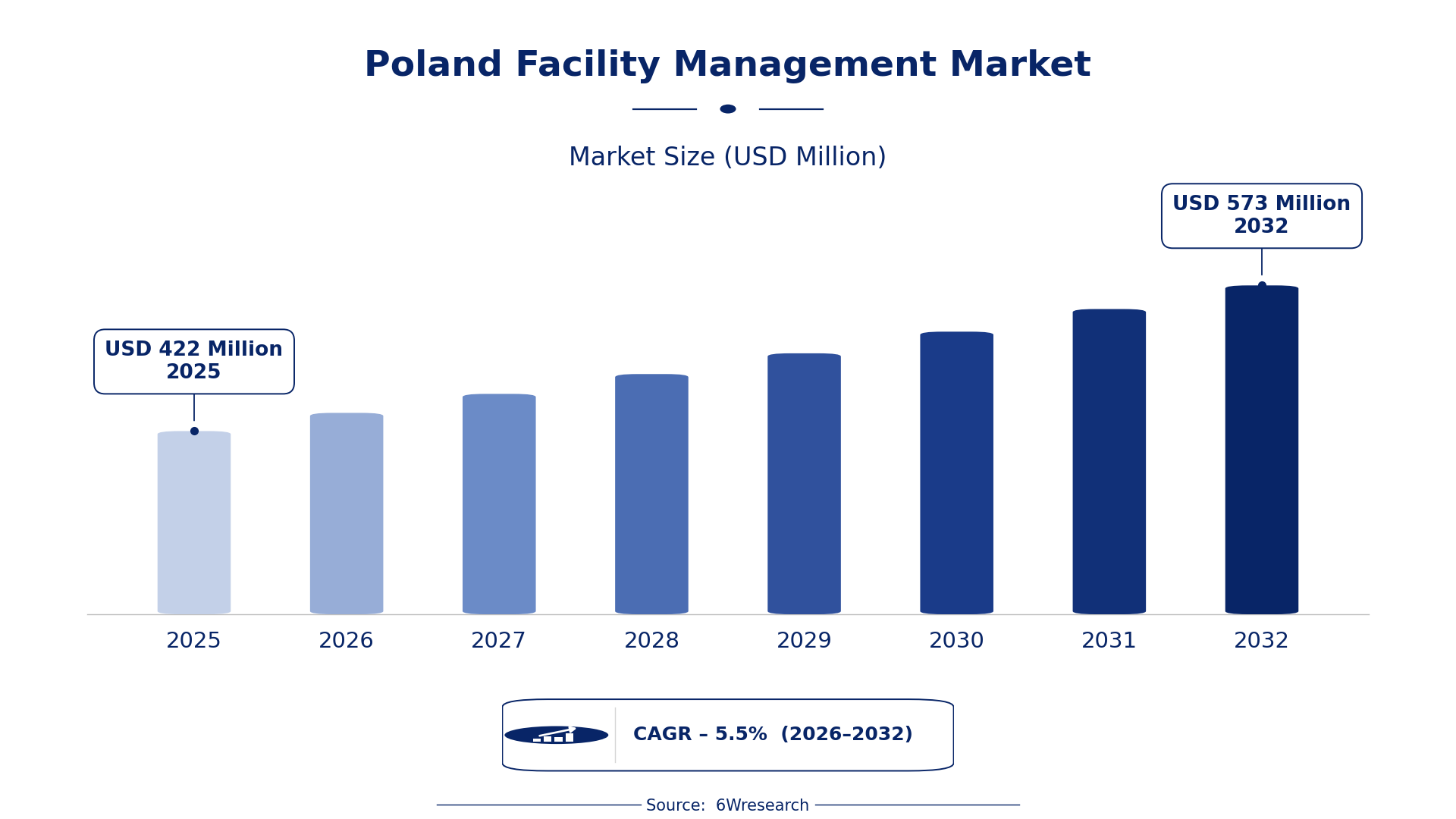
The Poland Facility Management Market was estimated at USD 422 Million in 2025 and is projected to reach USD 573 Million by 2032, growing at a CAGR of 5.5% from 2026 to 2032.
Poland Facility Management Market Synopsis
The primary force driving the Poland Facility Management Market is the increasing emphasis on cost efficiency and sustainability in building operations. Organizations are increasingly recognizing the value of outsourced facility management services, enabling them to focus on core activities while enhancing operational efficiency.
As businesses seek to adapt to a rapidly changing environment, technology adoption—especially IoT and data analytics—has become essential. This shift not only optimizes facility operations but also aligns with the growing demand for integrated services across various sectors, including commercial, industrial, and public domains.
Poland Facility Management Market Year-wise Growth Rate and Key Drivers
This graph illustrates the annual growth rates of the Poland Facility Management Market from 2021 to 2032, highlighting a steady upward trajectory and projected expansion over the forecast period.
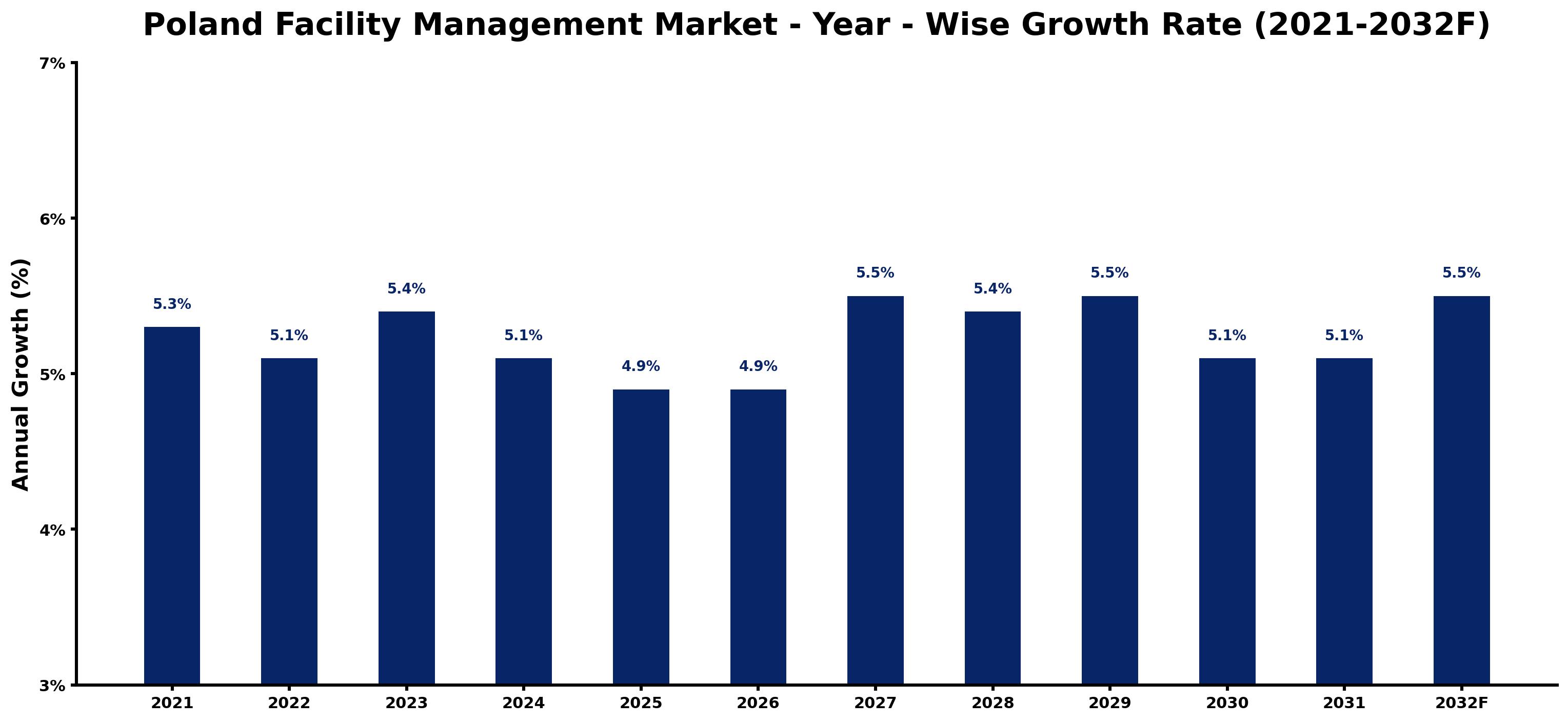
The table below presents the year‑wise growth rates along with the key drivers influencing the market
| Year | Growth Rate | Major Drivers |
| 2021 | 5.3% | Increased focus on health standards post-COVID-19 pandemic. |
| 2022 | 5.1% | Growing adoption of smart building technologies in urban areas. |
| 2023 | 5.4% | Government regulations mandating green certifications for facilities. |
| 2024 | 5.1% | Surge in demand for flexible workspace solutions post-pandemic. |
| 2025 | 4.9% | Rise in outsourcing of facilities services by SMEs. |
| 2026 | 4.9% | Investment in enhancing operational efficiency by large firms. |
| 2027 | 5.5% | Polish National Fund supporting modernization of facility services. |
| 2028 | 5.4% | Increased urbanization leading to higher facility management needs. |
| 2029 | 5.5% | Shift towards digital transformation in property management practices. |
| 2030 | 5.1% | Adoption of IoT solutions for proactive facility maintenance. |
| 2031 | 5.1% | Increased foreign investment boosting facilities management requirements. |
| 2032 | 5.5% | Continued emphasis on sustainability drives management innovations. |
Note: Market size estimations and growth projections presented in this report are based on 6Wresearch's proprietary forecasting methodology, utilizing the latest available industry data, government publications, and primary research inputs.
Poland Facility Management Market Key Takeaways
Below are some of the specific key takeaways from the market, including:
- The market is shifting towards integrated facility management solutions that enhance operational efficiency.
- Technological advancements are pivotal, particularly the integration of IoT and AI in facility management practices.
- Outsourcing facility management services is gaining traction as businesses aim to streamline operations.
- Environmental sustainability is becoming a key factor driving demand for energy-efficient solutions.
- Government regulations are increasingly influencing market dynamics, focusing on safety and sustainability standards.
Evaluation of Restraints in Poland Facility Management Market
While the Poland Facility Management Market is growing, it faces several restraints. The competitive landscape is intensifying as both local and international service providers vie for market share, leading to price pressures. Rising labor costs further complicate the situation, forcing companies to deliver high-quality services at competitive rates.
on top of that, the need to adapt to rapidly evolving technology and sustainability standards presents a significant challenge. The COVID-19 pandemic has also heightened the emphasis on health and safety, prompting facility management firms to enhance their protocols, which can strain resources and operational capacity.
Poland Facility Management Market Trends
The landscape of the Poland Facility Management Market is currently shaped by several noteworthy trends. A growing focus on integrated facility management solutions is emerging as organizations seek to optimize both operational efficiency and service delivery. Additionally, the adoption of advanced technologies such as IoT and AI is transforming traditional management practices, allowing for predictive maintenance and improved energy management.
Workplace wellness initiatives are gaining traction, driven by an increasing awareness of employee health and productivity. This trend is leading to a demand for services that promote healthier environments, such as enhanced air quality and ergonomic workplace design. on top of that, the push for sustainability in building operations is prompting organizations to invest in energy-efficient solutions that align with regulatory expectations and corporate social responsibility goals.
Poland Facility Management Market Opportunities
Opportunities in the Poland Facility Management Market are abundant, especially for companies ready to innovate. The demand for smart building technologies is rising, offering a lucrative avenue for businesses that provide cutting-edge solutions. Companies that specialize in energy efficiency and sustainability practices are well-positioned to capture a growing segment of the market, as organizations strive to meet environmental regulations and improve their carbon footprints.
As organizations increasingly outsource their facility management needs, there is a notable shift toward service providers that can offer comprehensive, integrated solutions. This presents a significant growth opportunity for firms willing to expand their service offerings and develop strategic partnerships with technology vendors.
Government Initiatives in the Poland Facility Management Market
Government policies are significantly shaping the Poland Facility Management Market. With a focus on enhancing safety, efficiency, and sustainability, regulatory frameworks are being established to govern building management practices. Compliance with building codes, energy efficiency standards, and occupational health requirements are critical components that influence service delivery and operational protocols in the sector.
- A national initiative launched in early 2025 aims to improve building safety compliance across various sectors.
- Currently underway is a comprehensive regulatory review process focusing on energy efficiency standards for public buildings.
- Upcoming legislation planned for 2026 is set to introduce stricter waste management practices in facility operations.
- Public-private partnerships are being encouraged to drive innovation in facility management services, with several proposals in development.
- Ongoing workshops and training programs initiated by the government aim to improve workforce skills in facility management.
Future Insights of the Poland Facility Management Market
Looking ahead to 2026-2032, the Poland Facility Management Market is expected to maintain a steady growth trajectory. The demand for cost-effective management solutions will persist across various sectors, including healthcare, education, and commercial real estate. As organizations increasingly adopt technology-driven solutions like IoT and AI, operational efficiency and service delivery will be enhanced.
The focus on sustainability and energy efficiency is also set to intensify, pushing facility management firms to innovate and offer eco-friendly solutions. As awareness of the benefits of effective facility management grows, businesses are likely to recognize the value of outsourcing these services to specialized providers, further driving market expansion.
Poland Facility Management Market Latest Developments
In the past year, the Poland Facility Management Market has seen considerable activity, with various developments indicating a shift towards more integrated and technology-driven solutions. The industry's response to the pandemic has spurred innovations aimed at enhancing health and safety within facilities, as well as promoting sustainability.
- A major technology vendor announced an ongoing initiative to implement AI-driven analytics for predictive maintenance across several facilities, initiated in Q1 2025.
- A leading regional operator launched a new service offering focused on energy management in mid-2025, aimed at optimizing energy consumption in commercial buildings.
- Plans for a comprehensive digital infrastructure upgrade are set to begin in late 2025, enhancing the operational capabilities of facility management services.
- An ongoing partnership between a facility management firm and a sustainability consultant aims to develop green building strategies, with early results expected by Q2 2026.
- A recently completed training program in early 2025 focused on upskilling facility managers in health and safety compliance, reflecting the industry's response to current demands.
Poland Facility Management Market - Key Attractiveness of the Report
- 10 Years of Market Numbers
- Historical Data Starting from 2022 to 2025
- Base Year: 2025
- Forecast Data until 2032
- Key Performance Indicators Impacting the Market
- Major Upcoming Developments and Projects
Key Highlights of the Report:
- Poland Facility Management Market Outlook
- Market Size of Poland Facility Management Market, 2025
- Forecast of Poland Facility Management Market, 2032
- Historical Data and Forecast of Poland Facility Management Revenues & Volume for the Period 2022-2032F
- Poland Facility Management Market Trend Evolution
- Poland Facility Management Market Drivers and Challenges
- Poland Facility Management Price Trends
- Poland Facility Management Porter's Five Forces
- Poland Facility Management Industry Life Cycle
- Historical Data and Forecast of Poland Facility Management Market Revenues & Volume By Component for the Period 2022-2032F
- Historical Data and Forecast of Poland Facility Management Market Revenues & Volume By Solutions for the Period 2022-2032F
- Historical Data and Forecast of Poland Facility Management Market Revenues & Volume By Services for the Period 2022-2032F
- Historical Data and Forecast of Poland Facility Management Market Revenues & Volume By Deployment Mode for the Period 2022-2032F
- Historical Data and Forecast of Poland Facility Management Market Revenues & Volume By Cloud for the Period 2022-2032F
- Historical Data and Forecast of Poland Facility Management Market Revenues & Volume By On-premises for the Period 2022-2032F
- Historical Data and Forecast of Poland Facility Management Market Revenues & Volume By Organization Size for the Period 2022-2032F
- Historical Data and Forecast of Poland Facility Management Market Revenues & Volume By Large enterprises for the Period 2022-2032F
- Historical Data and Forecast of Poland Facility Management Market Revenues & Volume By Small and medium-sized enterprises (SMEs) for the Period 2022-2032F
- Historical Data and Forecast of Poland Facility Management Market Revenues & Volume By Vertical for the Period 2022-2032F
- Historical Data and Forecast of Poland Facility Management Market Revenues & Volume By BFSI for the Period 2022-2032F
- Historical Data and Forecast of Poland Facility Management Market Revenues & Volume By IT and Telecom for the Period 2022-2032F
- Historical Data and Forecast of Poland Facility Management Market Revenues & Volume By Government and Public Administration for the Period 2022-2032F
- Historical Data and Forecast of Poland Facility Management Market Revenues & Volume By Healthcare for the Period 2022-2032F
- Historical Data and Forecast of Poland Facility Management Market Revenues & Volume By Education for the Period 2022-2032F
- Historical Data and Forecast of Poland Facility Management Market Revenues & Volume By Retail for the Period 2022-2032F
- Historical Data and Forecast of Poland Facility Management Market Revenues & Volume By Energy and Utilities for the Period 2022-2032F
- Historical Data and Forecast of Poland Facility Management Market Revenues & Volume By Manufacturing for the Period 2022-2032F
- Poland Facility Management Import Export Trade Statistics
- Market Opportunity Assessment By Component
- Market Opportunity Assessment By Deployment Mode
- Market Opportunity Assessment By Organization Size
- Market Opportunity Assessment By Vertical
- Poland Facility Management Top Companies Market Share
- Poland Facility Management Competitive Benchmarking By Technical and Operational Parameters
- Poland Facility Management Company Profiles
- Poland Facility Management Key Strategic Recommendations






































