Poland Flash Led Market Size, Share & Growth Rate
The Poland Flash Led Market was estimated at USD 1416 Million in 2025 and is projected to reach USD 2051 Million by 2032, growing at a CAGR of 5.4% from 2026 to 2032. This growth trajectory is primarily driven by the increasing integration of LED technology across diverse sectors such as automotive, consumer electronics, and advertising. Rising consumer demand for energy-efficient lighting solutions and the growing prevalence of smart technologies are also pivotal in propelling market expansion.
Poland Flash Led Market Year-wise Growth Rate and Key Drivers
This graph highlights how the Poland Flash Led Market has steadily grown over the years, supported by major growth factors.
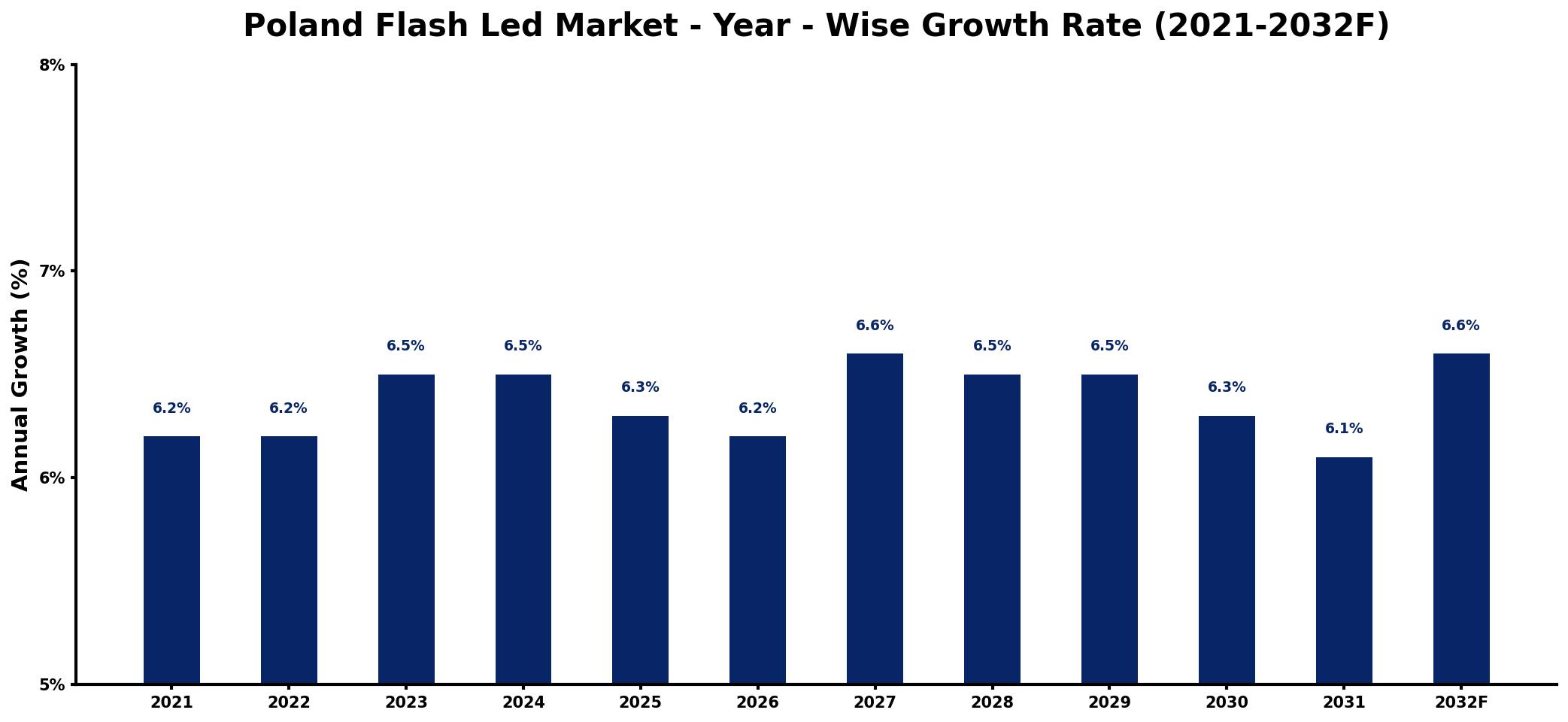
The table below presents the year‑wise growth rates along with the key drivers influencing the market
| Year | Growth Rate | Major Drivers |
| 2021 | 6.2% | Rising consumer electronics demand |
| 2022 | 6.2% | Increased investment in infrastructure |
| 2023 | 6.5% | Growing popularity of smart homes |
| 2024 | 6.5% | Expansion of renewable energy projects |
| 2025 | 6.3% | Surge in outdoor lighting applications |
| 2026 | 6.2% | Boost in energy efficiency regulations |
| 2027 | 6.6% | Growth in automotive lighting solutions |
| 2028 | 6.5% | Increased demand for sustainable products |
| 2029 | 6.5% | improved raw material availability |
| 2030 | 6.3% | Rise in domestic manufacturing capabilities |
| 2031 | 6.1% | Growing focus on smart cities |
| 2032 | 6.6% | strengthening international trade flows |
Note: Market size estimations and growth projections presented in this report are based on 6Wresearch's proprietary forecasting methodology, utilizing the latest available industry data, government publications, and primary research inputs.
Poland Flash Led Market Synopsis
The rising demand for high-brightness LEDs in automotive applications, particularly for headlights and taillights, is a key factor influencing the Poland Flash LED market. This uptick is complemented by the growing popularity of smartphones and personal electronics, which increasingly incorporate advanced flash LED technology.
Additionally, consumer awareness about the long lifespan and energy efficiency of LED products is fostering a shift from traditional lighting solutions. The market is witnessing a notable trend towards compact, portable flash LED products, responding to the needs for versatility in outdoor and emergency scenarios.
Poland Flash Led Market Key Takeaways
- The automotive sector is a critical driver for the growth of high-brightness LEDs.
- Smart lighting solutions are increasingly influencing consumer preferences in the market.
- Compact and rechargeable flash LED products are becoming more popular among consumers.
- Strong competition necessitates continuous innovation from companies within the sector.
- Investment opportunities are emerging due to government initiatives promoting sustainability.
Evaluation of Restraints in Poland Flash Led Market
Despite its promising growth, the Poland Flash LED market faces substantial challenges. Intense competition from local and international players can limit market share for emerging brands. Rapid technological advancements necessitate constant innovation, putting pressure on companies to frequently update their product lines. Furthermore, fluctuations in raw material prices can adversely affect profit margins, while compliance with stringent regulatory requirements complicates market entry for new entrants.
Poland Flash Led Market Trends
Current trends within the Poland Flash LED market reflect a growing consumer preference for energy-efficient and environmentally friendly lighting solutions. Smart lighting technology, including features like brightness adjustment and extended battery life, is increasingly sought after. Manufacturers are focusing on innovative designs tailored to meet the demands for portability and functionality, driven by the popularity of outdoor activities and emergency preparedness.
Poland Flash Led Market Opportunities
The market holds numerous opportunities for investment, particularly in the manufacturing and distribution of energy-efficient flash LED products. As government policies shift towards sustainability, there is a promising avenue for partnerships with public bodies to enhance market penetration. Research and development focused on new lighting solutions tailored for the Polish market can yield significant returns, especially as consumer awareness about LED technology benefits continues to rise.
Government Initiatives in the Poland Flash Led Market
The Polish government has implemented various policies to stimulate growth in the Flash LED market. These include tax incentives and subsidies aimed at encouraging R&D investments in LED technology. Additionally, regulatory measures to promote energy efficiency support the adoption of LED lighting solutions. The government also focuses on raising consumer awareness about the advantages of LED lights, which fosters greater demand for these products across the nation.
Future Insights of the Poland Flash Led Market
Looking ahead to 2026-2032, the Poland Flash LED market is poised for substantial growth, bolstered by ongoing technological advancements and increasing demand for energy-efficient lighting. Awareness of the environmental benefits associated with LED technology, alongside government support for sustainable practices, will further drive market expansion. The continual integration of smart features into LED products is likely to enhance consumer appeal and broaden application ranges across various sectors.
Poland Flash Led Market Latest Developments (2025 - 2026)
In recent months, the Poland Flash LED market has seen a surge in innovation, with manufacturers unveiling advanced lighting solutions that emphasize both performance and energy efficiency. The industry is increasingly focusing on sustainable practices, with several companies reporting developments in rechargeable LED technologies. Collaborative efforts with local governments aimed at promoting energy-efficient initiatives have also been on the rise, positioning companies to take advantage of new market opportunities.
Poland Flash Led Market - Key Attractiveness of the Report
- 10 Years of Market Numbers
- Historical Data Starting from 2022 to 2025
- Base Year: 2025
- Forecast Data until 2032
- Key Performance Indicators Impacting the Market
- Major Upcoming Developments and Projects
Key Highlights of the Report:
- Poland Flash Led Market Outlook
- Market Size of Poland Flash Led Market, 2025
- Forecast of Poland Flash Led Market, 2032
- Historical Data and Forecast of Poland Flash Led Revenues & Volume for the Period 2022-2032F
- Poland Flash Led Market Trend Evolution
- Poland Flash Led Market Drivers and Challenges
- Poland Flash Led Price Trends
- Poland Flash Led Porter's Five Forces
- Poland Flash Led Industry Life Cycle
- Historical Data and Forecast of Poland Flash Led Market Revenues & Volume By Power Consumption for the Period 2022-2032F
- Historical Data and Forecast of Poland Flash Led Market Revenues & Volume By Less than 1 A for the Period 2022-2032F
- Historical Data and Forecast of Poland Flash Led Market Revenues & Volume By More than or Equal to 1 A for the Period 2022-2032F
- Historical Data and Forecast of Poland Flash Led Market Revenues & Volume By Types for the Period 2022-2032F
- Historical Data and Forecast of Poland Flash Led Market Revenues & Volume By Smartphone for the Period 2022-2032F
- Historical Data and Forecast of Poland Flash Led Market Revenues & Volume By Feature phone for the Period 2022-2032F
- Historical Data and Forecast of Poland Flash Led Market Revenues & Volume By Other for the Period 2022-2032F
- Poland Flash Led Import Export Trade Statistics
- Market Opportunity Assessment By Power Consumption
- Market Opportunity Assessment By Types
- Poland Flash Led Top Companies Market Share
- Poland Flash Led Competitive Benchmarking By Technical and Operational Parameters
- Poland Flash Led Company Profiles
- Poland Flash Led Key Strategic Recommendations






































