Poland Kosher Food Market Size, Share & Growth Rate
The Poland Kosher Food Market was estimated at USD 942 Million in 2025 and is projected to reach USD 1347 Million by 2032, growing at a CAGR of 5.2% from 2026 to 2032. This impressive growth trajectory is propelled by a rising consumer awareness of dietary preferences and the increasing demand for kosher-certified products. Moreover, the expansion of retail channels and the foodservice sector is enhancing the availability of kosher options, capturing a diverse range of consumers beyond the strictly observant Jewish community.
Poland Kosher Food Market Year-wise Growth Rate and Key Drivers
This graph highlights how the Poland Kosher Food Market has steadily grown over the years, supported by major growth factors.
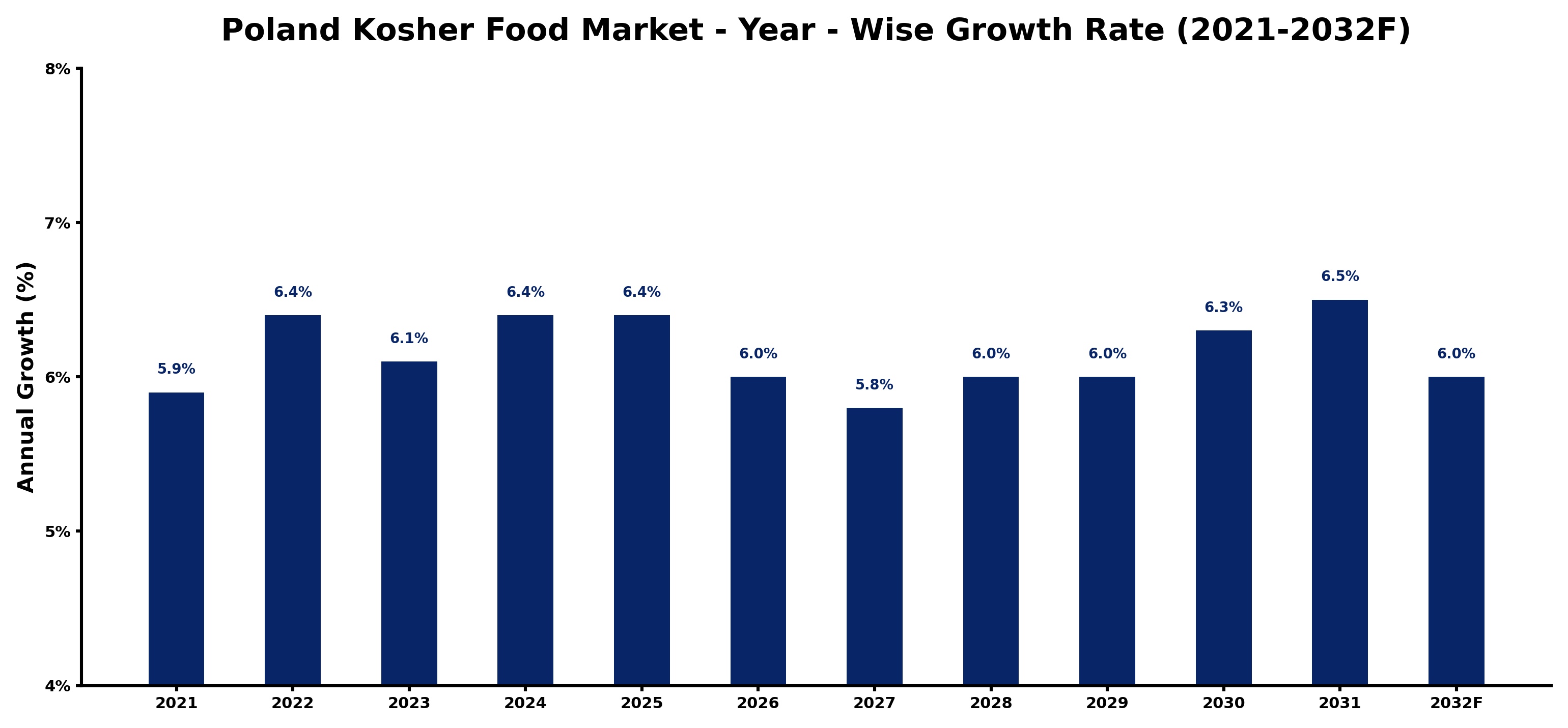
The table below presents the year‑wise growth rates along with the key drivers influencing the market
| Year | Growth Rate | Major Drivers |
| 2021 | 5.9% | Polish kosher food production scale up attracts international distribution partnerships |
| 2022 | 6.4% | Export driven demand surge boosts local kosher food processing capacity |
| 2023 | 6.1% | Automated kosher food processing lines boost production efficiency and output |
| 2024 | 6.4% | Technological advancements enhanced kosher certification processes and production efficiency |
| 2025 | 6.4% | Kosher food certification investments boost production line efficiency in Poland |
| 2026 | 6.0% | Improved processing capacity boosts output of certified kosher products |
| 2027 | 5.8% | Technology adoption in kosher food production streamlines processing efficiency |
| 2028 | 6.0% | Local manufacturers invest in high capacity kosher food production lines |
| 2029 | 6.0% | Kosher certification process improvements enhanced production line efficiency |
| 2030 | 6.3% | New manufacturing plants boost Poland's kosher food processing capacity |
| 2031 | 6.5% | Improved supply chain logistics boosted kosher food distribution efficiency |
| 2032 | 6.0% | Kosher certification demand drives local meat processing facility upgrades |
Note - Market size estimations and growth projections presented in this report are based on 6Wresearch’s advanced forecasting approach, validated with industry datasets as of June 2026.
Poland Kosher Food Market Synopsis
The Polish kosher food market has recently experienced significant momentum, primarily due to the growing acceptance and curiosity surrounding kosher dietary practices. This dynamic market is poised for substantial growth, fueled by an expanding customer base that includes both religious and secular consumers. Additionally, the increasing accessibility of kosher products in various retail and foodservice environments is likely to stimulate further demand.
As we look ahead, the market is set to continue its upward trajectory, benefiting from heightened consumer education and interest in health-conscious eating habits. The focus on transparency and adherence to dietary regulations will support ongoing growth, ensuring that the kosher food segment remains competitive amidst evolving consumer preferences and market dynamics.
Poland Kosher Food Market Key Takeaways
- The market is driven by both religious observance and a growing interest in kosher dietary practices among non-Jewish consumers.
- Increased availability of kosher products across retail and foodservice channels is enhancing consumer choice and driving sales.
- Poland's regulatory framework supports industry growth by emphasizing product quality and compliance with kosher certification standards.
- Competitive pressure from alternative food products remains a concern, necessitating ongoing innovation within the kosher sector.
- Consumer awareness regarding dietary preferences and health-related concerns is shaping product offerings and marketing strategies.
Evaluation of Restraints in Poland Kosher Food Market
The Poland Kosher Food Market faces several restraints that could hinder its overall growth. A primary concern is the challenge of maintaining kosher certification standards while managing production costs. The complexities involved in ensuring compliance with these stringent regulations can pose significant hurdles for producers, particularly smaller entities. Additionally, there is fierce competition from a variety of alternative food products that cater to similar consumer preferences. This competitive landscape requires kosher food manufacturers to continuously adapt to changing consumer demands while navigating regulatory requirements related to food safety and labeling.
Poland Kosher Food Market Trends
The Polish kosher food market is currently witnessing several notable trends. Notably, an increasing number of health-conscious consumers are gravitating towards kosher products, recognizing the perceived quality and safety associated with kosher certification. Plant-based and organic kosher options are gaining traction, reflecting broader trends in sustainable eating and health awareness. Furthermore, the rise of e-commerce has facilitated access to kosher products, allowing consumers to explore a diverse range of offerings from the comfort of their homes.
Poland Kosher Food Market Opportunities
Opportunities for growth within the Poland kosher food market are abundant. The expanding demographic of consumers interested in kosher products presents a lucrative target audience for retailers and manufacturers. Investing in innovative marketing strategies that highlight the quality and health benefits of kosher foods could attract new customers. Moreover, the ongoing integration of technology in food production and distribution can streamline processes, enhance product quality, and expand reach. Collaboration with restaurants and catering services to introduce kosher menus is another avenue for growth that could capitalize on rising consumer interest.
Government Initiatives in the Poland Kosher Food Market
The Polish government has implemented various initiatives to promote the kosher food market. Regulatory frameworks emphasize maintaining high standards of product quality while ensuring compliance with both religious and safety guidelines. Policies fostering transparency in kosher certification help build consumer confidence and trust in the market. Additionally, public spending aimed at enhancing food safety measures directly supports kosher food production, benefiting both manufacturers and consumers.
Future Insights of the Poland Kosher Food Market
Looking ahead to 2026-2032, the Poland kosher food market is poised for robust growth. Continued consumer interest in health and wellness, along with a growing appreciation for dietary diversity, will contribute to increasing demand. The successful navigation of competitive pressures and ongoing adaptation to consumer preferences will be crucial in sustaining market momentum. As retailers and manufacturers enhance their kosher offerings and leverage new technologies, the market is likely to expand in both size and significance within the broader food landscape.
Poland Kosher Food Market Latest Developments (May 2025 - June 2026)
In recent months, the Polish kosher food market has seen a noticeable increase in product innovation, with several brands introducing new kosher-certified items to cater to diverse dietary preferences. The rise of online platforms dedicated to kosher foods has also expanded access for consumers, particularly in urban areas. Collaborations between food manufacturers and retail outlets are becoming more common, enhancing visibility for kosher options and driving sales. As the market evolves, responsiveness to consumer feedback and trends remains essential for sustaining growth.
Poland Kosher Food Market - Key Attractiveness of the Report
- 10 Years of Market Numbers
- Historical Data Starting from 2022 to 2025
- Base Year: 2025
- Forecast Data until 2032
- Key Performance Indicators Impacting the Market
- Major Upcoming Developments and Projects
Key Highlights of the Report:
- Poland Kosher Food Market Outlook
- Market Size of Poland Kosher Food Market, 2025
- Forecast of Poland Kosher Food Market, 2032
- Historical Data and Forecast of Poland Kosher Food Revenues & Volume for the Period 2022-2032F
- Poland Kosher Food Market Trend Evolution
- Poland Kosher Food Market Drivers and Challenges
- Poland Kosher Food Price Trends
- Poland Kosher Food Porter's Five Forces
- Poland Kosher Food Industry Life Cycle
- Historical Data and Forecast of Poland Kosher Food Market Revenues & Volume By Type for the Period 2022-2032F
- Historical Data and Forecast of Poland Kosher Food Market Revenues & Volume By Meat for the Period 2022-2032F
- Historical Data and Forecast of Poland Kosher Food Market Revenues & Volume By Dairy for the Period 2022-2032F
- Historical Data and Forecast of Poland Kosher Food Market Revenues & Volume By Pareve for the Period 2022-2032F
- Historical Data and Forecast of Poland Kosher Food Market Revenues & Volume By Application for the Period 2022-2032F
- Historical Data and Forecast of Poland Kosher Food Market Revenues & Volume By Seafood for the Period 2022-2032F
- Historical Data and Forecast of Poland Kosher Food Market Revenues & Volume By Processed Meat and Poultry for the Period 2022-2032F
- Historical Data and Forecast of Poland Kosher Food Market Revenues & Volume By Beverages for the Period 2022-2032F
- Historical Data and Forecast of Poland Kosher Food Market Revenues & Volume By Staples for the Period 2022-2032F
- Historical Data and Forecast of Poland Kosher Food Market Revenues & Volume By Snacks & Savoury for the Period 2022-2032F
- Historical Data and Forecast of Poland Kosher Food Market Revenues & Volume By Bakery and Confectionery for the Period 2022-2032F
- Historical Data and Forecast of Poland Kosher Food Market Revenues & Volume By Others for the Period 2022-2032F
- Historical Data and Forecast of Poland Kosher Food Market Revenues & Volume By Distribution Channel for the Period 2022-2032F
- Historical Data and Forecast of Poland Kosher Food Market Revenues & Volume By Supermarkets and Hypermarkets for the Period 2022-2032F
- Historical Data and Forecast of Poland Kosher Food Market Revenues & Volume By Grocery Stores for the Period 2022-2032F
- Historical Data and Forecast of Poland Kosher Food Market Revenues & Volume By Online Stores for the Period 2022-2032F
- Poland Kosher Food Import Export Trade Statistics
- Market Opportunity Assessment By Type
- Market Opportunity Assessment By Application
- Market Opportunity Assessment By Distribution Channel
- Poland Kosher Food Top Companies Market Share
- Poland Kosher Food Competitive Benchmarking By Technical and Operational Parameters
- Poland Kosher Food Company Profiles
- Poland Kosher Food Key Strategic Recommendations






































