Poland Over the Top Market Size & Growth Rate (2026-2032)
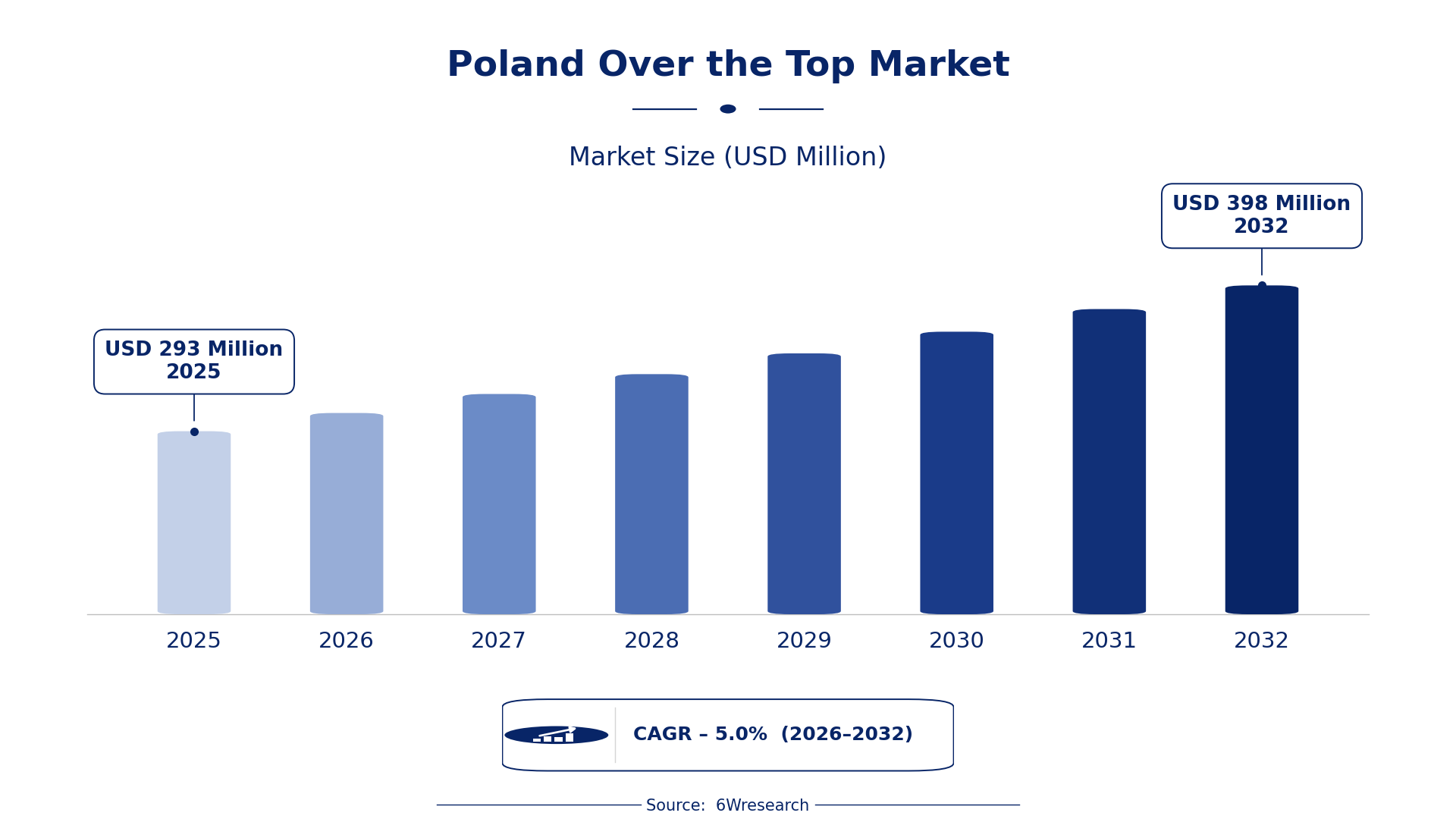
The Poland Over the Top Market was estimated at USD 293 Million in 2025 and is projected to reach USD 398 Million by 2032, growing at a CAGR of 5.0% from 2026 to 2032.
Poland Over the Top Market Synopsis
The primary force shaping the Poland Over the Top (OTT) market is the relentless demand for on-demand streaming content. With an increasing number of internet users and a growing preference for ad-free viewing experiences, platforms are racing to meet these evolving consumer expectations.
As competition intensifies, providers are not only expanding their content libraries but also innovating in delivery methods. The shift towards mobile consumption is significant; viewers are increasingly utilizing smartphones and tablets for streaming, compelling companies to invest in mobile-first technologies and high-quality offerings.
Poland Over the Top Market Year-wise Growth Rate and Key Drivers
This graph illustrates the annual growth rates of the Poland Over the Top Market from 2021 to 2032, highlighting a steady upward trajectory and projected expansion over the forecast period.
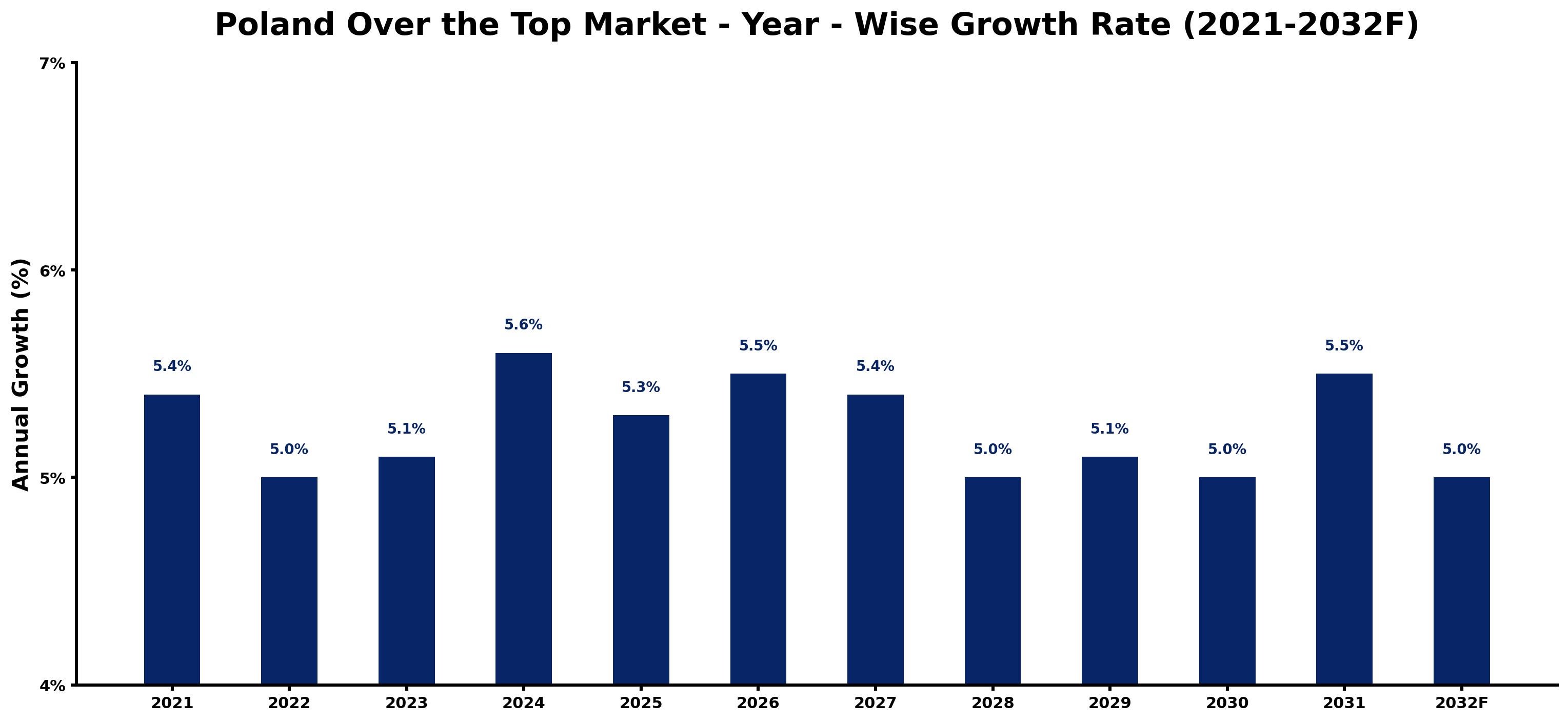
The table below presents the year‑wise growth rates along with the key drivers influencing the market
| Year | Growth Rate | Major Drivers |
| 2021 | 5.4% | Increased investments in local original content production. |
| 2022 | 5.0% | Rise of smart TVs boosting subscription service adoption. |
| 2023 | 5.1% | Government support for digital media literacy initiatives. |
| 2024 | 5.6% | Growing interest in esports streaming among Polish youth. |
| 2025 | 5.3% | Broadband penetration increasing access to OTT platforms. |
| 2026 | 5.5% | Emergence of local influencers driving viewer engagement. |
| 2027 | 5.4% | Partnerships with telecommunications firms enhancing distribution reach. |
| 2028 | 5.0% | Launch of exclusive content attracting new subscribers. |
| 2029 | 5.1% | Demographic shifts favoring binge-watching consumption habits. |
| 2030 | 5.0% | Adoption of cloud-based services improving content delivery. |
| 2031 | 5.5% | Regulatory support for broadcasting rights expansion. |
| 2032 | 5.0% | Increased competition fostering innovation in content offerings. |
Note: Market size estimations and growth projections presented in this report are based on 6Wresearch's proprietary forecasting methodology, utilizing the latest available industry data, government publications, and primary research inputs.
Poland Over the Top Market Key Takeaways
Below are some of the specific key takeaways from the market, including:
- The transition to subscription-based models is gaining momentum, as viewers prefer ad-free experiences.
- Local and international players are competing fiercely, driving innovation and diverse content offerings.
- Smart device adoption is fueling OTT service consumption across various demographics.
- Investment in original programming is increasing to cater to unique audience preferences.
- Advanced user experience features such as personalized recommendations are becoming essential for subscriber retention.
Evaluation of Restraints in Poland Over the Top Market
While growth prospects are favorable, the Poland OTT market grapples with key constraints. The saturation of service providers creates an intensely competitive environment, making it challenging for new entrants to gain a foothold. Regulatory hurdles, including compliance with local broadcasting standards, add layers of complexity that can stifle innovation and slow market entry. Furthermore, providers must address varying audience preferences, requiring finely-tuned content offerings. Issues surrounding internet infrastructure, especially in less urbanized regions, can also detract from service quality, limiting the reach of OTT solutions. These factors necessitate strategic navigation to thrive in this crowded marketplace.
Poland Over the Top Market Trends
Several trends are currently influencing the Poland OTT market. The surge in video streaming subscriptions continues as platforms such as Netflix and HBO GO capitalize on consumer demand for varied content. A notable shift towards mobile viewing highlights the necessity for services to optimize apps for smaller screens, making content more accessible.
Additionally, the focus on original content production is escalating, with local narratives being prioritized to cater to domestic viewers. As users seek personalized viewing experiences, companies are investing heavily in technology that facilitates recommendations and tailored content. All of these trends underscore the evolving nature of how consumers engage with digital entertainment in Poland.
Poland Over the Top Market Opportunities
The Poland OTT market holds considerable opportunities for both existing players and newcomers. With the rising internet user base, there’s a vast potential for subscription growth, particularly in underserved areas. Content creation is an area ripe for investment, as original programming increasingly resonates with Polish audiences. Furthermore, technology investments that enhance user experience, such as machine learning for content recommendation and data analytics, could provide competitive advantages. Partnerships with local media outlets could also facilitate content distribution and increase visibility. Investors should closely monitor these segments for potential returns in the burgeoning OTT landscape.
Government Initiatives in the Poland Over the Top Market
Government policies significantly impact the Poland OTT market, balancing traditional broadcasting interests with the demands of emerging OTT providers. The National Broadcasting Council (KRRiT) enforces regulations that ensure compliance with advertising standards and content accessibility. Recent initiatives aim to promote digital innovation while fostering a diverse media environment.
- A new regulatory framework introduced in 2025 requires OTT services to enhance advertising transparency and user accessibility standards.
- A national digital infrastructure upgrade program, currently underway, is expected to improve internet connectivity in rural areas, benefitting OTT providers.
- In 2026, the government plans to launch funding programs aimed at supporting local content production to boost the domestic media landscape.
- The Audiovisual Media Services Directive (AVMSD), implemented recently, mandates a level playing field between traditional and OTT platforms.
- Ongoing discussions are taking place regarding potential reforms to adapt licensing processes for new market entrants.
Future Insights of the Poland Over the Top Market
Looking ahead to 2026-2032, the Poland OTT market is set to grow steadily as consumer behavior continues to evolve. A higher penetration of smart devices will likely drive further adoption of streaming services. As demand for localized content increases, both local and global players will need to innovate rapidly to meet diverse preferences.
Investment in technology to enhance user experience will be essential for sustaining growth. The market's adaptability to changing regulatory environments and consumer demands will be vital for long-term success. These dynamics indicate a vibrant future for OTT services in Poland, ripe with potential.
Poland Over the Top Market Latest Developments
The past year has been marked by notable developments in the Poland OTT market, reflecting a heightened focus on content quality and user engagement. Providers are responding to the competitive pressure with innovative solutions that enhance the viewing experience.
- A major regional player launched a new subscription plan in early 2025, offering exclusive access to popular local shows and films.
- An ongoing initiative began in mid-2025, focused on expanding broadband internet access to rural communities, which is critical for increasing OTT consumption.
- A service upgrade to enhance streaming quality across devices was successfully completed by late 2025, resulting in improved customer satisfaction rates.
- By mid-2026, a new collaborative platform between various OTT providers is expected to enhance content sharing and cross-promotion.
- A technology vendor is preparing to launch a personalization engine in late 2025, aiming to provide tailored content suggestions to users based on viewing habits.
Poland Over the Top Market - Key Attractiveness of the Report
- 10 Years of Market Numbers
- Historical Data Starting from 2022 to 2025
- Base Year: 2025
- Forecast Data until 2032
- Key Performance Indicators Impacting the Market
- Major Upcoming Developments and Projects
Key Highlights of the Report:
- Poland Over the Top Market Outlook
- Market Size of Poland Over the Top Market, 2025
- Forecast of Poland Over the Top Market, 2032
- Historical Data and Forecast of Poland Over the Top Revenues & Volume for the Period 2022-2032F
- Poland Over the Top Market Trend Evolution
- Poland Over the Top Market Drivers and Challenges
- Poland Over the Top Price Trends
- Poland Over the Top Porter's Five Forces
- Poland Over the Top Industry Life Cycle
- Historical Data and Forecast of Poland Over the Top Market Revenues & Volume By Type for the Period 2022-2032F
- Historical Data and Forecast of Poland Over the Top Market Revenues & Volume By Game Streaming for the Period 2022-2032F
- Historical Data and Forecast of Poland Over the Top Market Revenues & Volume By Audio Streaming for the Period 2022-2032F
- Historical Data and Forecast of Poland Over the Top Market Revenues & Volume By Video Streaming for the Period 2022-2032F
- Historical Data and Forecast of Poland Over the Top Market Revenues & Volume By Communication for the Period 2022-2032F
- Historical Data and Forecast of Poland Over the Top Market Revenues & Volume By Monetization Model for the Period 2022-2032F
- Historical Data and Forecast of Poland Over the Top Market Revenues & Volume By Subscription-based for the Period 2022-2032F
- Historical Data and Forecast of Poland Over the Top Market Revenues & Volume By Advertising-based for the Period 2022-2032F
- Historical Data and Forecast of Poland Over the Top Market Revenues & Volume By Transaction-based for the Period 2022-2032F
- Historical Data and Forecast of Poland Over the Top Market Revenues & Volume By Streaming Device for the Period 2022-2032F
- Historical Data and Forecast of Poland Over the Top Market Revenues & Volume By Smartphones and Tablets for the Period 2022-2032F
- Historical Data and Forecast of Poland Over the Top Market Revenues & Volume By Desktops and Laptops for the Period 2022-2032F
- Historical Data and Forecast of Poland Over the Top Market Revenues & Volume By IPTV and Consoles for the Period 2022-2032F
- Historical Data and Forecast of Poland Over the Top Market Revenues & Volume By Vertical for the Period 2022-2032F
- Historical Data and Forecast of Poland Over the Top Market Revenues & Volume By Media and Entertainment for the Period 2022-2032F
- Historical Data and Forecast of Poland Over the Top Market Revenues & Volume By Education and Learning for the Period 2022-2032F
- Historical Data and Forecast of Poland Over the Top Market Revenues & Volume By Gaming for the Period 2022-2032F
- Historical Data and Forecast of Poland Over the Top Market Revenues & Volume By Service Utilities for the Period 2022-2032F
- Poland Over the Top Import Export Trade Statistics
- Market Opportunity Assessment By Type
- Market Opportunity Assessment By Monetization Model
- Market Opportunity Assessment By Streaming Device
- Market Opportunity Assessment By Vertical
- Poland Over the Top Top Companies Market Share
- Poland Over the Top Competitive Benchmarking By Technical and Operational Parameters
- Poland Over the Top Company Profiles
- Poland Over the Top Key Strategic Recommendations






































