Poland Printed Electronics Market Size, Share & Growth Rate
The Poland Printed Electronics Market was estimated at USD 347 Million in 2025 and is projected to reach USD 482 Million by 2032, growing at a CAGR of 4.8% from 2026 to 2032. This growth trajectory is primarily driven by advancements in printing technologies that enable the production of flexible and cost-effective electronic components. Additionally, the increasing demand for innovative applications in consumer electronics, wearable technology, and smart devices significantly contributes to the market's robust expansion.
Poland Printed Electronics Market Year-wise Growth Rate and Key Drivers
This graph highlights how the Poland Printed Electronics Market has steadily grown over the years, supported by major growth factors.
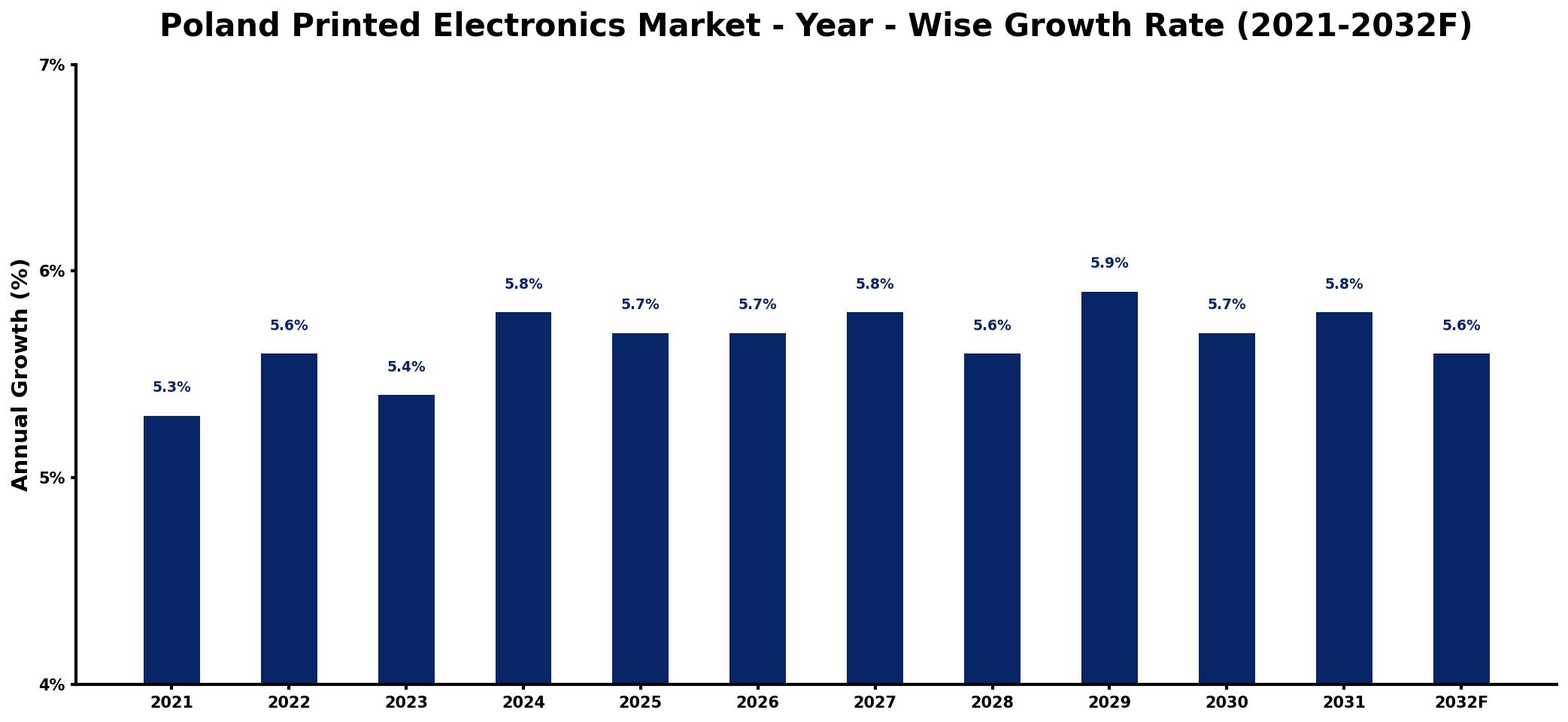
The table below presents the year‑wise growth rates along with the key drivers influencing the market
| Year | Growth Rate | Major Drivers |
| 2021 | 5.3% | Rising demand for innovative solutions |
| 2022 | 5.6% | Increased investments in technology startups |
| 2023 | 5.4% | Expansion of renewable energy initiatives |
| 2024 | 5.8% | Growing interest in smart packaging |
| 2025 | 5.7% | Development of wearable health devices |
| 2026 | 5.7% | Surge in automotive sector applications |
| 2027 | 5.8% | Enhanced funding for research projects |
| 2028 | 5.6% | Adoption of IoT in manufacturing |
| 2029 | 5.9% | Emergence of sustainable material trends |
| 2030 | 5.7% | rising procurement volume requirements |
| 2031 | 5.8% | Collaboration between tech companies |
| 2032 | 5.6% | Proliferation of smart home products |
Note: Market size estimations and growth projections presented in this report are based on 6Wresearch's proprietary forecasting methodology, utilizing the latest available industry data, government publications, and primary research inputs.
Poland Printed Electronics Market Synopsis
The demand for printed electronics in Poland is gaining momentum, particularly due to their application in sensors and displays across various industries. As enterprises seek to enhance functionality while minimizing production costs, the integration of printed electronics becomes increasingly appealing.
Moreover, the growth of the automotive sector in Poland, with a focus on smart vehicles and connectivity, presents significant opportunities for printed electronic components. The synergy between innovation in printing processes and rising consumer expectations fuels the market's growth potential.
Poland Printed Electronics Market Key Takeaways
- The market is expected to thrive on the back of innovations in printing technologies.
- Consumer demand for flexible, lightweight electronic solutions is escalating.
- Automotive applications are emerging as key growth drivers in the printed electronics sector.
- Government initiatives are fostering R&D, thereby supporting market expansion.
- Challenges remain with production costs and competition from traditional manufacturing methods.
Evaluation of Restraints in Poland Printed Electronics Market
Despite the promising growth outlook for the Poland Printed Electronics Market, several restraints could hinder progress. High production costs remain a significant concern, as they often limit the feasibility of printed electronic products compared to established traditional manufacturing methods. Furthermore, the market faces challenges related to the integration of these advanced technologies into mainstream applications. Technical limitations, particularly regarding performance reliability and durability, must be addressed to facilitate broader adoption. Without concerted efforts to lower costs and improve technology, the market could see slowed growth in the coming years.
Poland Printed Electronics Market Trends
Currently, one notable trend in the Poland Printed Electronics Market is the increasing emphasis on sustainability. Companies are pursuing environmentally friendly materials and processes, aligning with global trends towards greener manufacturing. Additionally, the development of advanced hybrid technologies, which combine printed electronics with traditional components, is gaining traction, providing a versatile approach to product development.
Emerging applications such as printed batteries and smart textiles are also redefining market dynamics. These innovations are crucial in catering to the evolving demands of consumers who seek more integrated, user-friendly electronic solutions that fit into their daily lives seamlessly.
Poland Printed Electronics Market Opportunities
The Poland Printed Electronics Market is poised for substantial growth opportunities, particularly in the medical and healthcare sectors. The demand for flexible sensors that can monitor vital signs or enhance diagnostics presents a lucrative avenue for investment. Moreover, as the Internet of Things (IoT) continues to expand, the need for more integrated and flexible electronic solutions will likely drive significant demand for printed electronics. Companies focusing on R&D and creating strategic partnerships could capitalize on these opportunities to gain a competitive advantage.
Government Initiatives in the Poland Printed Electronics Market
Government policies in Poland are playing a crucial role in fostering advancements in the printed electronics market. Various national initiatives are geared towards promoting research and development, encouraging collaborations between academia and industry. Furthermore, public spending aimed at enhancing technological infrastructures supports companies engaged in printed electronics, facilitating innovation and competitiveness. By prioritizing electronic manufacturing advancements, the Polish government is creating an environment conducive to market growth.
Future Insights of the Poland Printed Electronics Market
Looking ahead to the 2026-2032 period, the Poland Printed Electronics Market is expected to evolve significantly. The ongoing integration of printed electronics in consumer products and smart applications will drive continuous growth. Technological innovations, especially in materials science, will likely yield new opportunities for performance enhancements and cost reductions. Additionally, as Poland positions itself as a hub for technology development in Europe, collaborations within the EU could further boost the market's potential, laying the foundation for a vibrant electronic manufacturing landscape.
Poland Printed Electronics Market Latest Developments (2025 - 2026)
Recent developments in the Poland Printed Electronics Market have focused on enhancing production capabilities and expanding applications. Key industry players are increasingly investing in new technologies that reduce costs while improving the efficiency of printed electronics. Furthermore, collaborations between research institutions and companies have yielded promising innovations, particularly in the automotive and healthcare sectors. The market is witnessing a growing interest in developing flexible electronics that seamlessly integrate into everyday devices, reflecting a trend towards more interconnected technology solutions.
Poland Printed Electronics Market - Key Attractiveness of the Report
- 10 Years of Market Numbers
- Historical Data Starting from 2022 to 2025
- Base Year: 2025
- Forecast Data until 2032
- Key Performance Indicators Impacting the Market
- Major Upcoming Developments and Projects
Key Highlights of the Report:
- Poland Printed Electronics Market Outlook
- Market Size of Poland Printed Electronics Market, 2025
- Forecast of Poland Printed Electronics Market, 2032
- Historical Data and Forecast of Poland Printed Electronics Revenues & Volume for the Period 2022-2032F
- Poland Printed Electronics Market Trend Evolution
- Poland Printed Electronics Market Drivers and Challenges
- Poland Printed Electronics Price Trends
- Poland Printed Electronics Porter's Five Forces
- Poland Printed Electronics Industry Life Cycle
- Historical Data and Forecast of Poland Printed Electronics Market Revenues & Volume By Material for the Period 2022-2032F
- Historical Data and Forecast of Poland Printed Electronics Market Revenues & Volume By Ink for the Period 2022-2032F
- Historical Data and Forecast of Poland Printed Electronics Market Revenues & Volume By Substrate for the Period 2022-2032F
- Historical Data and Forecast of Poland Printed Electronics Market Revenues & Volume By Technology for the Period 2022-2032F
- Historical Data and Forecast of Poland Printed Electronics Market Revenues & Volume By Screen for the Period 2022-2032F
- Historical Data and Forecast of Poland Printed Electronics Market Revenues & Volume By Inkjet for the Period 2022-2032F
- Historical Data and Forecast of Poland Printed Electronics Market Revenues & Volume By Flexographic for the Period 2022-2032F
- Historical Data and Forecast of Poland Printed Electronics Market Revenues & Volume By Gravure for the Period 2022-2032F
- Historical Data and Forecast of Poland Printed Electronics Market Revenues & Volume By Device for the Period 2022-2032F
- Historical Data and Forecast of Poland Printed Electronics Market Revenues & Volume By Displays for the Period 2022-2032F
- Historical Data and Forecast of Poland Printed Electronics Market Revenues & Volume By Photovoltaic for the Period 2022-2032F
- Historical Data and Forecast of Poland Printed Electronics Market Revenues & Volume By Lighting for the Period 2022-2032F
- Historical Data and Forecast of Poland Printed Electronics Market Revenues & Volume By RFID for the Period 2022-2032F
- Historical Data and Forecast of Poland Printed Electronics Market Revenues & Volume By Others for the Period 2022-2032F
- Poland Printed Electronics Import Export Trade Statistics
- Market Opportunity Assessment By Material
- Market Opportunity Assessment By Technology
- Market Opportunity Assessment By Device
- Poland Printed Electronics Top Companies Market Share
- Poland Printed Electronics Competitive Benchmarking By Technical and Operational Parameters
- Poland Printed Electronics Company Profiles
- Poland Printed Electronics Key Strategic Recommendations






































