Qatar ADBLUE Market (2026-2032) | Industry, Segmentation, Trends, Analysis, Share, Size & Revenue, Competitive Landscape, Outlook, Companies, Growth, Value, Forecast
Market Forecast By Storage Solution (Bulk Storage Tanks, Dispensers, Portable Containers, Other Storage Solutions), By Application (Commercial Vehicles, Passenger Cars, Railway Trains, Non-Road Mobile Machinery) And Competitive Landscape
| Product Code: ETC8898443 | Publication Date: Sep 2024 | Updated Date: Sep 2026 | Product Type: Market Research Report | |
| Publisher: 6Wresearch | Author: Sumit Sagar | No. of Pages: 70 | No. of Figures: 35 | No. of Tables: 5 |
Qatar ADBLUE Market Growth Rate
According to 6Wresearch internal databases and industry insights, the Qatar ADBLUE Market is projected to grow at an estimated compound annual growth rate (CAGR) of 4.36% during the forecast period 2026–2032.
Qatar ADBLUE Market Year-wise Growth Rate and Key Drivers (2022–2032)
This graph illustrates the annual growth rates of the Qatar ADBLUE Market from 2022 to 2032, highlighting a steady upward trajectory and projected market expansion over the forecast period.
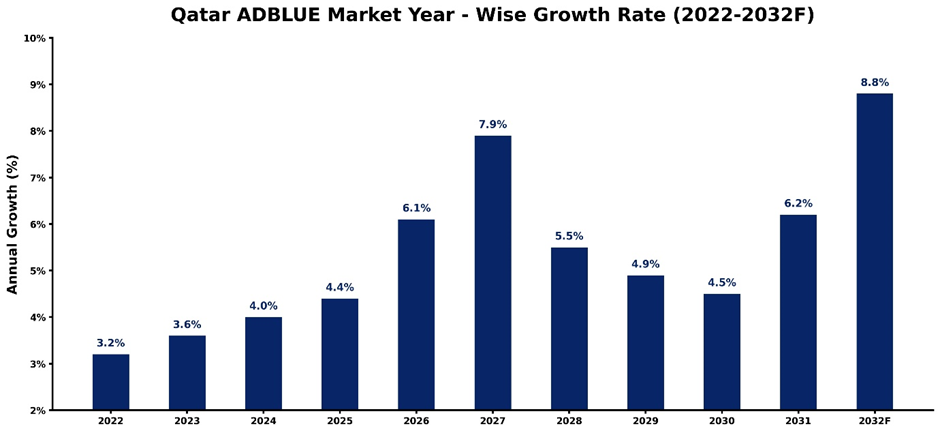
The following table presents the estimated annual growth rates of the market for each year, along with the key factors influencing market performance during the respective period. The values are intended to highlight year-wise drivers rather than provide a direct comparison between individual years.
| Year | Estimated Growth (%) | Market Rationale |
| 2022 | 3.2% | ADBLUE demand remained concentrated among modern diesel fleets and early SCR-equipped commercial vehicles. |
| 2023 | 3.7% | Qatar's move toward Euro 5-equivalent clean diesel for imported buses and trucks strengthened the market environment for advanced emission-control systems. |
| 2024 | 4% | Increasing availability of ADBLUE products and greater awareness among fleet operators supported market development. |
| 2025 | 5.8% | Commercial fleet modernization and wider access to bulk ADBLUE supply contributed to stronger recurring consumption. |
| 2026 | 3.9% | Continued introduction of SCR-equipped commercial vehicles is expected to increase demand for emission-control consumables. |
| 2027 | 3.6% | Fleet operators are expected to increase planned ADBLUE procurement as SCR-equipped vehicles become a larger part of replacement fleets. |
| 2028 | 4.5% | Greater use of bulk storage and dedicated dispensing infrastructure should improve accessibility for high-volume customers. |
| 2029 | 8.5% | Growth in freight movement and high-utilization commercial fleets is expected to sustain recurring ADBLUE consumption. |
| 2030 | 5.4% | Cleaner transport policies and continued operation of diesel heavy-duty vehicles support market expansion. |
| 2031 | 6.4% | Commercial vehicle replacement and increasing SCR penetration maintain demand despite growing electrification. |
| 2032 | 7.9% | A mature SCR-equipped commercial fleet and established ADBLUE distribution network are expected to support continued growth. |
Topics Covered in the Qatar ADBLUE Market Report
The Qatar ADBLUE Market Report provides a comprehensive analysis based on storage solution and application. It offers detailed insights into key industry trends, growth drivers, emerging opportunities, competitive developments, and high-growth segments. The report presents an objective assessment of current dynamics and future prospects, enabling stakeholders to make informed business decisions and develop effective strategies aligned with the evolving industry landscape.
Taiwan Abalone Market Highlights
| Report Name | Qatar ADBLUE Market |
| Forecast period | 2026-2032 |
| CAGR | 4.36% |
| Growing Sector | Construction |
Qatar ADBLUE Market Synopsis
The Qatar ADBLUE Market is projected to expand at a measured pace during 2026–2032. ADBLUE is an aqueous urea solution used in Selective Catalytic Reduction (SCR) systems of compatible diesel vehicles, where it helps convert nitrogen oxides (NOx) in exhaust gases into nitrogen and water, thereby supporting compliance with stringent vehicle-emission requirements. Industry demand in Qatar is primarily driven by commercial vehicle fleet modernization, Euro 5-equivalent diesel requirements for imported buses and trucks, rising deployment of SCR-equipped vehicles, and the development of dedicated ADBLUE refilling infrastructure.
Evaluation of Growth Drivers in Qatar ADBLUE Market (2026–2032)
Below are some major drivers and their influence on the market dynamics:
| Drivers | Primary Segment Affected | Why It Matters (Evidence) |
| Euro 5-equivalent diesel requirements | Commercial Vehicles | Cleaner diesel requirements for imported buses and trucks encourage the introduction of newer emission-control technologies. |
| Increasing SCR-equipped fleet | Commercial Vehicles | SCR-equipped diesel vehicles require ADBLUE as part of their emissions-control operation. |
| Domestic ADBLUE availability | Bulk Storage Tanks | Local suppliers improve product accessibility and support larger fleet purchases. |
| Expansion of fleet dispensing | Bulk Storage Tanks | Dedicated dispensing reduces refueling downtime and makes high-volume ADBLUE management more efficient. |
| Freight and logistics activity | Commercial Vehicles | Heavy-duty fleets operate for long periods and generate recurring ADBLUE demand. |
| Environmental objectives | Commercial Vehicles | Qatar's broader environmental agenda encourages lower-emission transportation technologies. |
The Qatar ADBLUE Market is projected to grow at a compound annual growth rate (CAGR) of 4.36% during 2026–2032. The most crucial growth factor is the transformation of Qatar's commercial diesel fleet, while The Ministry of Transport announced a policy needing Euro 5-equivalent clean diesel for imported buses and trucks, creating a robust functioning environment for newer diesel vehicles and advanced exhaust-treatment technologies. The second major factor is the attainability of domestic ADBLUE products, and it is particularly important for fleet operators as reliable access to the fluid is crucial for uninterrupted SCR-equipped vehicle operation. Qatar has maintained a growing heavy-vehicle fleet, with commercial vehicles showcasing a major portion of diesel consumption, while the global SCR (Selective Catalytic Reduction) vehicle fleet is expected to surpass 100 million units by 2030, promoting long-term demand for ADBLUE/DEF solutions.
Evaluation of Restraints in Qatar ADBLUE Market
Below are some major restraints and their influence on market dynamics:
| Restraints | Primary Segment Affected | What This Means (Evidence) |
| Increasing electrification | Commercial Vehicles | Battery-electric vehicles do not require ADBLUE, reducing the future diesel addressable market. |
| Limited SCR adoption in older vehicles | Commercial Vehicles | Legacy diesel vehicles without SCR technology do not consume ADBLUE. |
| Storage sensitivity | Bulk Storage Tanks | Dedicated dispensing reduces refueling downtime. |
| Product contamination risk | Portable Containers | Contaminated or off-specification fluid can cause SCR-system problems. |
| Lower consumption from private users | Passenger Cars | Passenger vehicles generally have lower utilization and therefore lower recurring ADBLUE demand. |
Qatar ADBLUE Market Challenges
The Qatar ADBLUE Industry faces various challenges related to fleet technology changes, supply-chain management and product quality. The industry is highly dependent on the installed base of SCR-equipped diesel vehicles, meaning that changes in vehicle propulsion technology directly affect future consumption. The country's hot climate also makes storage management important, while fleet operators and distributors need appropriate storage facilities, clean dispensing equipment and appropriate inventory rotation. At the same time, suppliers must sustain product specifications throughout transportation and storage. Globally, more than 40 million commercial vehicles are equipped with SCR technology, rising reliability of AdBlue/DEF availability and proper storage infrastructure. The global diesel vehicle fleet exceeds 1 billion units, with heavy-duty commercial vehicles showcasing a major application area for SCR technology, making sustained demand for AdBlue/DEF supply, storage, and distribution infrastructure.
Qatar ADBLUE Market Trends
Key developments impacting the Qatar ADBLUE Market Growth are highlighted below:
- Rising focus on product quality: ISO 22241-compliant ADBLUE is becoming crucial for fleet operators wanting to protect SCR equipment and sustain dependable emissions performance.
- Local supply development: The attainability of ADBLUE is increasing owing to Qatar-based producers and distributors and it helps in augmenting supply continuity.
- Rising coexistence of diesel and electric fleets: ADBLUE needs are expected to be increasing in heavy-duty applications even while passenger and public transportation progressively become more electrified.
Investment Opportunities in the Qatar ADBLUE Market
Potential investment opportunities in the Qatar ADBLUE Market include the following:
- Bulk storage infrastructure: Fund allocation in large tanks and IBC-based systems can address the needs of logistics and industrial fleets with high recurring consumption.
- Fleet ADBLUE dispensing sites: Automated or dedicated ADBLUE dispensers can add value by reducing replenishment times and by enhancing inventory management.
- Long-term commercial supply agreements: Fleet-based contracts can give stable recurring demand and decrease exposure to fluctuations in retail sales.
Top Players in Qatar ADBLUE Market
A list of leading companies involved in the Qatar ADBLUE Market is presented below:
1. Shell
| Company Name | Shell |
|---|---|
| Established Year | 1907 |
| Headquarters | London, United Kingdom |
| Official Website | Click Here |
Shell is a leading global energy and lubricants company with a portfolio that includes AdBlue/DEF products for SCR-equipped diesel vehicles.
2. Yara
| Company Name | Yara |
|---|---|
| Established Year | 1905 |
| Headquarters | Oslo, Norway |
| Official Website | Click Here |
Yara is a major global producer and supplier of AdBlue, marketed under its Air1 brand.
3. BASF
| Company Name | BASF |
|---|---|
| Established Year | 1865 |
| Headquarters | Ludwigshafen, Germany |
| Official Website | Click Here |
BASF is a worldwide chemical company that supplies AdBlue/DEF solutions for vehicles equipped with SCR technology.
Government Initiatives Being Implemented in the Qatar ADBLUE Market
The Qatar AdBlue Market is being supported by government initiatives focused on reducing vehicle emissions, promoting cleaner transportation technologies, and improving environmental sustainability. The Ministry of Transport has implemented policies encouraging the use of Euro 5-equivalent clean diesel for buses and trucks, supporting the adoption of emission-control technologies such as Selective Catalytic Reduction (SCR) systems that require AdBlue to reduce nitrogen oxide (NOx) emissions. Qatar’s transition toward environmentally friendly transportation under the Qatar National Vision 2030 has encouraged investments in cleaner fuel infrastructure and low-emission vehicle technologies. Qatar has also introduced ultra-low sulfur diesel (ULSD) that meets Euro 5 emission specifications, creating a favorable environment for the adoption of AdBlue-compatible diesel vehicles.
Future Insights of the Qatar ADBLUE Market
The Qatar ADBLUE Market is expected to remain on a positive growth path through 2032, but expansion will be concentrated rather than broad-based. Commercial vehicles are expected to continue accounting for the majority of consumption as trucks and buses generally have higher annual operating hours and stronger SCR-related fluid requirements. Bulk distribution is likely to become increasingly important as commercial users shift toward planned procurement, on-site storage and dedicated dispensing systems. Suppliers capable of providing both product and infrastructure are expected to have a stronger competitive position than companies focused only on small-volume retail packaging. Heavy-duty trucks can consume around 3–5% of diesel volume as AdBlue, creating commercial fleets a major source of recurring AdBlue need.
Market Segmentation Analysis
This report presents a detailed analysis of the Qatar ADBLUE Market segments along with their leading categories.
By Storage Solution – Bulk Storage Tanks Segment Dominates, While Dispensers Registers Strong Growth
According to Sumit Sagar, Senior Research Analyst, 6Wresearch, Bulk Storage Tanks accounted for approximately 58.6% of the Qatar ADBLUE Market Share in 2025, supported by the growing requirement for high-volume ADBLUE storage among commercial vehicle fleets, bus operators, logistics companies, and industrial users. Bulk storage tanks enable centralized inventory management and regular refilling of SCR-equipped vehicles, making them particularly suitable for high-consumption fleet operations. At the same time, Dispensers are projected to register a stronger CAGR of 5.1% during 2026–2032, driven by increasing deployment of dedicated ADBLUE dispensing infrastructure at fleet depots, commercial fueling locations, and high-throughput transport facilities.
By Application – Commercial Vehicles Segment Dominates, While Non-Road Mobile Machinery Registers Strong Growth
By application, Commercial Vehicles accounted for approximately 72.4% market share in 2025, driven by the extensive use of SCR-equipped diesel trucks, buses, and logistics fleets requiring recurring ADBLUE consumption. In parallel, Non-Road Mobile Machinery is projected to register a stronger CAGR of 5.4% during 2026–2032, supported by increasing use of emission-compliant diesel equipment in construction, infrastructure, industrial, and other heavy-duty applications.
Note: Market size estimations and growth projections presented in this report are based on 6Wresearch's proprietary forecasting methodology, utilizing the latest available industry data, government publications, and primary research inputs.
Key Attractiveness of the Report:
- 10 Years of Market Numbers
- Historical Data Starting from 2022 to 2025
- Base Year: 2025
- Forecast Data until 2032
- Key Performance Indicators Impacting the Market
- Major Upcoming Developments and Projects
Key Highlights of the Report:
- Qatar ADBLUE Market Outlook
- Market Size of Qatar ADBLUE Market, 2025
- Forecast of Qatar ADBLUE Market, 2032
- Historical Data and Forecast of Qatar ADBLUE Revenues & Volume for the Period 2022-2032
- Qatar ADBLUE Market Trend Evolution
- Qatar ADBLUE Market Drivers and Challenges
- Qatar ADBLUE Price Trends
- Qatar ADBLUE Porter's Five Forces
- Qatar ADBLUE Industry Life Cycle
- Historical Data and Forecast of Qatar ADBLUE Market Revenues & Volume By Storage Solution for the Period 2022-2032
- Historical Data and Forecast of Qatar ADBLUE Market Revenues & Volume By Bulk Storage Tanks for the Period 2022-2032
- Historical Data and Forecast of Qatar ADBLUE Market Revenues & Volume By Dispensers for the Period 2022-2032
- Historical Data and Forecast of Qatar ADBLUE Market Revenues & Volume By Portable Containers for the Period 2022-2032
- Historical Data and Forecast of Qatar ADBLUE Market Revenues & Volume By Other Storage Solutions for the Period 2022-2032
- Historical Data and Forecast of Qatar ADBLUE Market Revenues & Volume By Application for the Period 2022-2032
- Historical Data and Forecast of Qatar ADBLUE Market Revenues & Volume By Commercial Vehicles for the Period 2022-2032
- Historical Data and Forecast of Qatar ADBLUE Market Revenues & Volume By Passenger Cars for the Period 2022-2032
- Historical Data and Forecast of Qatar ADBLUE Market Revenues & Volume By Railway Trains for the Period 2022-2032
- Historical Data and Forecast of Qatar ADBLUE Market Revenues & Volume By Non-Road Mobile Machinery for the Period 2022-2032
- Qatar ADBLUE Import Export Trade Statistics
- Market Opportunity Assessment By Storage Solution
- Market Opportunity Assessment By Application
- Qatar ADBLUE Top Companies Market Share
- Qatar ADBLUE Competitive Benchmarking By Technical and Operational Parameters
- Qatar ADBLUE Company Profiles
- Qatar ADBLUE Key Strategic Recommendations
Market Covered
The report offers an extensive study of the following market segments:
By Storage Solution
- Bulk Storage Tanks
- Dispensers
- Portable Containers
- Other Storage Solutions
By Application
- Commercial Vehicles
- Passenger Cars
- Railway Trains
- Non-Road Mobile Machinery
Qatar ADBLUE Market (2026-2032): FAQs
The Qatar ADBLUE Market is estimated to grow at a CAGR of 4.36% during 2026–2032.
The major drivers are commercial fleet modernization, logistics activity and the expansion of bulk ADBLUE infrastructure.
Bulk storage, fleet dispensing infrastructure and recurring commercial supply agreements represent some of the strongest opportunities.
The market outlook is positive as local production expands and adoption of SCR-equipped diesel vehicles increases.
6Wresearch actively monitors the Qatar ADBLUE Market and publishes its comprehensive annual report, highlighting emerging trends, growth drivers, revenue analysis, and forecast outlook. Our insights help businesses to make data-backed strategic decisions with ongoing market dynamics. Our analysts track relevent industries related to the Qatar ADBLUE Market, allowing our clients with actionable intelligence and reliable forecasts tailored to emerging regional needs.
Yes, we provide customisation as per your requirements. To learn more, feel free to contact us on sales@6wresearch.com
| 1 Executive Summary |
| 2 Introduction |
| 2.1 Key Highlights of the Report |
| 2.2 Report Description |
| 2.3 Market Scope & Segmentation |
| 2.4 Research Methodology |
| 2.5 Assumptions |
| 3 Qatar ADBLUE Market Overview |
| 3.1 Qatar Country Macro Economic Indicators |
| 3.2 Qatar ADBLUE Market Revenues & Volume, 2022 & 2032F |
| 3.3 Qatar ADBLUE Market - Industry Life Cycle |
| 3.4 Qatar ADBLUE Market - Porter's Five Forces |
| 3.5 Qatar ADBLUE Market Revenues & Volume Share, By Storage Solution, 2022 & 2032F |
| 3.6 Qatar ADBLUE Market Revenues & Volume Share, By Application, 2022 & 2032F |
| 4 Qatar ADBLUE Market Dynamics |
| 4.1 Impact Analysis |
| 4.2 Market Drivers |
| 4.2.1 Implementation of stricter emission norms in Qatar |
| 4.2.2 Increasing awareness about environmental sustainability |
| 4.2.3 Growth in the automotive industry in Qatar |
| 4.2.4 Government initiatives promoting the use of AdBlue in vehicles |
| 4.3 Market Restraints |
| 4.3.1 Fluctuating prices of raw materials used in AdBlue production |
| 4.3.2 Lack of infrastructure for AdBlue distribution in remote areas |
| 4.3.3 Limited consumer awareness about the benefits of using AdBlue |
| 5 Qatar ADBLUE Market Trends |
| 6 Qatar ADBLUE Market, By Types |
| 6.1 Qatar ADBLUE Market, By Storage Solution |
| 6.1.1 Overview and Analysis |
| 6.1.2 Qatar ADBLUE Market Revenues & Volume, By Storage Solution, 2022-2032F |
| 6.1.3 Qatar ADBLUE Market Revenues & Volume, By Bulk Storage Tanks, 2022-2032F |
| 6.1.4 Qatar ADBLUE Market Revenues & Volume, By Dispensers, 2022-2032F |
| 6.1.5 Qatar ADBLUE Market Revenues & Volume, By Portable Containers, 2022-2032F |
| 6.1.6 Qatar ADBLUE Market Revenues & Volume, By Other Storage Solutions, 2022-2032F |
| 6.2 Qatar ADBLUE Market, By Application |
| 6.2.1 Overview and Analysis |
| 6.2.2 Qatar ADBLUE Market Revenues & Volume, By Commercial Vehicles, 2022-2032F |
| 6.2.3 Qatar ADBLUE Market Revenues & Volume, By Passenger Cars, 2022-2032F |
| 6.2.4 Qatar ADBLUE Market Revenues & Volume, By Railway Trains, 2022-2032F |
| 6.2.5 Qatar ADBLUE Market Revenues & Volume, By Non-Road Mobile Machinery, 2022-2032F |
| 7 Qatar ADBLUE Market Import-Export Trade Statistics |
| 7.1 Qatar ADBLUE Market Export to Major Countries |
| 7.2 Qatar ADBLUE Market Imports from Major Countries |
| 8 Qatar ADBLUE Market Key Performance Indicators |
| 8.1 Average AdBlue consumption per vehicle in Qatar |
| 8.2 Number of vehicles using AdBlue in Qatar |
| 8.3 Percentage of AdBlue production capacity utilized |
| 8.4 Number of AdBlue distribution points in key locations in Qatar |
| 8.5 Percentage of vehicles compliant with emission standards in Qatar |
| 9 Qatar ADBLUE Market - Opportunity Assessment |
| 9.1 Qatar ADBLUE Market Opportunity Assessment, By Storage Solution, 2022 & 2032F |
| 9.2 Qatar ADBLUE Market Opportunity Assessment, By Application, 2022 & 2032F |
| 10 Qatar ADBLUE Market - Competitive Landscape |
| 10.1 Qatar ADBLUE Market Revenue Share, By Companies, 2025 |
| 10.2 Qatar ADBLUE Market Competitive Benchmarking, By Operating and Technical Parameters |
| 11 Company Profiles |
| 12 Recommendations |
| 13 Disclaimer |
Global Go To Market Strategy - 2030
Export potential enables firms to identify high-growth global markets with greater confidence by combining advanced trade intelligence with a structured quantitative methodology. The framework analyzes emerging demand trends and country-level import patterns while integrating macroeconomic and trade datasets such as GDP and population forecasts, bilateral import–export flows, tariff structures, elasticity differentials between developed and developing economies, geographic distance, and import demand projections. Using weighted trade values from 2020–2024 as the base period to project country-to-country export potential for 2030, these inputs are operationalized through calculated drivers such as gravity model parameters, tariff impact factors, and projected GDP per-capita growth. Through an analysis of hidden potentials, demand hotspots, and market conditions that are most favorable to success, this method enables firms to focus on target countries, maximize returns, and global expansion with data, backed by accuracy.
By factoring in the projected importer demand gap that is currently unmet and could be potential opportunity, it identifies the potential for the Exporter (Country) among 190 countries, against the general trade analysis, which identifies the biggest importer or exporter.
To discover high-growth global markets and optimize your business strategy:
Click Here
Request Primary Research & Report
- Single User License$ 1,995
- Department License$ 2,400
- Site License$ 3,120
- Global License$ 3,795

Leadership Perspectives from Industry Events
Search
6Wresearch in the News
 Forbes
Citing 6Wresearch analytics to map global infrastructure and pharmaceutical industry trajectories.
 Bloomberg Law
Direct syndication of 6Wresearch's macro data points, capturing complex supply chain shifts.
 Reuters
Tracking industrial manufacturing adjustments and electronic security ecosystem scaling.
 Mint
Mint
Utilizing deep-tech sector market sizing to analyze global automation and robotics.
 The Economic Times
Anchoring features on industrial IoT growth metrics and connected smart-grid devices.
 Business Standard
Featuring strategic evaluations of Advanced Driver Assistance Systems (ADAS) and AI road safety.
 The Hindu
Spotlighting core commercial metrics ranging from unmanned aerial vehicles (UAVs) to consumer durables.
 Financial Express
Anchoring quarterly reviews on cross-border real estate tech and structural hardware manufacturing.
 Yahoo Finance
Syndicating the tracker's $30.1 billion untapped-market findings, spotlighting Japan, the US and China as India's top new-potential importers.
 India Today
Carrying the release on smartphones leading India's export potential to $94 billion by 2031, per 6WExportGTM data.
 Dailyhunt
Distributing the tracker findings to its regional readership, framing India's export diversification into Japan and Mexico.
 PR Newswire Original release
Publishing the full India Export Attractiveness Tracker 2026, detailing new trade corridors across iron ore, LCVs and pharmaceuticals.
 The Industrial
Highlighting the tracker's read on India's semiconductor ambitions and long-term chip-assembly export potential.
 PTI News
Reporting on the $66.81 billion pharmaceuticals export opportunity flagged in the tracker, amid looming US generic-drug tariffs.
 Tribune India
Covering the tracker's tariff-versus-regulation analysis across India's mature export markets in the US, China and UAE.
 ANI News
Amplifying the report's findings on polished diamonds, refined petroleum and medicines as India's core export engines.
 International Business Magazine
Covering the report's insight into how AEB, blind spot detection, and driver monitoring are reshaping India's ADAS market.
 Focus Gaming News
Highlighting the research forecast for Egypt's gambling market, projecting steady growth through 2032.
Thought Leadership and Analyst Meet





Our Clients








Latest Reports
- Global Whey Protein Market (2025-2031)
- Bahrain Vehicle-Supported Bicycle Drive Chains Market (2026-2032)
- Azerbaijan Vehicle-Supported Bicycle Drive Chains Market (2026-2032)
- Australia Vehicle-Supported Bicycle Drive Chains Market (2026-2032)
- Argentina Vehicle-Supported Bicycle Drive Chains Market (2026-2032)
- Algeria Vehicle-Supported Bicycle Drive Chains Market (2026-2032)
- Zimbabwe Vehicle-Grade Aluminum Materials Market (2026-2032)
- Zambia Vehicle-Grade Aluminum Materials Market (2026-2032)
- Yemen Vehicle-Grade Aluminum Materials Market (2026-2032)
- Vanuatu Vehicle-Grade Aluminum Materials Market (2026-2032)
Industry Events and Analyst Meet

EV India Expo 2026

HIMTEX 2026

India Refining Summit 2026

India EV Show 2026

EV tech India Expo 2026
Whitepaper
- Middle East & Africa Commercial Security Market Click here to view more.
- Middle East & Africa Fire Safety Systems & Equipment Market Click here to view more.
- GCC Drone Market Click here to view more.
- Middle East Lighting Fixture Market Click here to view more.
- GCC Physical & Perimeter Security Market Click here to view more.


