Qatar E-wallet Market Size, Share & Growth Rate
The Qatar E-wallet Market was estimated at USD 467 Million in 2025 and is projected to reach USD 653 Million by 2032, growing at a CAGR of 4.9% from 2026 to 2032. This growth trajectory is fueled by a robust push towards digital transformation by the government and financial institutions, effectively encouraging cashless transactions across various sectors. Additionally, the increasing smartphone penetration and the public's affinity for convenient payment solutions further contribute to this upward momentum.
Qatar E-wallet Market Year-wise Growth Rate and Key Drivers
This graph highlights how the Qatar E-wallet Market has steadily grown over the years, supported by major growth factors.
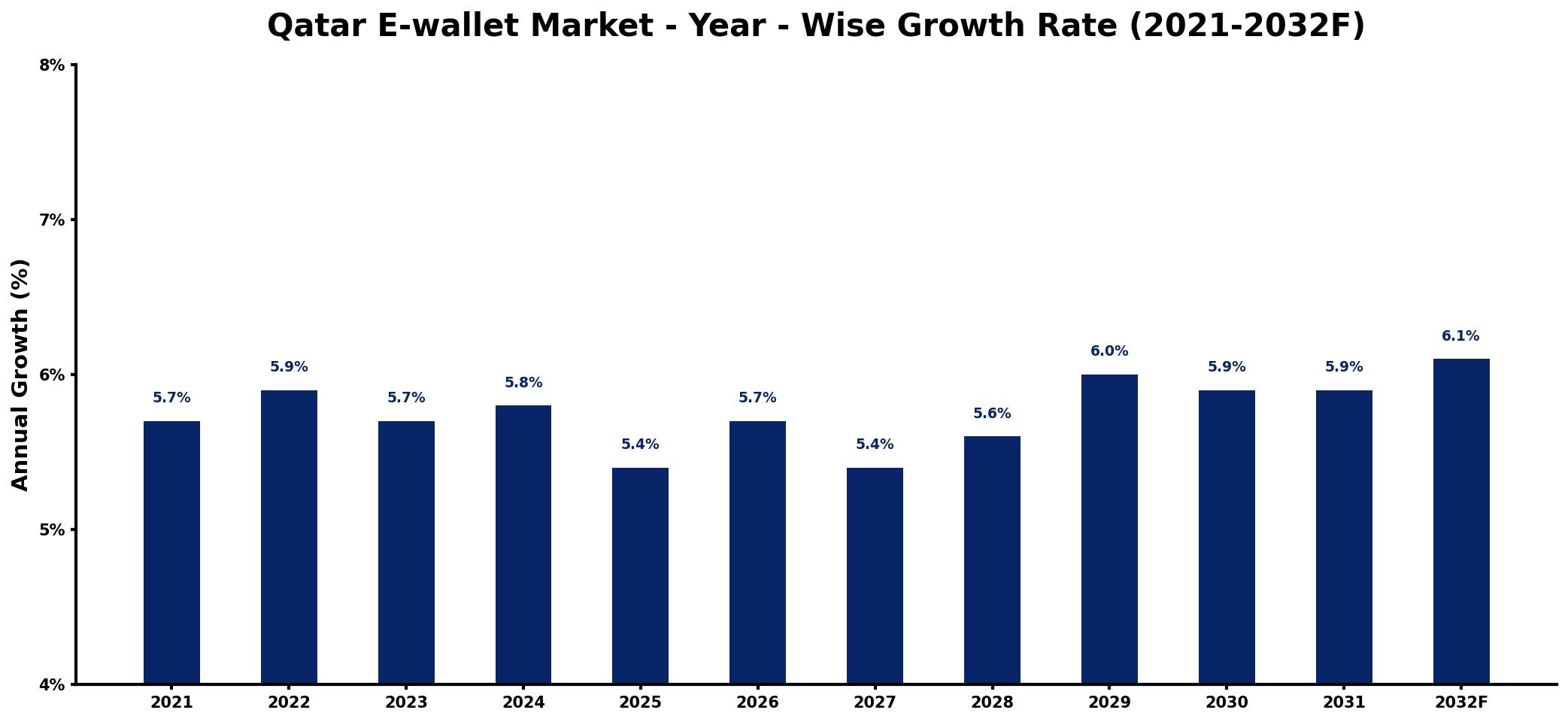
The table below presents the year‑wise growth rates along with the key drivers influencing the market
| Year | Growth Rate | Major Drivers |
| 2021 | 5.7% | Rise in digital payment adoption |
| 2022 | 5.9% | Expansion of fintech startups ecosystem |
| 2023 | 5.7% | Increased smartphone penetration rates |
| 2024 | 5.8% | Growing demand for contactless solutions |
| 2025 | 5.4% | Investment in blockchain technology initiatives |
| 2026 | 5.7% | Enhancement of cybersecurity measures |
| 2027 | 5.4% | Surge in e-commerce transactions volume |
| 2028 | 5.6% | Integration with loyalty rewards programs |
| 2029 | 6.0% | Collaboration with traditional banks increasing |
| 2030 | 5.9% | Government initiatives promoting digitalization |
| 2031 | 5.9% | Emergence of new payment platforms |
| 2032 | 6.1% | increased overall sector activity |
Note: Market size estimations and growth projections presented in this report are based on 6Wresearch's proprietary forecasting methodology, utilizing the latest available industry data, government publications, and primary research inputs.
Qatar E-wallet Market Synopsis
The strongest force currently shaping the Qatar E-wallet Market is the government's unwavering commitment to establishing a cashless economy. Initiatives and partnerships with financial institutions are promoting digital payments, which is driving increased consumer acceptance and usage of e-wallets for everyday transactions.
As cash-based transactions remain prevalent in certain demographics, ongoing efforts to enhance user trust and education surrounding e-wallets are critical. This focus not only addresses consumer hesitance but also accelerates the integration of digital payment solutions into the fabric of everyday life in Qatar.
Qatar E-wallet Market Key Takeaways
- The market is set for significant growth, with strong governmental support for digital payment initiatives.
- Technological advancements and smartphone adoption are pivotal in driving user engagement with e-wallets.
- Increasing partnerships between e-wallet providers and businesses enhance transaction convenience and versatility.
- COVID-19 has been a catalyst for rapid adoption, embedding digital payment habits in consumer behavior.
- Regulatory considerations remain crucial as the market evolves, impacting innovation and security standards.
Evaluation of Restraints in Qatar E-wallet Market
While the Qatar E-wallet Market is on an impressive growth trajectory, it is not without its restraints. Regulatory challenges pose a significant barrier, as authorities seek to balance innovation with the need for robust security measures. Additionally, instilling trust in digital wallets remains a hurdle; consumers in certain segments may still prefer cash transactions. Overcoming these challenges requires concerted efforts from providers to bridge the gap between traditional payment methods and emerging digital solutions.
Qatar E-wallet Market Trends
A notable trend in the Qatar E-wallet Market is the increasing inclination towards contactless payments, driven by a blend of convenience and health consciousness spurred by the pandemic. Enhanced user experience through seamless transactions and loyalty programs is also becoming standard practice among e-wallet providers. Furthermore, the integration of value-added services, such as budgeting tools and financial management features, is emerging as a key differentiator.
Qatar E-wallet Market Opportunities
The growth of the Qatar E-wallet Market presents several compelling opportunities for investment. With the government's ongoing digitization initiatives, companies that innovate in user experience and security measures stand to benefit significantly. Additionally, expanding e-wallet functionalities to include features like savings accounts or microloans could engage a wider audience and deepen user loyalty.
Government Initiatives in the Qatar E-wallet Market
The Qatari government is actively fostering a cashless economy through various initiatives aimed at enhancing digital payment infrastructure. By investing in technological advancements and launching campaigns to promote digital literacy, authorities are effectively laying the groundwork for widespread e-wallet adoption. Public spending is geared towards improving connectivity and supporting businesses in integrating e-wallet solutions into their payment systems, thereby boosting consumer confidence and participation.
Future Insights of the Qatar E-wallet Market
Looking forward to 2026-2032, the Qatar E-wallet Market is expected to continue its robust growth trajectory, driven by technological advancements and an increasingly digital-first population. As e-wallet functionalities expand and consumer trust strengthens, this market will likely become a cornerstone of everyday financial transactions. Furthermore, anticipated regulatory frameworks will help streamline operations and encourage a more secure, user-friendly landscape for digital payments.
Qatar E-wallet Market Latest Developments (2025 - 2026)
In the recent months leading up to mid-2026, the Qatar E-wallet Market has witnessed significant shifts as various providers enhance their offerings with innovative features. There has been a marked increase in collaborations between e-wallet services and local businesses, streamlining payment processes and broadening user acceptance. Additionally, trends suggest a growing emphasis on security features to address consumer concerns and regulatory requirements, ensuring the market remains responsive to both user needs and compliance mandates.
Qatar E-wallet Market - Key Attractiveness of the Report
- 10 Years of Market Numbers
- Historical Data Starting from 2022 to 2025
- Base Year: 2025
- Forecast Data until 2032
- Key Performance Indicators Impacting the Market
- Major Upcoming Developments and Projects
Key Highlights of the Report:
- Qatar E-wallet Market Outlook
- Market Size of Qatar E-wallet Market, 2025
- Forecast of Qatar E-wallet Market, 2032
- Historical Data and Forecast of Qatar E-wallet Revenues & Volume for the Period 2022-2032F
- Qatar E-wallet Market Trend Evolution
- Qatar E-wallet Market Drivers and Challenges
- Qatar E-wallet Price Trends
- Qatar E-wallet Porter's Five Forces
- Qatar E-wallet Industry Life Cycle
- Historical Data and Forecast of Qatar E-wallet Market Revenues & Volume By Application for the Period 2022-2032F
- Historical Data and Forecast of Qatar E-wallet Market Revenues & Volume By Restaurants for the Period 2022-2032F
- Historical Data and Forecast of Qatar E-wallet Market Revenues & Volume By Transportation for the Period 2022-2032F
- Historical Data and Forecast of Qatar E-wallet Market Revenues & Volume By Banking for the Period 2022-2032F
- Historical Data and Forecast of Qatar E-wallet Market Revenues & Volume By Retail for the Period 2022-2032F
- Historical Data and Forecast of Qatar E-wallet Market Revenues & Volume By Type for the Period 2022-2032F
- Historical Data and Forecast of Qatar E-wallet Market Revenues & Volume By Closed E Wallets for the Period 2022-2032F
- Historical Data and Forecast of Qatar E-wallet Market Revenues & Volume By Semi Closed E Wallets for the Period 2022-2032F
- Historical Data and Forecast of Qatar E-wallet Market Revenues & Volume By Open E Wallets for the Period 2022-2032F
- Historical Data and Forecast of Qatar E-wallet Market Revenues & Volume By Mode for the Period 2022-2032F
- Historical Data and Forecast of Qatar E-wallet Market Revenues & Volume By Online for the Period 2022-2032F
- Historical Data and Forecast of Qatar E-wallet Market Revenues & Volume By M Wallet for the Period 2022-2032F
- Historical Data and Forecast of Qatar E-wallet Market Revenues & Volume By Mode for the Period 2022-2032F
- Historical Data and Forecast of Qatar E-wallet Market Revenues & Volume By Online for the Period 2022-2032F
- Historical Data and Forecast of Qatar E-wallet Market Revenues & Volume By M Wallet for the Period 2022-2032F
- Qatar E-wallet Import Export Trade Statistics
- Market Opportunity Assessment By Application
- Market Opportunity Assessment By Type
- Market Opportunity Assessment By Mode
- Qatar E-wallet Top Companies Market Share
- Qatar E-wallet Competitive Benchmarking By Technical and Operational Parameters
- Qatar E-wallet Company Profiles
- Qatar E-wallet Key Strategic Recommendations






































