Qatar Electrical Components Market Size, Share & Growth Rate
The Qatar Electrical Components Market was estimated at USD 273 Million in 2025 and is projected to reach USD 381 Million by 2032, growing at a CAGR of 4.9% from 2026 to 2032. This growth trajectory is primarily driven by significant infrastructure development projects and urbanization, as Qatar continues to expand its cities and modernize its facilities. Furthermore, the increasing emphasis on energy efficiency and sustainability is propelling demand for innovative electrical solutions across various sectors.
Qatar Electrical Components Market Year-wise Growth Rate and Key Drivers
This graph highlights how the Qatar Electrical Components Market has steadily grown over the years, supported by major growth factors.
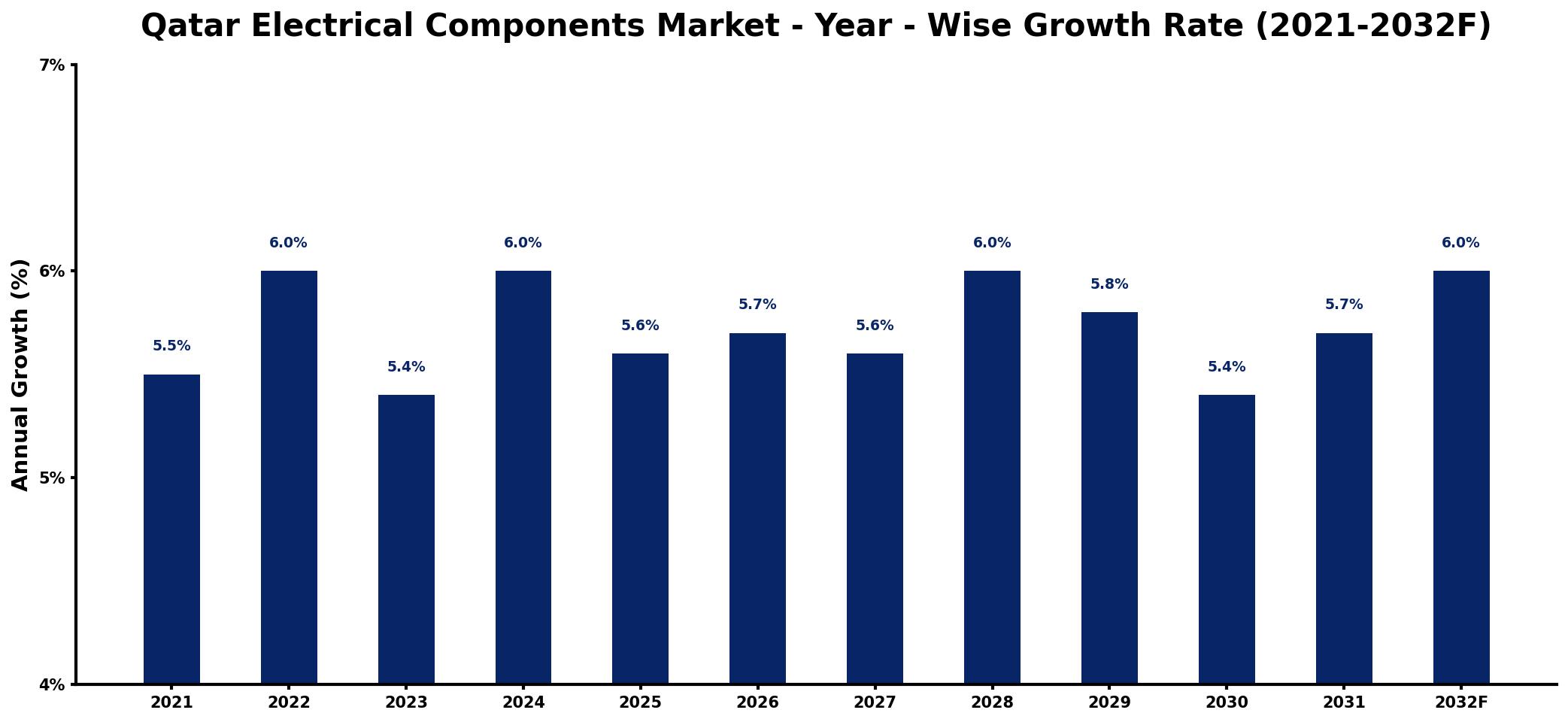
The table below presents the year‑wise growth rates along with the key drivers influencing the market
| Year | Growth Rate | Major Drivers |
| 2021 | 5.5% | Rising construction sector investments |
| 2022 | 6.0% | Increased renewable energy projects |
| 2023 | 5.4% | Growing demand for smart technology |
| 2024 | 6.0% | Expansion of urban infrastructure projects |
| 2025 | 5.6% | Higher investments in green technologies |
| 2026 | 5.7% | Surge in residential development projects |
| 2027 | 5.6% | Boost in industrial automation adoption |
| 2028 | 6.0% | Growth in telecommunications infrastructure |
| 2029 | 5.8% | Strengthened regional trade agreements |
| 2030 | 5.4% | Increased focus on sustainability initiatives |
| 2031 | 5.7% | Emergence of electric vehicle market |
| 2032 | 6.0% | Rising consumer electronics demand |
Note: Market size estimations and growth projections presented in this report are based on 6Wresearch's proprietary forecasting methodology, utilizing the latest available industry data, government publications, and primary research inputs.
Qatar Electrical Components Market Synopsis
The strongest force shaping the Qatar Electrical Components Market is the surge in infrastructure development, catalyzed by government initiatives and urbanization. This has led to an uptick in demand for various electrical components, from switches and outlets to advanced smart technologies.
Moreover, the nation's commitment to sustainable practices is driving the adoption of eco-friendly solutions such as LED lighting and energy-efficient appliances. The construction sector's rapid growth—encompassing both residential and commercial projects—continues to support the markets expansion.
Qatar Electrical Components Market Key Takeaways
- The market is projected to grow from USD 273 Million in 2025 to USD 381 Million by 2032, reflecting an increasing demand for energy-efficient solutions.
- Infrastructure development and urbanization are the primary growth drivers behind the rising demand for electrical components.
- Government initiatives promoting sustainability are influencing the adoption of advanced electrical technologies.
- Quality assurance and electrical safety are becoming paramount in component selection, particularly given Qatar's challenging climate.
- Emerging technologies and innovations are reshaping the landscape of the electrical components market.
Evaluation of Restraints in Qatar Electrical Components Market
While the Qatar Electrical Components Market is poised for growth, it faces significant restraints linked to its dependence on imports. This reliance makes it vulnerable to supply chain disruptions, which can lead to delays and increased costs, particularly for key infrastructure projects. Additionally, fluctuating global prices can complicate planning and budgeting for construction firms. The harsh desert climate poses further challenges; ensuring the quality and safety of electrical components becomes a complex, often costly endeavor. Compliance with varying regulatory standards also adds another layer of complexity for market participants.
Qatar Electrical Components Market Trends
A notable trend in the Qatar Electrical Components Market is the increasing integration of smart technologies into everyday applications. As consumer demand for automation rises, manufacturers are developing sophisticated products that not only meet energy efficiency standards but also enhance user experience. Additionally, the push towards renewable energy is leading to a greater adoption of solar and wind solutions, thereby expanding the market for associated electrical components. Lastly, the trend toward modular and customizable electrical systems is gaining traction, allowing for tailored solutions in both residential and commercial sectors.
Qatar Electrical Components Market Opportunities
Opportunities within the Qatar Electrical Components Market are abundant, particularly in the realm of renewable energy integration. The governments commitment to diversifying energy sources offers potential growth for components that support solar and wind technologies. Furthermore, as urbanization continues to expand, there will be an increasing need for modern infrastructure, paving the way for innovations in electrical solutions. Investing in R&D for eco-friendly products, such as energy-efficient lighting and appliances, can also yield significant returns as sustainability becomes a key market driver.
Government Initiatives in the Qatar Electrical Components Market
The Qatari government is actively promoting initiatives aimed at enhancing infrastructure and supporting sustainable development. Public spending is being directed towards large-scale construction projects, which creates a favorable environment for the electrical components market. Additionally, various policies are in place to encourage the adoption of renewable energy technologies and energy-efficient solutions, thereby stimulating demand within the sector. Programs aimed at fostering innovation and technology transfer further underscore the governments commitment to advancing the electrical components landscape in Qatar.
Future Insights of the Qatar Electrical Components Market
Looking ahead to 2026-2032, the Qatar Electrical Components Market is expected to continue on its growth trajectory, largely driven by ongoing infrastructure investments and the integration of smart technologies. The demand for high-quality electrical components will intensify as safety standards evolve and environmental consciousness becomes even more prevalent. The market will also witness a shift toward modular systems and custom solutions, catering to the specific needs of various industries. With sustainability at the forefront, innovation and adaptation will play key roles in shaping the future landscape.
Qatar Electrical Components Market Latest Developments (2025 - 2026)
In recent months, the Qatar Electrical Components Market has seen a shift toward incorporating smart technologies into existing infrastructures. Manufacturers are increasingly focusing on developing energy-efficient solutions that comply with stringent government regulations. Additionally, there has been a notable rise in partnerships between technology firms and construction companies aimed at integrating renewable energy solutions into new builds. These developments reflect a broader commitment to innovation and sustainability, positioning the market for continued growth in the coming years.
Qatar Electrical Components Market - Key Attractiveness of the Report
- 10 Years of Market Numbers
- Historical Data Starting from 2022 to 2025
- Base Year: 2025
- Forecast Data until 2032
- Key Performance Indicators Impacting the Market
- Major Upcoming Developments and Projects
Key Highlights of the Report:
- Qatar Electrical Components Market Outlook
- Market Size of Qatar Electrical Components Market, 2025
- Forecast of Qatar Electrical Components Market, 2032
- Historical Data and Forecast of Qatar Electrical Components Revenues & Volume for the Period 2022-2032F
- Qatar Electrical Components Market Trend Evolution
- Qatar Electrical Components Market Drivers and Challenges
- Qatar Electrical Components Price Trends
- Qatar Electrical Components Porter's Five Forces
- Qatar Electrical Components Industry Life Cycle
- Historical Data and Forecast of Qatar Electrical Components Market Revenues & Volume By Building Automation for the Period 2022-2032F
- Historical Data and Forecast of Qatar Electrical Components Market Revenues & Volume By Datacom Accessories for the Period 2022-2032F
- Historical Data and Forecast of Qatar Electrical Components Market Revenues & Volume By Security & wiring Accessories for the Period 2022-2032F
- Historical Data and Forecast of Qatar Electrical Components Market Revenues & Volume By Cables & Wires for the Period 2022-2032F
- Historical Data and Forecast of Qatar Electrical Components Market Revenues & Volume By Datacom Cables for the Period 2022-2032F
- Historical Data and Forecast of Qatar Electrical Components Market Revenues & Volume By LV Cables for the Period 2022-2032F
- Historical Data and Forecast of Qatar Electrical Components Market Revenues & Volume By MV&HV Cables for the Period 2022-2032F
- Historical Data and Forecast of Qatar Electrical Components Market Revenues & Volume By Special Cables for the Period 2022-2032F
- Historical Data and Forecast of Qatar Electrical Components Market Revenues & Volume By Industrial Automation for the Period 2022-2032F
- Historical Data and Forecast of Qatar Electrical Components Market Revenues & Volume By Automation Controls for the Period 2022-2032F
- Historical Data and Forecast of Qatar Electrical Components Market Revenues & Volume By Auxiliary Controls for the Period 2022-2032F
- Historical Data and Forecast of Qatar Electrical Components Market Revenues & Volume By Drives & Motion Controls for the Period 2022-2032F
- Historical Data and Forecast of Qatar Electrical Components Market Revenues & Volume By Measurement Controls and Relays for the Period 2022-2032F
- Historical Data and Forecast of Qatar Electrical Components Market Revenues & Volume By Lighting for the Period 2022-2032F
- Historical Data and Forecast of Qatar Electrical Components Market Revenues & Volume By Fixtures for the Period 2022-2032F
- Historical Data and Forecast of Qatar Electrical Components Market Revenues & Volume By Lamps & LEDs for the Period 2022-2032F
- Historical Data and Forecast of Qatar Electrical Components Market Revenues & Volume By Power Distribution for the Period 2022-2032F
- Historical Data and Forecast of Qatar Electrical Components Market Revenues & Volume By Cable Management for the Period 2022-2032F
- Historical Data and Forecast of Qatar Electrical Components Market Revenues & Volume By Enclosures & Panels for the Period 2022-2032F
- Historical Data and Forecast of Qatar Electrical Components Market Revenues & Volume By LV Electrical Distribution for the Period 2022-2032F
- Historical Data and Forecast of Qatar Electrical Components Market Revenues & Volume By Renewable Energies for the Period 2022-2032F
- Historical Data and Forecast of Qatar Electrical Components Market Revenues & Volume By HVAC for the Period 2022-2032F
- Historical Data and Forecast of Qatar Electrical Components Market Revenues & Volume By Renewable energy for the Period 2022-2032F
- Historical Data and Forecast of Qatar Electrical Components Market Revenues & Volume By Safety & Tools for the Period 2022-2032F
- Historical Data and Forecast of Qatar Electrical Components Market Revenues & Volume By Safety Equipment for the Period 2022-2032F
- Historical Data and Forecast of Qatar Electrical Components Market Revenues & Volume By Working Tools & Accessories for the Period 2022-2032F
- Qatar Electrical Components Import Export Trade Statistics
- Market Opportunity Assessment By Building Automation
- Market Opportunity Assessment By Cables & Wires
- Market Opportunity Assessment By Industrial Automation
- Market Opportunity Assessment By Lighting
- Market Opportunity Assessment By Power Distribution
- Market Opportunity Assessment By Renewable Energies
- Market Opportunity Assessment By Safety & Tools
- Qatar Electrical Components Top Companies Market Share
- Qatar Electrical Components Competitive Benchmarking By Technical and Operational Parameters
- Qatar Electrical Components Company Profiles
- Qatar Electrical Components Key Strategic Recommendations






































