Qatar Melamine Market Size Growth Rate
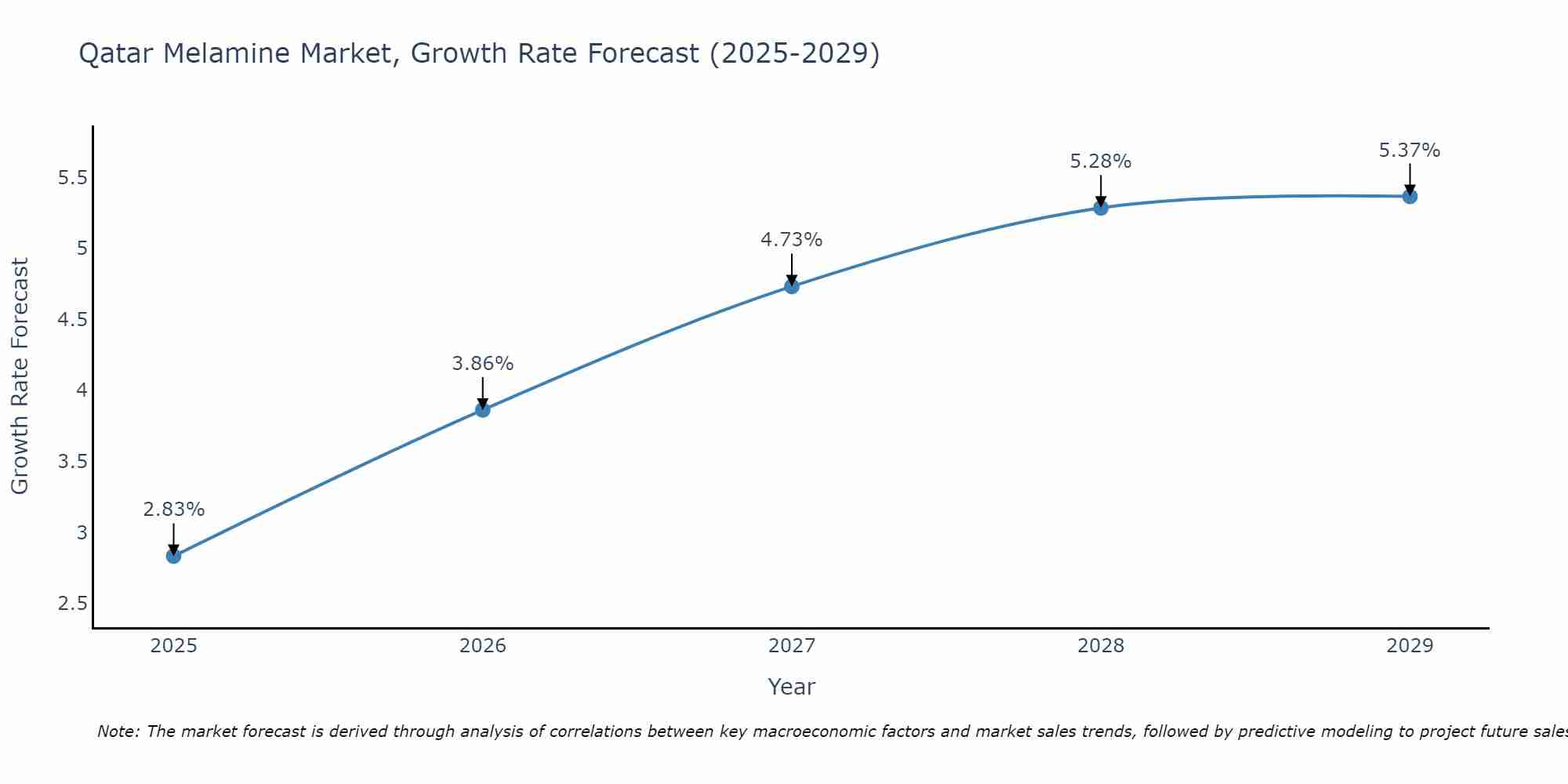
The Qatar Melamine Market is likely to experience consistent growth rate gains over the period 2025 to 2029. From 2.83% in 2025, the growth rate steadily ascends to 5.37% in 2029.
Qatar Melamine Market Synopsis
Market Size is projected to register a CAGR of 8. 2% over the forecasted period owing to its increased applications across multiple industries such as construction, automotive, furniture among others due to its high durability properties and flame resistance characteristics compared other materials used for similar applications.
Drivers of the Market
The growth of the Qatar melamine market is driven by several factors. Melamine, a versatile chemical compound, is widely used in the production of durable and heat-resistant products, including laminates, coatings, and plastics. Qatar robust construction and infrastructure projects create a demand for melamine-based materials used in interior finishes and coatings. The increasing urbanization and commercial development in the country contribute to the requirement for melamine-based products. Furthermore, melamine`s application in the manufacturing of tableware and kitchenware aligns with Qatar hospitality and retail sectors, bolstering market growth. As Qatar continues to invest in industrial expansion and diversification, the demand for melamine is anticipated to remain strong, supported by its wide-ranging applications across multiple industries.
Challenges of the Market
The Qatar melamine market encounters challenges related to product safety and regulatory compliance. Melamine is widely used in the production of various consumer and industrial goods, and ensuring its safety in food contact materials is paramount. Addressing concerns about potential migration of melamine into food and beverages and aligning with international safety standards remains a challenge for manufacturers and importers in the Qatar market.
COVID-19 Impact on the Market
The Qatar melamine market, which finds application in the production of laminates, coatings, and plastics, faced COVID-19-related challenges. Melamine`s demand is closely tied to the construction, furniture, and automotive industries. Before the pandemic, the market was influenced by urbanization, infrastructure projects, and interior decoration trends. However, the pandemic led to project delays, supply chain disruptions, and reduced consumer spending. This affected the market negatively as construction activities slowed down. As Qatar construction sector revives and interior decoration projects resume, the melamine market is expected to recover. The rebound of the furniture industry and increasing automotive production could also contribute to market growth.
Key Players in the Market
Key players in the Qatar melamine market include Qatar Melamine Company and Ali Bin Khalifa Al Hitmi & Co. Qatar Melamine Company is a significant producer of melamine, a versatile chemical used in various applications, including plastics and resins. Ali Bin Khalifa Al Hitmi & Co. , known as ABKK, is involved in the distribution of chemicals and industrial products, including melamine, serving Qatar diverse industries. These key players contribute to Qatar chemical and manufacturing sectors by providing essential melamine for plastic, laminate, and other applications.
Key Highlights of the Report:
- Qatar Melamine Market Outlook
- Market Size of Qatar Melamine Market, 2024
- Forecast of Qatar Melamine Market, 2031
- Historical Data and Forecast of Qatar Melamine Revenues & Volume for the Period 2021-2031
- Qatar Melamine Market Trend Evolution
- Qatar Melamine Market Drivers and Challenges
- Qatar Melamine Price Trends
- Qatar Melamine Porter's Five Forces
- Qatar Melamine Industry Life Cycle
- Historical Data and Forecast of Qatar Melamine Market Revenues & Volume By Forms for the Period 2021-2031
- Historical Data and Forecast of Qatar Melamine Market Revenues & Volume By Melamine Resin for the Period 2021-2031
- Historical Data and Forecast of Qatar Melamine Market Revenues & Volume By Melamine Foams for the Period 2021-2031
- Historical Data and Forecast of Qatar Melamine Market Revenues & Volume By Applications for the Period 2021-2031
- Historical Data and Forecast of Qatar Melamine Market Revenues & Volume By Laminates for the Period 2021-2031
- Historical Data and Forecast of Qatar Melamine Market Revenues & Volume By Wood Adhesives for the Period 2021-2031
- Historical Data and Forecast of Qatar Melamine Market Revenues & Volume By Surface Coatings for the Period 2021-2031
- Historical Data and Forecast of Qatar Melamine Market Revenues & Volume By Thermoset Plastics for the Period 2021-2031
- Historical Data and Forecast of Qatar Melamine Market Revenues & Volume By End-users for the Period 2021-2031
- Historical Data and Forecast of Qatar Melamine Market Revenues & Volume By Construction for the Period 2021-2031
- Historical Data and Forecast of Qatar Melamine Market Revenues & Volume By Chemical for the Period 2021-2031
- Historical Data and Forecast of Qatar Melamine Market Revenues & Volume By Textile for the Period 2021-2031
- Historical Data and Forecast of Qatar Melamine Market Revenues & Volume By Automotive for the Period 2021-2031
- Qatar Melamine Import Export Trade Statistics
- Market Opportunity Assessment By Forms
- Market Opportunity Assessment By Applications
- Market Opportunity Assessment By End-users
- Qatar Melamine Top Companies Market Share
- Qatar Melamine Competitive Benchmarking By Technical and Operational Parameters
- Qatar Melamine Company Profiles
- Qatar Melamine Key Strategic Recommendations






































