Qatar Over the Top Market Size & Growth Rate (2026-2032)
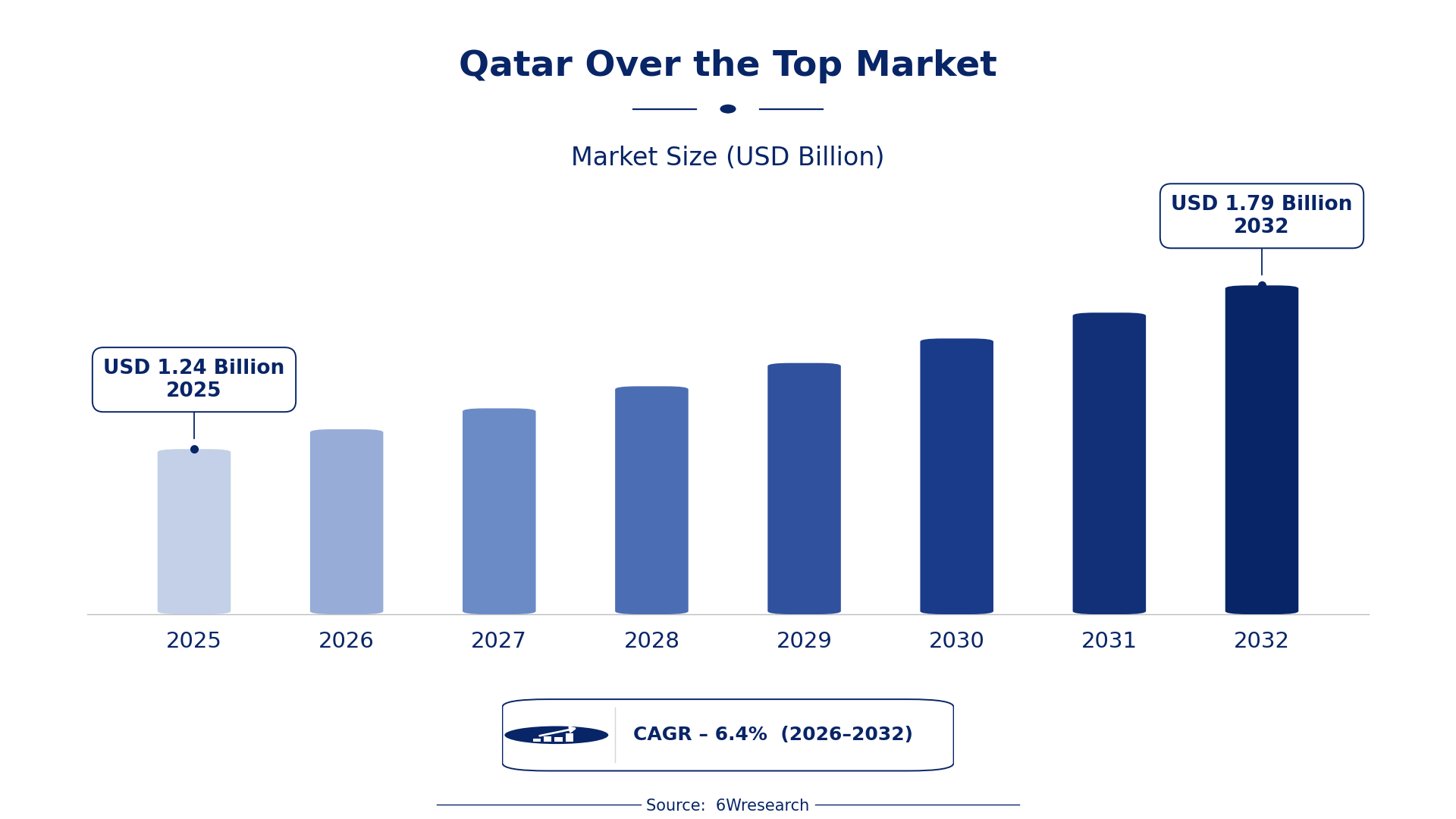
The Qatar Over the Top Market was estimated at USD 1235 Million in 2025 and is projected to reach USD 1786 Million by 2032, growing at a CAGR of 6.4% from 2026 to 2032.
Qatar Over the Top Market Synopsis
In Qatar, the Over the Top (OTT) Market has witnessed a remarkable shift as consumers abandon traditional TV in favor of internet-based streaming services. This transition is not merely a trend; it reflects a fundamental change in how entertainment is consumed, with various platforms providing video, audio, and messaging services tailored to modern preferences.
A youthful demographic, combined with high-speed internet access, propels the growth of OTT services. The expansion of smartphones and smart TVs facilitates easy access to diverse content. Local and international content providers are responding by offering a wide array of on-demand services to meet the evolving demands of Qatari consumers.
Qatar Over the Top Market Year-wise Growth Rate and Key Drivers
This graph illustrates the annual growth rates of the Qatar Over the Top Market from 2021 to 2032, highlighting a steady upward trajectory and projected expansion over the forecast period.
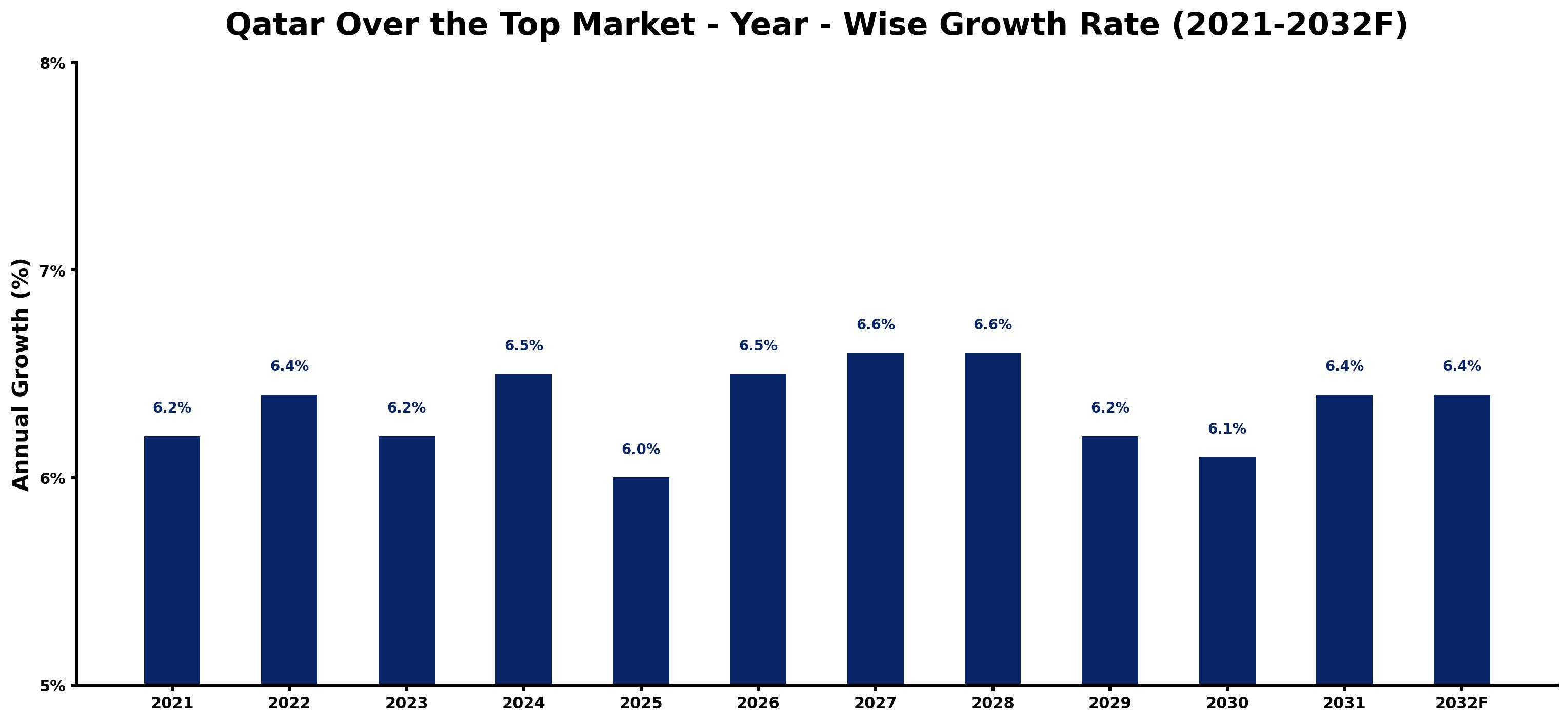
The table below presents the year‑wise growth rates along with the key drivers influencing the market
| Year | Growth Rate | Major Drivers |
| 2021 | 6.2% | Increased smartphone penetration among young Qatari population. |
| 2022 | 6.4% | Launch of major sports events driving streaming demand. |
| 2023 | 6.2% | Qatar National Vision 2030 promoting digital entertainment growth. |
| 2024 | 6.5% | Investment in 5G technology enhancing streaming capabilities. |
| 2025 | 6.0% | Growing expatriate community boosting diverse content subscriptions. |
| 2026 | 6.5% | Qatar’s hosting of FIFA World Cup increasing OTT viewership. |
| 2027 | 6.6% | Partnerships with local content creators expanding offerings. |
| 2028 | 6.6% | Rise in digital payment adoption facilitating subscription ease. |
| 2029 | 6.2% | Regulatory support for foreign OTT service providers. |
| 2030 | 6.1% | Launch of new regional OTT platforms diversifying options. |
| 2031 | 6.4% | Government initiatives promoting cultural content on OTT services. |
| 2032 | 6.4% | Increased advertising revenue for local OTT operators. |
Note: Market size estimations and growth projections presented in this report are based on 6Wresearch's proprietary forecasting methodology, utilizing the latest available industry data, government publications, and primary research inputs.
Qatar Over the Top Market Key Takeaways
Below are some of the specific key takeaways from the market, including:
- Changing media consumption habits are central to the growth of the OTT market.
- High-speed internet and smartphone penetration enhance service accessibility.
- Content localization is crucial for attracting diverse consumer preferences.
- Subscription models are evolving, with increased competition among platforms.
- Opportunities for partnerships between telecom and content providers are emerging.
Evaluation of Restraints in Qatar Over the Top Market
The Qatar OTT market faces several restraints that could hinder its growth trajectory. High competition among streaming platforms creates pressure to offer unique and quality content. However, licensing issues and regional regulations can complicate content acquisition, limiting options for providers. Additionally, the need for localized content to cater to the diverse Qatari audience adds complexity to service offerings. Companies must remain agile in their strategies to navigate these challenges effectively.
Qatar Over the Top Market Trends
As the OTT market in Qatar evolves, several trends are becoming increasingly prominent. One major trend is the focus on content personalization, allowing consumers to enjoy tailored viewing experiences based on their preferences. There’s also a growing interest in interactive content, such as live events and gaming integrations, which engage users more actively. Lastly, bundling services with existing telecommunications packages is gaining traction, appealing to cost-sensitive consumers while enhancing overall value.
Qatar Over the Top Market Opportunities
Investors and companies have considerable opportunities in the Qatar OTT Market. The increasing consumer shift towards digital content presents avenues for innovative startups that can capitalize on niche markets. Additionally, the enhancement of infrastructure, particularly in rural areas, could lead to expanded user bases. Collaborations between local creators and international platforms for co-production of content may attract diverse audiences and elevate the market profile.
Government Initiatives in the Qatar Over the Top Market
The Qatari government is actively shaping the OTT market through various initiatives aimed at enhancing digital infrastructure and regulatory frameworks. These efforts are crucial as they provide the necessary support for a burgeoning digital economy while ensuring that consumer interests are prioritized. Government policies that favor content localization and promote partnerships between local businesses and foreign entities are pivotal in fostering a competitive market environment.
- A recent initiative focused on upgrading national digital infrastructure to enhance internet connectivity for OTT service providers.
- Currently ongoing regulatory reforms aim to streamline licensing processes for content distribution, encouraging more entrants into the market.
- Plans for upcoming public-private partnerships to boost the production of localized content through collaboration with regional creators.
- New policies to enhance consumer protection in digital content consumption, ensuring transparency in subscription models.
- Support for training programs aimed at developing local talent in digital media and content creation, fostering a sustainable industry.
Future Insights of the Qatar Over the Top Market
The outlook for the Qatar OTT Market from 2026 to 2032 indicates robust growth driven by continuous technological advancements and shifts in consumer behavior. As more households gain access to high-speed internet and devices, the potential for new content types and services will expand. Companies that prioritize innovation in user experience and content diversity will likely thrive in this competitive environment, positioning themselves for long-term success.
Qatar Over the Top Market Latest Developments
In the past year, the Qatar OTT Market has seen several noteworthy developments that signal its dynamic nature. Companies are increasingly focusing on enhancing their service offerings and technology capabilities to better engage consumers and improve the overall experience.
- A new OTT platform launched in early 2025, featuring an extensive library of local and international content aimed at young adults.
- An initiative that began in mid-2025 is currently underway, focused on integrating artificial intelligence into content recommendations on existing platforms.
- By late 2025, a collaboration is expected to finalize between a leading telecommunications provider and a major content creator for an exclusive series.
- In Q1 2026, plans are being developed for a promotional campaign to increase awareness about the benefits of subscribing to OTT services among older demographics.
- A rollout expected to begin in the second half of 2026 is aimed at introducing new pricing models, including ad-supported tiers for budget-conscious consumers.
Qatar Over the Top Market - Key Attractiveness of the Report
- 10 Years of Market Numbers
- Historical Data Starting from 2022 to 2025
- Base Year: 2025
- Forecast Data until 2032
- Key Performance Indicators Impacting the Market
- Major Upcoming Developments and Projects
Key Highlights of the Report:
- Qatar Over the Top Market Outlook
- Market Size of Qatar Over the Top Market, 2025
- Forecast of Qatar Over the Top Market, 2032
- Historical Data and Forecast of Qatar Over the Top Revenues & Volume for the Period 2022-2032F
- Qatar Over the Top Market Trend Evolution
- Qatar Over the Top Market Drivers and Challenges
- Qatar Over the Top Price Trends
- Qatar Over the Top Porter's Five Forces
- Qatar Over the Top Industry Life Cycle
- Historical Data and Forecast of Qatar Over the Top Market Revenues & Volume By Type for the Period 2022-2032F
- Historical Data and Forecast of Qatar Over the Top Market Revenues & Volume By Game Streaming for the Period 2022-2032F
- Historical Data and Forecast of Qatar Over the Top Market Revenues & Volume By Audio Streaming for the Period 2022-2032F
- Historical Data and Forecast of Qatar Over the Top Market Revenues & Volume By Video Streaming for the Period 2022-2032F
- Historical Data and Forecast of Qatar Over the Top Market Revenues & Volume By Communication for the Period 2022-2032F
- Historical Data and Forecast of Qatar Over the Top Market Revenues & Volume By Monetization Model for the Period 2022-2032F
- Historical Data and Forecast of Qatar Over the Top Market Revenues & Volume By Subscription-based for the Period 2022-2032F
- Historical Data and Forecast of Qatar Over the Top Market Revenues & Volume By Advertising-based for the Period 2022-2032F
- Historical Data and Forecast of Qatar Over the Top Market Revenues & Volume By Transaction-based for the Period 2022-2032F
- Historical Data and Forecast of Qatar Over the Top Market Revenues & Volume By Streaming Device for the Period 2022-2032F
- Historical Data and Forecast of Qatar Over the Top Market Revenues & Volume By Smartphones and Tablets for the Period 2022-2032F
- Historical Data and Forecast of Qatar Over the Top Market Revenues & Volume By Desktops and Laptops for the Period 2022-2032F
- Historical Data and Forecast of Qatar Over the Top Market Revenues & Volume By IPTV and Consoles for the Period 2022-2032F
- Historical Data and Forecast of Qatar Over the Top Market Revenues & Volume By Vertical for the Period 2022-2032F
- Historical Data and Forecast of Qatar Over the Top Market Revenues & Volume By Media and Entertainment for the Period 2022-2032F
- Historical Data and Forecast of Qatar Over the Top Market Revenues & Volume By Education and Learning for the Period 2022-2032F
- Historical Data and Forecast of Qatar Over the Top Market Revenues & Volume By Gaming for the Period 2022-2032F
- Historical Data and Forecast of Qatar Over the Top Market Revenues & Volume By Service Utilities for the Period 2022-2032F
- Qatar Over the Top Import Export Trade Statistics
- Market Opportunity Assessment By Type
- Market Opportunity Assessment By Monetization Model
- Market Opportunity Assessment By Streaming Device
- Market Opportunity Assessment By Vertical
- Qatar Over the Top Top Companies Market Share
- Qatar Over the Top Competitive Benchmarking By Technical and Operational Parameters
- Qatar Over the Top Company Profiles
- Qatar Over the Top Key Strategic Recommendations






































