Qatar Retail Market Size, Share & Growth Rate
The Qatar Retail Market was estimated at USD 740 Million in 2025 and is projected to reach USD 1310 Million by 2032, growing at a CAGR of 8.5% from 2026 to 2032. This positive trajectory is driven by several factors including a burgeoning population, increased disposable incomes, and a shift towards modern retail formats. The retail sector is becoming increasingly pivotal in Qatar's diversification efforts away from a hydrocarbon-dependent economy.
Qatar Retail Market Year-wise Growth Rate and Key Drivers
This graph highlights how the Qatar Retail Market has steadily grown over the years, supported by major growth factors.
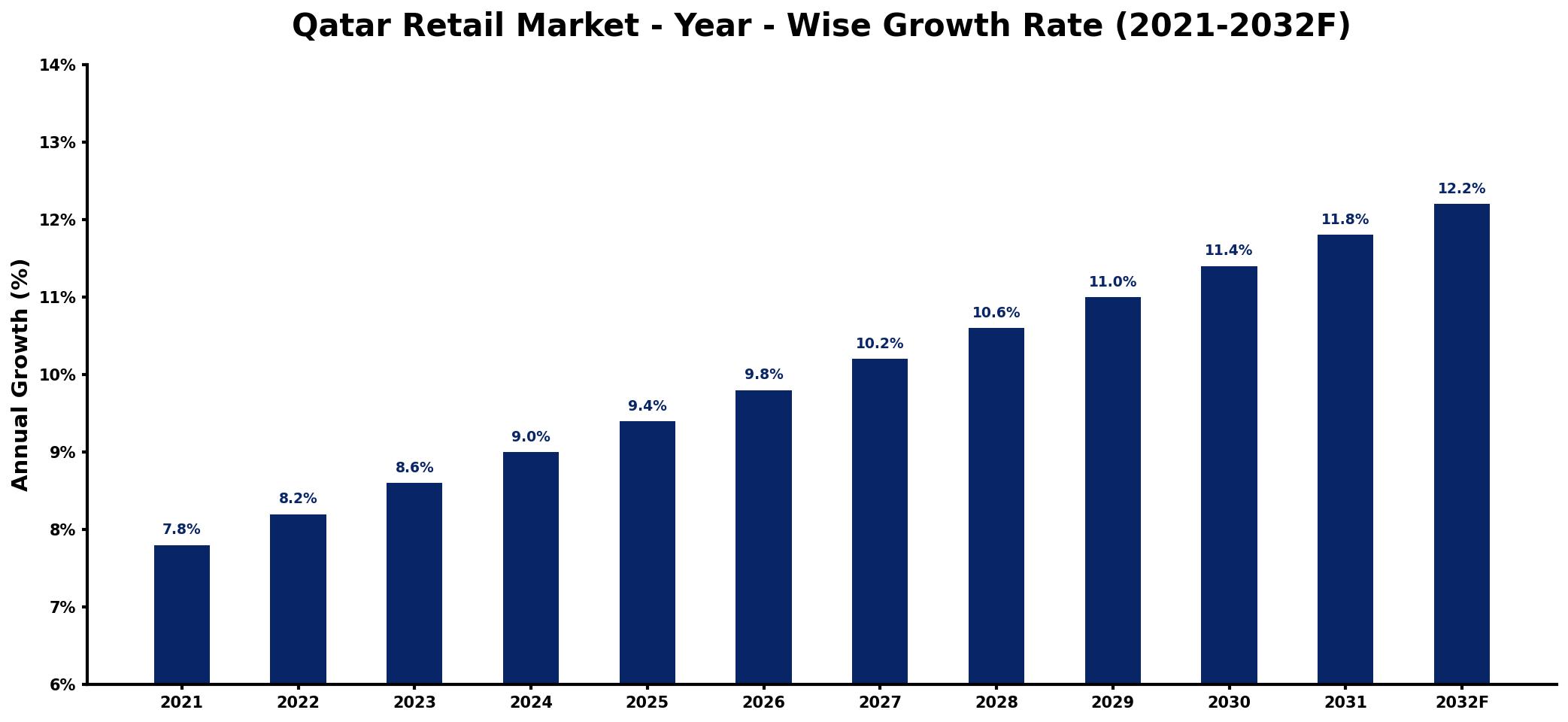
The table below presents the year‑wise growth rates along with the key drivers influencing the market
| Year | Growth Rate | Major Drivers |
| 2021 | 7.8% | rising consumer spending trends |
| 2022 | 8.2% | increased tourism and hospitality |
| 2023 | 8.6% | expansion of e-commerce platforms |
| 2024 | 9.0% | enhanced digital payment solutions |
| 2025 | 9.4% | growth in luxury brand offerings |
| 2026 | 9.8% | development of new shopping centers |
| 2027 | 10.2% | influx of expatriate population |
| 2028 | 10.6% | improvements in logistics infrastructure |
| 2029 | 11.0% | increased production capacity utilization |
| 2030 | 11.4% | emphasis on sustainability practices |
| 2031 | 11.8% | increased domestic production output |
| 2032 | 12.2% | rising demand for personalized experiences |
Note: Market size estimations and growth projections presented in this report are based on 6Wresearch's proprietary forecasting methodology, utilizing the latest available industry data, government publications, and primary research inputs.
Qatar Retail Market Synopsis
The retail landscape in Qatar is evolving, showcasing a dynamic blend of traditional markets and modern shopping experiences. With a growing preference for e-commerce, consumers are witnessing enhanced convenience and varied product offerings, prompting retailers to adapt their strategies accordingly.
As industries expand and tourism flourishes, retail players are investing heavily in innovative technologies and customer engagement methods. This shift not only enhances the shopping experience but also aligns with the governments vision of positioning Qatar as a regional retail hub.
Qatar Retail Market Key Takeaways
- The retail market is set for substantial growth, influenced by rising consumer spending and demographic changes.
- E-commerce is rapidly gaining traction, reshaping consumer preferences and purchasing behaviors.
- Investment in modern retail formats is crucial for attracting both local and international brands.
- Technological innovations are enhancing operational efficiencies and customer experiences.
- The governments initiatives to diversify the economy are providing further impetus to the retail sector.
Evaluation of Restraints in Qatar Retail Market
Despite its promising growth, the Qatar retail market faces notable restraints. The competitive landscape is intensifying, with both local and international players vying for market share. Additionally, fluctuations in consumer preferences and economic dependencies on oil and gas can introduce uncertainties. Furthermore, stringent regulatory frameworks and import restrictions may also impact the accessibility of foreign goods, creating challenges for retailers seeking to expand their offerings.
Qatar Retail Market Trends
Current trends in the Qatar retail market are being shaped by technological advancements and evolving consumer expectations. The increasing prevalence of mobile shopping, fueled by high smartphone penetration rates, is reshaping how retailers engage with customers. Moreover, sustainability is becoming a critical focus, as consumers demand eco-friendly products and practices from retailers. Loyalty programs and personalized shopping experiences are also gaining traction, as businesses strive to foster deeper connections with their clientele.
Qatar Retail Market Opportunities
The Qatar retail market presents various opportunities for growth and investment. Emerging sectors such as health and wellness, electronics, and luxury goods are attracting considerable interest from both consumers and investors. As the population continues to grow, so does the demand for diverse product categories and retail formats. Additionally, the expanding e-commerce landscape offers a fertile ground for online retailers to tap into new consumer segments and enhance accessibility across the region.
Government Initiatives in the Qatar Retail Market
The Qatari government is actively pursuing initiatives to foster a robust retail environment as part of its National Vision 2030. Efforts include public spending on infrastructure and the development of retail-friendly policies aimed at attracting foreign investments. Additionally, promotional programs designed to support local businesses and enhance the overall shopping experience are being implemented, signaling a commitment to diversifying the economy and positioning Qatar as a retail hub in the Middle East.
Future Insights of the Qatar Retail Market
Looking ahead to 2026-2032, the Qatar retail market is anticipated to expand significantly, fueled by continued economic diversification efforts and a burgeoning population. Retailers who embrace technology and sustainability are likely to thrive, as consumer preferences shift towards responsible consumption. Additionally, as Qatar prepares to host global events, the hospitality and tourism sectors will further stimulate retail growth, creating new opportunities for both established and emerging brands.
Qatar Retail Market Latest Developments (2025 - 2026)
Recent developments in the Qatar retail sector reflect a concerted effort to innovate and adapt to changing market dynamics. A surge in digital retail initiatives has been noted, with numerous businesses enhancing their online platforms and engaging in multichannel strategies. Furthermore, several new shopping malls and retail complexes are in the pipeline, designed to elevate the consumer experience and offer a wide array of services and products.
Qatar Retail Market - Key Attractiveness of the Report
- 10 Years of Market Numbers
- Historical Data Starting from 2022 to 2025
- Base Year: 2025
- Forecast Data until 2032
- Key Performance Indicators Impacting the Market
- Major Upcoming Developments and Projects
Key Highlights of the Report:
- Qatar Retail Market Outlook
- Market Size of Qatar Retail Market, 2025
- Forecast of Qatar Retail Market, 2032
- Historical Data and Forecast of Qatar Retail Revenues & Volume for the Period 2022-2032F
- Qatar Retail Market Trend Evolution
- Qatar Retail Market Drivers and Challenges
- Qatar Retail Price Trends
- Qatar Retail Porter's Five Forces
- Qatar Retail Industry Life Cycle
- Historical Data and Forecast of Qatar Retail Market Revenues & Volume By Product for the Period 2022-2032F
- Historical Data and Forecast of Qatar Retail Market Revenues & Volume By Food and Beverages for the Period 2022-2032F
- Historical Data and Forecast of Qatar Retail Market Revenues & Volume By Personal and Household Care for the Period 2022-2032F
- Historical Data and Forecast of Qatar Retail Market Revenues & Volume By Apparel for the Period 2022-2032F
- Historical Data and Forecast of Qatar Retail Market Revenues & Volume By Footwear and Accessories for the Period 2022-2032F
- Historical Data and Forecast of Qatar Retail Market Revenues & Volume By Furniture for the Period 2022-2032F
- Historical Data and Forecast of Qatar Retail Market Revenues & Volume By Toys for the Period 2022-2032F
- Historical Data and Forecast of Qatar Retail Market Revenues & Volume By Electronic and Household Appliances for the Period 2022-2032F
- Historical Data and Forecast of Qatar Food and Beverages Retail Market Revenues & Volume By Other Products for the Period 2022-2032F
- Historical Data and Forecast of Qatar Retail Market Revenues & Volume By Distribution Channel for the Period 2022-2032F
- Historical Data and Forecast of Qatar Retail Market Revenues & Volume By Supermarkets/Hypermarkets for the Period 2022-2032F
- Historical Data and Forecast of Qatar Retail Market Revenues & Volume By Convenience Stores for the Period 2022-2032F
- Historical Data and Forecast of Qatar Retail Market Revenues & Volume By Department Stores for the Period 2022-2032F
- Historical Data and Forecast of Qatar Retail Market Revenues & Volume By Specialty Stores for the Period 2022-2032F
- Historical Data and Forecast of Qatar Retail Market Revenues & Volume By Online for the Period 2022-2032F
- Historical Data and Forecast of Qatar Retail Market Revenues & Volume By Other Distribution Channels for the Period 2022-2032F
- Qatar Retail Import Export Trade Statistics
- Market Opportunity Assessment By Product
- Market Opportunity Assessment By Distribution Channel
- Qatar Retail Top Companies Market Share
- Qatar Retail Competitive Benchmarking By Technical and Operational Parameters
- Qatar Retail Company Profiles
- Qatar Retail Key Strategic Recommendations






































