Qatar Secondhand Apparel Market Size, Share & Growth Rate
The Qatar Secondhand Apparel Market was estimated at USD 304 Million in 2025 and is projected to reach USD 442 Million by 2032, growing at a CAGR of 5.5% from 2026 to 2032. This growth trajectory is primarily driven by a burgeoning awareness of sustainability among consumers, alongside rising affluence that allows a broader demographic to explore pre-owned clothing options at attractive price points. The intersection of eco-consciousness and value-driven shopping is crafting a vibrant landscape for secondhand apparel in Qatar.
Qatar Secondhand Apparel Market Growth Rate Analysis (2021-2032)
The Qatar secondhand apparel market has shown steady growth, with annual increases of 6.5% in 2021 and 6.7% in 2022, largely driven by rising consumer awareness of sustainability and cost-effectiveness. Growth slightly tapered to 6.4% in 2023, influenced by fluctuating economic conditions. However, the market rebounded with a projected 6.5% growth in 2024, bolstered by investments in digital platforms enhancing accessibility and consumer engagement. The trend is expected to stabilize around 6.6% through 2026, as infrastructure improvements and changing buying habits reinforce demand. Minor fluctuations in later years, such as a dip to 6.2% in 2031, may stem from saturation and competitive pressures, yet overall consumer interest remains robust.
Qatar Secondhand Apparel Market Year-wise Growth Rate and Key Drivers
This graph highlights how the Qatar Secondhand Apparel Market has steadily grown over the past five years, supported by major growth factors.
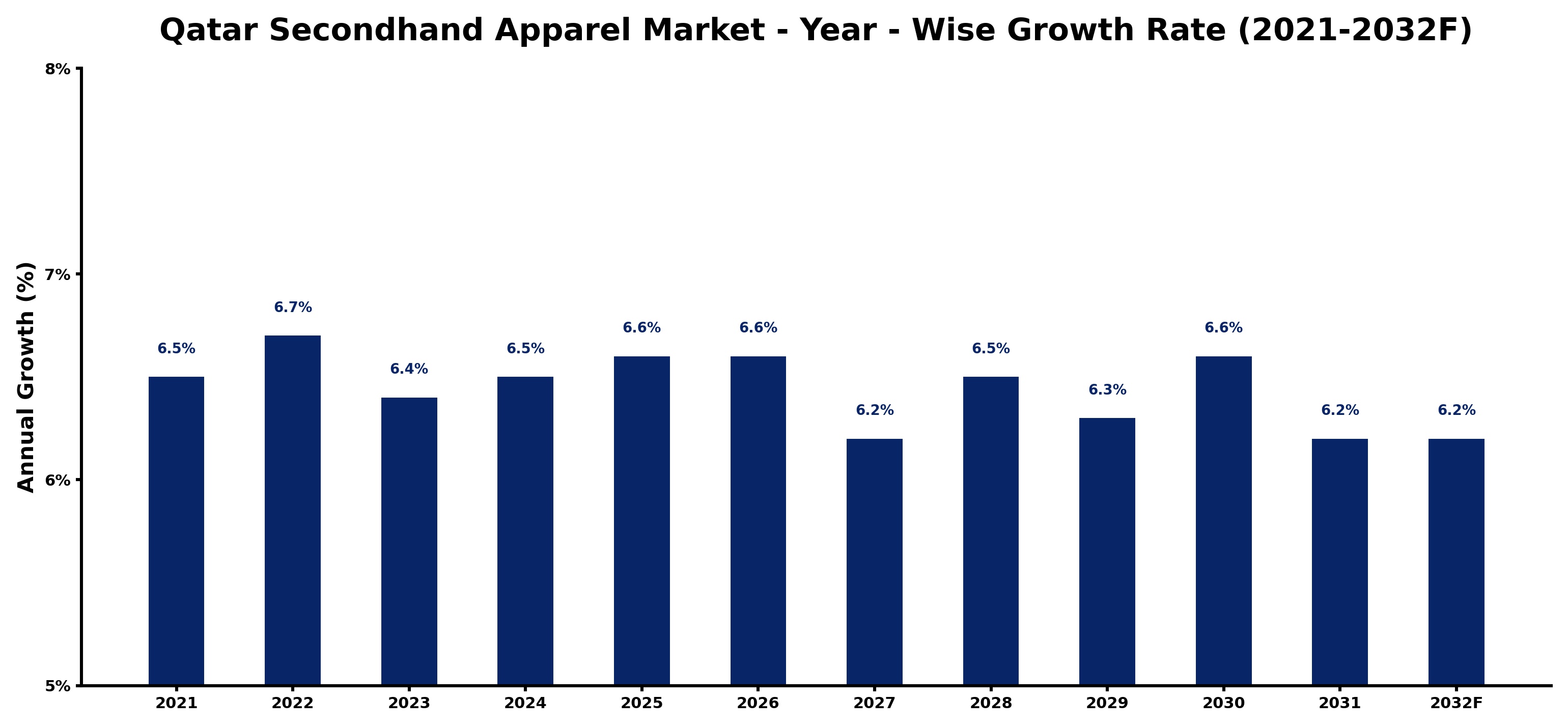
The table below presents the year‑wise growth rates along with the key drivers influencing the market
| Year | Growth Rate | Major Drivers |
| 2021 | 6.5% | Increasing industrial infrastructure investments |
| 2022 | 6.7% | Expansion of manufacturing activities |
| 2023 | 6.4% | Expansion of transportation and logistics networks |
| 2024 | 6.5% | Increasing adoption of advanced technologies |
| 2025 | 6.6% | Growing urbanization and commercial development |
| 2026 | 6.6% | Government infrastructure modernization initiatives |
| 2027 | 6.2% | Growing urbanization and commercial development |
| 2028 | 6.5% | Expansion of commercial construction activities |
| 2029 | 6.3% | Rapid growth in telecom and data center sectors |
| 2030 | 6.6% | Increasing smart city development projects |
| 2031 | 6.2% | Growing renewable energy integration projects |
| 2032 | 6.2% | Increasing smart city development projects |
Note - Market size estimations and growth projections presented in this report are based on 6Wresearch’s advanced forecasting approach, validated with industry datasets as of June 2026.
Qatar Secondhand Apparel Market Synopsis
In recent years, the secondhand apparel market in Qatar has experienced notable momentum, propelled by the increasing acceptance of sustainable fashion. As traditional views evolve, more consumers are viewing pre-owned clothing as not just a budget-friendly option, but also a stylish and eco-friendly choice. This shift in perspective is set against a backdrop of rising disposable incomes, providing fertile ground for further market expansion.
Looking ahead, the Qatar secondhand apparel market is positioned for continued growth, influenced by cultural shifts that favor sustainability and individuality in fashion. With a younger demographic increasingly prioritizing unique and environmentally conscious choices, the future appears promising for businesses operating within this space. As consumer attitudes evolve, the potential for market diversification and innovation remains substantial.
Qatar Secondhand Apparel Market Key Takeaways
- The market is fueled by heightened consumer awareness surrounding sustainability and environmental impact.
- Shifts in cultural attitudes are promoting a growing acceptance of pre-owned clothing among diverse demographics.
- Effective management of inventory and quality assurance are critical for maintaining customer trust and satisfaction.
- The COVID-19 pandemic has accelerated the shift towards online platforms, enhancing accessibility for consumers.
- The market outlook remains robust, with key growth opportunities arising from evolving shopping behaviors.
Evaluation of Restraints in Qatar Secondhand Apparel Market
Despite promising growth, the Qatar secondhand apparel market faces significant challenges that could hinder its expansion. Cultural perceptions surrounding pre-owned items still linger, with some consumers viewing secondhand clothing as inferior or stigmatized. This mindset can impede the broader acceptance of secondhand options. Additionally, ensuring consistent quality control is paramount, as consumers increasingly demand well-maintained garments that meet their style preferences. Addressing these issues through effective marketing and education will be vital for market players aiming to capture a larger share of the growing consumer base.
Qatar Secondhand Apparel Market Trends
Several current trends are shaping the Qatar secondhand apparel market landscape. The rise of digital platforms has transformed how consumers engage with pre-owned fashion, enabling easier access and broader selections. Social media influencers advocating for sustainable choices further bolster interest. Moreover, the growing trend of 'thrifting' is not just about saving money, but also about the unique styles that come with secondhand clothing. This cultural phenomenon is attracting younger generations, influencing their shopping behaviors and fashion preferences.
Qatar Secondhand Apparel Market Opportunities
The Qatar secondhand apparel market presents genuine opportunities for growth and investment. Increasing consumer enthusiasm for sustainable fashion opens avenues for businesses that prioritize eco-friendly practices. Additionally, the burgeoning interest in online shopping creates a ripe environment for innovative e-commerce platforms focused on pre-owned items. Collaborations with local fashion designers to curate exclusive secondhand collections could also resonate with consumers looking for uniqueness in their wardrobe. Such strategies not only enhance brand visibility but also cater to the evolving tastes of a discerning market.
Government Initiatives in the Qatar Secondhand Apparel Market
The government of Qatar has taken an active interest in promoting sustainability and environmental consciousness, which aligns with the goals of the secondhand apparel market. Policies aimed at reducing waste and encouraging recycling have created a supportive framework for businesses operating in this sector. Public initiatives that focus on education about sustainable practices also contribute positively to consumer awareness and acceptance of secondhand shopping. These measures help to foster a culture of sustainability, further bolstering the market's growth potential.
Future Insights of the Qatar Secondhand Apparel Market
Looking forward to the period between 2026 and 2032, the Qatar secondhand apparel market is set to evolve significantly. As sustainability remains a focal point of consumer preference, brands that effectively communicate their commitment to eco-friendly practices will likely thrive. The integration of technology and personalization in the shopping experience will be pivotal in attracting consumers. Additionally, the increasing inclination towards online platforms will reshape market dynamics, creating an environment where convenience and sustainability coalesce, ultimately driving sustained growth.
Qatar Secondhand Apparel Market Latest Developments (May 2025 - June 2026)
In the past year, the Qatar secondhand apparel market has witnessed a surge in digital transformation, with many retailers enhancing their online presence to adapt to changing consumer behaviors post-pandemic. This shift has allowed for increased consumer engagement and sales growth through e-commerce platforms. Additionally, local thrift shops have collaborated with social influencers to promote unique secondhand offerings, effectively tapping into a younger audience that values sustainability and originality. Overall, the market is pivoting towards innovative practices that align with modern consumer values.
Qatar Secondhand Apparel Market - Key Attractiveness of the Report
- 10 Years of Market Numbers
- Historical Data Starting from 2022 to 2025
- Base Year: 2025
- Forecast Data until 2032
- Key Performance Indicators Impacting the Market
- Major Upcoming Developments and Projects
Key Highlights of the Report:
- Qatar Secondhand Apparel Market Outlook
- Market Size of Qatar Secondhand Apparel Market, 2025
- Forecast of Qatar Secondhand Apparel Market, 2032F
- Historical Data and Forecast of Qatar Secondhand Apparel Revenues & Volume for the Period 2022-2032F
- Qatar Secondhand Apparel Market Trend Evolution
- Qatar Secondhand Apparel Market Drivers and Challenges
- Qatar Secondhand Apparel Price Trends
- Qatar Secondhand Apparel Porter's Five Forces
- Qatar Secondhand Apparel Industry Life Cycle
- Historical Data and Forecast of Qatar Secondhand Apparel Market Revenues & Volume By Sector for the Period 2022-2032F
- Historical Data and Forecast of Qatar Secondhand Apparel Market Revenues & Volume By Resale for the Period 2022-2032F
- Historical Data and Forecast of Qatar Secondhand Apparel Market Revenues & Volume By Traditional Thrift Stores and Donations for the Period 2022-2032F
- Historical Data and Forecast of Qatar Secondhand Apparel Market Revenues & Volume By Product Type for the Period 2022-2032F
- Historical Data and Forecast of Qatar Secondhand Apparel Market Revenues & Volume By Dresses & Tops for the Period 2022-2032F
- Historical Data and Forecast of Qatar Secondhand Apparel Market Revenues & Volume By Shirts & T-shirts for the Period 2022-2032F
- Historical Data and Forecast of Qatar Secondhand Apparel Market Revenues & Volume By Sweaters, Coats & Jackets for the Period 2022-2032F
- Historical Data and Forecast of Qatar Secondhand Apparel Market Revenues & Volume By Jeans & Pants for the Period 2022-2032F
- Historical Data and Forecast of Qatar Secondhand Apparel Market Revenues & Volume By Others for the Period 2022-2032F
- Historical Data and Forecast of Qatar Secondhand Apparel Market Revenues & Volume By Target Population for the Period 2022-2032F
- Historical Data and Forecast of Qatar Secondhand Apparel Market Revenues & Volume By Men for the Period 2022-2032F
- Historical Data and Forecast of Qatar Secondhand Apparel Market Revenues & Volume By Women for the Period 2022-2032F
- Historical Data and Forecast of Qatar Secondhand Apparel Market Revenues & Volume By Kids for the Period 2022-2032F
- Historical Data and Forecast of Qatar Secondhand Apparel Market Revenues & Volume By Sales Channel for the Period 2022-2032F
- Historical Data and Forecast of Qatar Secondhand Apparel Market Revenues & Volume By Wholesalers/Distributors for the Period 2022-2032F
- Historical Data and Forecast of Qatar Secondhand Apparel Market Revenues & Volume By Hypermarkets/Supermarkets for the Period 2022-2032F
- Historical Data and Forecast of Qatar Secondhand Apparel Market Revenues & Volume By Multi-brand Stores for the Period 2022-2032F
- Historical Data and Forecast of Qatar Secondhand Apparel Market Revenues & Volume By Independent Small Stores for the Period 2022-2032F
- Historical Data and Forecast of Qatar Secondhand Apparel Market Revenues & Volume By Departmental Stores for the Period 2022-2032F
- Historical Data and Forecast of Qatar Secondhand Apparel Market Revenues & Volume By Online Retailers for the Period 2022-2032F
- Historical Data and Forecast of Qatar Secondhand Apparel Market Revenues & Volume By Others for the Period 2022-2032F
- Qatar Secondhand Apparel Import Export Trade Statistics
- Market Opportunity Assessment By Sector
- Market Opportunity Assessment By Product Type
- Market Opportunity Assessment By Target Population
- Market Opportunity Assessment By Sales Channel
- Qatar Secondhand Apparel Top Companies Market Share
- Qatar Secondhand Apparel Competitive Benchmarking By Technical and Operational Parameters
- Qatar Secondhand Apparel Company Profiles
- Qatar Secondhand Apparel Key Strategic Recommendations






































