Qatar Sweet Biscuits Market Size, Share & Growth Rate
The Qatar Sweet Biscuits Market was estimated at USD 477 Million in 2025 and is projected to reach USD 655 Million by 2032, growing at a CAGR of 4.6% from 2026 to 2032. This upward trajectory is primarily driven by changing consumer lifestyles favoring convenient snack options and the cultural significance of sweet biscuits in social gatherings. As consumers increasingly indulge in premium offerings, the market is evolving to meet their demands for quality and variety.
Qatar Sweet Biscuits Market Year-wise Growth Rate and Key Drivers
This graph highlights how the Qatar Sweet Biscuits Market has steadily grown over the years, supported by major growth factors.
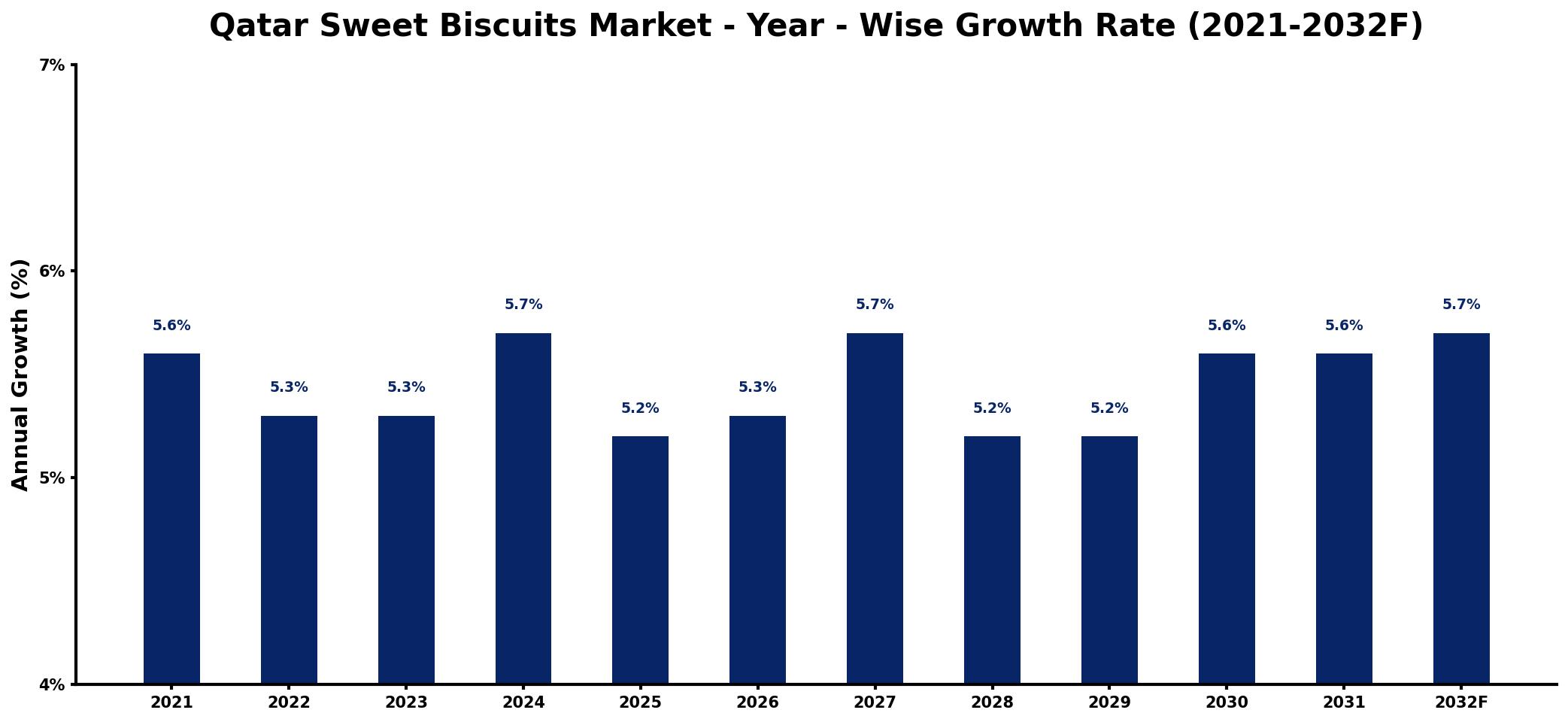
The table below presents the year‑wise growth rates along with the key drivers influencing the market
| Year | Growth Rate | Major Drivers |
| 2021 | 5.6% | Rising consumer health awareness |
| 2022 | 5.3% | Growing demand for convenience foods |
| 2023 | 5.3% | Increase in local production capacity |
| 2024 | 5.7% | Expansion of retail distribution channels |
| 2025 | 5.2% | Higher disposable income levels |
| 2026 | 5.3% | Emergence of innovative flavors |
| 2027 | 5.7% | enhanced product quality standards |
| 2028 | 5.2% | increased production capacity utilization |
| 2029 | 5.2% | Growing popularity of snacking trends |
| 2030 | 5.6% | rising export shipment volumes |
| 2031 | 5.6% | Enhanced consumer engagement strategies |
| 2032 | 5.7% | Development of sustainable packaging solutions |
Note: Market size estimations and growth projections presented in this report are based on 6Wresearch's proprietary forecasting methodology, utilizing the latest available industry data, government publications, and primary research inputs.
Qatar Sweet Biscuits Market Synopsis
The sweet biscuits market in Qatar has experienced a notable surge, propelled by an increasing preference for on-the-go snacking and a rich cultural backdrop that embraces these treats. Traditionally enjoyed with tea and coffee, sweet biscuits have become a staple in both everyday life and special occasions, reinforcing their position within the local market.
However, as we look forward, the market is poised for significant transformation, responding to evolving consumer preferences towards healthier and premium biscuit options. The incorporation of innovative flavors and ingredients will be vital in maintaining the markets momentum while catering to the health-conscious segment of consumers.
Qatar Sweet Biscuits Market Key Takeaways
- Consumer demand for convenience is driving the growth of sweet biscuits in Qatar.
- Health and wellness trends are prompting manufacturers to innovate with healthier options.
- Sweet biscuits are integral to Qatari culture, often served during social events and gatherings.
- There is a growing willingness among consumers to invest in premium products that offer unique flavors.
- The COVID-19 pandemic has accelerated the adoption of online distribution channels for sweet biscuits.
Evaluation of Restraints in Qatar Sweet Biscuits Market
Despite the overall growth trajectory, the Qatar sweet biscuits market faces notable constraints. A shift in snacking habits towards healthier alternatives has led to a decline in demand for traditional sweet biscuits. Consumers are increasingly conscious of ingredient transparency and nutritional content, which pressures manufacturers to adapt their offerings. Additionally, competition from a diverse range of snack foods complicates the positioning of sweet biscuits as a preferred option, necessitating strategic marketing and product innovation to capture consumer interest.
Qatar Sweet Biscuits Market Trends
Several trends are shaping the landscape of the Qatar sweet biscuits market. The rise of premiumization is notable, as consumers are drawn to artisanal and gourmet biscuit varieties that promise unique flavor experiences. Additionally, there is an increasing focus on health-oriented products, with manufacturers exploring organic ingredients and reduced sugar options. E-commerce has emerged as a key distribution channel, reflecting changing shopping behaviors influenced by the pandemic, and social media marketing is becoming increasingly important in reaching target demographics.
Qatar Sweet Biscuits Market Opportunities
The evolving preferences of Qatari consumers present substantial opportunities for growth in the sweet biscuits market. Innovating with healthier formulations that appeal to the growing health-conscious demographic can lead to new customer segments. Furthermore, tapping into the premium market by creating exclusive and high-quality products can attract discerning consumers willing to pay a premium for unique taste experiences. Additionally, expanding online presence and distribution capabilities can enhance accessibility and drive sales.
Government Initiatives in the Qatar Sweet Biscuits Market
The Qatari government has been proactive in promoting local food production and supporting the snack industry through various initiatives. This includes incentives for small and medium-sized enterprises (SMEs) that enhance local food offerings, thereby encouraging the growth of the sweet biscuits segment. Public awareness campaigns focused on healthy eating further drive market participation, encouraging manufacturers to align their product portfolios with national health objectives.
Future Insights of the Qatar Sweet Biscuits Market
Looking ahead to 2026-2032, the Qatar sweet biscuits market is expected to continue its growth trajectory, driven by ongoing innovations and shifting consumer preferences. The integration of health-conscious formulations alongside traditional flavors will be critical in appealing to a broader audience. Additionally, the rise of e-commerce will likely redefine how consumers interact with brands, creating avenues for direct consumer engagement and personalized offerings. The market is well-positioned to adapt and flourish in this dynamic environment.
Qatar Sweet Biscuits Market Latest Developments (2025 - 2026)
Recent developments in the Qatar sweet biscuits market indicate a strong push towards diversifying product offerings. Manufacturers are increasingly launching new flavors and healthier options in response to consumer demand. Additionally, online sales channels are being expanded, reflecting a strategic shift towards digital engagement. Collaborations with local influencers for marketing campaigns are also on the rise, aiming to better connect with the younger demographic.
Qatar Sweet Biscuits Market - Key Attractiveness of the Report
- 10 Years of Market Numbers
- Historical Data Starting from 2022 to 2025
- Base Year: 2025
- Forecast Data until 2032
- Key Performance Indicators Impacting the Market
- Major Upcoming Developments and Projects
Key Highlights of the Report:
- Qatar Sweet Biscuits Market Outlook
- Market Size of Qatar Sweet Biscuits Market, 2025
- Forecast of Qatar Sweet Biscuits Market, 2032
- Historical Data and Forecast of Qatar Sweet Biscuits Revenues & Volume for the Period 2022-2032F
- Qatar Sweet Biscuits Market Trend Evolution
- Qatar Sweet Biscuits Market Drivers and Challenges
- Qatar Sweet Biscuits Price Trends
- Qatar Sweet Biscuits Porter's Five Forces
- Qatar Sweet Biscuits Industry Life Cycle
- Historical Data and Forecast of Qatar Sweet Biscuits Market Revenues & Volume By Product Type for the Period 2022-2032F
- Historical Data and Forecast of Qatar Sweet Biscuits Market Revenues & Volume By Chocolate-coated Biscuits for the Period 2022-2032F
- Historical Data and Forecast of Qatar Sweet Biscuits Market Revenues & Volume By Cookies for the Period 2022-2032F
- Historical Data and Forecast of Qatar Sweet Biscuits Market Revenues & Volume By Filled Biscuits for the Period 2022-2032F
- Historical Data and Forecast of Qatar Sweet Biscuits Market Revenues & Volume By Plain Biscuits for the Period 2022-2032F
- Historical Data and Forecast of Qatar Sweet Biscuits Market Revenues & Volume By Sandwich Biscuits for the Period 2022-2032F
- Historical Data and Forecast of Qatar Sweet Biscuits Market Revenues & Volume By Other Sweet Biscuits for the Period 2022-2032F
- Historical Data and Forecast of Qatar Sweet Biscuits Market Revenues & Volume By Distribution Channel for the Period 2022-2032F
- Historical Data and Forecast of Qatar Sweet Biscuits Market Revenues & Volume By Supermarkets/Hypermarkets for the Period 2022-2032F
- Historical Data and Forecast of Qatar Sweet Biscuits Market Revenues & Volume By Specialist Retailers for the Period 2022-2032F
- Historical Data and Forecast of Qatar Sweet Biscuits Market Revenues & Volume By Convenience Stores for the Period 2022-2032F
- Historical Data and Forecast of Qatar Sweet Biscuits Market Revenues & Volume By Online Stores for the Period 2022-2032F
- Historical Data and Forecast of Qatar Sweet Biscuits Market Revenues & Volume By Other Distribution Channels for the Period 2022-2032F
- Qatar Sweet Biscuits Import Export Trade Statistics
- Market Opportunity Assessment By Product Type
- Market Opportunity Assessment By Distribution Channel
- Qatar Sweet Biscuits Top Companies Market Share
- Qatar Sweet Biscuits Competitive Benchmarking By Technical and Operational Parameters
- Qatar Sweet Biscuits Company Profiles
- Qatar Sweet Biscuits Key Strategic Recommendations






































