Romania Acrylic Acid Market Size (2020-2030)
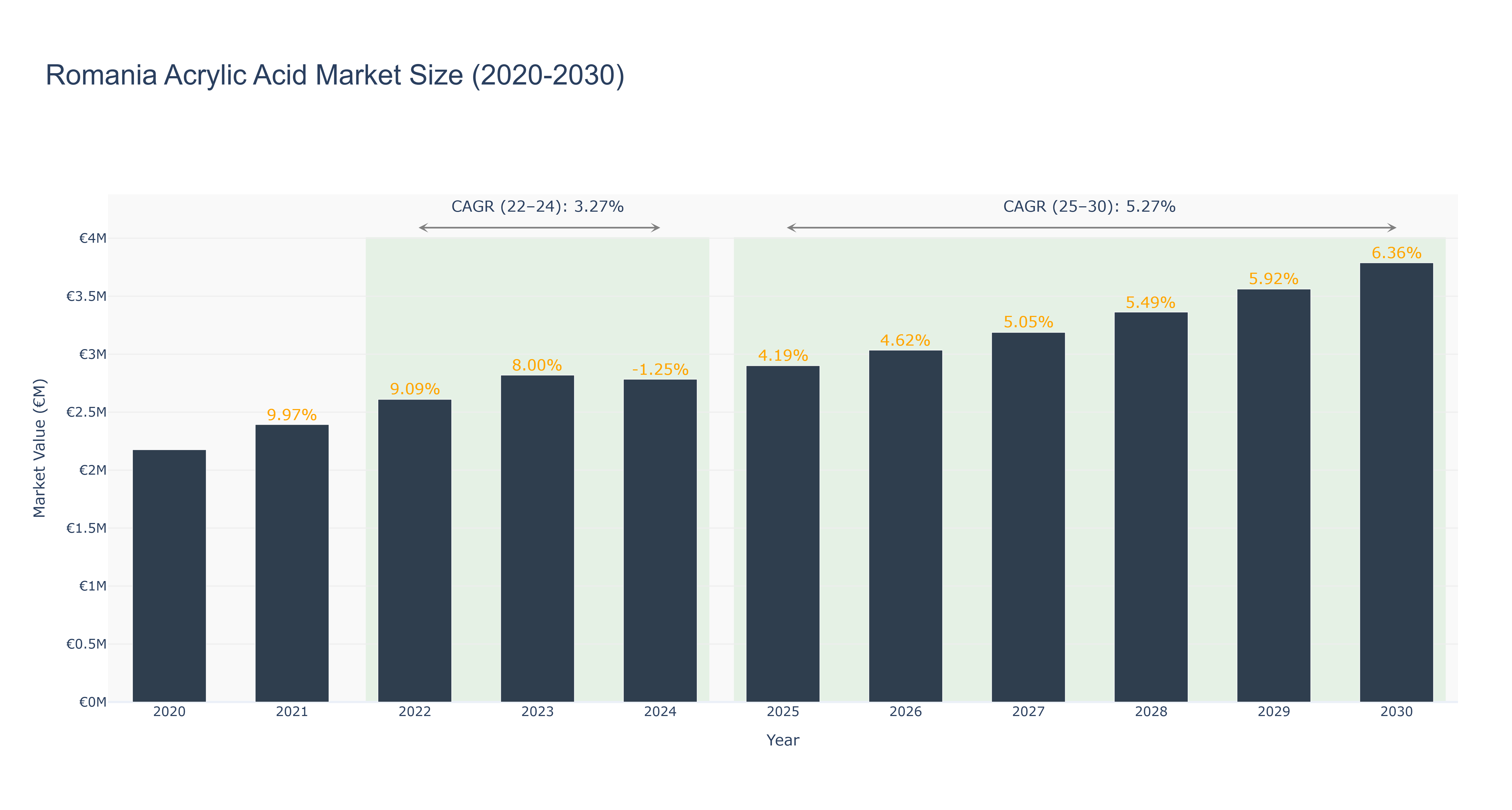
Romania Acrylic Acid Market has shown a fluctuating trend over the past decade. The market peaked at €3.79 million in 2030, with a steady growth rate. From 2020 to 2024, the market size ranged from €2.18 million to €2.78 million, experiencing a slight decline in 2024. The forecasted growth from 2025 to 2030 is promising, with an expected market size of €3.79 million in 2030. The CAGR values for the periods 2022-24 and 2025-30 are 3.27% and 5.27%, respectively. The market's growth can be attributed to increasing demand for acrylic acid in various industries, such as adhesives, textiles, and personal care products. Recent developments in Romania's chemical industry, including investments in research and development for eco-friendly acrylic acid production methods, are expected to further boost market growth in the coming years.
Romania Acrylic Acid Market: Production & Trade Performance (2019-2025)
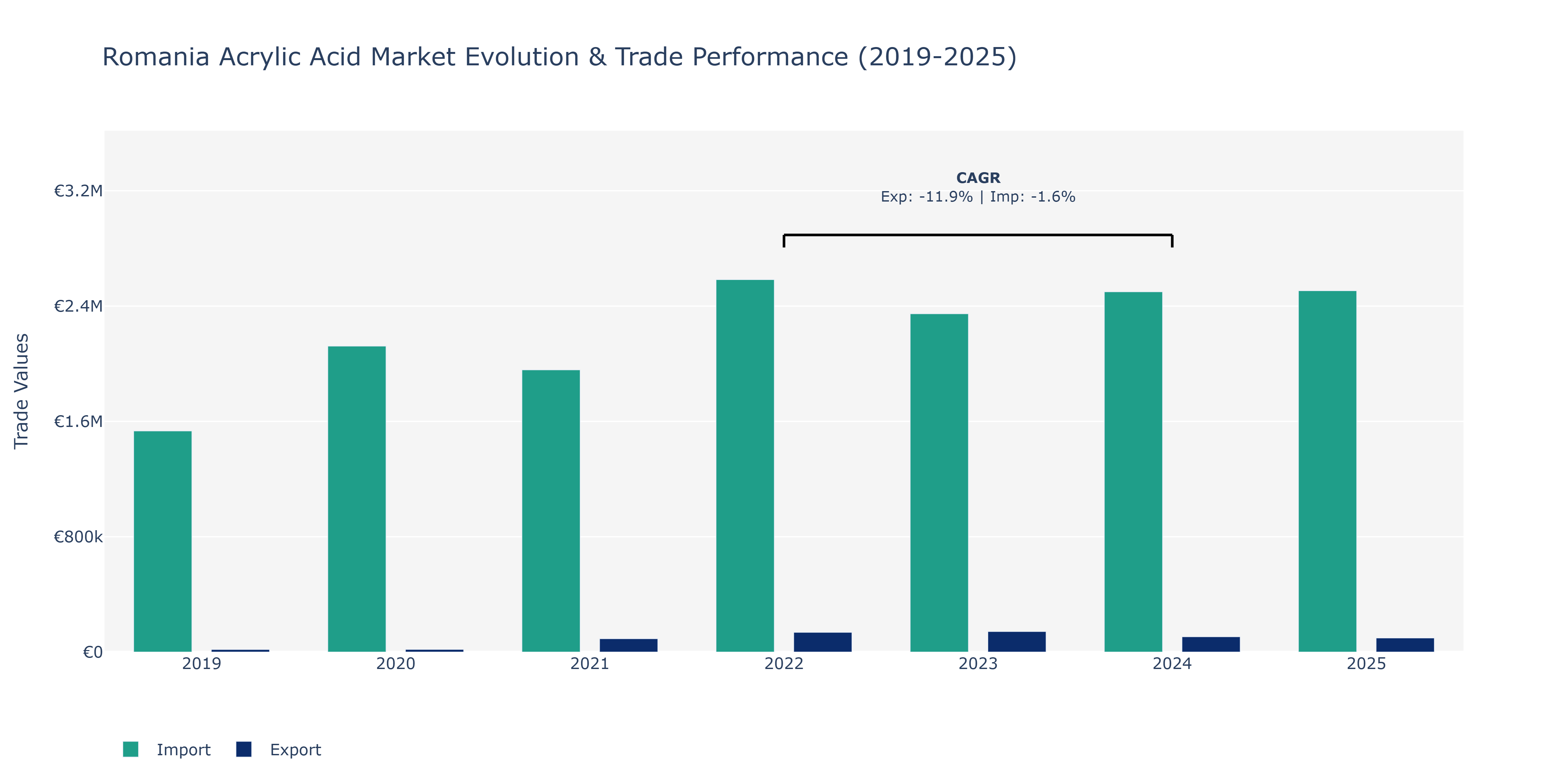
Between 2019 and 2025, Romania's Acrylic Acid Market witnessed varying trends in exports and imports. The exports started at €17.78 thousand in 2019, showing a slight upward trajectory until 2022, reaching €136.63 thousand before dropping in the following years. In contrast, imports showed a consistent increase from €1.53 million in 2019 to €2.51 million in 2025, with minor fluctuations. The peak export value was €142.20 thousand in 2023, while imports peaked at €2.58 million in 2022. The fluctuations in exports can be attributed to changing global demand, supply chain disruptions, and market competition, impacting Romania's position in the Acrylic Acid Market. On the other hand, the steady rise in imports reflects the country's dependence on foreign sources for acrylic acid, possibly due to limited domestic production capacity or cost advantages from international suppliers. Such dynamics highlight Romania's position within the global acrylic acid trade landscape, necessitating strategic market positioning and supply chain management to navigate future uncertainties.
Romania Acrylic acid Market Overview
The Romania acrylic acid market is experiencing steady growth driven by increasing demand from various end-use industries such as adhesives, coatings, and textiles. The market is primarily influenced by the construction sector, where acrylic acid is used in adhesives and sealants. The automotive industry also plays a significant role in the market as acrylic acid is utilized in coatings for vehicles. Additionally, the growing popularity of acrylic-based products in the furniture and packaging industries is further boosting market growth. Key market players in Romania include domestic producers as well as international companies, contributing to a competitive landscape. The market is expected to continue expanding due to ongoing industrial development and increasing consumer demand for acrylic acid-based products.
Romania Acrylic acid Market Trends
The Romania Acrylic acid market is currently experiencing growth driven by increasing demand from end-use industries such as adhesives, paints, coatings, and textiles. The market is witnessing a shift towards eco-friendly and sustainable acrylic acid derivatives, in line with the global trend towards environmentally friendly products. Manufacturers are focusing on developing bio-based acrylic acid products to cater to the growing demand for sustainable solutions. Additionally, technological advancements in production processes are leading to improved product quality and cost-effectiveness, further driving market growth. The increasing investment in research and development activities aimed at enhancing product performance and expanding application areas is expected to continue shaping the Romania Acrylic acid market in the near future.
Romania Acrylic acid Market Challenges
In the Romania Acrylic acid market, some challenges that are commonly faced include fluctuating raw material prices, increasing competition from imported acrylic acid products, and regulatory hurdles related to environmental concerns. The volatility in raw material prices, such as propylene, can impact the overall production costs and profit margins for local manufacturers. Imported acrylic acid products from other countries can pose a threat to domestic producers, leading to price wars and market saturation. Additionally, stringent environmental regulations regarding the disposal of by-products and waste generated during the production process can add to operational costs and require continuous compliance monitoring. Overall, navigating these challenges requires strategic planning, efficient operations, and a strong understanding of market dynamics.
Romania Acrylic acid Market Investment Opportunities
The Romania Acrylic acid market presents promising investment opportunities due to the increasing demand for acrylic acid in various industries such as adhesives, coatings, textiles, and personal care products. With a growing economy and infrastructure development in Romania, there is a significant potential for expansion in the acrylic acid market. Investing in acrylic acid production facilities or partnering with local manufacturers to meet the rising demand can be a lucrative opportunity for investors. Additionally, focusing on innovation and product development to cater to specific industry needs and preferences can further enhance the investment prospects in the Romania acrylic acid market. Conducting thorough market research and staying updated on industry trends will be crucial for successful investment decision-making in this sector.
Romania Acrylic acid Market Government Policy
Government policies related to the Romania Acrylic acid Market focus on promoting sustainability and environmental protection. The Romanian government has implemented regulations to ensure that acrylic acid production processes adhere to strict environmental standards to reduce emissions and minimize environmental impact. Additionally, there are policies in place to encourage investment in research and development within the acrylic acid industry to foster innovation and technological advancements. The government also promotes transparency and fair competition within the market to ensure a level playing field for all industry players. Overall, the government`s policies aim to support the growth of the acrylic acid market in Romania while ensuring sustainability and environmental responsibility.
Romania Acrylic acid Market Future Outlook
The future outlook for the Romania Acrylic acid market appears promising, driven by increasing demand from various end-use industries such as textiles, adhesives, and coatings. The market is expected to witness steady growth due to the expanding construction and automotive sectors in the region. Additionally, the rising focus on sustainable and eco-friendly products is likely to boost the demand for bio-based acrylic acid in Romania. However, challenges such as volatile raw material prices and stringent regulations may impact market growth to some extent. Overall, innovations in production technologies and increasing investments in research and development are anticipated to drive the Romania Acrylic acid market towards growth and expansion in the coming years.
Key Highlights of the Report:
- Romania Acrylic acid Market Outlook
- Market Size of Romania Acrylic acid Market, 2021
- Forecast of Romania Acrylic acid Market, 2027
- Historical Data and Forecast of Romania Acrylic acid Revenues & Volume for the Period 2018 - 2027
- Romania Acrylic acid Market Trend Evolution
- Romania Acrylic acid Market Drivers and Challenges
- Romania Acrylic acid Price Trends
- Romania Acrylic acid Porter's Five Forces
- Romania Acrylic acid Industry Life Cycle
- Historical Data and Forecast of Romania Acrylic acid Market Revenues & Volume By Product for the Period 2018 - 2027
- Historical Data and Forecast of Romania Acrylic acid Market Revenues & Volume By Acrylate Esters for the Period 2018 - 2027
- Historical Data and Forecast of Romania Acrylic acid Market Revenues & Volume By Glacial Acrylic Acid for the Period 2018 - 2027
- Historical Data and Forecast of Romania Acrylic acid Market Revenues & Volume By Others for the Period 2018 - 2027
- Historical Data and Forecast of Romania Acrylic acid Market Revenues & Volume By End-users for the Period 2018 - 2027
- Historical Data and Forecast of Romania Acrylic acid Market Revenues & Volume By Surfactants and Surface Coatings for the Period 2018 - 2027
- Historical Data and Forecast of Romania Acrylic acid Market Revenues & Volume By Organic Chemicals for the Period 2018 - 2027
- Historical Data and Forecast of Romania Acrylic acid Market Revenues & Volume By Water Filtration for the Period 2018 - 2027
- Historical Data and Forecast of Romania Acrylic acid Market Revenues & Volume By Adhesives and Sealants for the Period 2018 - 2027
- Historical Data and Forecast of Romania Acrylic acid Market Revenues & Volume By Textiles for the Period 2018 - 2027
- Historical Data and Forecast of Romania Acrylic acid Market Revenues & Volume By Water Treatment for the Period 2018 - 2027
- Historical Data and Forecast of Romania Acrylic acid Market Revenues & Volume By Personal Care Products for the Period 2018 - 2027
- Historical Data and Forecast of Romania Acrylic acid Market Revenues & Volume By Others for the Period 2018 - 2027
- Romania Acrylic acid Import Export Trade Statistics
- Market Opportunity Assessment By Product
- Market Opportunity Assessment By End-users
- Romania Acrylic acid Top Companies Market Share
- Romania Acrylic acid Competitive Benchmarking By Technical and Operational Parameters
- Romania Acrylic acid Company Profiles
- Romania Acrylic acid Key Strategic Recommendations






































