Romania Construction Market: Import Trend Analysis
In the Romania construction market, the import trend showed a growth rate of 3.12% from 2023 to 2024, with a Compound Annual Growth Rate (CAGR) of 14.57% from 2020 to 2024. This notable increase in imports can be attributed to a surge in demand for construction materials and equipment, indicating a positive market stability and robust import momentum during the period.
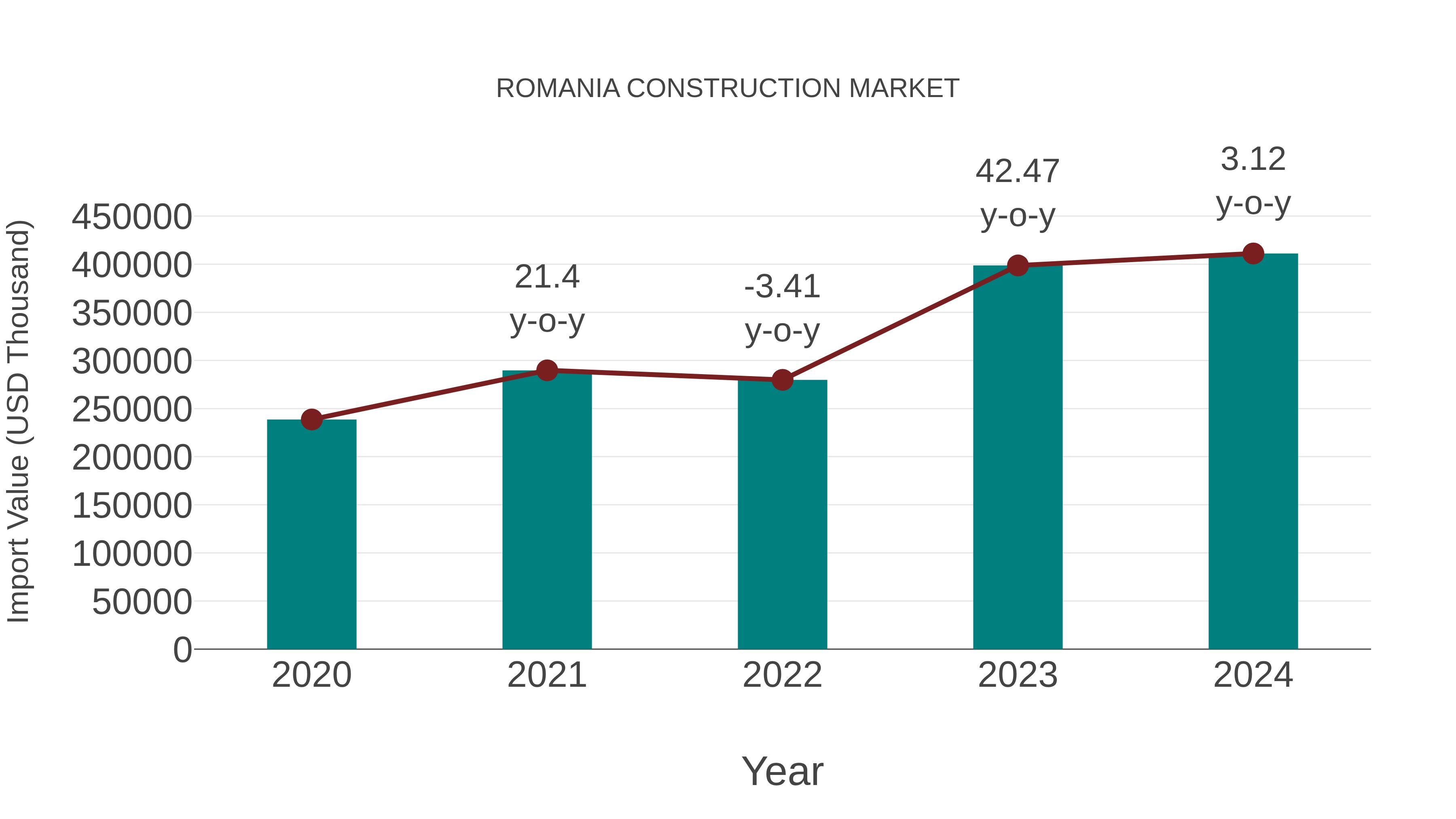
Romania Construction Market Growth Rate
According to 6Wresearch internal database and industry insights, the Romania Construction Market is projected to grow at a compound annual growth rate (CAGR) of 6.2% during the forecast period (2026–2032).
Five-Years Growth Trajectory of the Romania Construction Market with Core Drivers
Below is the evaluation of the year-wise growth rate along with key drivers:
| Years | Estimated Annual Growth (%) | Growth Drivers |
| 2021 | 5 | Increased government investments in infrastructure projects |
| 2022 | 5.5 | Rising urbanization and demand for residential spaces |
| 2023 | 5.7 | Growth in commercial construction and industrial facilities |
| 2024 | 6 | Expansion of transportation infrastructure projects |
| 2025 | 6.1 | Government initiatives to promote green building technologies |
Topics Covered in the Romania Construction Market Report
The Romania Construction Market report thoroughly covers the market by Product Types, Sectors, and Categories. The report provides a detailed analysis of ongoing market trends, opportunities/high-growth areas, and market drivers that will help stakeholders devise and align strategies according to current and future market dynamics.
Romania Construction Market Highlights
| Report Name | Romania Construction Market |
| Forecast period | 2026-2032 |
| CAGR | 6.2% |
| Growing Sector | Construction and Infrastructure Development |
Romania Construction Market Synopsis
Steady expansion in Romania Construction Sector is fueled by strong demand from residential, commercial, and infrastructure projects. Urban population growth, improving income levels, and the widening middle class are increasing the need for modern housing and infrastructure. Additionally, government-backed policies promoting sustainable building practices and energy efficiency, combined with investments in transportation and energy, are reinforcing industry growth. Progress in smart city initiatives and logistics infrastructure is further driving construction activity.
Evaluation of Growth Drivers in the Romania Construction Market
Below are some prominent drivers and their influence on the Romania Construction Market dynamics:
| Drivers | Primary Segments Affected | Why it Matters |
| Government Infrastructure Investments | By Product (Heavy and Civil Engineering) | Government spending on roadways, bridges, and energy infrastructure is driving demand. |
| Urbanization and Population Growth | By Sector (Urban) | Urban expansion is creating a higher need for housing and commercial construction projects. |
| Green Building Technology Adoption | By Category (New) | Energy-efficient and sustainable construction is becoming a key focus. |
| Development in Industrial Sectors | By Product (General Construction) | Increased demand for factories, warehouses, and logistics facilities is on the rise. |
The Romania Construction Market is projected to grow at a CAGR of 6.2% during the forecast period (2026–2032). The Romania Construction Market is being propelled by growing residential demand, expanding commercial projects, and increased government spending on infrastructure. Momentum is further supported by green building methods, smart city development, and the adoption of energy-saving technologies. Furthermore, government focus on eco-friendly building programs is keeping environmental sustainability at the center of future construction development. Moreover, these factors are driving long-term growth and innovation in Romania Construction Sector.
Evaluation of Restraints in the Romania Construction Market
Below are some prominent restraints and their influence on the Romania Construction Market dynamics:
| Restraints | Primary Segments Affected | What this Means |
| Rising Raw Material Prices | By Product (All Categories) | Fluctuating price of raw material like cement and steel can push construction costs up. |
| Bureaucratic Hurdles in Licensing | By Sector (Urban, Rural) | Permit- related delays can negatively impact project completion timelines. |
| Skilled Labor Shortage | By Product (General Construction) | Lack of skilled labor may slow down project completion rates. |
| Regulatory Challenges in Sustainability | By Category (New, Renovation) | Enhanced environmental requirements could increase the cost burden for compliance. |
Romania Construction Market Challenges
The Romania Construction Industry encounters several challenges such as fluctuating input costs, lack of availability of skilled workers, and complex administrative procedures for project approvals. Increasing prices of essential materials, especially steel and cement, pose risks to profit margins. Additionally, meeting increasingly strict sustainability regulations is becoming more challenging. Although constraints persist, government support and ongoing urban expansion are likely to sustain market growth.
Romania Construction Market Trends
Several key trends are shaping the Romania Construction Market Growth:
- Urban Growth in Romania and Associated Demand for Housing – With the high rate of urbanisation in Romania, the demand for new residential construction is ever-growing, especially in large metropolitan areas such as Bucharest, Cluj Napoca and Timisoara.
- Sustainable Construction Demand – Heightened climate awareness is encouraging wider use of energy-efficient construction methods and LEED certification.
- Modular & Prefabricated Construction Techniques – These methods are being used frequently as they reduce costs and speed up construction.
- Emphasis on Infrastructure Projects – The Romanian government growing investment in transport infrastructure, including roads and bridges, is fueling expansion in the construction market.
Investment Opportunities in the Romania Construction Market
Some notable investment opportunities include:
- Buying better builders: The trend toward sustainable building continues to increase and build on the growing number of people wanting to create environmentally friendly buildings, through more energy-efficient building processes and products.
- Development of infrastructure: There are currently many government investment opportunities into infrastructure projects including roads, bridges, transportation, and utilities.
- Residential and Commercial Property Markets: There are currently strong markets for housing and commercial office spaces located in urban centers, leading to significant investment opportunities in this area of development.
- Smart Buildings Technology: Investment in IoT automated systems and construction technologies for smart buildings will greatly increase in purchasing value.
Top 5 Leading Players in the Romania Construction Market
Some leading players operating in the Romania Construction Market Share include:
1 Conarg Engineering
| Company Name | Conarg Engineering |
|---|---|
| Established Year | 1994 |
| Headquarters | Bucharest, Romania |
| Official Website | Click Here |
Conarg Engineering is a leader in the Romanian construction market, specializing in infrastructure projects, industrial construction, and civil engineering works.
2 Holcim Romania
| Company Name | Holcim Romania |
|---|---|
| Established Year | 1999 |
| Headquarters | Bucharest, Romania |
| Official Website | Click Here |
Holcim Romania, a part of the global Holcim Group, provides building materials including cement, aggregates, and ready-mix concrete for construction projects across Romania.
3 Strabag SRL
| Company Name | Strabag SRL |
|---|---|
| Established Year | 2004 |
| Headquarters | Bucharest, Romania |
| Official Website | Click Here |
Strabag SRL is a major construction and civil engineering company, known for large infrastructure, transportation, and residential projects across Romania.
4 Romconstruct
| Company Name | Romconstruct |
|---|---|
| Established Year | 1993 |
| Headquarters | Bucharest, Romania |
| Official Website | - |
Romconstruct is a well-established construction company in Romania, providing services in residential, commercial, and industrial construction, with a focus on quality and sustainability.
5 Porr Construct
| Company Name | Porr Construct |
|---|---|
| Established Year | 2005 |
| Headquarters | Bucharest, Romania |
| Official Website | Click Here |
Porr Construct is a leading construction firm in Romania, with expertise in commercial, residential, and infrastructure projects, focusing on timely delivery and innovation.
Government Regulations Introduced in the Romania Construction Market
According to Romanian government data, initiatives such as the Romanian Green Building Council, the National Sustainable Development Strategy, and the Energy Efficiency Law are supporting growth in the construction market. Government policies emphasize sustainable construction practices, energy-efficient buildings, and reduced environmental impact. Measures including subsidies for energy-efficient housing, tax incentives for green building materials, and regulations promoting renewable energy use in new developments are strengthening market expansion.
Future Insights of the Romania Construction Market
Strong demand for residential and commercial property, growth in the development of infrastructure projects, and growth in sustainable construction technologies will drive increased growth in the Romania Construction Market. In addition, initiatives by national governments that support the construction of smart city projects and the use of green building standards also positively affect the growth outlook for this market. As a result of these factors, urbanization trends and the expansion of the middle-class population will drive the need for modern, energy-efficient buildings, thereby further supporting continued growth in the Construction Industry.
Market Segmentation Analysis
The report offers a comprehensive study of the following market segments and their leading categories:
By Product Type – Heavy and Civil Engineering to Lead the Market
According to Ritika Kalra, Senior Research Analyst at 6Wresearch, Heavy and civil engineering construction, including infrastructure projects such as roads, bridges, and railways, is expected to dominate the Romania construction market due to substantial government investment in transportation and utilities.
By Sector – Urban Sector to Lead the Market
Urban areas are witnessing significant growth in residential, commercial, and infrastructure construction. As more people migrate to cities, the demand for new housing and commercial spaces is increasing, leading to a dominant focus on urban construction projects.
By Category – New Construction to Lead the Market
The demand for new construction is higher than for renovation projects in Romania. Driven by the growing population, urbanization, and expanding infrastructure projects, new construction activities are expected to dominate the market over the forecast period.
Key Attractiveness of the Report
- 10 Years of Market Numbers
- Historical Data Starting from 2022 to 2025
- Base Year: 2025
- Forecast Data until 2032
- Key Performance Indicators Impacting the Market
- Major Upcoming Developments and Projects
Key Highlights of the Report:
- Romania Construction Market Outlook
- Market Size of Romania Construction Market, 2025
- Forecast of Romania Construction Market, 2032
- Historical Data and Forecast of Romania Construction Revenues & Volume for the Period 2022- 2032
- Romania Construction Market Trend Evolution
- Romania Construction Market Drivers and Challenges
- Romania Construction Price Trends
- Romania Construction Porter's Five Forces
- Romania Construction Industry Life Cycle
- Historical Data and Forecast of Romania Construction Market Revenues & Volume By Product for the Period 2022- 2032
- Historical Data and Forecast of Romania Construction Market Revenues & Volume By Heavy and Civil Engineering for the Period 2022- 2032
- Historical Data and Forecast of Romania Construction Market Revenues & Volume By General Construction for the Period 2022- 2032
- Historical Data and Forecast of Romania Construction Market Revenues & Volume By Sector for the Period 2022- 2032
- Historical Data and Forecast of Romania Construction Market Revenues & Volume By Urban for the Period 2022- 2032
- Historical Data and Forecast of Romania Construction Market Revenues & Volume By Rural for the Period 2022- 2032
- Historical Data and Forecast of Romania Construction Market Revenues & Volume By Category for the Period 2022- 2032
- Historical Data and Forecast of Romania Construction Market Revenues & Volume By New for the Period 2022- 2032
- Historical Data and Forecast of Romania Construction Market Revenues & Volume By Renovation for the Period 2022- 2032
- Romania Construction Import Export Trade Statistics
- Market Opportunity Assessment By Product
- Market Opportunity Assessment By Sector
- Market Opportunity Assessment By Category
- Romania Construction Top Companies Market Share
- Romania Construction Competitive Benchmarking By Technical and Operational Parameters
- Romania Construction Company Profiles
- Romania Construction Key Strategic Recommendations
Markets Covered
The report offers a comprehensive study of the following market segments:
By Product Type
- Heavy and Civil Engineering
- General Construction
By Sector
- Urban
- Rural
By Category
- New
- Renovation






































