Romania Energy Security Market Size & Growth Rate (2026-2032)
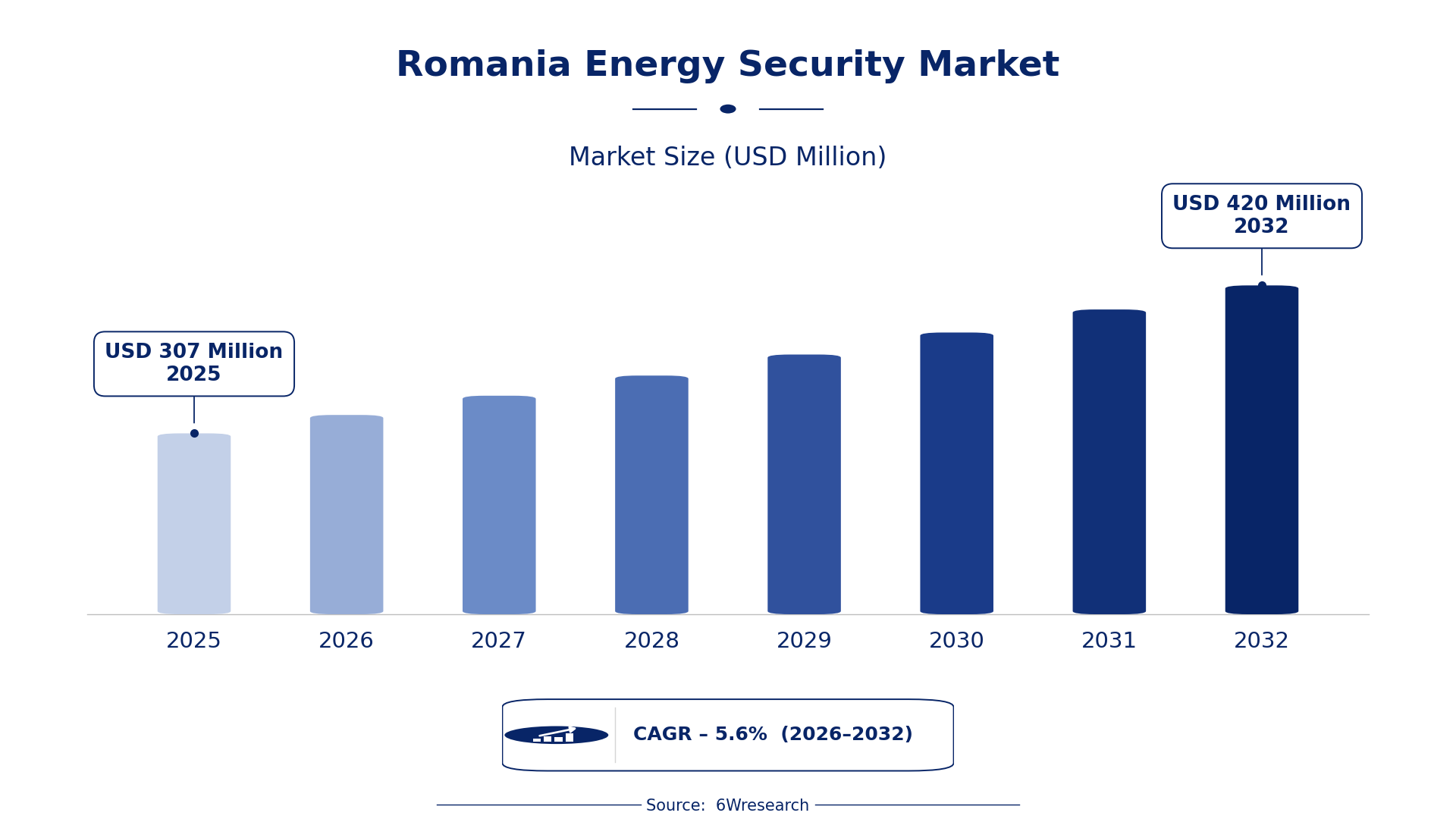
The Romania Energy Security Market was estimated at USD 307 Million in 2025 and is projected to reach USD 420 Million by 2032, growing at a CAGR of 5.6% from 2026 to 2032.
Romania Energy Security Market Synopsis
The foremost force influencing the Romania Energy Security Market is the urgent need to diversify energy sources. This necessity arises from a combination of geopolitical pressures and domestic ambitions to enhance energy independence and sustainability.
As Romania pivots towards renewable energy, particularly wind and solar, investment in infrastructure modernization becomes increasingly critical. The focus on enhancing energy efficiency and reducing reliance on imported fossil fuels is reshaping the market dynamics considerably.
Romania Energy Security Market Year-wise Growth Rate and Key Drivers
This graph illustrates the annual growth rates of the Romania Energy Security Market from 2021 to 2032, highlighting a steady upward trajectory and projected expansion over the forecast period.
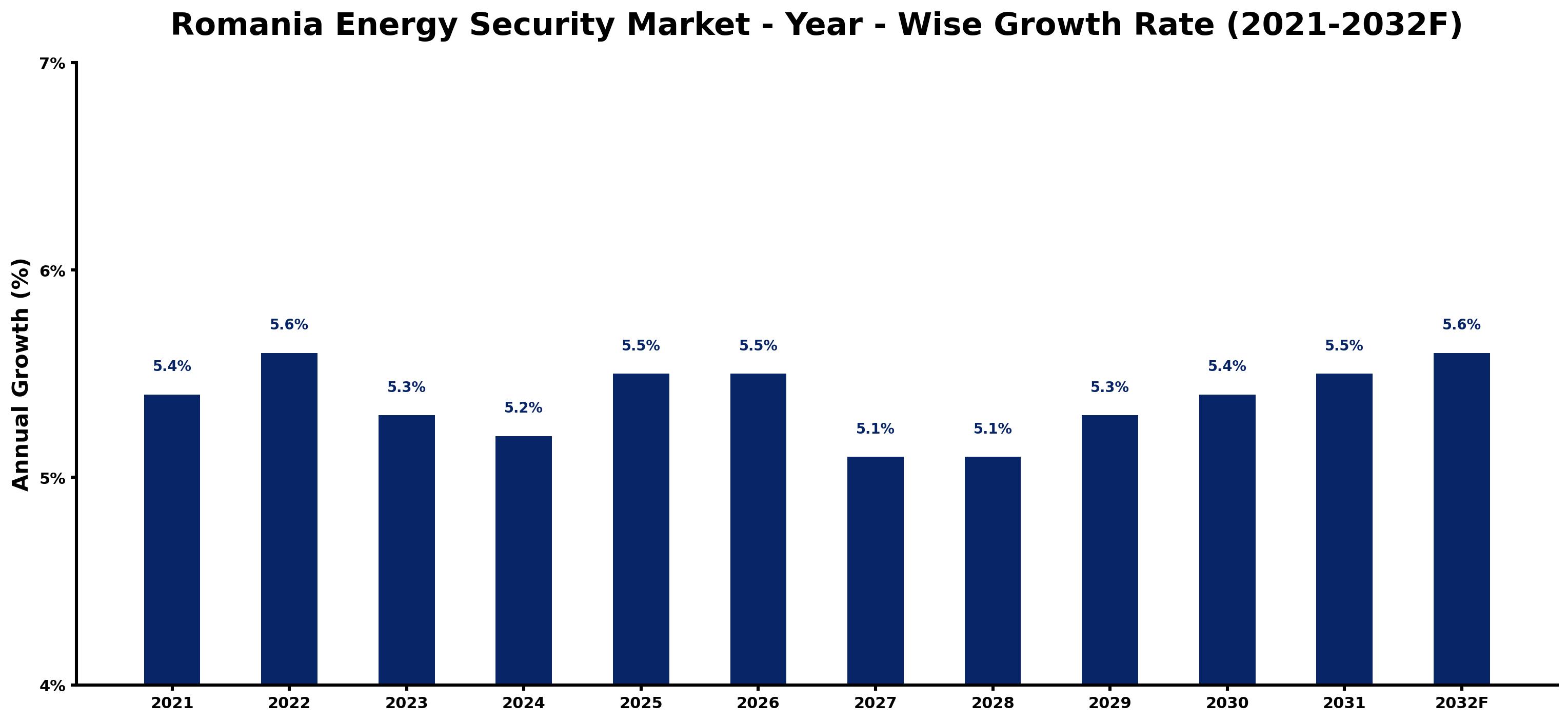
The table below presents the year‑wise growth rates along with the key drivers influencing the market
| Year | Growth Rate | Major Drivers |
| 2021 | 5.4% | Government initiatives to boost renewable energy investments |
| 2022 | 5.6% | Increased focus on cybersecurity for energy supply chains |
| 2023 | 5.3% | Strengthened regulations on energy market liberalization efforts |
| 2024 | 5.2% | Partnerships with EU for energy diversification projects |
| 2025 | 5.5% | Rising interest in offshore wind energy opportunities |
| 2026 | 5.5% | Incentives for smart grid technology deployment |
| 2027 | 5.1% | Growing public awareness of energy security concerns |
| 2028 | 5.1% | Supportive policies for hydrogen energy innovation |
| 2029 | 5.3% | Increased funding for nuclear energy modernization programs |
| 2030 | 5.4% | Regulatory push for energy efficiency in industrial sectors |
| 2031 | 5.5% | Local investment in geothermal energy initiatives |
| 2032 | 5.6% | Enhanced cross-border energy cooperation with neighboring countries |
Note: Market size estimations and growth projections presented in this report are based on 6Wresearch's proprietary forecasting methodology, utilizing the latest available industry data, government publications, and primary research inputs.
Romania Energy Security Market Key Takeaways
Below are some of the specific key takeaways from the market, including:
- The market is expected to see significant growth fueled by investments in renewable energy technologies.
- Government policies are actively promoting energy efficiency and reducing dependency on imports.
- Technological advancements in energy storage and grid modernization are gaining traction.
- Strategic partnerships are essential for addressing infrastructure challenges and enhancing market resilience.
- Geopolitical factors will continue to influence energy security strategies and investments.
Evaluation of Restraints in Romania Energy Security Market
Several factors are hindering the growth of the Romania Energy Security Market. A significant issue is the country's heavy reliance on imported fossil fuels, particularly natural gas from Russia, which poses risks of supply interruptions. The outdated energy infrastructure also remains a major limitation, inhibiting the necessary transition to more efficient and sustainable energy sources. on top of that, the slow pace of investment in domestic renewable energy projects exacerbates vulnerabilities, making it crucial for stakeholders to act decisively to modernize the system and diversify energy supplies.
Romania Energy Security Market Trends
The Romania Energy Security Market is currently characterized by a strong trend towards the integration of renewable energy sources. Wind and solar power are rapidly gaining ground, spurred by favorable government incentives. Innovations in energy storage technology are becoming increasingly important as they help stabilize supply and demand. on top of that, the push for digitalization in the energy sector is gaining momentum, as companies look to enhance operational efficiencies and improve cybersecurity measures.
Romania Energy Security Market Opportunities
Investment opportunities abound, particularly in the renewable energy sector where growth is forecasted. The modernization of the existing energy infrastructure offers a significant area for development. Additionally, advancements in technology for energy efficiency, such as smart grid solutions and energy management systems, are becoming increasingly vital. Public-private partnerships could also enhance capabilities and drive innovation, making this an opportune time for stakeholders looking to invest in the market.
Government Initiatives in the Romania Energy Security Market
Government policy plays a critical role in shaping the Romania Energy Security Market. The country's regulatory framework is increasingly aimed at promoting energy independence through diversification of energy sources. These public-sector priorities focus on enhancing infrastructure and encouraging the development of local energy sources, making policy a cornerstone of market growth.
- A recently completed initiative focused on introducing feed-in tariffs to support renewable energy projects.
- A currently ongoing program aimed at upgrading aging electricity infrastructure, slated for completion by late 2026.
- A planned regulatory reform expected to be introduced by 2028, aimed at increasing transparency in energy pricing.
- The development of shale gas reserves is currently being explored to reduce reliance on imports.
- Efforts to enhance interconnections with neighboring countries are underway to bolster regional energy security.
Future Insights of the Romania Energy Security Market
Looking ahead to the period from 2026 to 2032, the Romania Energy Security Market is set to advance considerably. The strong emphasis on renewable energy will likely drive growth, while the modernization of infrastructure will improve operational efficiency. Given the government's commitment to energy independence and sustainability, coupled with EU targets, Romania is well-positioned to transform its energy sector over the coming years. Strategic partnerships and technological advancements will play a vital role in realizing this vision.
Romania Energy Security Market Latest Developments
In the past year, the Romania Energy Security Market has seen notable activity as stakeholders respond to both challenges and opportunities. Investments in renewable energy projects have surged, indicating a robust commitment to achieving energy independence. on top of that, ongoing initiatives to enhance infrastructure are gaining traction, signaling a concerted effort to address existing inefficiencies.
- A leading regional operator initiated a project in early 2025 focused on solar power generation, with aims to expand capacity by 30% by 2026.
- A partnership between local authorities and energy providers was formed in Q2 2025 to support grid modernization initiatives.
- An energy storage technology pilot program launched in early 2025, aimed at integrating renewable sources more effectively.
- A major regulatory body is currently developing a framework for energy efficiency standards, expected to be released by mid-2026.
- Upcoming projects are planned to enhance interconnectivity with EU energy markets, projected to commence by late 2026.
Romania Energy Security Market - Key Attractiveness of the Report
- 10 Years of Market Numbers
- Historical Data Starting from 2022 to 2025
- Base Year: 2025
- Forecast Data until 2032
- Key Performance Indicators Impacting the Market
- Major Upcoming Developments and Projects
Key Highlights of the Report:
- Romania Energy Security Market Outlook
- Market Size of Romania Energy Security Market, 2025
- Forecast of Romania Energy Security Market, 2032
- Historical Data and Forecast of Romania Energy Security Revenues & Volume for the Period 2022-2032F
- Romania Energy Security Market Trend Evolution
- Romania Energy Security Market Drivers and Challenges
- Romania Energy Security Price Trends
- Romania Energy Security Porter's Five Forces
- Romania Energy Security Industry Life Cycle
- Historical Data and Forecast of Romania Energy Security Market Revenues & Volume By Power Plants for the Period 2022-2032F
- Historical Data and Forecast of Romania Energy Security Market Revenues & Volume By Nuclear for the Period 2022-2032F
- Historical Data and Forecast of Romania Energy Security Market Revenues & Volume By Thermal for the Period 2022-2032F
- Historical Data and Forecast of Romania Energy Security Market Revenues & Volume By Hydro for the Period 2022-2032F
- Historical Data and Forecast of Romania Energy Security Market Revenues & Volume By Oil for the Period 2022-2032F
- Historical Data and Forecast of Romania Energy Security Market Revenues & Volume By Gas for the Period 2022-2032F
- Historical Data and Forecast of Romania Energy Security Market Revenues & Volume By Renewable Energy for the Period 2022-2032F
- Historical Data and Forecast of Romania Energy Security Market Revenues & Volume By Technologies for the Period 2022-2032F
- Historical Data and Forecast of Romania Energy Security Market Revenues & Volume By Physical for the Period 2022-2032F
- Historical Data and Forecast of Romania Energy Security Market Revenues & Volume By Network Security for the Period 2022-2032F
- Romania Energy Security Import Export Trade Statistics
- Market Opportunity Assessment By Power Plants
- Market Opportunity Assessment By Technologies
- Romania Energy Security Top Companies Market Share
- Romania Energy Security Competitive Benchmarking By Technical and Operational Parameters
- Romania Energy Security Company Profiles
- Romania Energy Security Key Strategic Recommendations






































