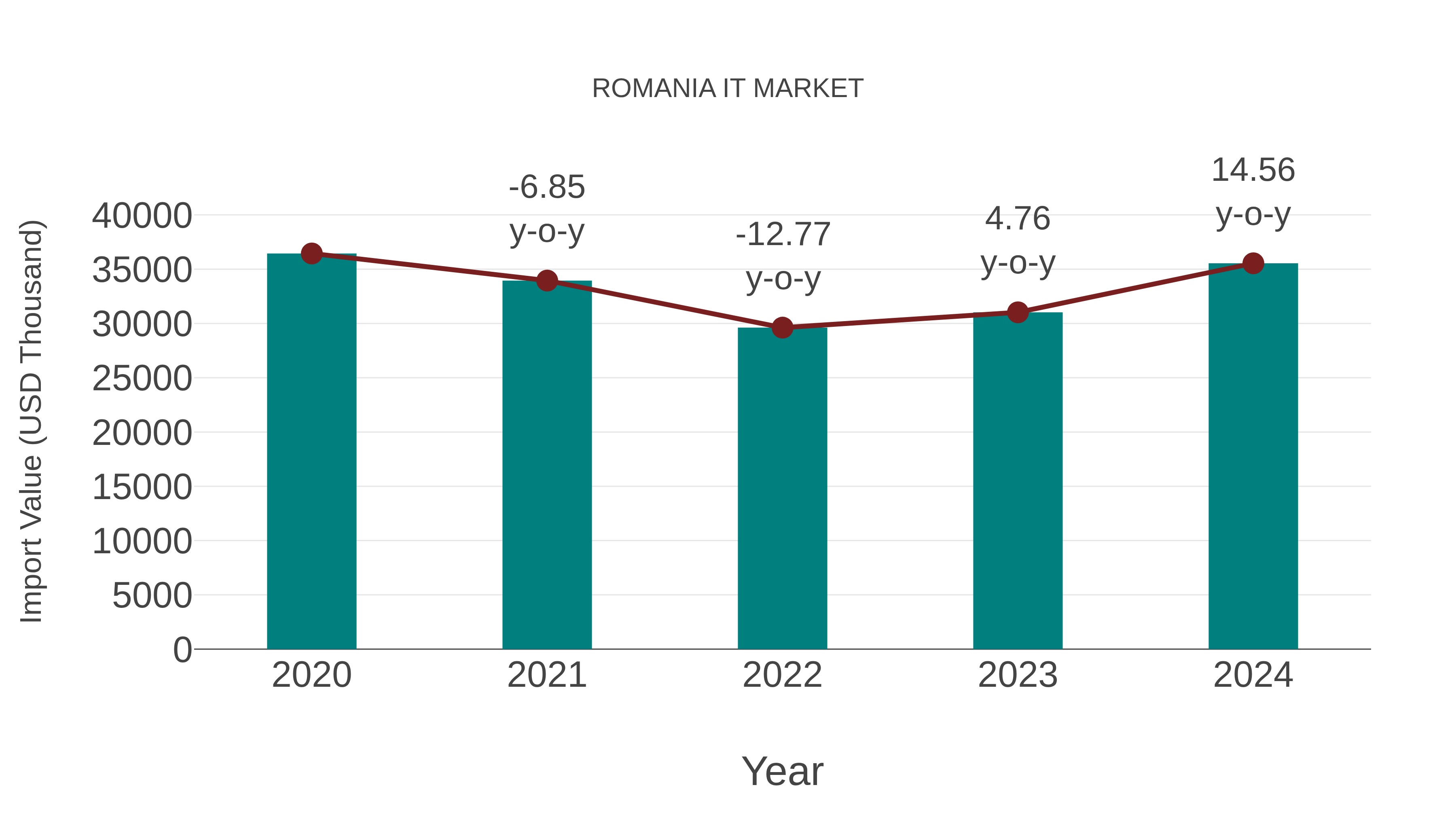
Romania It Market: Import Trend Analysis
In 2024, Romania`s IT market saw a notable increase in imports, reflecting a growing demand for technology products and services. This trend was driven by factors such as technological advancements and increased digitalization across industries.
Romania IT Market Growth Rate
According to 6Wresearch internal database and industry insights, the Romania IT Market is projected to grow at a compound annual growth rate (CAGR) of 6.2% during the forecast period 2026–2032.
Five-Year Growth Trajectory of the Romania IT Market with Core Drivers
Below mentioned are the evaluations of year-wise growth rate along with key drivers:
|
Year |
Est. Annual Growth (%) |
Growth Drivers |
|
2021 |
3.9% |
Rising demand for outsourcing and growth in software development services. |
|
2022 |
4.2% |
Increased use of cloud services and expansion of exports in IT services. |
|
2023 |
4.6% |
Growth of major fintech solutions and modernisation of IT infrastructure. |
|
2024 |
4.9% |
Expansion of investments in digital government platforms and cybersecurity. |
|
2025 |
5.3% |
High demand for AI-driven solutions and data centre investments. |
Topics Covered in the Romania IT Market Report
The Romania IT Market report thoroughly covers the market by enterprise size, end-user. It provides an unbiased and detailed analysis of ongoing market trends, opportunities, challenges, and market drivers, helping stakeholders align their strategies with current and future market dynamics.
Romania IT Market Highlights
| Report Name | Romania IT Market |
| Forecast period | 2026-2032 |
| CAGR | 6.2% |
| Growing Sector | Software Development and IT Services |
Romania IT Market Synopsis
Romania IT Market is expected to grow rapidly due to strong demand for outsourcing of IT services, a growing ecosystem of startups in the country, and increasing digitalisation of activities in the government and private sectors. Romania’s affordable and skilled workforce, favourable investment climate, and expanding technology hubs make it a better destination for IT services in Eastern Europe. The high use of cloud computing, cybersecurity solutions, artificial intelligence (AI), and data analytics is significantly changing the market. Public sector digital reforms and private sector automation are driving long-term Romania IT Market Growth.
Evaluation of Growth Drivers in the Romania IT Market
Below mentioned are some prominent drivers and their influence on the Romania IT Market dynamics:
| Drivers | Primary Segment Affected | Why It Matters (Evidence) |
| IT Outsourcing Demand | IT Services | Romania is an important outsourcing hub for European enterprises due to its skilled and trained workforce. |
| Government Digitalization | Government | The government is implementing new e-government platforms and digital public services. |
| Cybersecurity Needs | Cybersecurity Solutions | Growing cyber threats are increasing new investments in security software and services. |
| AI and Automation | All Segments | Businesses are increasingly using automation to improve efficiency and reduce prices. |
| Cloud Adoption | SMEs and Startups | Cloud solutions improve scalability and affordability for small firms. |
Romania IT Market Size is projected to grow at a compound annual growth rate (CAGR) of 6.2% from 2026 to 2032. The market growth is being fuelled by many key factors, including the rapid increase of IT outsourcing activities, which has positioned Romania as a better nearshoring destination for European and global enterprises due to its skilled workforce and affordable service delivery. The large-scale digitalisation of public administration activities, through e-government platforms, digital identity systems, and smart city policies, is driving major adoption of IT in the public sector. Increased usage of cloud computing across small and medium enterprises (SMEs) and large corporations is creating more demand for scalable, flexible, and affordable IT infrastructure solutions.
Evaluation of Restraints in the Romania IT Market
Below mentioned are some major restraints and their influence on the Romania IT Market dynamics:
| Restraints | Primary Segment Affected | What This Means (Evidence) |
| Talent Migration | IT Providers | Skilled professionals shifting to Western Europe reduces workforce availability. |
| Infrastructure Gaps | Rural IT Deployment | Uneven broadband and slow data infrastructure reduce its usage. |
| High Cyber Risks | All Segments | Weak legacy systems increase exposure to cyber threats. |
| Limited R&D Funding | IT Startups | Lower innovation funding restricts the advanced development of the product. |
| Fragmented Regulations | IT Providers | Inconsistent digital policies slow the speed of implementation. |
Romania IT Market Challenges
Romania IT Market faces many important challenges that could change its growth trajectory. One of the primary issues is the shifting of skilled IT professionals to more developed EU economies, which creates a shortage of talented professionals and reduces the availability ofan experienced workforce for domestic projects. The uneven digital infrastructure across urban and rural regions decreases the nationwide use of advanced IT solutions and limits sales for smaller enterprises. The market also faces growing cybersecurity threats, as many organisations still depend on old systems that are prone to cyberattacks, increasing the need for high investment in security solutions. Limited research and development (R&D) funding also reduces the ability of local IT firms to innovate and develop new technologies, which affects their sales on a global scale.
Romania IT Market Trends
Several notable trends are shaping the Romania IT Market dynamics:
- Cloud Adoption: Businesses are rapidly shifting towards cloud-based infrastructure to reduce expenditure of capital expenditure and improve operations.
- Cybersecurity Demand: Rising cybercrime and data breaches are increasing demand for encryption, threat detection, and managed security services.
- E-Government Development: Expansion of online tax filing, digital identity systems, and public data platforms is improving the usage of IT in the public sector.
- AI and Automation Integration: Enterprises are using AI-driven chatbots, intelligent analytics, and robotics to increase productivity.
- Nearshore Outsourcing Growth: Western European companies are increasingly starting new IT projects in Romania for better price and quality.
Investment Opportunities in the Romania IT Industry
Some notable investment opportunities in the Romania IT Industry are:
- Cloud Computing: Investments in private and hybrid cloud platforms to support growing enterprise demand. These platforms enable businesses to scale operations efficiently, reduce IT costs, and improve collaboration across locations.
- Cybersecurity Solutions: Funding for managed security service providers and AI-based cyber defence tools. Enhanced cybersecurity infrastructure helps organizations protect sensitive data, comply with regulations, and maintain customer trust.
- Software Development: Expansion of export-oriented software development and SaaS platforms. This growth supports the global delivery of customized IT solutions and strengthens Romania’s position as a competitive software services hub.
- Data Centres: Investment in energy-efficient data centres to support cloud and digital services growth. Modern data centres ensure high availability, faster data processing, and sustainable energy usage to meet increasing digital demands.
- Smart City Technologies: Deployment of digital traffic management, e-governance, and IoT infrastructure. These technologies enhance urban living, improve public services, and promote sustainable and connected city ecosystems.
Top 5 Leading Players in the Romania IT Market
Below is the list of prominent companies leading in the Romania IT Market:
1. Bitdefender
| Company Name | Bitdefender |
| Established Year | 2001 |
| Headquarters | Bucharest, Romania |
| Official Website | Click Here |
Bitdefender is one of Romania’s largest IT companies and a globally recognised leader in cybersecurity solutions. The company provides advanced threat protection software to enterprises, governments, and individual consumers worldwide. Bitdefender’s portfolio includes endpoint security, network security, cloud security, and managed security services.
2. UiPath
| Company Name | UiPath |
| Established Year | 2005 |
| Headquarters | Bucharest, Romania (Global HQ: New York, USA) |
| Official Website | Click Here |
UiPath is a leading global provider of robotic process automation (RPA) software that enables organizations to automate repetitive and rule-based business processes. The company’s platforms are widely used across BFSI, healthcare, manufacturing, and retail sectors to improve operational efficiency, reduce costs, and enhance productivity.
3. Endava Romania
| Company Name | Endava Romania |
| Established Year | 2000 |
| Headquarters | Bucharest, Romania |
| Official Website | Click Here |
Endava Romania is a prominent IT consulting and digital transformation services provider offering software engineering, cloud migration, and agile development solutions. The company supports global enterprises across the BFSI, retail, telecommunications, and technology sectors.
4. Atos Romania
| Company Name | Atos Romania |
| Established Year | 1997 |
| Headquarters | Bucharest, Romania |
| Official Website | Click Here |
Atos Romania delivers advanced cloud computing, cybersecurity, big data, and digital transformation solutions for both government and enterprise clients. The company is actively involved in large-scale public sector digitalisation projects and enterprise IT modernisation initiatives.
5. IBM Romania
| Company Name | IBM Romania |
| Established Year | 1911 (Romania Operations) |
| Headquarters | Bucharest, Romania |
| Official Website | Click Here |
IBM Romania provides a comprehensive range of IT solutions, including cloud computing, artificial intelligence, blockchain, data analytics, and IT consulting services. The company supports enterprises and public institutions in their digital transformation journeys by delivering secure, scalable, and intelligent technology platforms.
Government Regulations Introduced in the Romania IT Market
According to Romania’s government data, many digital policies and funding programs are being started by Romanian government, which supports growth in the IT sector. The National Digital Agenda and Romania’s participation in the EU Digital Europe Programme support worldwide expansion, adoption of cloud technologies, AI research, and cybersecurity infrastructure. Startups that are government-backed, tax prizes for software developers, and funding for smart city projects in Bucharest and Cluj-Napoca are strengthening the market demand. The government is implementing e-government platforms and digital public services to increase the demand in this market.
Future Insights of the Romania IT Market
Romania IT Market is expected to expand steadily as it is driven by growth in IT outsourcing, usage of cloud and cybersecurity, AI-based automation, and digital government policies. High investments from foreign countries, outsourcing demand in nearshores, and strong startup ecosystems will also increase competition in the market. The growing importance of data protection and compliance with European GDPR rules is increasing investments in cybersecurity solutions, which include advanced detection of threats, encryption of important messages, and managed security services.
Market Segmentation Analysis
The report offers a comprehensive study of the following market segments and their leading categories:
By Enterprise Size - Small and Medium Enterprises to dominate the market
According to Lakshita, Senior Research Analyst, 6Wresearch, Small and Medium Enterprises are expected to dominate the Romania IT Market Share due to the rapid formation of startups, e-commerce businesses, and technology-driven SMEs. These enterprises increasingly adopt cloud platforms, cybersecurity tools, and automation software to improve business scalability and cost efficiency.
By End-user - BFSI to dominate the market
BFSI sector is expected to dominate the Romania IT Market due to strong investments in fintech platforms, mobile banking applications, fraud detection systems, and data analytics solutions that ensure secure digital transactions.
Key Attractiveness of the Report
- 10 Years of Market Numbers.
- Historical Data from 2022 to 2025.
- Base Year: 2025.
- Forecast Data until 2032.
- Key Performance Indicators Impacting the Market.
- Major Upcoming Developments and Projects.
Key Highlights of the Report:
- Romania IT Market Outlook
- Market Size of Romania IT Market, 2025
- Forecast of Romania IT Market, 2032
- Historical Data and Forecast of Romania IT Revenues & Volume for the Period 2022- 2032F
- Romania IT Market Trend Evolution
- Romania IT Market Drivers and Challenges
- Romania IT Price Trends
- Romania IT Porter's Five Forces
- Romania IT Industry Life Cycle
- Historical Data and Forecast of Romania IT Market Revenues & Volume By Enterprise Size for the Period 2022- 2032F
- Historical Data and Forecast of Romania IT Market Revenues & Volume By Small and Medium Enterprises for the Period 2022- 2032F
- Historical Data and Forecast of Romania IT Market Revenues & Volume By Large Enterprises for the Period 2022- 2032F
- Historical Data and Forecast of Romania IT Market Revenues & Volume By End-user for the Period 2022- 2032F
- Historical Data and Forecast of Romania IT Market Revenues & Volume By Retail for the Period 2022- 2032F
- Historical Data and Forecast of Romania IT Market Revenues & Volume By Manufacturing for the Period 2022- 2032F
- Historical Data and Forecast of Romania IT Market Revenues & Volume By BFSI for the Period 2022- 2032F
- Historical Data and Forecast of Romania IT Market Revenues & Volume By Government for the Period 2022- 2032F
- Historical Data and Forecast of Romania IT Market Revenues & Volume By IT and Telecom for the Period 2022- 2032F
- Historical Data and Forecast of Romania IT Market Revenues & Volume By Other for the Period 2022- 2032F
- Romania IT Import Export Trade Statistics
- Market Opportunity Assessment By Enterprise Size
- Market Opportunity Assessment By End-user
- Romania IT Top Companies Market Share
- Romania IT Competitive Benchmarking By Technical and Operational Parameters
- Romania IT Company Profiles
- Romania IT Key Strategic Recommendations
Market Covered
The report offers a comprehensive study of the following Romania IT Market segments:
By Enterprise Size
- Small and Medium Enterprises
- Large Enterprises
By End-user
- Retail
- Manufacturing
- BFSI
- Government
- IT and Telecom
- Other Distribution Channels






































