Romania Loudspeaker Market Size (2020-2030)
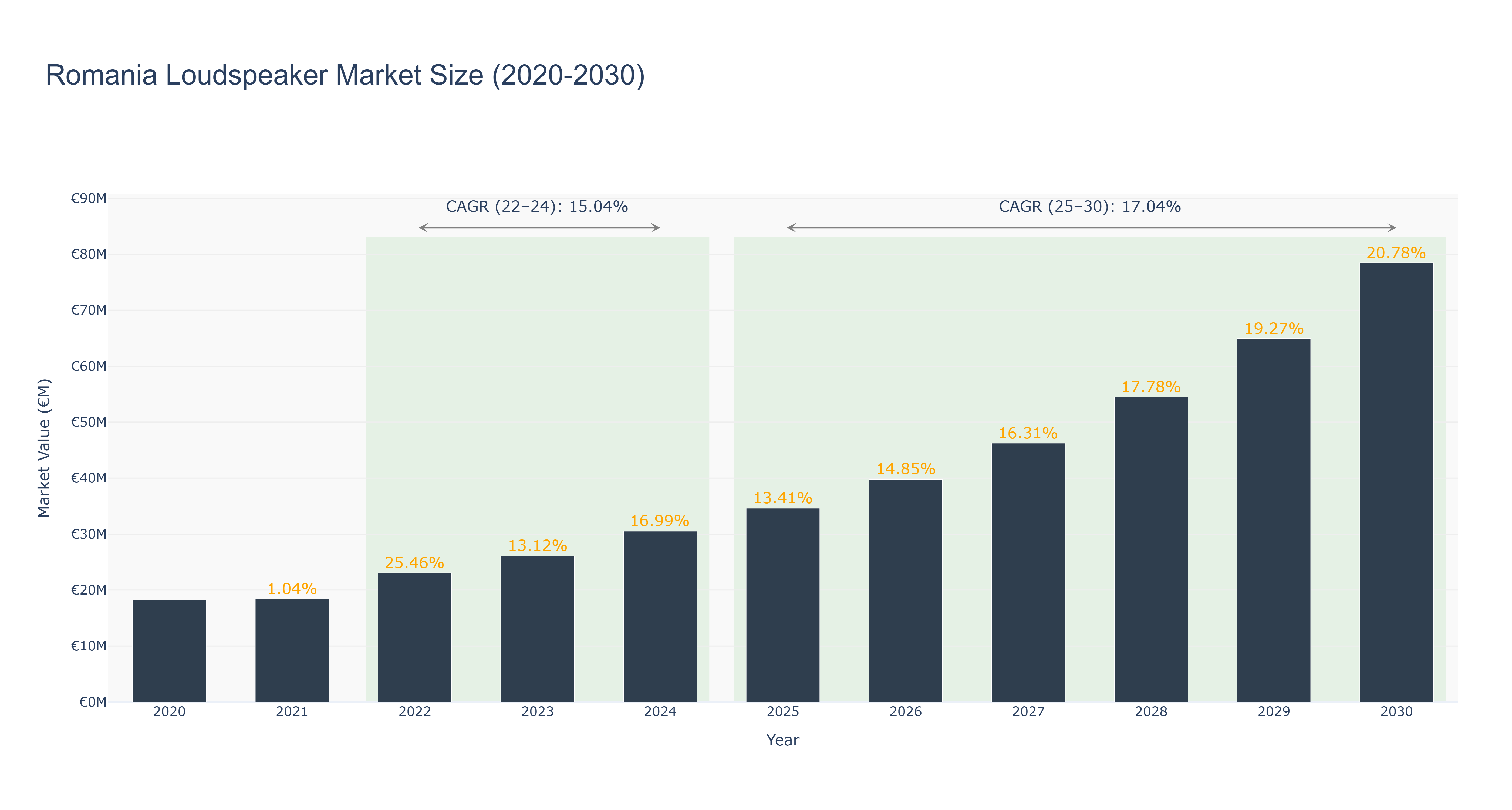
Romania Loudspeaker Market has shown a steady growth trajectory over the years. The market peaked at €78.45 million in 2030, with a notable increase in size from 2020 to 2024, reaching €30.52 million in 2024. Forecasted growth from 2025 to 2030 is promising, with an expected market size of €78.45 million by 2030. The CAGR for the period 2022-24 stands at 15.04%, while for 2025-30 it is projected at 17.04%. This growth can be attributed to increasing consumer demand for advanced audio technologies and the rise in smart home integration trends. Looking ahead, Romania is set to witness the launch of several innovative loudspeaker products tailored to the evolving needs of tech-savvy consumers, further driving market expansion.
Romania Loudspeaker Market: Production & Trade Performance (2019-2025)
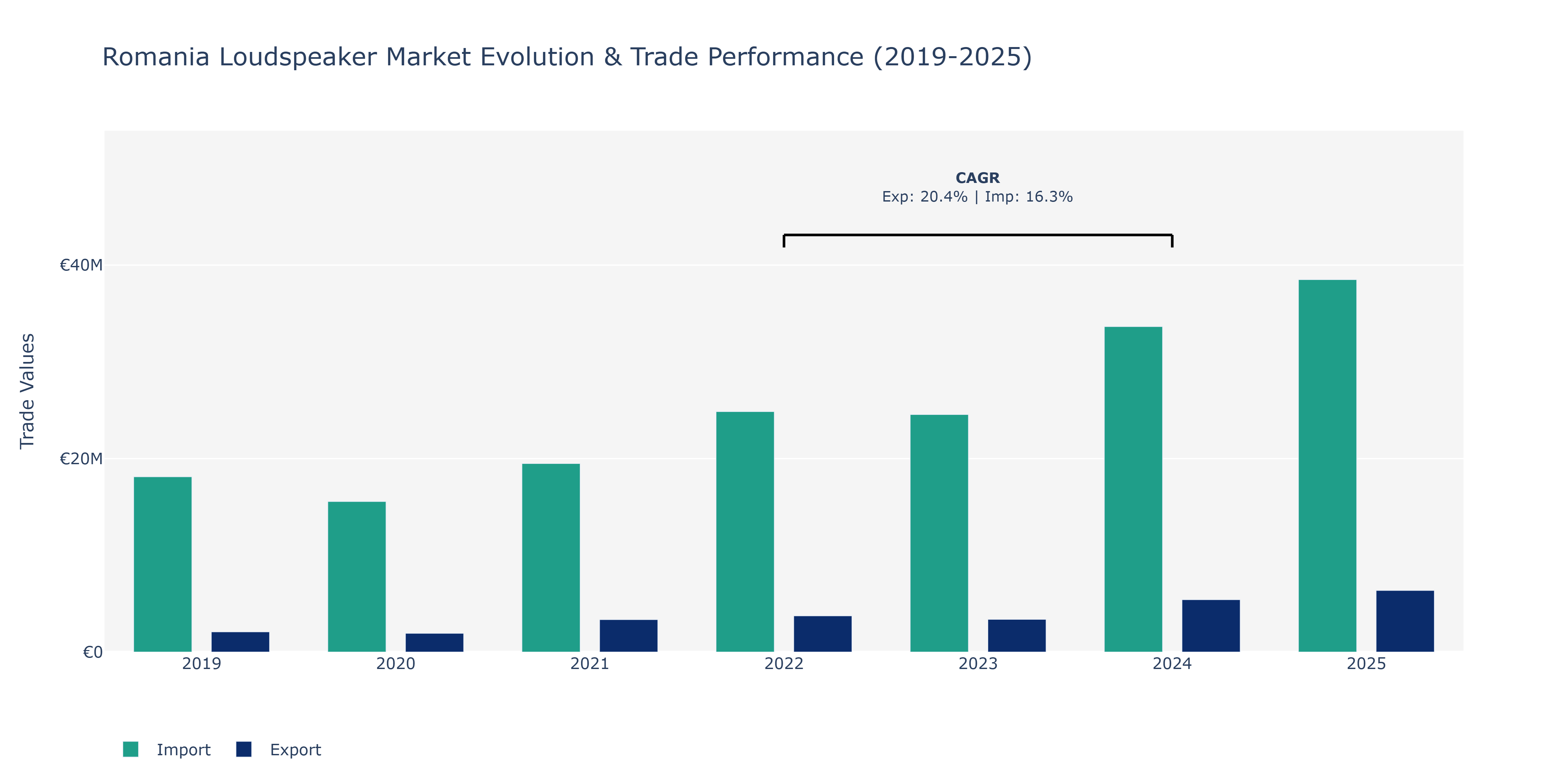
Between 2019 and 2025, Romania's Loudspeaker Market exhibited fluctuating trends in both Exports and Imports. Exports started at €2.08 million in 2019, experienced a slight decline in 2020 to €1.93 million, then surged to €3.35 million in 2021. The peak was reached in 2025 at €6.37 million, reflecting a steady upward trajectory. In contrast, Imports followed a similar pattern, starting at €18.11 million in 2019, decreasing in 2020 to €15.55 million, then rising sharply to €38.5 million in 2025. The peak points for both Exports and Imports indicate a growing demand for loudspeakers in Romania, potentially driven by technological advancements, increased consumer spending on electronics, and the country's expanding audio equipment industry. The significant growth in Imports could be attributed to the demand for advanced loudspeaker technologies not locally available, indicating opportunities for international manufacturers to enter the Romanian market with innovative products.
Romania Loudspeaker Market Synopsis
The Romania loudspeaker market is experiencing steady growth driven by increasing demand for audio equipment in various sectors such as entertainment, education, corporate, and residential. The market is characterized by a wide range of products including portable, Bluetooth, home theater, and professional loudspeakers. Key factors influencing market growth include the rising popularity of music streaming services, increasing disposable incomes, and the growing trend of home entertainment systems. Local and international manufacturers are actively competing in the market, offering innovative features and designs to cater to the diverse consumer preferences. With a focus on product quality and technological advancements, the Romania loudspeaker market is expected to continue its growth trajectory in the coming years, presenting opportunities for both established players and new entrants.
Romania Loudspeaker Market Trends
The Romania Loudspeaker Market is experiencing a shift towards wireless and smart speaker technology, driven by the increasing consumer demand for convenience and connectivity. This trend presents opportunities for companies to introduce innovative products with voice control capabilities and seamless integration with smart home systems. Additionally, the growing popularity of portable and outdoor speakers among the younger demographic offers a niche market for companies to cater to. With the rise in disposable income and the emphasis on quality audio experiences, there is a potential for premium and high-end loudspeakers to gain traction in the Romania market. Overall, the market is ripe for manufacturers and retailers to capitalize on these trends by offering a diverse range of products that appeal to the evolving preferences of Romanian consumers.
Romania Loudspeaker Market Challenges
In the Romania Loudspeaker Market, some key challenges include intense competition from global and local players, price sensitivity among consumers, and the impact of economic fluctuations on consumer spending. The market is highly competitive, with numerous brands offering a wide range of products at varying price points, making it challenging for companies to differentiate themselves and capture market share. Price sensitivity among consumers can also hinder sales, as many customers prioritize affordability over quality or brand reputation. Additionally, economic uncertainties and fluctuations can impact consumer confidence and discretionary spending on non-essential items like loudspeakers, further challenging companies in this market to sustain growth and profitability amidst changing market conditions.
Romania Loudspeaker Market Investment Opportunities
The Romania Loudspeaker Market is primarily driven by factors such as the increasing demand for high-quality audio equipment in various sectors including entertainment, automotive, and home audio systems. The growing popularity of music streaming services and the trend of smart homes with integrated audio systems are also contributing to the market growth. Additionally, the rising disposable income levels of consumers in Romania are leading to a higher willingness to invest in premium audio products. Technological advancements such as wireless connectivity options and advanced sound quality features are further fueling the demand for loudspeakers in the market. Overall, the combination of these factors is driving the growth of the loudspeaker market in Romania.
Romania Loudspeaker Market Government Policie
The Romanian government has implemented regulations regarding loudspeakers to ensure consumer safety and compliance with industry standards. These policies primarily focus on noise pollution control, electromagnetic compatibility, and energy efficiency requirements for loudspeaker products in accordance with EU directives. Additionally, the government has put in place import and export regulations to monitor the flow of loudspeakers in the market, and to protect local manufacturers. The government also provides support and incentives for research and development in the loudspeaker industry to promote innovation and competitiveness. Overall, the government policies aim to create a sustainable and thriving loudspeaker market in Romania while safeguarding the interests of consumers and industry players.
Romania Loudspeaker Market Future Outlook
The future outlook for the Romania Loudspeaker Market appears promising, with growth opportunities driven by factors such as the increasing demand for high-quality audio products in the consumer electronics sector, technological advancements leading to the development of innovative speaker designs, and the growing trend of smart home devices incorporating speakers. Additionally, the rising disposable income levels and changing lifestyle preferences among consumers are expected to further boost market growth. The market is likely to witness a shift towards wireless and portable speakers, as well as increasing adoption of smart speakers with voice assistant capabilities. However, competition among key players may intensify, leading to pricing pressures and the need for continuous product innovation to stay competitive in the market.
Key Highlights of the Report:
- Romania Loudspeaker Market Outlook
- Market Size of Romania Loudspeaker Market, 2025
- Forecast of Romania Loudspeaker Market, 2032
- Historical Data and Forecast of Romania Loudspeaker Revenues & Volume for the Period 2022 - 2032F
- Romania Loudspeaker Market Trend Evolution
- Romania Loudspeaker Market Drivers and Challenges
- Romania Loudspeaker Price Trends
- Romania Loudspeaker Porter's Five Forces
- Romania Loudspeaker Industry Life Cycle
- Historical Data and Forecast of Romania Loudspeaker Market Revenues & Volume By Product for the Period 2022 - 2032F
- Historical Data and Forecast of Romania Loudspeaker Market Revenues & Volume By Soundbar for the Period 2022 - 2032F
- Historical Data and Forecast of Romania Loudspeaker Market Revenues & Volume By Subwoofer for the Period 2022 - 2032F
- Historical Data and Forecast of Romania Loudspeaker Market Revenues & Volume By In-wall for the Period 2022 - 2032F
- Historical Data and Forecast of Romania Loudspeaker Market Revenues & Volume By Outdoor for the Period 2022 - 2032F
- Historical Data and Forecast of Romania Loudspeaker Market Revenues & Volume By Other Product Types for the Period 2022 - 2032F
- Historical Data and Forecast of Romania Loudspeaker Market Revenues & Volume By Application for the Period 2022 - 2032F
- Historical Data and Forecast of Romania Loudspeaker Market Revenues & Volume By Communication for the Period 2022 - 2032F
- Historical Data and Forecast of Romania Loudspeaker Market Revenues & Volume By Home Entertainment for the Period 2022 - 2032F
- Historical Data and Forecast of Romania Loudspeaker Market Revenues & Volume By Automotive for the Period 2022 - 2032F
- Historical Data and Forecast of Romania Loudspeaker Market Revenues & Volume By Events and Outdoor Entertainment for the Period 2022 - 2032F
- Romania Loudspeaker Import Export Trade Statistics
- Market Opportunity Assessment By Product
- Market Opportunity Assessment By Application
- Romania Loudspeaker Top Companies Market Share
- Romania Loudspeaker Competitive Benchmarking By Technical and Operational Parameters
- Romania Loudspeaker Company Profiles
- Romania Loudspeaker Key Strategic Recommendations






































