Steel Market: Romania vs Top 5 Major Economies in 2027 (Europe)
The Steel market in Romania is projected to grow at a high growth rate of 14.56% by 2027, highlighting the country's increasing focus on advanced technologies within the Europe region, where Germany holds the dominant position, followed closely by United Kingdom, France, Italy and Russia, shaping overall regional demand.
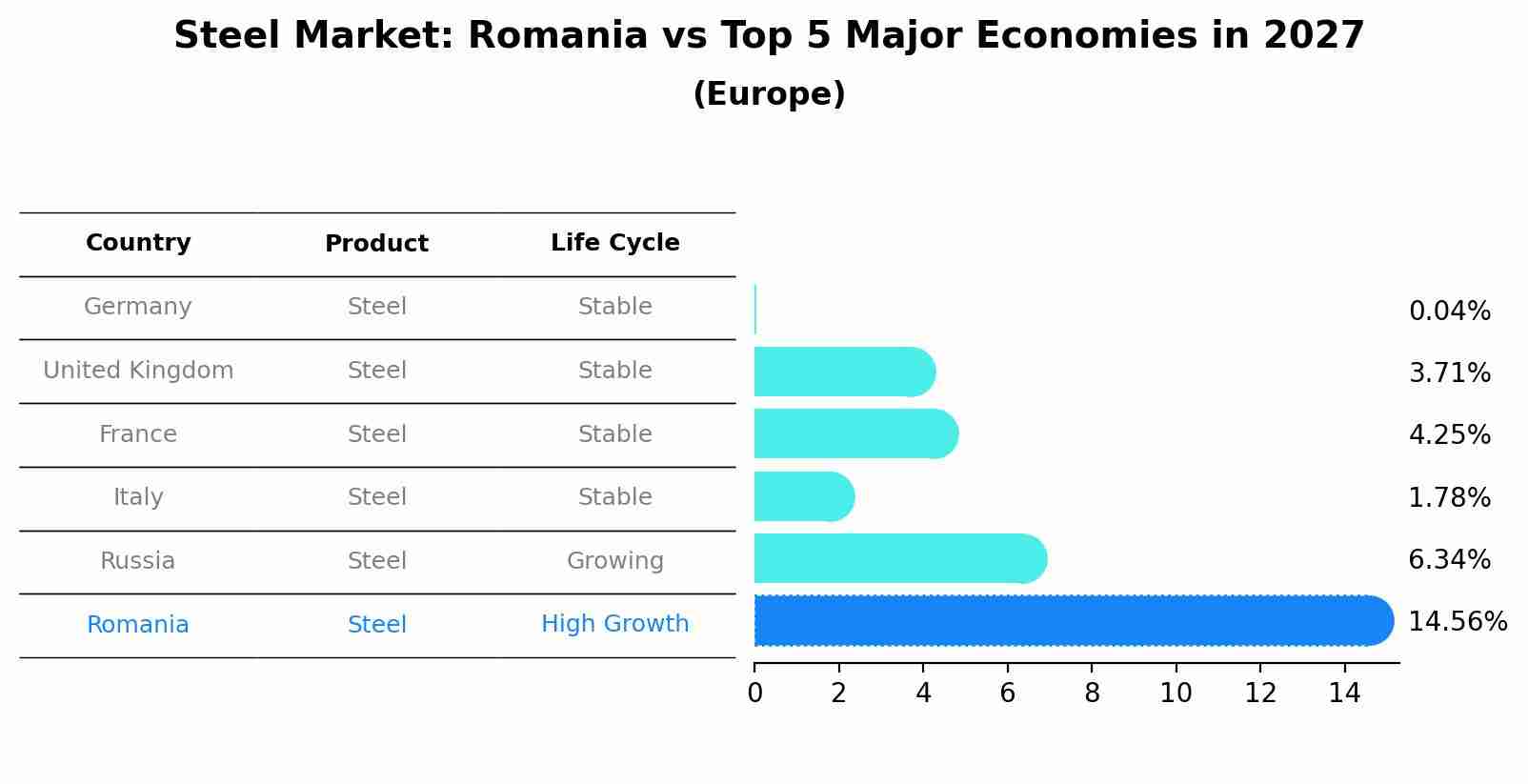
Romania Steel Market Growth Rate
According to 6Wresearch internal database and industry insights, the Romania Steel Market is projected to grow at a compound annual growth rate (CAGR) of 5.9% during the forecast period 2026–2032.
Topics Covered in the Romania Steel Market Report
The Romania Steel Market report thoroughly covers the market by type, product type, and applications. It provides an unbiased and detailed analysis of ongoing market trends, opportunities, challenges, and market drivers, helping stakeholders align their strategies with current and future market dynamics.
Romania Steel Market Highlights
| Report Name |
Romania Steel Market |
| Forecast period | 2026-2032 |
| CAGR | 5.9% |
| Growing Sector | Construction, Automotive, Manufacturing |
Romania Steel Market Synopsis
The Romania Steel Market is predicted to undergo steady growth. Growing construction activities, rising industrialization, and growing demand from the automotive and manufacturing sectors are spurring the development of the market. steel consumption is prompted through government-backed infrastructure projects, such as highway development and railway modernization. Rising fund allocation in renewable energy projects and industrial machinery production are making consistent demand for steel products. The market is also benefiting from technological advancements in steel processing and growing export opportunities within the European Union.
Evaluation of Growth Drivers in the Romania Steel Market
Below mentioned are some prominent drivers and their influence on the Romania Steel Market dynamics:
| Drivers | Primary Segment Affected | Why It Matters (Evidence) |
| Infrastructure Development | Application (Building & Construction) | Large-scale highway and rail projects increase steel consumption. |
| Automotive Industry Growth | Application (Automotive) | Rising vehicle production boosts demand for high-quality steel. |
| Industrial Expansion | Product Type | Machinery and equipment manufacturing need durable steel materials. |
| Government Investments | Type (Flat & Long Steel) | Public spending encourages infrastructure and energy sectors. |
| Export Opportunities | Market Demand | EU trade partnerships enriches steel exports from Romania. |
The Romania Steel Market is projected to grow at a CAGR of 5.9% from 2026 to 2032. Increasing need from infrastructure development and automotive manufacturing is majorly contributing to Romania Steel Market Growth. Government initiatives like the National Recovery and Resilience Plan (NRRP), which allocates funds for transport infrastructure and green energy projects, are further spurring steel consumption. Additionally, modernization of industrial facilities and increasing export demand within the EU are strengthening the market outlook.
Evaluation of Restraints in the Romania Steel Market
Below mentioned are some major restraints and their influence on the Romania Steel Market dynamics:
| Restraints | Primary Segment Affected | What This Means (Evidence) |
| High Energy Costs | Production | Steel manufacturing becomes expensive due to rising electricity prices. |
| Raw Material Price Volatility | Product Type | Fluctuating iron ore and coal prices impact profitability. |
| Environmental Regulations | Production | Strict EU emission norms increase compliance costs. |
| Import Competition | Market Penetration | domestic producers gets affected owing to cheaper imports from other countries. |
| Skilled Labor Shortage | Production | Productivity can get affected owing to lack of skilled workforce in advanced steel manufacturing |
Romania Steel Market Challenges
The Romania Steel Industry faces several restraints that could hinder its growth. High energy costs significantly increase production expenses, making domestic steel less competitive. Volatility in raw material costs such as iron ore and coal affects profit margins for manufacturers and strict environmental regulations under EU policies further increases compliance prices and require persistent fund allocation in sustainable technologies. Moreover, increasing competition from low-cost steel imports affects the market penetration of domestic players.
Romania Steel Market Trends
Several notable trends are shaping the Romania Steel Market dynamics:
- Adoption of Green Steel Production: To decrease carbon footprint, manufacturers are allocating funds in low-emission technologies like electric arc furnaces.
- Increasing Use of High-Strength Steel: To augment durability , the requirement increasing for advanced steel grades in automotive and construction sectors is rising.
- Digitalization in Manufacturing: To augment production efficiency, steel producers are incorporating automation and smart technologies.
- Growth in Renewable Energy Projects: Steel requiring is increasing for wind turbines and solar infrastructure projects across Romania.
Investment Opportunities in the Romania Steel Market
Some notable investment opportunities in the Romania Steel Market include:
- Expansion of Steel Production Facilities: To fulfil the growing domestic and export demand productively, money allocation in modern plants can help.
- Infrastructure Project Participation: Investors can take advantage from government-funded projects such as highways, railways, and energy systems.
- Development of Green Steel Technologies: To meet with EU environmental goals and reduce emissions ,funding in sustainable production methods can assist.
Top 5 Leading Players in the Romania Steel Market
Below is the list of prominent companies leading the Romania Steel Market:
1. Liberty Galați
| Company Name | Liberty Galați (LIBERTY Steel Group) |
|---|---|
| Established Year | 1960 |
| Headquarters | Galați, Romania |
| Official Website | Click Here |
Liberty Galați is one of the most dominating integrated steel producers in Romania, supplying flat steel products to industries such as construction, automotive, and shipbuilding.
2. TenarisSilcotub
| Company Name | TenarisSilcotub (Silcotub) |
|---|---|
| Established Year | 2004 |
| Headquarters | Zalău, Romania |
| Official Website | Click Here |
TenarisSilcotub is a major manufacturer of seamless steel pipes used in oil & gas, energy, and industrial applications. The company is renowned for its high-quality production standards and strong export presence.
3. Artrom Steel Tubes
| Company Name | Artrom Steel Tubes |
|---|---|
| Established Year | 2002 |
| Headquarters | Slatina, Romania |
| Official Website | Click Here |
Artrom Steel Tubes specializes in seamless steel pipes and serves industries such as automotive, energy, and engineering. The company is known for its advanced manufacturing technologies and focus on high-performance steel products.
4. ArcelorMittal Roman
| Company Name | ArcelorMittal Roman |
|---|---|
| Established Year | 1991 |
| Headquarters | Roman, Romania |
| Official Website | Click Here |
ArcelorMittal Roman concentrates on producing steel pipes and tubular products used in construction, energy, and industrial sectors.
5. ArcelorMittal Iași
| Company Name | ArcelorMittal Iași |
|---|---|
| Established Year | 1991 |
| Headquarters | Iași, Romania |
| Official Website | Click Here |
ArcelorMittal Iași manufactures steel pipes and related products for industrial and infrastructure applications. The company encourages regional steel demand and contributes to Romania’s overall steel production capacity.
Government Regulations Introduced in the Romania Steel Market
According to Romanian government data, numerous initiatives and regulations have been introduced to make sure sustainability in the steel sector. The government encourages projects under the National Recovery and Resilience Plan (NRRP), concentrating on green energy and infrastructure and compliance with the EU Emissions Trading System (ETS) needs steel manufacturers to decrease carbon emissions. Regulations also encourage the use of recycled steel and energy-efficient production technologies and incentives are provided for money allocation in sustainable manufacturing practices and modernization of existing facilities.
Future Insights of the Romania Steel Market
The Romania Steel Market is expected to grow steadily with increasing investments in infrastructure, automotive production, and renewable energy projects. The shift toward green steel production and sustainable practices will shape the future of the industry. Additionally, technological advancements and growing export opportunities within the EU will further strengthen the market. Rising demand for high-quality and specialized steel products is anticipated to create new growth avenues. Rising demand for high-quality, durable, and specialized steel products is expected to create new growth opportunities and enhance the overall competitiveness of the market.
Market Segmentation Analysis
The report offers a comprehensive study of the following market segments and their leading categories:
By Types – Flat Steel to dominate the market
Flat steel is expected to dominate the Romania Steel Market due to its extensive use in automotive manufacturing, construction, and appliances. Its versatility and superior surface quality make it suitable for high-end industrial applications.
By Product Type – Structural Steel to dominate the market
Structural steel is anticipated to lead the Romania Steel Market Share as it is widely used in infrastructure projects such as bridges, buildings, and industrial facilities. Its strength, durability, and cost-effectiveness make it a preferred choice in construction.
By Applications – Building & Construction to dominate the market
According to Mansi Ahuja, Senior Research Analyst at 6Wresearch, Building and construction is projected to dominate the application segment due to ongoing infrastructure projects and urban development. Steel is widely used in residential, commercial, and public infrastructure projects.
Key Attractiveness of the Report
- 10 Years of Market Numbers.
- Historical Data Starting from 2022 to 2025.
- Base Year: 2025.
- Forecast Data until 2032.
- Key Performance Indicators Impacting the Market.
- Major Upcoming Developments and Projects.
Key Highlights of the Report:
- Romania Steel Market Outlook
- Market Size of Romania Steel Market, 2025
- Forecast of Romania Steel Market, 2032
- Historical Data and Forecast of Romania Steel Revenues & Volume for the Period 2022-2032
- Romania Steel Market Trend Evolution
- Romania Steel Market Drivers and Challenges
- Romania Steel Price Trends
- Romania Steel Porter's Five Forces
- Romania Steel Industry Life Cycle
- Historical Data and Forecast of Romania Steel Market Revenues & Volume By Types for the Period 2022-2032
- Historical Data and Forecast of Romania Steel Market Revenues & Volume By Flat Steel for the Period 2022-2032
- Historical Data and Forecast of Romania Steel Market Revenues & Volume By Long Steel for the Period 2022-2032
- Historical Data and Forecast of Romania Steel Market Revenues & Volume By Product Type for the Period 2022-2032
- Historical Data and Forecast of Romania Steel Market Revenues & Volume By Structural Steel for the Period 2022-2032
- Historical Data and Forecast of Romania Steel Market Revenues & Volume By Prestressing Steel for the Period 2022-2032
- Historical Data and Forecast of Romania Steel Market Revenues & Volume By Bright Steel for the Period 2022-2032
- Historical Data and Forecast of Romania Steel Market Revenues & Volume By Welding Wire/Rod for the Period 2022-2032
- Historical Data and Forecast of Romania Steel Market Revenues & Volume By Iron Steel Wire for the Period 2022-2032
- Historical Data and Forecast of Romania Steel Market Revenues & Volume By Ropes for the Period 2022-2032
- Historical Data and Forecast of Romania Steel Market Revenues & Volume By Braids for the Period 2022-2032
- Historical Data and Forecast of Romania Steel Market Revenues & Volume By Applications for the Period 2022-2032
- Historical Data and Forecast of Romania Steel Market Revenues & Volume By Building & Construction for the Period 2022-2032
- Historical Data and Forecast of Romania Steel Market Revenues & Volume By Electrical Appliances for the Period 2022-2032
- Historical Data and Forecast of Romania Steel Market Revenues & Volume By Metal Products for the Period 2022-2032
- Historical Data and Forecast of Romania Steel Market Revenues & Volume By Domestic Appliances for the Period 2022-2032
- Historical Data and Forecast of Romania Steel Market Revenues & Volume By Mechanical Equipment for the Period 2022-2032
- Historical Data and Forecast of Romania Steel Market Revenues & Volume By Automotive for the Period 2022-2032
- Historical Data and Forecast of Romania Steel Market Revenues & Volume By Others for the Period 2022-2032
- Romania Steel Import Export Trade Statistics
- Market Opportunity Assessment By Types
- Market Opportunity Assessment By Product Type
- Market Opportunity Assessment By Applications
- Romania Steel Top Companies Market Share
- Romania Steel Competitive Benchmarking By Technical and Operational Parameters
- Romania Steel Company Profiles
- Romania Steel Key Strategic Recommendations
Market Covered
The report offers a comprehensive study of the following segments:
By Types
- Flat Steel
- Long Steel
By Product Type
- Structural Steel
- Prestressing Steel
- Bright Steel
- Welding Wire/Rod
- Iron Steel Wire, Ropes, Braids
By Applications
- Building & Construction
- Electrical Appliances
- Metal Products
- Domestic Appliances
- Mechanical Equipment
- Automotive
- Others






































