Romania Transportation Analytics Market Size & Growth Rate (2026-2032)
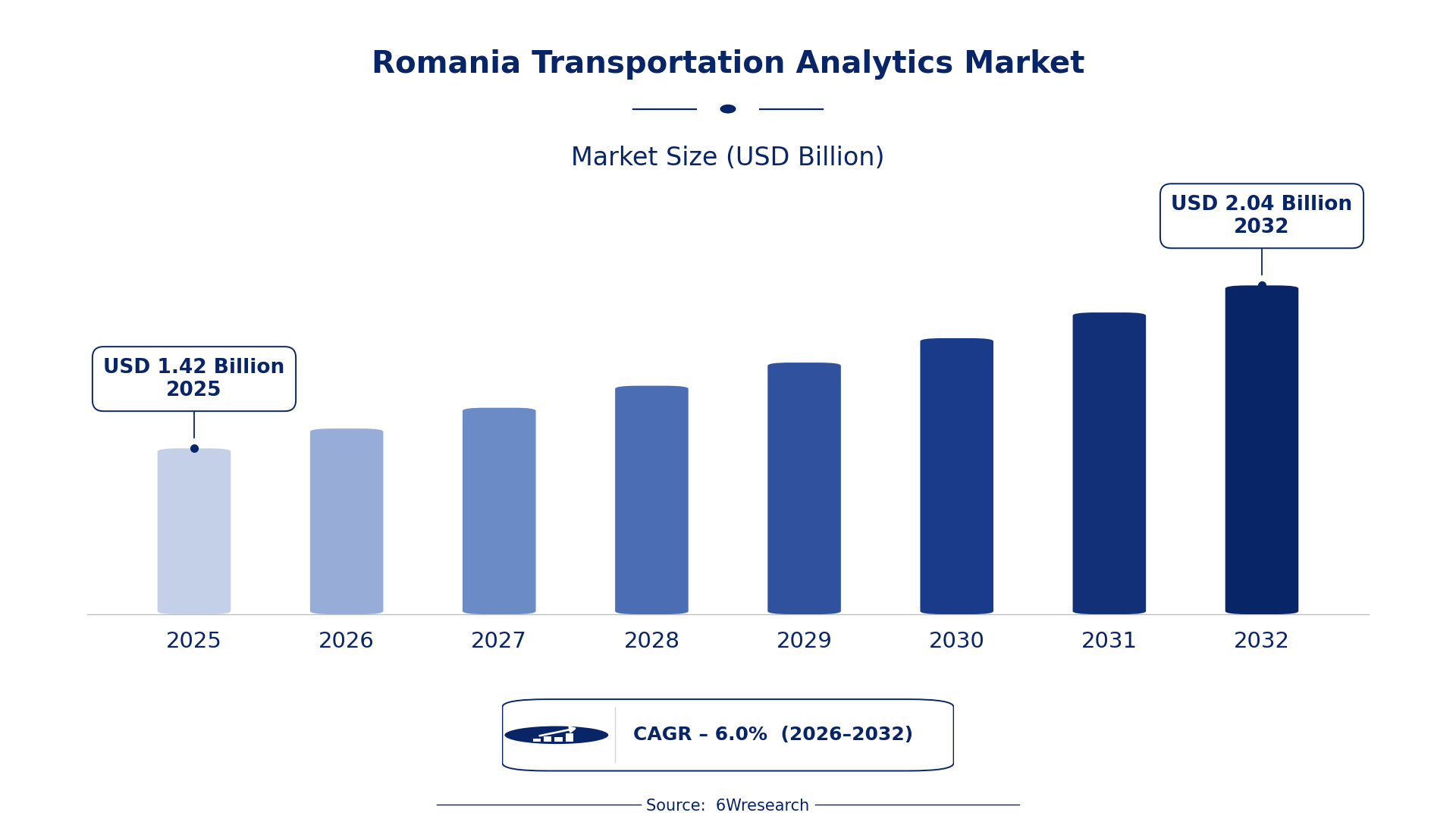
The Romania Transportation Analytics Market was estimated at USD 1416 Million in 2025 and is projected to reach USD 2042 Million by 2032, growing at a CAGR of 6.0% from 2026 to 2032.
Romania Transportation Analytics Market Synopsis
As urbanization accelerates in Romania, the demand for advanced transportation analytics is surging. Cities and transportation agencies are increasingly investing in data-driven solutions aimed at enhancing mobility and alleviating traffic congestion.
The integration of real-time data collection and analysis tools is transforming how Romanian transportation systems operate. Stakeholders are focusing on improving transit operations and infrastructure planning to meet the growing mobility needs of citizens.
Romania Transportation Analytics Market Year-wise Growth Rate and Key Drivers
This graph illustrates the annual growth rates of the Romania Transportation Analytics Market from 2021 to 2032, highlighting a steady upward trajectory and projected expansion over the forecast period.
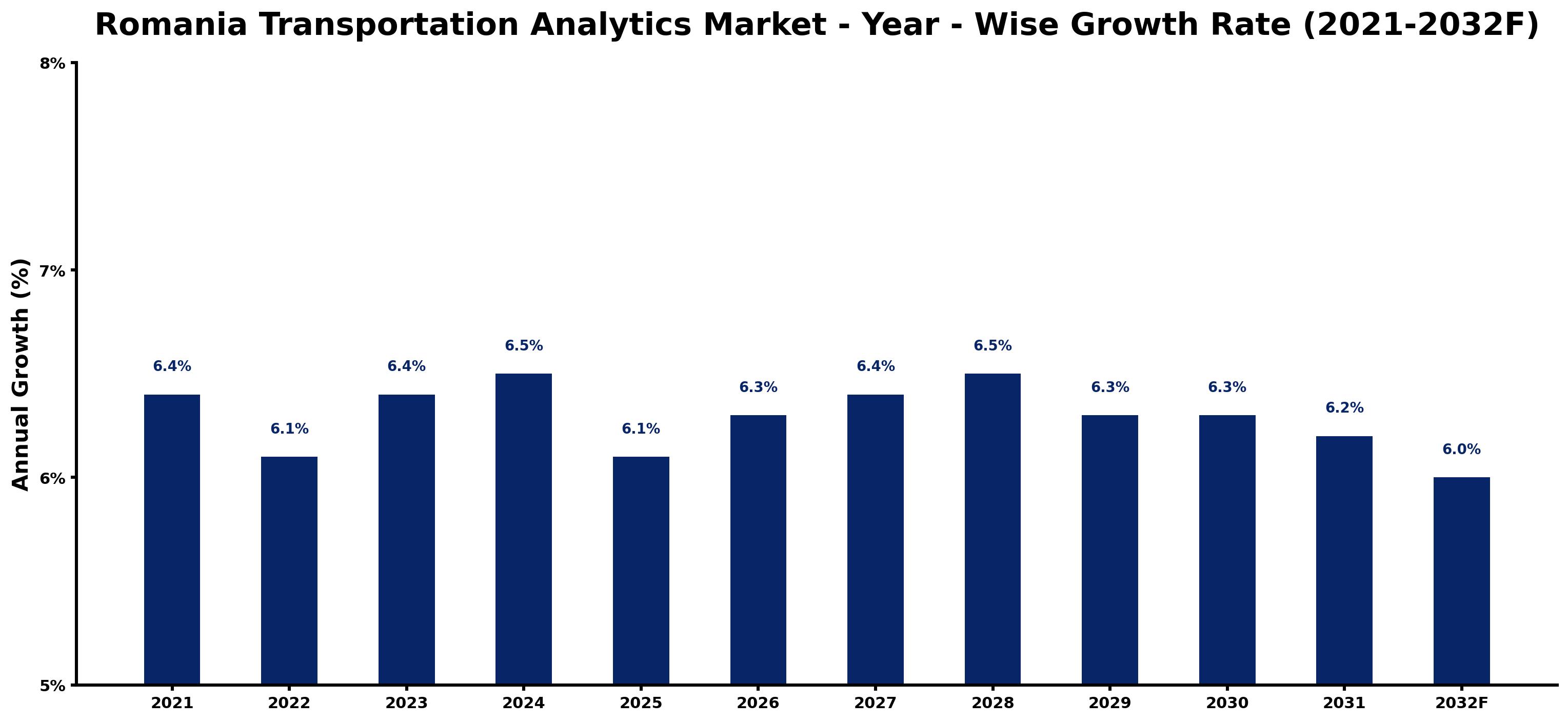
The table below presents the year‑wise growth rates along with the key drivers influencing the market
| Year | Growth Rate | Major Drivers |
| 2021 | 6.4% | EU funding for transport infrastructure improvements. |
| 2022 | 6.1% | Implementation of national smart transport systems policy. |
| 2023 | 6.4% | Rising urbanization driving demand for traffic optimization. |
| 2024 | 6.5% | Increased government focus on emissions reduction strategies. |
| 2025 | 6.1% | Development of real-time passenger information systems. |
| 2026 | 6.3% | Adoption of advanced telematics in logistics operations. |
| 2027 | 6.4% | Launch of national digital mobility platform. |
| 2028 | 6.5% | Integration of AI in public transportation planning. |
| 2029 | 6.3% | Emergence of mobility-as-a-service (MaaS) initiatives. |
| 2030 | 6.3% | Growing public interest in sustainable transport solutions. |
| 2031 | 6.2% | Local government incentives for data-driven traffic management. |
| 2032 | 6.0% | Enhanced safety regulations boosting analytics demand. |
Note: Market size estimations and growth projections presented in this report are based on 6Wresearch's proprietary forecasting methodology, utilizing the latest available industry data, government publications, and primary research inputs.
Romania Transportation Analytics Market Key Takeaways
Below are some of the specific key takeaways from the market, including:
- Increasing reliance on big data analytics for improved transportation efficiency and cost reduction.
- Government policies supporting smart city initiatives are driving market growth.
- Innovations in AI and predictive analytics are shaping future mobility solutions.
- Real-time monitoring technologies are becoming essential for urban planning.
- Collaboration between public and private sectors is fostering advancements in data-sharing frameworks.
Evaluation of Restraints in Romania Transportation Analytics Market
Despite the promising growth trajectory, the Romania Transportation Analytics Market faces several restraints. One significant issue is the challenge of integrating data across various transportation modes. Accurate predictive modeling for traffic forecasting remains elusive, complicating efforts to optimize transit systems. on top of that, privacy concerns surrounding mobility data sharing can hinder the adoption of analytics solutions.
Romania Transportation Analytics Market Trends
A shift towards AI-driven predictive algorithms is becoming apparent, enabling transportation agencies to better anticipate and respond to traffic conditions. The growing emphasis on sustainable transportation solutions is also shaping demand, with analytics playing a critical role in evaluating environmental impacts. Real-time traffic insights are increasingly being utilized to enhance user experiences, making travel more efficient and predictable.
Romania Transportation Analytics Market Opportunities
The market is ripe with opportunities for growth, particularly in public-private partnerships. By fostering collaboration, stakeholders can enhance data-sharing capabilities and drive innovation. Additionally, investments in smart infrastructure projects present avenues for technological advancements that can significantly enhance transportation efficiency and user satisfaction.
Government Initiatives in the Romania Transportation Analytics Market
Government initiatives play a critical role in shaping the Romania Transportation Analytics Market. A clear regulatory framework has been established to promote data-driven decision-making in infrastructure planning and traffic management. These policies prioritize smart city projects that leverage technology to improve urban mobility.
- A national smart city program launched in 2024 aims to integrate advanced data analytics into urban transportation systems.
- Currently ongoing public-private partnerships are facilitating data sharing for better traffic management solutions.
- A regulatory framework for data privacy protection was introduced in late 2023, ensuring secure mobility data sharing.
- Planned initiatives include a national digital infrastructure upgrade expected to enhance transportation analytics capabilities by 2027.
Future Insights of the Romania Transportation Analytics Market
Looking ahead to 2026-2032, the Romania Transportation Analytics Market is expected to continue its upward trajectory. As the government pushes for smart city initiatives, investments in data analytics technologies will likely increase. Enhanced connectivity and improved infrastructure will be pivotal in addressing the mobility challenges facing urban areas. The focus on sustainability and efficiency will further drive demand for innovative analytics solutions.
Romania Transportation Analytics Market Latest Developments
In the last 12-14 months, the Romania Transportation Analytics Market has witnessed dynamic developments. A surge in public interest regarding sustainable mobility has prompted stakeholders to prioritize advancements in analytics technologies.
- A major technology vendor announced a partnership with local authorities in early 2023 to implement real-time traffic monitoring systems across major urban centers.
- A pilot program focused on integrating AI-driven predictive algorithms was launched in mid-2023, aimed at improving public transport efficiency.
- Public consultations on the proposed national data-sharing framework commenced in late 2023, with feedback expected to shape future policies.
- Upcoming initiatives include a city-wide rollout of smart traffic lights planned for 2025, designed to optimize traffic flow based on real-time data.
Romania Transportation Analytics Market - Key Attractiveness of the Report
- 10 Years of Market Numbers
- Historical Data Starting from 2022 to 2025
- Base Year: 2025
- Forecast Data until 2032
- Key Performance Indicators Impacting the Market
- Major Upcoming Developments and Projects
Key Highlights of the Report:
- Romania Transportation Analytics Market Outlook
- Market Size of Romania Transportation Analytics Market, 2025
- Forecast of Romania Transportation Analytics Market, 2032
- Historical Data and Forecast of Romania Transportation Analytics Revenues & Volume for the Period 2022-2032F
- Romania Transportation Analytics Market Trend Evolution
- Romania Transportation Analytics Market Drivers and Challenges
- Romania Transportation Analytics Price Trends
- Romania Transportation Analytics Porter's Five Forces
- Romania Transportation Analytics Industry Life Cycle
- Historical Data and Forecast of Romania Transportation Analytics Market Revenues & Volume By Type for the Period 2022-2032F
- Historical Data and Forecast of Romania Transportation Analytics Market Revenues & Volume By Descriptive Analytics for the Period 2022-2032F
- Historical Data and Forecast of Romania Transportation Analytics Market Revenues & Volume By Predictive Analytics for the Period 2022-2032F
- Historical Data and Forecast of Romania Transportation Analytics Market Revenues & Volume By Prescriptive Analytics for the Period 2022-2032F
- Historical Data and Forecast of Romania Transportation Analytics Market Revenues & Volume By Mode for the Period 2022-2032F
- Historical Data and Forecast of Romania Transportation Analytics Market Revenues & Volume By Roadways for the Period 2022-2032F
- Historical Data and Forecast of Romania Transportation Analytics Market Revenues & Volume By Railways for the Period 2022-2032F
- Historical Data and Forecast of Romania Transportation Analytics Market Revenues & Volume By Airways for the Period 2022-2032F
- Historical Data and Forecast of Romania Transportation Analytics Market Revenues & Volume By Waterways for the Period 2022-2032F
- Romania Transportation Analytics Import Export Trade Statistics
- Market Opportunity Assessment By Type
- Market Opportunity Assessment By Mode
- Romania Transportation Analytics Top Companies Market Share
- Romania Transportation Analytics Competitive Benchmarking By Technical and Operational Parameters
- Romania Transportation Analytics Company Profiles
- Romania Transportation Analytics Key Strategic Recommendations






































