Russia Decaffeinated Coffee Market Size, Share & Growth Rate
The Russia Decaffeinated Coffee Market was estimated at USD 233 Million in 2025 and is projected to reach USD 254 Million by 2032, growing at a CAGR of 1.2% from 2026 to 2032. This growth trajectory is primarily driven by an increasing health consciousness among Russian consumers who are actively seeking lower caffeine alternatives. Additionally, the expanding availability of diverse decaffeinated products in retail channels, including supermarkets and online platforms, further supports market expansion.
Russia Decaffeinated Coffee Market Year-wise Growth Rate and Key Drivers
This graph highlights how the Russia Decaffeinated Coffee Market has steadily grown over the years, supported by major growth factors.
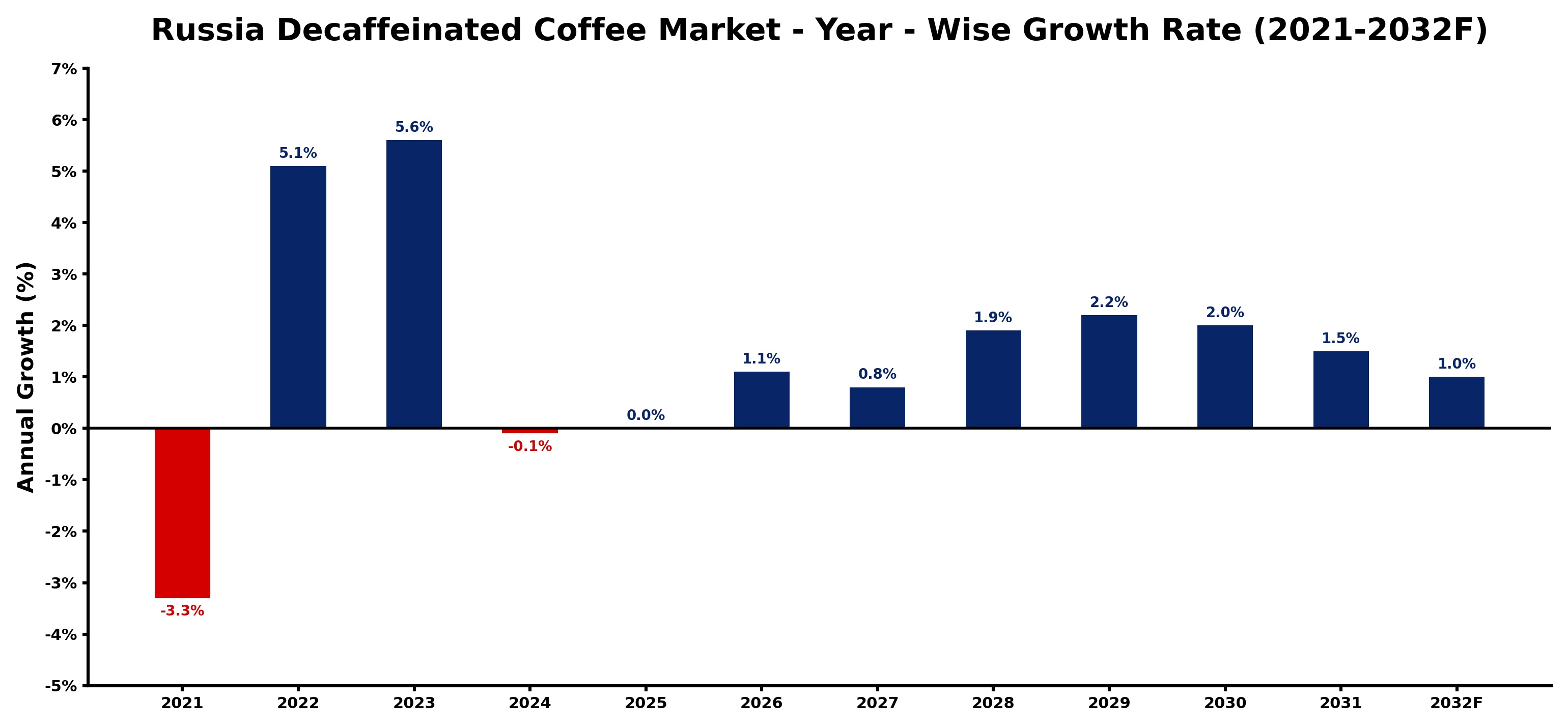
The table below presents the year‑wise growth rates along with the key drivers influencing the market
| Year | Growth Rate | Major Drivers |
| 2021 | -3.3% | Consumer preferences shifted downward |
| 2022 | 5.1% | Health consciousness drove demand |
| 2023 | 5.6% | Specialty coffee trends expanded market |
| 2024 | -0.1% | Economic factors limited purchasing power |
| 2025 | 0.0% | New product launches attracted interest |
| 2026 | 1.1% | Sustainability initiatives enhanced appeal |
| 2027 | 0.8% | Increased online sales channels emerged |
| 2028 | 1.9% | Coffee culture gained popularity |
| 2029 | 2.2% | Diverse flavor profiles attracted consumers |
| 2030 | 2.0% | Home brewing trends encouraged sales |
| 2031 | 1.5% | Subscription services gained traction |
| 2032 | 1.0% | Social media marketing boosted visibility |
Note - Market size estimations and growth projections presented in this report are based on 6Wresearch’s advanced forecasting approach, validated with industry datasets as of June 2026.
Russia Decaffeinated Coffee Market Synopsis
The Russia Decaffeinated Coffee Market is gaining momentum, reflecting a significant shift in consumer attitudes towards coffee consumption. As more individuals become aware of the health benefits associated with reducing caffeine intake, the demand for decaf products is steadily increasing, paving the way for a more vibrant market.
Moreover, the rise of coffee culture in Russia, combined with a growing number of specialty coffee shops offering premium decaffeinated options, illustrates a keen interest in quality and variety among consumers. This trend signals a notable opportunity for innovative product offerings tailored to meet the evolving demands of the market.
Russia Decaffeinated Coffee Market Key Takeaways
- The market is experiencing growth due to heightened health awareness and preference for lower caffeine options.
- Decaffeinated coffee products are increasingly available through various distribution channels, enhancing consumer access.
- Product innovation and premiumization are key strategies employed by manufacturers to attract discerning coffee drinkers.
- There is a notable shift towards sustainably sourced and environmentally friendly decaffeinated coffee options.
- Effective consumer education will be crucial in overcoming traditional preferences for regular coffee.
Evaluation of Restraints in Russia Decaffeinated Coffee Market
Despite the positive growth outlook, the Russia Decaffeinated Coffee Market faces notable constraints. One of the primary issues is the entrenched consumer preference for regular coffee, which can overshadow the potential for decaffeinated products. A significant portion of the population remains unaware of the benefits of decaf coffee, which hampers market penetration. Furthermore, limited distribution channels for decaffeinated options compared to their caffeinated counterparts can make it difficult for consumers to find and choose these products. The perception that decaf coffee may lack flavor or quality compared to regular options also poses a significant barrier to growth.
Russia Decaffeinated Coffee Market Trends
Key trends are emerging in the Russia Decaffeinated Coffee Market that reflect changing consumer preferences. An increasing number of consumers are gravitating towards organic and ethically sourced coffee, particularly decaf options produced using environmentally friendly methods such as the Swiss water process. This interest is driving demand for premium, high-quality decaffeinated products, prompting manufacturers to innovate and diversify their offerings.
Moreover, there is a shift towards online shopping as consumers seek the convenience of purchasing their favorite decaf products from home. The rise of e-commerce platforms allows for greater visibility of decaffeinated options, which could further fuel interest and sales in this segment.
Russia Decaffeinated Coffee Market Opportunities
The Russia Decaffeinated Coffee Market presents significant investment opportunities. As consumer awareness about the health benefits of reducing caffeine intake continues to rise, there is a compelling case for investors to explore partnerships with local coffee producers. Tailoring new decaf products to cater to the local palate can enhance market appeal. Additionally, targeted marketing strategies aimed at educating consumers about the advantages of decaffeinated options, combined with leveraging digital platforms for expanded online sales, can facilitate deeper market penetration.
Government Initiatives in the Russia Decaffeinated Coffee Market
Government policies in Russia play a crucial role in shaping the decaffeinated coffee market. Regulations regarding food safety and quality standards, along with import tariffs on coffee beans, impact pricing and availability. Moreover, initiatives aimed at promoting healthy consumption habits and supporting domestic coffee production contribute to creating a more favorable environment for decaffeinated coffee. Understanding these policies is essential for companies looking to navigate the competitive landscape effectively.
Future Insights of the Russia Decaffeinated Coffee Market
Looking ahead to 2026-2032, the Russia Decaffeinated Coffee Market is set to evolve significantly. Increasing health-conscious consumption trends will likely drive demand for decaffeinated products, positioning them as viable alternatives to regular coffee. The growing coffee culture, characterized by the expanding presence of specialty shops and diverse offerings, is expected to further enhance consumer interest in decaf options. Companies are anticipated to focus on innovation and strategic marketing to align with these changing preferences, thus securing a robust market presence.
Russia Decaffeinated Coffee Market Latest Developments (May 2025 - June 2026)
Recent developments in the Russia Decaffeinated Coffee Market indicate a growing emphasis on sustainability and quality. Manufacturers are increasingly introducing innovative brewing methods and product lines that align with consumer demands for healthier options. Additionally, e-commerce growth is facilitating easier access to a wider range of decaffeinated products, positioning companies to capitalize on the expanding market interest. The focus on consumer education surrounding the benefits of decaf is gaining traction, with marketing campaigns being tailored to appeal to health-conscious consumers.
Russia Decaffeinated Coffee Market - Key Attractiveness of the Report
- 10 Years of Market Numbers
- Historical Data Starting from 2022 to 2025
- Base Year: 2025
- Forecast Data until 2032
- Key Performance Indicators Impacting the Market
- Major Upcoming Developments and Projects
Key Highlights of the Report:
- Russia Decaffeinated Coffee Market Outlook
- Market Size of Russia Decaffeinated Coffee Market, 2025
- Forecast of Russia Decaffeinated Coffee Market, 2032
- Historical Data and Forecast of Russia Decaffeinated Coffee Revenues & Volume for the Period 2022-2032F
- Russia Decaffeinated Coffee Market Trend Evolution
- Russia Decaffeinated Coffee Market Drivers and Challenges
- Russia Decaffeinated Coffee Price Trends
- Russia Decaffeinated Coffee Porter's Five Forces
- Russia Decaffeinated Coffee Industry Life Cycle
- Historical Data and Forecast of Russia Decaffeinated Coffee Market Revenues & Volume By Product for the Period 2022-2032F
- Historical Data and Forecast of Russia Decaffeinated Coffee Market Revenues & Volume By Roasted for the Period 2022-2032F
- Historical Data and Forecast of Russia Decaffeinated Coffee Market Revenues & Volume By Raw for the Period 2022-2032F
- Historical Data and Forecast of Russia Decaffeinated Coffee Market Revenues & Volume By Species for the Period 2022-2032F
- Historical Data and Forecast of Russia Decaffeinated Coffee Market Revenues & Volume By Arabica for the Period 2022-2032F
- Historical Data and Forecast of Russia Decaffeinated Coffee Market Revenues & Volume By Robusta for the Period 2022-2032F
- Historical Data and Forecast of Russia Decaffeinated Coffee Market Revenues & Volume By Distribution Channel for the Period 2022-2032F
- Historical Data and Forecast of Russia Decaffeinated Coffee Market Revenues & Volume By Online for the Period 2022-2032F
- Historical Data and Forecast of Russia Decaffeinated Coffee Market Revenues & Volume By Offline for the Period 2022-2032F
- Russia Decaffeinated Coffee Import Export Trade Statistics
- Market Opportunity Assessment By Product
- Market Opportunity Assessment By Species
- Market Opportunity Assessment By Distribution Channel
- Russia Decaffeinated Coffee Top Companies Market Share
- Russia Decaffeinated Coffee Competitive Benchmarking By Technical and Operational Parameters
- Russia Decaffeinated Coffee Company Profiles
- Russia Decaffeinated Coffee Key Strategic Recommendations






































