Russia Gamification Market Size, Share & Growth Rate
The Russia Gamification Market was estimated at USD 176 Million in 2025 and is projected to reach USD 193 Million by 2032, growing at a CAGR of 1.3% from 2026 to 2032. This growth is fueled by the increasing integration of gamification techniques into various sectors, particularly in education and healthcare, where they enhance user engagement and training efficacy. The rise of digital platforms and mobile device usage also plays a pivotal role in driving demand for innovative gamification solutions.
Russia Gamification Market Year-wise Growth Rate and Key Drivers
This graph highlights how the Russia Gamification Market has steadily grown over the years, supported by major growth factors.
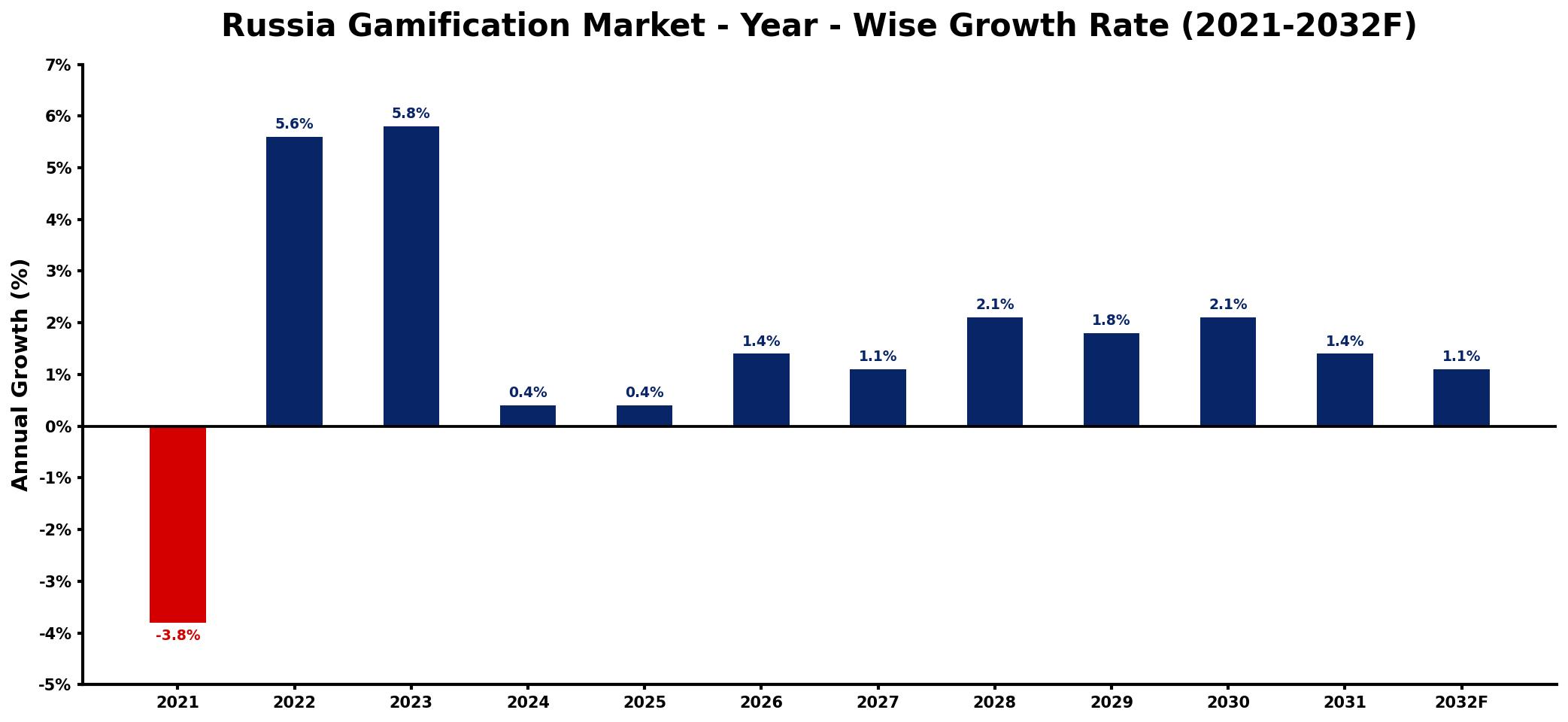
The table below presents the year‑wise growth rates along with the key drivers influencing the market
| Year | Growth Rate | Major Drivers |
| 2021 | -3.8% | decrease in technology investments |
| 2022 | 5.6% | rise in digital engagement initiatives |
| 2023 | 5.8% | growth in user retention strategies |
| 2024 | 0.4% | expansion of educational applications |
| 2025 | 0.4% | increased funding for startups |
| 2026 | 1.4% | development of immersive experiences |
| 2027 | 1.1% | enhancement of employee training programs |
| 2028 | 2.1% | diversification of entertainment platforms |
| 2029 | 1.8% | boost in consumer loyalty programs |
| 2030 | 2.1% | adoption of cross-industry solutions |
| 2031 | 1.4% | integration of analytics tools |
| 2032 | 1.1% | emphasis on behavioral science applications |
Note: Market size estimations and growth projections presented in this report are based on 6Wresearch's proprietary forecasting methodology, utilizing the latest available industry data, government publications, and primary research inputs.
Russia Gamification Market Synopsis
The Russia Gamification Market is currently experiencing remarkable momentum, propelled by widespread adoption of gamification strategies across diverse industries. Organizations are increasingly recognizing the potential of these techniques to elevate customer experiences and boost employee productivity.
As businesses continue to innovate and adapt to changing consumer preferences, the market is poised for further expansion. This transformation is being driven not only by technological advancements but also by a cultural shift toward valuing interactivity and engagement in both personal and professional environments.
Russia Gamification Market Key Takeaways
- Strong growth is projected in the gamification sector, driven by increasing digital adoption.
- Education, healthcare, and retail are the leading industries leveraging gamification techniques.
- Advanced technologies such as AI and VR are being integrated into gamification solutions, enhancing their appeal.
- Organizations are focusing on personalized experiences to boost user engagement and loyalty.
- Cultural nuances and regulatory challenges must be navigated for successful implementation.
Evaluation of Restraints in Russia Gamification Market
The Russia Gamification Market faces several restraints that could impact its growth trajectory. A primary challenge is the cultural diversity within the population, which can influence the acceptance of gamified solutions. Different attitudes towards gaming can lead to varied levels of engagement among users, making it essential for companies to tailor their approaches. Additionally, regulatory hurdles and concerns surrounding data privacy can complicate the deployment of gamification strategies, potentially deterring investment. Awareness and understanding of gamification benefits among businesses also require bolstering, as limited knowledge can restrict market uptake. Economic fluctuations further complicate investment decisions in this dynamic environment, demanding adaptability from market participants.
Russia Gamification Market Trends
In the evolving landscape of the Russia Gamification Market, notable trends are emerging that shape both demand and technological innovation. The increasing use of gamified solutions in customer engagement strategies highlights a shift towards creating personalized, interactive experiences. As companies look to enhance loyalty and participation, real-time feedback mechanisms are becoming increasingly commonplace. Moreover, the integration of emerging technologies like augmented reality (AR) and virtual reality (VR) into gamification platforms is not only modernizing user engagement but also fostering new avenues for immersive experiences that captivate users.
Russia Gamification Market Opportunities
The opportunities for growth in the Russia Gamification Market are ripe across multiple sectors, particularly education, healthcare, and marketing. With digital technologies on the rise, businesses are increasingly pursuing gamification as a means to enhance training effectiveness and customer interaction. The demand for innovative gamified applications tailored to local preferences presents a unique investment opportunity. Companies can also explore partnerships with technology providers and consultants specializing in gamification to capitalize on the burgeoning interest and innovation within this sector. Understanding regulatory frameworks and cultural aspects will be critical for harnessing these opportunities effectively.
Government Initiatives in the Russia Gamification Market
The Russian government recognizes the potential of the gamification market and is actively promoting its development through various initiatives. Policies aimed at encouraging research and development in gamification technologies are in place, with a focus on fostering partnerships between the public and private sectors. Additionally, the government is streamlining regulatory processes to create a more favorable environment for companies entering the market. By supporting integration of gamification into sectors like education and healthcare, the government aims to stimulate innovation and economic growth in the region.
Future Insights of the Russia Gamification Market
Looking ahead to 2026-2032, the Russia Gamification Market is set to evolve with sustained growth fueled by technological advancements and increased digital engagement. As more businesses recognize the value of gamification in enhancing customer relationships and employee motivation, the sector is expected to broaden its reach across various industries. Furthermore, the penetration of smartphones and internet access will catalyze the demand for gamified solutions, leading to more immersive and interactive experiences. The combination of rising consumer expectations and technological progress positions the market for vibrant expansion in the coming years.
Russia Gamification Market Latest Developments (2025 - 2026)
Recent developments in the Russia Gamification Market indicate a continued trend towards innovation and integration. Companies are increasingly adopting advanced technologies to enhance the gamification experience, focusing on personalized content and real-time user engagement. Additionally, there is a rising number of collaborations and partnerships aimed at creating tailored gamification solutions for different industries. As businesses strive to improve user engagement and training outcomes, the market landscape is becoming increasingly competitive, with an emphasis on user-centric design and functionality.
Russia Gamification Market - Key Attractiveness of the Report
- 10 Years of Market Numbers
- Historical Data Starting from 2022 to 2025
- Base Year: 2025
- Forecast Data until 2032
- Key Performance Indicators Impacting the Market
- Major Upcoming Developments and Projects
Key Highlights of the Report:
- Russia Gamification Market Outlook
- Market Size of Russia Gamification Market, 2025
- Forecast of Russia Gamification Market, 2032
- Historical Data and Forecast of Russia Gamification Revenues & Volume for the Period 2022-2032F
- Russia Gamification Market Trend Evolution
- Russia Gamification Market Drivers and Challenges
- Russia Gamification Price Trends
- Russia Gamification Porter's Five Forces
- Russia Gamification Industry Life Cycle
- Historical Data and Forecast of Russia Gamification Market Revenues & Volume By Component for the Period 2022-2032F
- Historical Data and Forecast of Russia Gamification Market Revenues & Volume By Solution for the Period 2022-2032F
- Historical Data and Forecast of Russia Gamification Market Revenues & Volume By Services for the Period 2022-2032F
- Historical Data and Forecast of Russia Gamification Market Revenues & Volume By Deployment for the Period 2022-2032F
- Historical Data and Forecast of Russia Gamification Market Revenues & Volume By Cloud for the Period 2022-2032F
- Historical Data and Forecast of Russia Gamification Market Revenues & Volume By On-premises for the Period 2022-2032F
- Historical Data and Forecast of Russia Gamification Market Revenues & Volume By Organization Size for the Period 2022-2032F
- Historical Data and Forecast of Russia Gamification Market Revenues & Volume By SMEs for the Period 2022-2032F
- Historical Data and Forecast of Russia Gamification Market Revenues & Volume By Large Enterprises for the Period 2022-2032F
- Historical Data and Forecast of Russia Gamification Market Revenues & Volume By End-User for the Period 2022-2032F
- Historical Data and Forecast of Russia Gamification Market Revenues & Volume By Enterprise-Driven for the Period 2022-2032F
- Historical Data and Forecast of Russia Gamification Market Revenues & Volume By Consumer-Driven for the Period 2022-2032F
- Russia Gamification Import Export Trade Statistics
- Market Opportunity Assessment By Component
- Market Opportunity Assessment By Deployment
- Market Opportunity Assessment By Organization Size
- Market Opportunity Assessment By End-User
- Russia Gamification Top Companies Market Share
- Russia Gamification Competitive Benchmarking By Technical and Operational Parameters
- Russia Gamification Company Profiles
- Russia Gamification Key Strategic Recommendations






































