Russia High Performance Computing as a Service Market Size & Growth Rate (2026-2032)
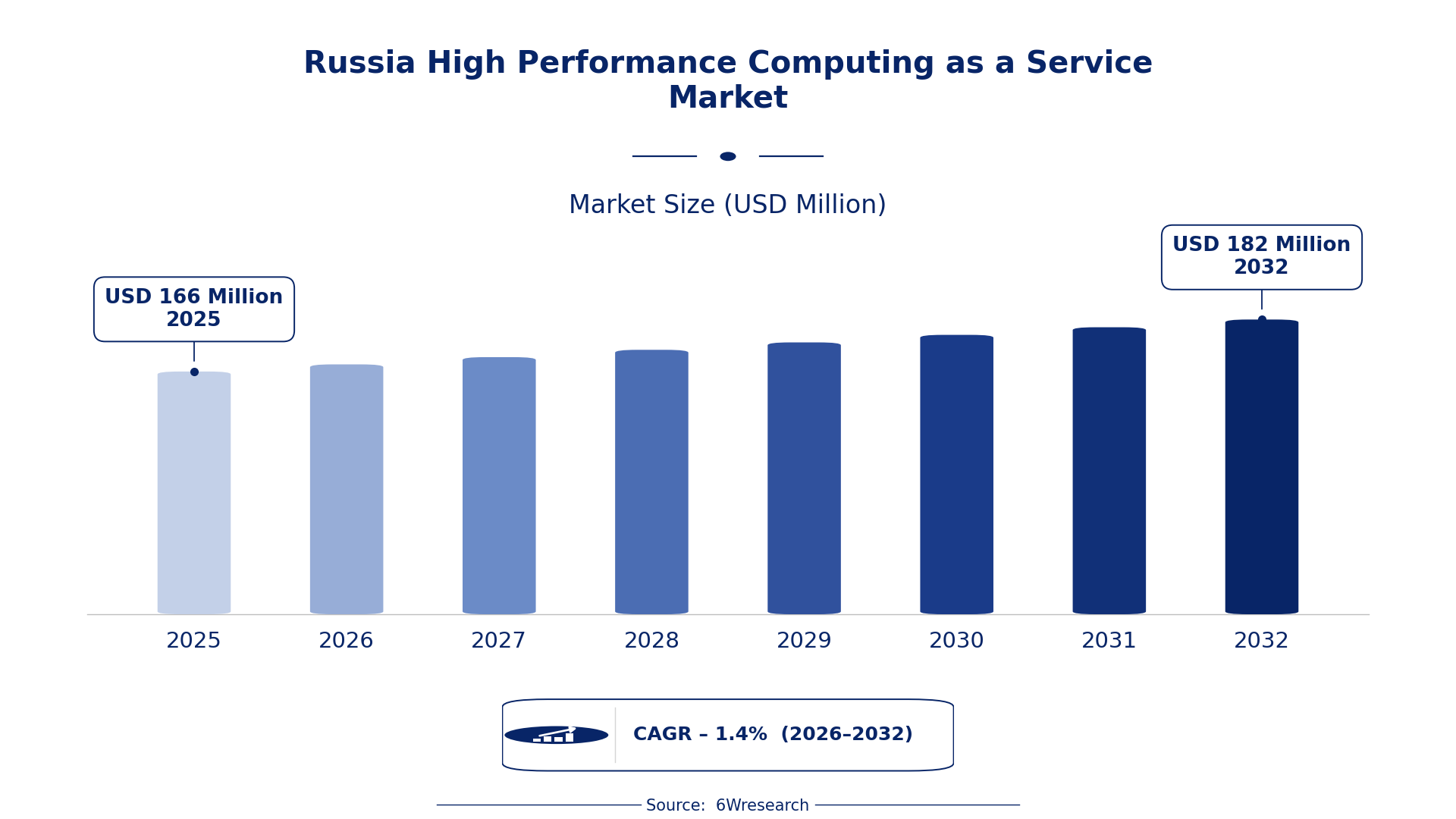
The Russia High Performance Computing as a Service Market was estimated at USD 166 Million in 2025 and is projected to reach USD 182 Million by 2032, growing at a CAGR of 1.4% from 2026 to 2032.
Russia High Performance Computing as a Service Market Synopsis
The Russia High Performance Computing as a Service (HPCaaS) market is on an upward trajectory, fueled by heightened demands for computational resources across various sectors. While the market has seen substantial activity in recent years, its future is likely to be shaped by an increasing shift toward cloud-based solutions and advanced computing capabilities.
As industries like finance, healthcare, and research continue to embrace sophisticated technologies, the HPCaaS market is positioned to expand further. This growth is underscored by governmental support and investments in digital transformation, reflecting a broader commitment to enhancing Russia's technological landscape.
Russia High Performance Computing as a Service Market Year-wise Growth Rate and Key Drivers
This graph illustrates the annual growth rates of the Russia High Performance Computing as a Service Market from 2021 to 2032, highlighting a steady upward trajectory and projected expansion over the forecast period.
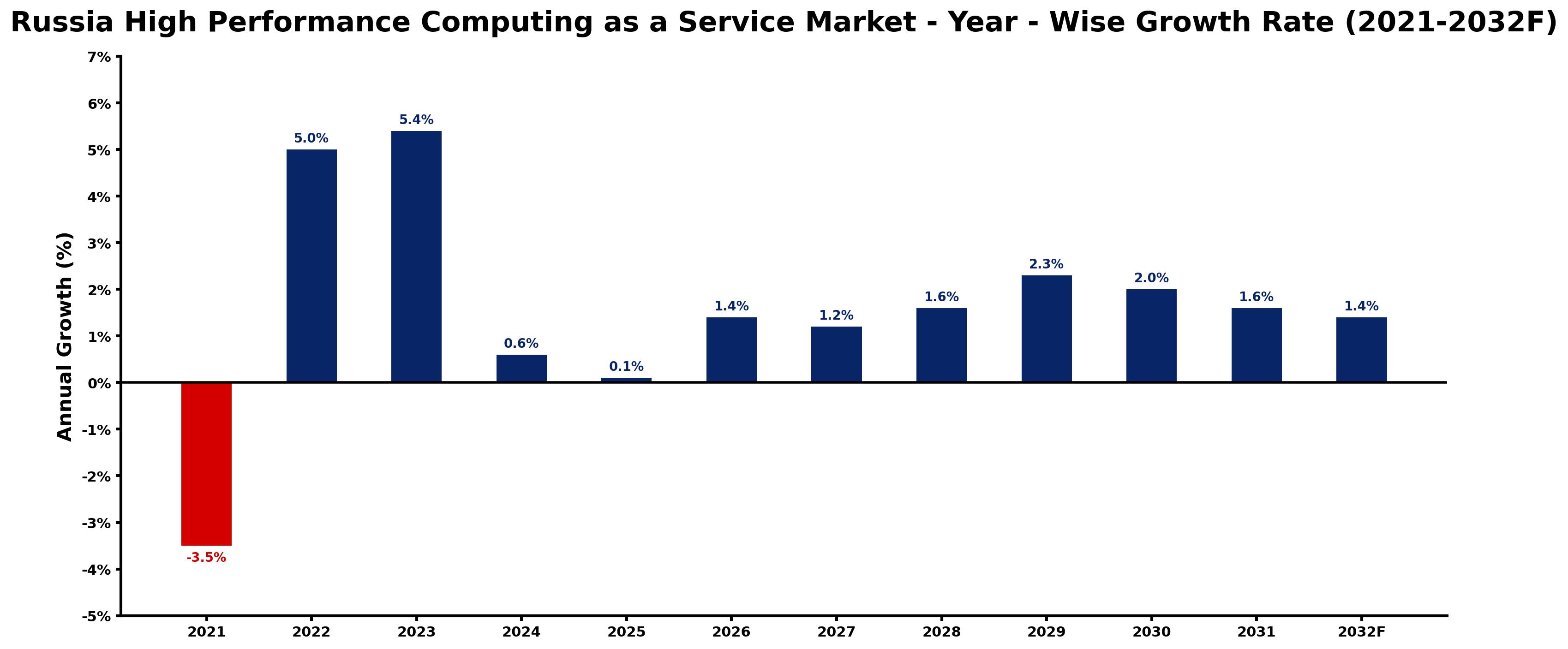
The table below presents the year‑wise growth rates along with the key drivers influencing the market
| Year | Growth Rate | Major Drivers |
| 2021 | -3.5% | Decreased government funding for technology innovation initiatives. |
| 2022 | 5.0% | Launch of national quantum computing development strategy. |
| 2023 | 5.4% | Rising investment in AI-driven data analytics solutions. |
| 2024 | 0.6% | Emergence of localized HPC collaboration projects across enterprises. |
| 2025 | 0.1% | Increased focus on cybersecurity measures for data processing. |
| 2026 | 1.4% | Adaptation of HPC technologies by agriculture for yield optimization. |
| 2027 | 1.2% | Strong national focus on climate modeling and simulation capabilities. |
| 2028 | 1.6% | Partnerships between universities and tech firms boosting HPC use. |
| 2029 | 2.3% | Government incentives for HPC in energy efficiency improvements. |
| 2030 | 2.0% | Demand surge for HPC in healthcare data processing initiatives. |
| 2031 | 1.6% | Local tech startups enhancing regional HPC infrastructure growth. |
| 2032 | 1.4% | Growing interest in personalized medicine utilizing HPC capabilities. |
Note: Market size estimations and growth projections presented in this report are based on 6Wresearch's proprietary forecasting methodology, utilizing the latest available industry data, government publications, and primary research inputs.
Russia High Performance Computing as a Service Market Key Takeaways
Below are some of the specific key takeaways from the market, including:
- The market is experiencing a significant shift towards cloud-based HPCaaS solutions, driven by cost-effectiveness and scalability.
- Demand for HPCaaS is being propelled by the rise of data-intensive applications, particularly in AI and machine learning.
- Government initiatives focusing on digital transformation are enhancing the growth potential of the HPCaaS market.
- Investment in advanced computing infrastructure is crucial for the ongoing development of HPCaaS solutions.
- Despite challenges, there is a growing awareness of HPCaaS benefits among potential users across various sectors.
Evaluation of Restraints in Russia High Performance Computing as a Service Market
Several factors are limiting the growth of the Russia High Performance Computing as a Service market. A primary concern is the limited understanding of HPCaaS solutions among potential users, which hampers adoption. Coupled with this is the issue of data security, where businesses are hesitant to migrate sensitive operations to cloud environments.
Additionally, regulatory restrictions on data transfer and storage create a complex environment for HPCaaS providers. The absence of standardized pricing models further complicates the decision-making process for organizations considering HPCaaS solutions. Addressing these challenges will require focused efforts on education, security investments, and regulatory collaboration.
Russia High Performance Computing as a Service Market Trends
A notable trend in the Russia HPCaaS market is the increasing integration of artificial intelligence and machine learning applications. Businesses are recognizing the necessity of high-performance computing to support these advanced technologies, driving demand for scalable solutions. Additionally, organizations are gravitating towards pay-as-you-go models, allowing them to manage costs more effectively while accessing powerful computing resources.
The trend towards cloud adoption is also evident, as companies seek flexibility without the burden of heavy upfront investments in infrastructure. This shift is indicative of a broader movement within the industry to prioritize efficiency and agility in operations, signaling a transformative phase in the HPCaaS sector.
Russia High Performance Computing as a Service Market Opportunities
Opportunities abound for growth within the Russia HPCaaS market, particularly as enterprises and research institutions seek to collaborate on innovative projects. The government's push for digital transformation opens doors for HPCaaS providers to partner with various sectors, especially in healthcare and energy.
The increasing demand for advanced computational capabilities presents a fertile ground for investment in HPCaaS solutions. Providers who can address the growing needs for data analysis, simulations, and modeling will find a receptive market eager for sophisticated solutions that enhance operational efficiency.
Government Initiatives in the Russia High Performance Computing as a Service Market
Government policies play a crucial role in shaping the Russia High Performance Computing as a Service market. With a focus on digital economy initiatives, the government is actively promoting advancements in high-performance computing technologies. This regulatory support is essential for fostering innovation and encouraging the adoption of HPCaaS solutions across various sectors.
- A recently completed initiative focused on enhancing digital infrastructure to support high-performance computing capabilities across industries.
- Currently ongoing is the Digital Economy Program, which aims to integrate advanced computing technologies into traditional sectors.
- A planned public-private initiative expected to expand access to HPCaaS solutions by 2028, enhancing collaboration between the government and private sector.
- Funding for research and development in HPCaaS through the National Technological Initiative, aimed at boosting technological capabilities.
- The Strategy for the Development of Artificial Intelligence includes provisions for strengthening HPC infrastructure to support AI applications.
Future Insights of the Russia High Performance Computing as a Service Market
Looking ahead to 2026-2032, the Russia HPCaaS market is expected to experience steady growth driven by increasing adoption rates among various industries. The demand for advanced computing power for complex simulations and data analytics will continue to rise, particularly as organizations aim to leverage emerging technologies.
The government's emphasis on digital transformation and innovation is likely to catalyze further investments in HPCaaS solutions. As cloud-based services gain traction, companies that can provide tailored solutions to meet evolving business needs will thrive, shaping the competitive landscape of the HPCaaS market in Russia.
Russia High Performance Computing as a Service Market Latest Developments
Recent developments in the Russia High Performance Computing as a Service market reflect a dynamic industry responding to growing demands. Over the past year, there has been a notable increase in partnerships aimed at enhancing HPC capabilities, as organizations seek to optimize their computational resources.
- A major technology vendor launched a new cloud-based HPCaaS platform in early 2025, aimed at providing enhanced computational power for research institutions.
- An initiative that began in mid-2025 and remains underway focuses on developing standardized pricing models to improve market transparency.
- A rollout expected to begin in the second half of 2026 aims to expand HPCaaS access to small and medium-sized enterprises.
- Currently ongoing is a collaboration between research institutions to develop advanced AI algorithms that require high-performance computing resources.
- A planned infrastructure upgrade initiative is set to launch in 2027, aimed at improving data security for HPCaaS solutions.
Russia High Performance Computing as a Service Market - Key Attractiveness of the Report
- 10 Years of Market Numbers
- Historical Data Starting from 2022 to 2025
- Base Year: 2025
- Forecast Data until 2032
- Key Performance Indicators Impacting the Market
- Major Upcoming Developments and Projects
Key Highlights of the Report:
- Russia High Performance Computing as a Service Market Outlook
- Market Size of Russia High Performance Computing as a Service Market, 2025
- Forecast of Russia High Performance Computing as a Service Market, 2032
- Historical Data and Forecast of Russia High Performance Computing as a Service Revenues & Volume for the Period 2022-2032F
- Russia High Performance Computing as a Service Market Trend Evolution
- Russia High Performance Computing as a Service Market Drivers and Challenges
- Russia High Performance Computing as a Service Price Trends
- Russia High Performance Computing as a Service Porter's Five Forces
- Russia High Performance Computing as a Service Industry Life Cycle
- Historical Data and Forecast of Russia High Performance Computing as a Service Market Revenues & Volume By Verticals for the Period 2022-2032F
- Historical Data and Forecast of Russia High Performance Computing as a Service Market Revenues & Volume By BFSI for the Period 2022-2032F
- Historical Data and Forecast of Russia High Performance Computing as a Service Market Revenues & Volume By Healthcare for the Period 2022-2032F
- Historical Data and Forecast of Russia High Performance Computing as a Service Market Revenues & Volume By Life Sciences for the Period 2022-2032F
- Historical Data and Forecast of Russia High Performance Computing as a Service Market Revenues & Volume By Manufacturing for the Period 2022-2032F
- Historical Data and Forecast of Russia High Performance Computing as a Service Market Revenues & Volume By Deployment Type for the Period 2022-2032F
- Historical Data and Forecast of Russia High Performance Computing as a Service Market Revenues & Volume By Colocation for the Period 2022-2032F
- Historical Data and Forecast of Russia High Performance Computing as a Service Market Revenues & Volume By Hosted Private Cloud for the Period 2022-2032F
- Historical Data and Forecast of Russia High Performance Computing as a Service Market Revenues & Volume By Public Cloud for the Period 2022-2032F
- Historical Data and Forecast of Russia High Performance Computing as a Service Market Revenues & Volume By Component for the Period 2022-2032F
- Historical Data and Forecast of Russia High Performance Computing as a Service Market Revenues & Volume By Software for the Period 2022-2032F
- Historical Data and Forecast of Russia High Performance Computing as a Service Market Revenues & Volume By Services for the Period 2022-2032F
- Russia High Performance Computing as a Service Import Export Trade Statistics
- Market Opportunity Assessment By Verticals
- Market Opportunity Assessment By Deployment Type
- Market Opportunity Assessment By Component
- Russia High Performance Computing as a Service Top Companies Market Share
- Russia High Performance Computing as a Service Competitive Benchmarking By Technical and Operational Parameters
- Russia High Performance Computing as a Service Company Profiles
- Russia High Performance Computing as a Service Key Strategic Recommendations






































