Russia Mirrors Market Summary
The russia mirrors market was estimated at USD 142 Million in 2025 and is projected to reach USD 156 Million by 2032, growing at a CAGR of 1.4% from 2026 to 2032.
Russia Mirrors Market Year-wise Growth Rate and Key Drivers
This graph highlights how the Russia Mirrors Market has steadily grown over the past five years, supported by major growth factors.
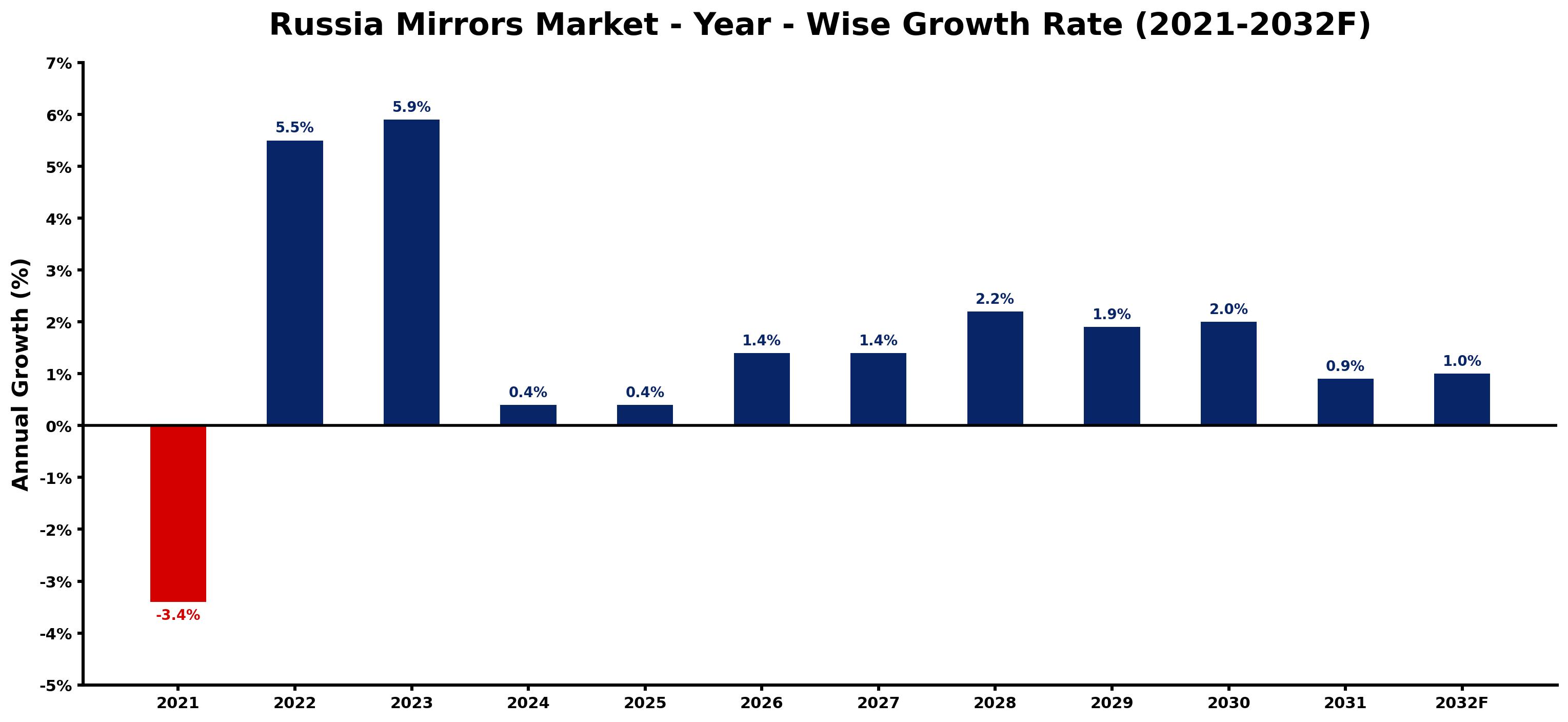
The table below presents the year wise growth rates along with the key drivers influencing the market
| Year | Growth Rate | Major Drivers |
| 2021 | -3.4% | Heightened geopolitical tensions led to decreased consumer spending and limited market access for imported mirrors. |
| 2022 | 5.5% | Innovations in eco-friendly materials attracted environmentally conscious buyers and manufacturers. |
| 2023 | 5.9% | Emerging trends in interior design emphasized multifunctional spaces, boosting mirror sales significantly. |
| 2024 | 0.4% | Local artisans began collaborating with designers, enhancing the uniqueness of mirror products. |
| 2025 | 0.4% | Economic recovery led to increased disposable income for luxury home improvement purchases. |
| 2026 | 1.4% | Smart home technologies gained traction, integrating mirrors as digital display tools. |
| 2027 | 1.4% | Urbanization trends intensified, leading to higher demand for space-saving mirror solutions. |
| 2028 | 2.2% | Home renovation projects flourished as homeowners opted for aesthetic upgrades post-pandemic. |
| 2029 | 1.9% | Social media influencers highlighted home design, driving consumer interest in stylish mirrors. |
| 2030 | 2.0% | Sustainability trends pushed manufacturers to innovate recyclable and biodegradable mirror materials. |
| 2031 | 0.9% | Increased tourism fostered demand for decorative mirrors in hospitality and commercial sectors. |
| 2032 | 1.0% | Online retail channels expanded, making mirrors more accessible to a wider audience. |
Note - Market size estimations and growth projections presented in this report are based on 6Wresearch's advanced forecasting approach, validated with industry datasets as of June 2026.
Russia Mirrors Market Synopsis
The Russia Mirrors Market is projected to reach 1.4% and witness significant growth during the forecast period (2026-2032). This market is anticipated to grow at a compound annual growth rate of 3.10%, driven by multiple factors that reflect the evolving preferences of consumers and advancements in design technology. The expansion in consumer spending, coupled with a growing interest in high-end interior design products, is expected to significantly enhance the market landscape during this period.
Russia Mirrors Market Growth Drivers
The growth trajectory of the Russia Mirrors Market is primarily attributed to various economic and social factors:
- The increasing consumer spending power is facilitating the demand for premium interior design products, particularly mirrors that serve both functional and aesthetic purposes.
- A surge in residential construction projects across urban and suburban areas is contributing to the rising need for mirrors in new homes, enhancing overall market growth.
- Trends in interior design that emphasize personalization and luxury are driving the preference for unique mirrors that complement diverse décor styles.
- The emergence of innovative smart mirrors incorporates advanced features, such as voice control and facial recognition, appealing to a tech-savvy consumer base.
- Manufacturers are focusing on introducing designs that prioritize safety and durability, such as mirrors with shatterproof glass and anti-fingerprint coatings, further stimulating market demand.
Russia Mirrors Market Trends and Opportunities
The Russia Mirrors Market is experiencing several trends that present unique opportunities for growth:
- The integration of technology in mirror design, such as smart features that enhance user experience, is becoming increasingly popular, positioning smart mirrors as a key growth segment.
- Eco-friendly manufacturing practices and the use of sustainable materials are gaining traction, appealing to environmentally conscious consumers.
- The demand for mirrors that serve multifunctional purposes, such as those combining lighting and reflective capabilities, is on the rise, indicating a shift towards more innovative product offerings.
- Increased online retail presence is making it easier for consumers to access a variety of mirror options, thus expanding market reach and improving sales channels.
- Collaboration between designers and manufacturers is fostering creativity and innovation in mirror design, leading to the development of exclusive, bespoke mirrors tailored to high-end clientele.
Russia Mirrors Market Challenges and Restraints
Despite the promising outlook for the Russia Mirrors Market, several challenges could hinder its growth:
- Economic fluctuations and changes in disposable income levels could negatively impact consumer spending on non-essential home décor items.
- Supply chain disruptions, aggravated by geopolitical tensions, could lead to increased production costs and affect product availability.
- The competition from imported mirrors, which may offer lower prices, poses a challenge for local manufacturers aiming to maintain market share.
- Consumer preferences may shift rapidly, necessitating continuous innovation and adaptation by manufacturers to stay relevant in the market.
- Safety regulations and compliance standards can impose additional costs and development timelines on manufacturers, impacting their ability to bring new products to market quickly.
Russia Mirrors Market Government Investment and Initiatives
The government of Russia has been actively involved in initiatives aimed at promoting the domestic manufacturing sector, including the mirrors market. Public spending on infrastructure and construction projects is expected to drive demand for mirrors as part of new residential and commercial buildings. Additionally, incentives for local manufacturers, including support for innovation, aim to enhance product quality and competitiveness. Programs that focus on technology adoption in manufacturing processes are also crucial, as they encourage the development of advanced mirror technologies that align with current market trends.
Russia Mirrors Market Latest Developments (May 2025 - June 2026)
Recent developments in the Russia Mirrors Market have indicated a shift towards more innovative and technologically advanced products. The rising interest in smart mirrors has led to an increase in research and development activities aimed at integrating sophisticated features, such as augmented reality and connectivity options. Moreover, many local manufacturers have begun investing in sustainable materials and environmentally friendly production processes to meet changing consumer preferences. Industry events and exhibitions have also highlighted an emphasis on design collaboration and the importance of aesthetics in mirror production. These trends are anticipated to shape the market significantly in the near future.
Russia Mirrors Market - Key Attractiveness of the Report
- 10 Years of Market Numbers
- Historical Data Starting from 2022 to 2025
- Base Year: 2025
- Forecast Data until 2032
- Key Performance Indicators Impacting the Market
- Major Upcoming Developments and Projects
Key Highlights of the Report:
- Russia Mirrors Market Outlook
- Market Size of Russia Mirrors Market, 2025
- Forecast of Russia Mirrors Market, 2032F
- Historical Data and Forecast of Russia Mirrors Revenues & Volume for the Period 2022-2032F
- Russia Mirrors Market Trend Evolution
- Russia Mirrors Market Drivers and Challenges
- Russia Mirrors Price Trends
- Russia Mirrors Porter's Five Forces
- Russia Mirrors Industry Life Cycle
- Historical Data and Forecast of Russia Mirrors Market Revenues & Volume By Types for the Period 2022-2032F
- Historical Data and Forecast of Russia Mirrors Market Revenues & Volume By Silver Mirror for the Period 2022-2032F
- Historical Data and Forecast of Russia Mirrors Market Revenues & Volume By Plated Mirror for the Period 2022-2032F
- Historical Data and Forecast of Russia Mirrors Market Revenues & Volume By Others for the Period 2022-2032F
- Historical Data and Forecast of Russia Mirrors Market Revenues & Volume By End-users for the Period 2022-2032F
- Historical Data and Forecast of Russia Mirrors Market Revenues & Volume By Bathroom for the Period 2022-2032F
- Historical Data and Forecast of Russia Mirrors Market Revenues & Volume By Make-up for the Period 2022-2032F
- Historical Data and Forecast of Russia Mirrors Market Revenues & Volume By Dressing for the Period 2022-2032F
- Historical Data and Forecast of Russia Mirrors Market Revenues & Volume By Decorative for the Period 2022-2032F
- Historical Data and Forecast of Russia Mirrors Market Revenues & Volume By Advertising for the Period 2022-2032F
- Historical Data and Forecast of Russia Mirrors Market Revenues & Volume By Others for the Period 2022-2032F
- Russia Mirrors Import Export Trade Statistics
- Market Opportunity Assessment By Types
- Market Opportunity Assessment By End-users
- Russia Mirrors Top Companies Market Share
- Russia Mirrors Competitive Benchmarking By Technical and Operational Parameters
- Russia Mirrors Company Profiles
- Russia Mirrors Key Strategic Recommendations






































