Samoa Ethyl Alcohol Market Growth Rate Analysis (2025 - 2031)
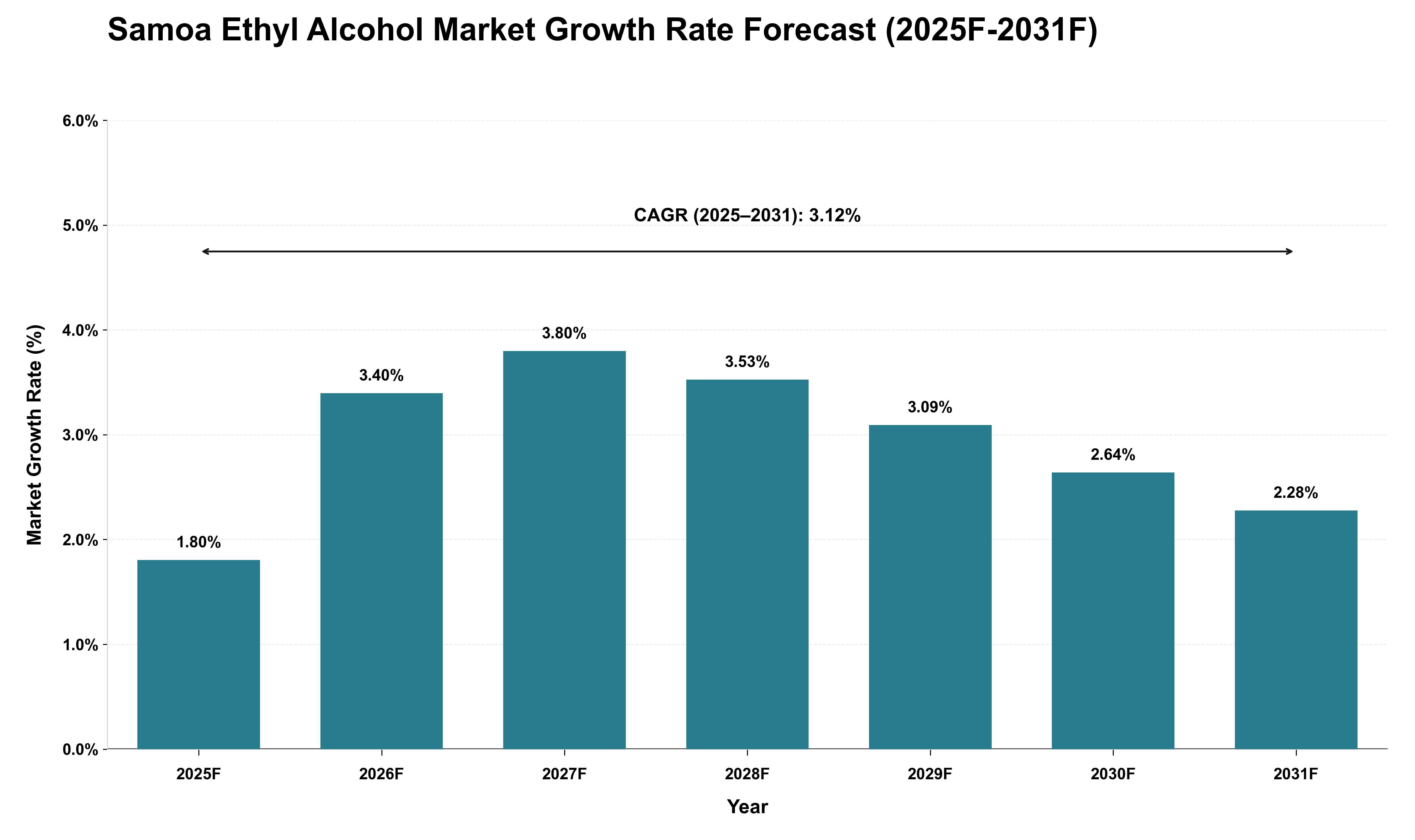
From 2025 onward, the Samoa ethyl alcohol market is anticipated to experience a compound annual growth rate (CAGR) of 3.12%, reflecting a nuanced interplay of regulatory and trade policy factors. The initial growth in 2025 at 1.80% will likely be influenced by evolving import regulations and potential tariff adjustments that could affect pricing dynamics. As trade policies stabilize, the market is expected to gain momentum, peaking at 3.80% in 2027, driven by increased demand for both industrial and consumer applications of ethyl alcohol. However, as global supply chains adapt and local production capabilities are enhanced, growth rates will gradually moderate to approximately 2.28% by 2031. This trajectory suggests that while regulatory frameworks may initially constrain growth through compliance costs, they will ultimately foster a more competitive environment that supports sustainable expansion within the sector over the forecast period.
Key Highlights of the Report:
- Samoa Ethyl Alcohol Market Outlook
- Market Size of Samoa Ethyl Alcohol Market, 2024
- Forecast of Samoa Ethyl Alcohol Market, 2031
- Historical Data and Forecast of Samoa Ethyl Alcohol Revenues & Volume for the Period 2021-2031
- Samoa Ethyl Alcohol Market Trend Evolution
- Samoa Ethyl Alcohol Market Drivers and Challenges
- Samoa Ethyl Alcohol Price Trends
- Samoa Ethyl Alcohol Porter`s Five Forces
- Samoa Ethyl Alcohol Industry Life Cycle
- Historical Data and Forecast of Samoa Ethyl Alcohol Market Revenues & Volume By Grade for the Period 2021-2031
- Historical Data and Forecast of Samoa Ethyl Alcohol Market Revenues & Volume By Food Grade for the Period 2021-2031
- Historical Data and Forecast of Samoa Ethyl Alcohol Market Revenues & Volume By Industrial Grade for the Period 2021-2031
- Historical Data and Forecast of Samoa Ethyl Alcohol Market Revenues & Volume By Pharmaceutical Grade for the Period 2021-2031
- Historical Data and Forecast of Samoa Ethyl Alcohol Market Revenues & Volume By Lab Grade for the Period 2021-2031
- Historical Data and Forecast of Samoa Ethyl Alcohol Market Revenues & Volume By End-user Industry for the Period 2021-2031
- Historical Data and Forecast of Samoa Ethyl Alcohol Market Revenues & Volume By Automotive and Transportation for the Period 2021-2031
- Historical Data and Forecast of Samoa Ethyl Alcohol Market Revenues & Volume By Food and Beverage for the Period 2021-2031
- Historical Data and Forecast of Samoa Ethyl Alcohol Market Revenues & Volume By Pharmaceutical for the Period 2021-2031
- Historical Data and Forecast of Samoa Ethyl Alcohol Market Revenues & Volume By Cosmetics and Personal Care (Includes hand-Sanitizer) for the Period 2021-2031
- Historical Data and Forecast of Samoa Ethyl Alcohol Market Revenues & Volume By Other End-user Industries for the Period 2021-2031
- Samoa Ethyl Alcohol Import Export Trade Statistics
- Market Opportunity Assessment By Grade
- Market Opportunity Assessment By End-user Industry
- Samoa Ethyl Alcohol Top Companies Market Share
- Samoa Ethyl Alcohol Competitive Benchmarking By Technical and Operational Parameters
- Samoa Ethyl Alcohol Company Profiles
- Samoa Ethyl Alcohol Key Strategic Recommendations






































