Saudi Arabia Bicycle Carbon Frames Market Size, Share & Growth Rate
The Saudi Arabia Bicycle Carbon Frames Market was estimated at USD 227 Million in 2025 and is projected to reach USD 289 Million by 2032, growing at a CAGR of 3.5% from 2026 to 2032. This growth trajectory is largely influenced by a rising health consciousness among the population, alongside the government's commitment to enhancing the country's sports infrastructure. Increasing participation in cycling events and the promotion of cycling as an eco-friendly mode of transport are further stimulating demand for high-performance carbon frames.
Saudi Arabia Bicycle Carbon Frames Market Growth Rate Analysis (2021-2032)
The Saudi Arabia bicycle carbon frames market has seen a remarkable turnaround since 2021, when it recorded a decline of 2.1%. This was largely attributed to the impact of the pandemic on consumer spending and recreational activities. However, in 2022, the market rebounded with a growth of 6.6%, fueled by a heightened consumer interest in cycling and recreational outdoor activities. By 2023, growth soared to 10.7%, as investments in local manufacturing and a push for sustainable transport options gained momentum. Looking ahead, growth is expected to stabilize between 3.8% and 4.7% through 2032, driven by ongoing infrastructure developments, favorable policies promoting cycling, and growing environmental awareness among consumers.
Saudi Arabia Bicycle Carbon Frames Market Year-wise Growth Rate and Key Drivers
This graph highlights how the Saudi Arabia Bicycle Carbon Frames Market has steadily grown over the past five years, supported by major growth factors.
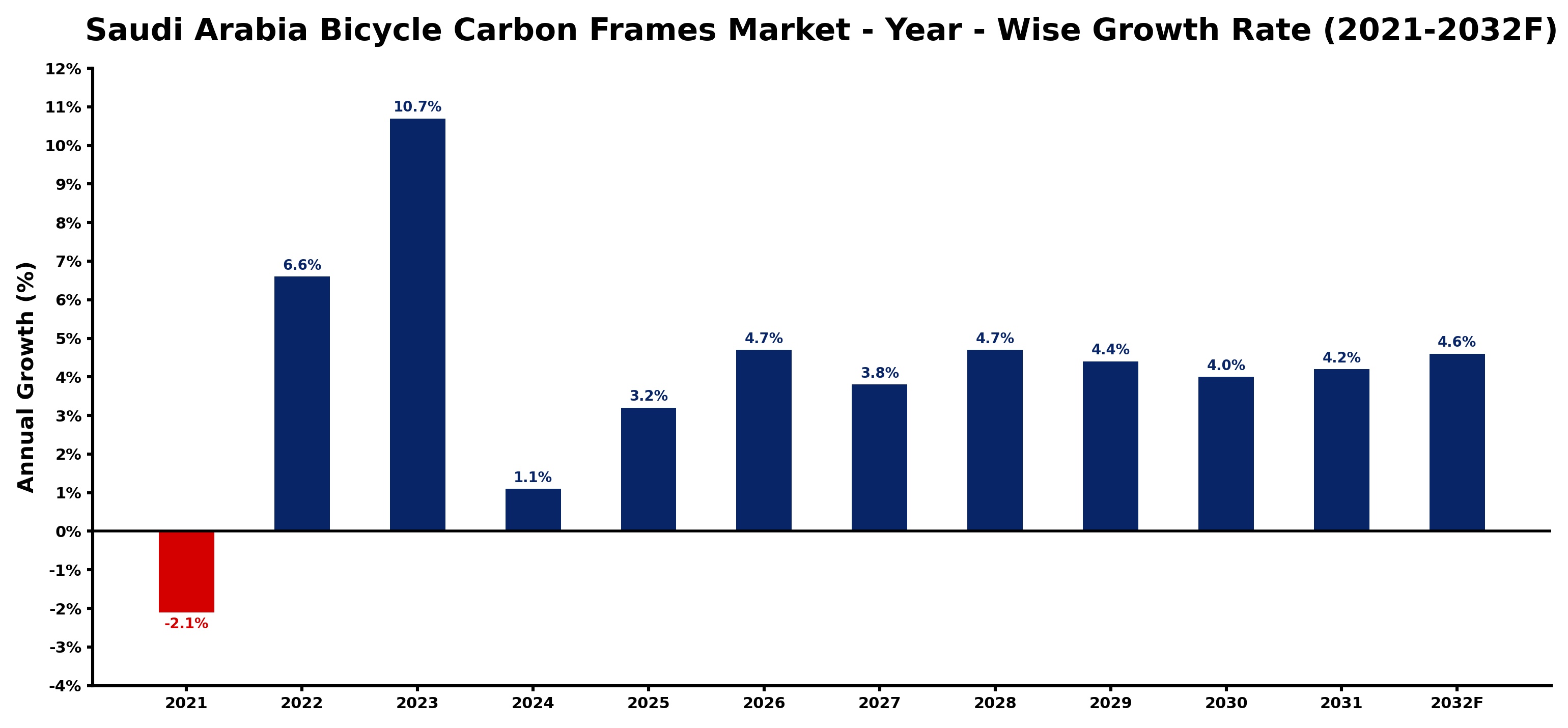
The table below presents the year‑wise growth rates along with the key drivers influencing the market
| Year | Growth Rate | Major Drivers |
| 2021 | -2.1% | Supply chain disruptions limited availability |
| 2022 | 6.6% | Increased health awareness drove demand |
| 2023 | 10.7% | Growing cycling culture enhanced popularity |
| 2024 | 1.1% | Infrastructure improvements expanded access |
| 2025 | 3.2% | Sustainability trends encouraged eco-friendly choices |
| 2026 | 4.7% | Technological advancements improved performance |
| 2027 | 3.8% | Rising disposable income supported purchases |
| 2028 | 4.7% | Youth engagement in cycling increased |
| 2029 | 4.4% | Urbanization trends boosted cycling adoption |
| 2030 | 4.0% | E-commerce growth enhanced market reach |
| 2031 | 4.2% | Fitness trends promoted cycling activities |
| 2032 | 4.6% | Government initiatives supported cycling infrastructure |
Note - Market size estimations and growth projections presented in this report are based on 6Wresearch's advanced forecasting approach, validated with industry datasets as of June 2026.
Saudi Arabia Bicycle Carbon Frames Market Synopsis
The Saudi Arabia bicycle carbon frames market has emerged as a vibrant segment within the broader cycling industry, driven by a burgeoning interest in cycling as both a sport and a recreational activity. With professional cyclists and enthusiastic amateurs favoring lightweight and durable frames, there is a consistent demand for high-quality carbon options that enhance performance on both road and mountain bikes.
As the kingdom focuses on promoting active lifestyles and sports tourism, the popularity of cycling events continues to rise. This shift not only reflects changing consumer preferences but also underscores the increasing importance of bicycle carbon frames in achieving competitive edge and superior riding experiences.
Saudi Arabia Bicycle Carbon Frames Market Key Takeaways
- Demand for lightweight and durable bicycle frames is driving market expansion.
- Growing sports tourism and cycling events in Saudi Arabia foster increased interest in cycling.
- Key players are focused on developing competitive and premium cycling equipment.
- Government initiatives to enhance cycling infrastructure support market growth.
- COVID-19 has heightened interest in outdoor and eco-friendly activities, further boosting the market.
Evaluation of Restraints in Saudi Arabia Bicycle Carbon Frames Market
Despite the growth potential, the Saudi Arabia bicycle carbon frames market faces notable challenges. A significant restraint is the cultural perception surrounding cycling, which has historically not been as strong as in other regions. Efforts must be made to promote cycling as a practical and sustainable mode of transportation. Additionally, the availability of affordable carbon frames is a pressing concern, as consumers may gravitate towards more cost-effective alternatives. Competition from manufacturers of aluminum and steel frames, combined with international brands that dominate the market, adds another layer of complexity that local players must navigate. Investments in safety infrastructure and heightened consumer awareness around cycling safety will also be essential for market growth.
Saudi Arabia Bicycle Carbon Frames Market Trends
Current trends in the Saudi Arabia bicycle carbon frames market reveal a shift towards customization and technological integration. Consumers are increasingly looking for tailored bike configurations that meet individual preferences and performance standards. Additionally, advancements in materials and manufacturing processes are resulting in even lighter and stronger frames. There is also a noticeable trend towards sustainable practices, with manufacturers exploring eco-friendly materials and production methods that resonate with the growing global emphasis on sustainability.
Saudi Arabia Bicycle Carbon Frames Market Opportunities
Investment opportunities abound within the Saudi Arabia bicycle carbon frames market as demand for high-performance cycling equipment continues to escalate. The rise of cycling clubs and events presents avenues for partnerships and sponsorships, while investments in bicycle infrastructure development can create a more conducive environment for cycling enthusiasts. Moreover, tapping into the burgeoning e-commerce sector can allow manufacturers to reach a wider audience and cater to the growing trend of online shopping for sports equipment.
Government Initiatives in the Saudi Arabia Bicycle Carbon Frames Market
The Saudi government has demonstrated a commitment to fostering a culture of health and fitness through various initiatives aimed at increasing cycling participation. These efforts include investments in cycling infrastructure, such as dedicated bike lanes and community cycling events. Furthermore, public campaigns promoting the health benefits of cycling are likely to enhance overall awareness and acceptance of this activity, encouraging more individuals to consider cycling as a viable mode of transportation.
Future Insights of the Saudi Arabia Bicycle Carbon Frames Market
Looking towards the future, the Saudi Arabia bicycle carbon frames market is positioned for sustained growth driven by increasing health awareness and government support. The anticipated expansion of cycling events and the potential establishment of more recreational cycling facilities will further entrench cycling into the lifestyle of the populace. With continuous advancements in frame technology and materials, the market is set to evolve, offering innovative solutions that cater to the performance demands of cyclists.
Saudi Arabia Bicycle Carbon Frames Market Latest Developments (May 2025 - June 2026)
Recent developments in the Saudi Arabia bicycle carbon frames market indicate a push towards integrating smart technologies into cycling equipment. Innovations such as performance-tracking sensors and enhanced aerodynamic designs are gaining traction, appealing particularly to competitive cyclists. Additionally, partnerships between local manufacturers and international brands are becoming more common as businesses seek to leverage expertise and expand their market reach. The increasing presence of cycling events is also attracting sponsorship deals, further invigorating the market landscape.
Saudi Arabia Bicycle Carbon Frames Market - Key Attractiveness of the Report
- 10 Years of Market Numbers
- Historical Data Starting from 2022 to 2025
- Base Year: 2025
- Forecast Data until 2032
- Key Performance Indicators Impacting the Market
- Major Upcoming Developments and Projects
Key Highlights of the Report:
- Saudi Arabia Bicycle Carbon Frames Market Outlook
- Market Size of Saudi Arabia Bicycle Carbon Frames Market, 2025
- Forecast of Saudi Arabia Bicycle Carbon Frames Market, 2032F
- Historical Data and Forecast of Saudi Arabia Bicycle Carbon Frames Revenues & Volume for the Period 2022-2032F
- Saudi Arabia Bicycle Carbon Frames Market Trend Evolution
- Saudi Arabia Bicycle Carbon Frames Market Drivers and Challenges
- Saudi Arabia Bicycle Carbon Frames Price Trends
- Saudi Arabia Bicycle Carbon Frames Porter's Five Forces
- Saudi Arabia Bicycle Carbon Frames Industry Life Cycle
- Historical Data and Forecast of Saudi Arabia Bicycle Carbon Frames Market Revenues & Volume By Material for the Period 2022-2032F
- Historical Data and Forecast of Saudi Arabia Bicycle Carbon Frames Market Revenues & Volume By Full Carbon for the Period 2022-2032F
- Historical Data and Forecast of Saudi Arabia Bicycle Carbon Frames Market Revenues & Volume By Half Carbon for the Period 2022-2032F
- Historical Data and Forecast of Saudi Arabia Bicycle Carbon Frames Market Revenues & Volume By Product Type for the Period 2022-2032F
- Historical Data and Forecast of Saudi Arabia Bicycle Carbon Frames Market Revenues & Volume By Mountain Bike for the Period 2022-2032F
- Historical Data and Forecast of Saudi Arabia Bicycle Carbon Frames Market Revenues & Volume By Road Bike for the Period 2022-2032F
- Historical Data and Forecast of Saudi Arabia Bicycle Carbon Frames Market Revenues & Volume By Application for the Period 2022-2032F
- Historical Data and Forecast of Saudi Arabia Bicycle Carbon Frames Market Revenues & Volume By Manual Bicycle for the Period 2022-2032F
- Historical Data and Forecast of Saudi Arabia Bicycle Carbon Frames Market Revenues & Volume By E-bikes for the Period 2022-2032F
- Saudi Arabia Bicycle Carbon Frames Import Export Trade Statistics
- Market Opportunity Assessment By Material
- Market Opportunity Assessment By Product Type
- Market Opportunity Assessment By Application
- Saudi Arabia Bicycle Carbon Frames Top Companies Market Share
- Saudi Arabia Bicycle Carbon Frames Competitive Benchmarking By Technical and Operational Parameters
- Saudi Arabia Bicycle Carbon Frames Company Profiles
- Saudi Arabia Bicycle Carbon Frames Key Strategic Recommendations






































