Saudi Arabia Contactless Payment Market Size & Growth Rate (2026-2032)
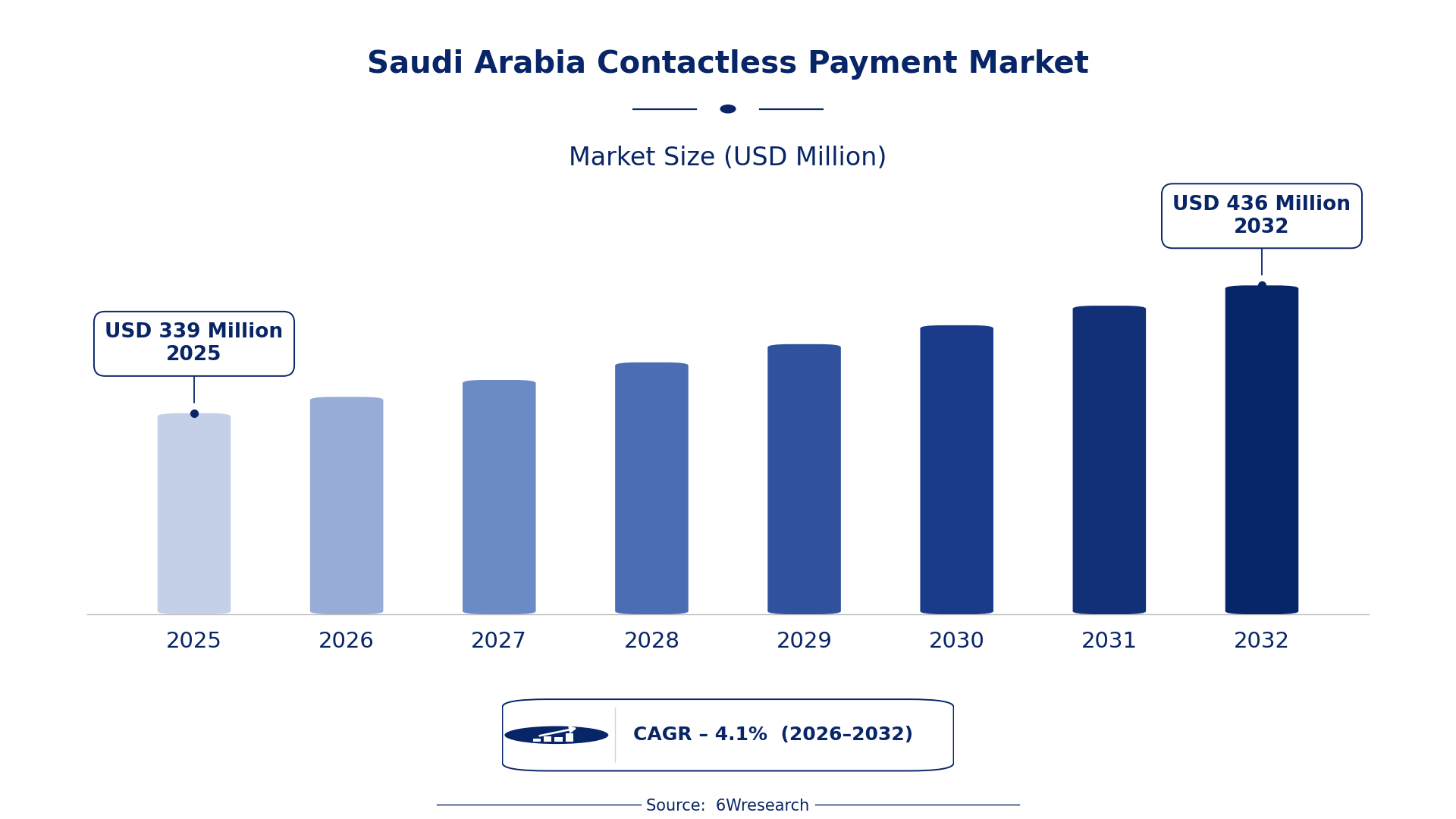
The Saudi Arabia Contactless Payment Market was estimated at USD 339 Million in 2025 and is projected to reach USD 436 Million by 2032, growing at a CAGR of 4.1% from 2026 to 2032.
Saudi Arabia Contactless Payment Market Synopsis
The Saudi Arabia Contactless Payment market has witnessed a surge in adoption, reflecting a shift in consumer behavior toward fast and secure transaction methods. As the market matures, the focus is shifting toward integrating advanced technologies and enhancing user experiences.
Looking ahead, the market is expected to grow in sophistication, with a rising number of businesses adopting contactless solutions. This growth will be driven by the continued demand for convenience, security, and the inclusion of unbanked populations into the financial ecosystem.
Saudi Arabia Contactless Payment Market Year-wise Growth Rate and Key Drivers
This graph illustrates the annual growth rates of the Saudi Arabia Contactless Payment Market from 2021 to 2032, highlighting a steady upward trajectory and projected expansion over the forecast period.
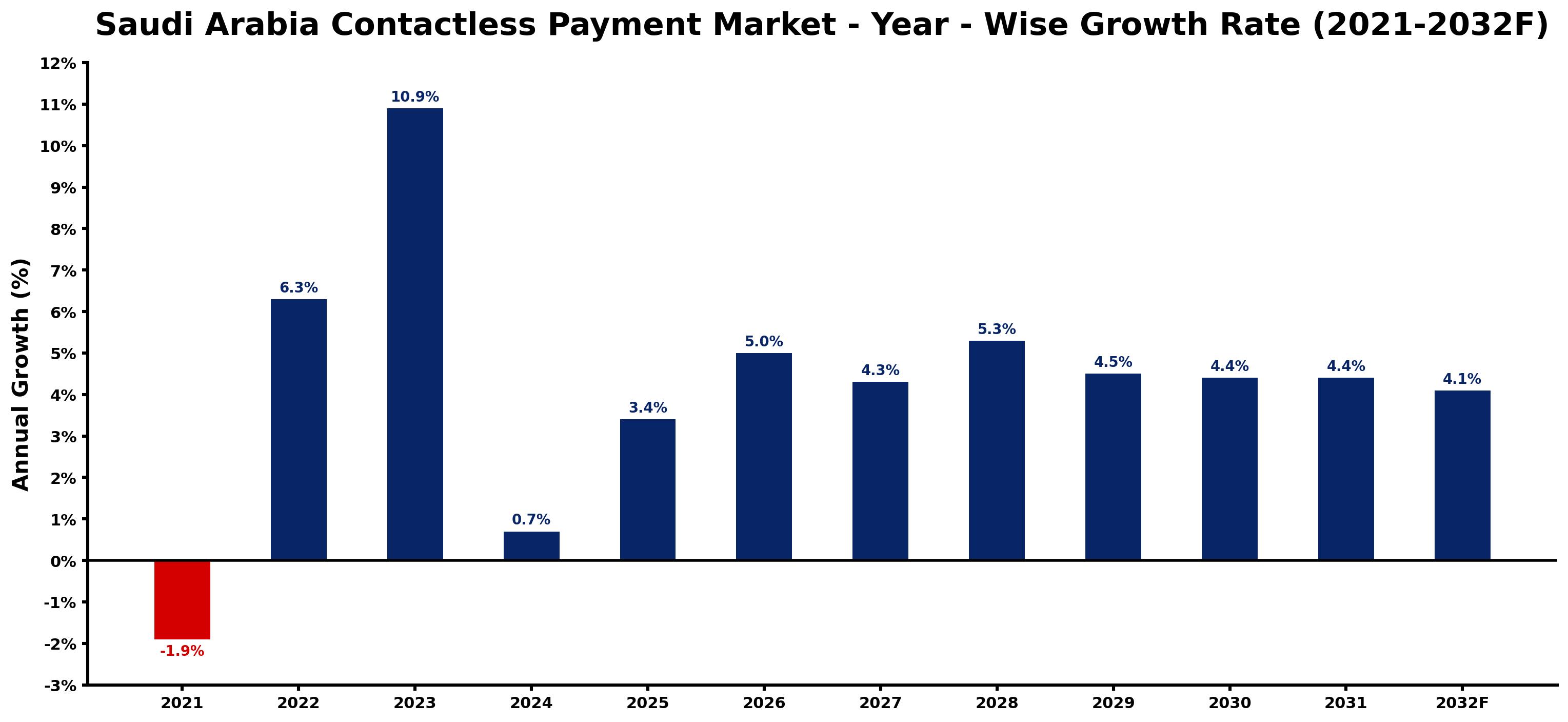
The table below presents the year‑wise growth rates along with the key drivers influencing the market
| Year | Growth Rate | Major Drivers |
| 2021 | -1.9% | Low merchant adoption due to local bank regulations. |
| 2022 | 6.3% | National payment strategy supports cashless transactions push. |
| 2023 | 10.9% | Increased smartphone penetration fuels mobile payments adoption. |
| 2024 | 0.7% | Government incentives boost contactless payment security measures. |
| 2025 | 3.4% | Rise in e-commerce drives demand for contactless solutions. |
| 2026 | 5.0% | Young population embraces digital payment technologies rapidly. |
| 2027 | 4.3% | Retail sector digitization accelerates contactless payment integration. |
| 2028 | 5.3% | Local fintech innovations enhance user-friendly payment experiences. |
| 2029 | 4.5% | Regulatory support for digital finance aids market growth. |
| 2030 | 4.4% | Consumer preference shifts towards convenient payment methods. |
| 2031 | 4.4% | Increased financial literacy enhances digital payment understanding. |
| 2032 | 4.1% | Contactless payment acceptance expands across small businesses. |
Note: Market size estimations and growth projections presented in this report are based on 6Wresearch's proprietary forecasting methodology, utilizing the latest available industry data, government publications, and primary research inputs.
Saudi Arabia Contactless Payment Market Key Takeaways
Below are some of the specific key takeaways from the market, including:
- Rapid consumer adoption of mobile wallets and NFC technologies is reshaping payment preferences.
- The COVID-19 pandemic served as a catalyst for accelerated contactless payment implementation.
- Increased focus on data security and fraud prevention is critical for market sustainability.
- Government initiatives are paving the way for greater financial inclusion through contactless solutions.
- Emerging technologies are set to redefine the customer experience in payment transactions.
Evaluation of Restraints in Saudi Arabia Contactless Payment Market
Despite the growth trajectory, the Saudi Arabia Contactless Payment market faces notable restraints. One major concern is the security of contactless payment systems, which must continuously evolve to counteract potential fraud and data breaches. on top of that, ensuring that these solutions are user-friendly and accessible to all demographics, particularly the unbanked, remains a challenge. The regulatory landscape also requires ongoing adaptation to foster innovation while safeguarding consumer interests.
Saudi Arabia Contactless Payment Market Trends
Several trends are shaping the Saudi Arabia Contactless Payment market. The growing prevalence of mobile payment solutions is driving consumer preferences for contactless transactions. Enhanced partnerships between financial institutions and technology providers are fostering innovation in payment methods. Additionally, the shift toward digital wallets is being propelled by convenience and efficiency, particularly among younger consumers.
Saudi Arabia Contactless Payment Market Opportunities
There are significant opportunities for growth in the Saudi Arabia Contactless Payment market. The government’s push for digital transformation presents avenues for businesses to invest in contactless infrastructure. As fintech solutions expand, there’s potential for innovative payment technologies that can cater to various consumer segments. on top of that, enhancing financial literacy can improve adoption rates among unbanked populations, creating a broader customer base.
Government Initiatives in the Saudi Arabia Contactless Payment Market
Government policies are instrumental in shaping the Saudi Arabia Contactless Payment market. The regulatory framework supports the promotion of digital payment solutions, emphasizing security and user accessibility. Recent initiatives have highlighted the importance of integrating technology into the financial sector, ensuring that all citizens can benefit from modern payment methods.
- A national digital infrastructure upgrade programme has recently been launched to enhance connectivity and access to payment solutions.
- Ongoing initiatives focus on developing secure payment frameworks to bolster consumer confidence in contactless transactions.
- Plans for a public-private partnership aimed at increasing financial literacy among unbanked populations are expected to roll out by 2027.
- A regulatory framework introduced in 2025 mandates the implementation of contactless payment solutions in public transportation systems.
Future Insights of the Saudi Arabia Contactless Payment Market
From 2026 to 2032, the Saudi Arabia Contactless Payment market is expected to continue its upward trajectory, driven by technological advancements and changing consumer behaviors. Increased smartphone penetration and a growing preference for cashless transactions will further propel this market. As businesses adapt to these shifts, the integration of artificial intelligence and blockchain in payment processing is likely to become more pronounced, enhancing security and efficiency.
Saudi Arabia Contactless Payment Market Latest Developments
In the past year, the Saudi Arabia Contactless Payment market has seen substantial developments. Major players in the financial technology sector are enhancing their offerings, driven by consumer demand for improved security and efficiency in payment methods. The government’s active role in promoting digital payments has further accelerated market momentum.
- A significant partnership was formed in early 2025 between leading tech firms to develop a new mobile wallet application that integrates advanced security features.
- Ongoing enhancements to existing contactless payment infrastructure are being implemented to improve transaction speeds and user experiences.
- A pilot program for a contactless payment system in public transport is currently underway, expected to be fully operational by mid-2026.
- A planned rollout of biometric authentication for contactless transactions is scheduled to begin in late 2025, aiming to boost security.
Saudi Arabia Contactless Payment Market - Key Attractiveness of the Report
- 10 Years of Market Numbers
- Historical Data Starting from 2022 to 2025
- Base Year: 2025
- Forecast Data until 2032
- Key Performance Indicators Impacting the Market
- Major Upcoming Developments and Projects
Key Highlights of the Report:
- Saudi Arabia Contactless Payment Market Outlook
- Market Size of Saudi Arabia Contactless Payment Market, 2025
- Forecast of Saudi Arabia Contactless Payment Market, 2032
- Historical Data and Forecast of Saudi Arabia Contactless Payment Revenues & Volume for the Period 2022-2032F
- Saudi Arabia Contactless Payment Market Trend Evolution
- Saudi Arabia Contactless Payment Market Drivers and Challenges
- Saudi Arabia Contactless Payment Price Trends
- Saudi Arabia Contactless Payment Porter's Five Forces
- Saudi Arabia Contactless Payment Industry Life Cycle
- Historical Data and Forecast of Saudi Arabia Contactless Payment Market Revenues & Volume By Component for the Period 2022-2032F
- Historical Data and Forecast of Saudi Arabia Contactless Payment Market Revenues & Volume By Hardware for the Period 2022-2032F
- Historical Data and Forecast of Saudi Arabia Contactless Payment Market Revenues & Volume By Solutions for the Period 2022-2032F
- Historical Data and Forecast of Saudi Arabia Contactless Payment Market Revenues & Volume By Services for the Period 2022-2032F
- Historical Data and Forecast of Saudi Arabia Contactless Payment Market Revenues & Volume By Vertical for the Period 2022-2032F
- Historical Data and Forecast of Saudi Arabia Contactless Payment Market Revenues & Volume By Retail for the Period 2022-2032F
- Historical Data and Forecast of Saudi Arabia Contactless Payment Market Revenues & Volume By Hospitality for the Period 2022-2032F
- Historical Data and Forecast of Saudi Arabia Contactless Payment Market Revenues & Volume By Healthcare for the Period 2022-2032F
- Historical Data and Forecast of Saudi Arabia Contactless Payment Market Revenues & Volume By Energy and Utilities for the Period 2022-2032F
- Historical Data and Forecast of Saudi Arabia Contactless Payment Market Revenues & Volume By Transportation and Logistics for the Period 2022-2032F
- Historical Data and Forecast of Saudi Arabia Contactless Payment Market Revenues & Volume By BFSI for the Period 2022-2032F
- Historical Data and Forecast of Saudi Arabia Contactless Payment Market Revenues & Volume By Others (Government, telecommunications, and education) for the Period 2022-2032F
- Saudi Arabia Contactless Payment Import Export Trade Statistics
- Market Opportunity Assessment By Component
- Market Opportunity Assessment By Vertical
- Saudi Arabia Contactless Payment Top Companies Market Share
- Saudi Arabia Contactless Payment Competitive Benchmarking By Technical and Operational Parameters
- Saudi Arabia Contactless Payment Company Profiles
- Saudi Arabia Contactless Payment Key Strategic Recommendations






































