Saudi Arabia Digital Twin Market Size, Share & Growth Rate
The Saudi Arabia Digital Twin Market was estimated at USD 386 Million in 2025 and is projected to reach USD 492 Million by 2032, growing at a CAGR of 3.5% from 2026 to 2032. This growth trajectory is primarily driven by the Saudi government's commitment to digital transformation as part of its Vision 2030 initiative. The surge in investments towards smart city projects and advancements in manufacturing technology further bolster the adoption of digital twin solutions, as businesses seek to enhance operational efficiency and improve decision-making processes.
Saudi Arabia Digital Twin Market Year-wise Growth Rate and Key Drivers
This graph highlights how the Saudi Arabia Digital Twin Market has steadily grown over the years, supported by major growth factors.
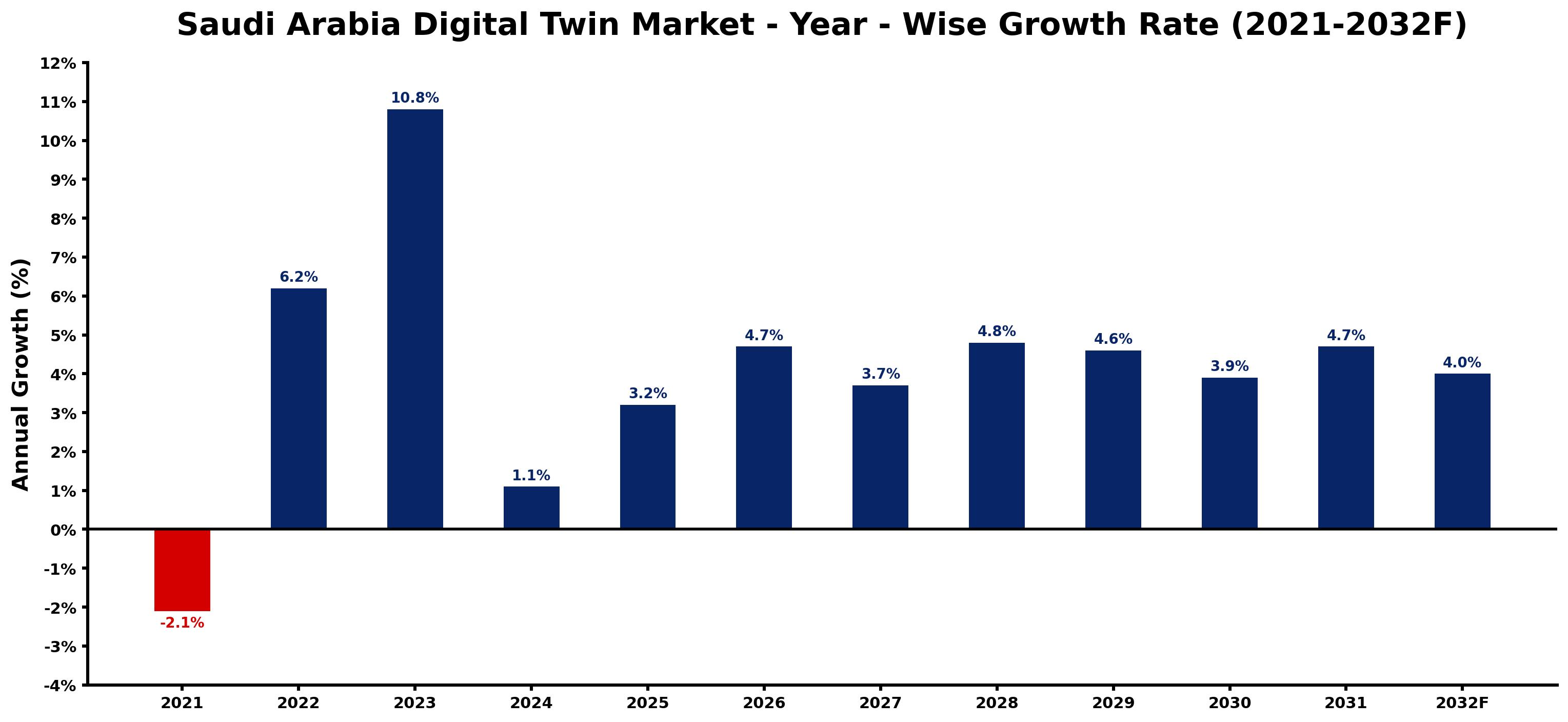
The table below presents the year‑wise growth rates along with the key drivers influencing the market
| Year | Growth Rate | Major Drivers |
| 2021 | -2.1% | Rapid growth in telecom and data center sectors |
| 2022 | 6.2% | Growing urbanization and commercial development |
| 2023 | 10.8% | Rising electricity demand across industries |
| 2024 | 1.1% | Increasing industrial automation investments |
| 2025 | 3.2% | Rapid growth in telecom and data center sectors |
| 2026 | 4.7% | Rising electricity demand across industries |
| 2027 | 3.7% | Rising electricity demand across industries |
| 2028 | 4.8% | Increasing industrial infrastructure investments |
| 2029 | 4.6% | Government infrastructure modernization initiatives |
| 2030 | 3.9% | Rising electricity demand across industries |
| 2031 | 4.7% | Increasing industrial automation investments |
| 2032 | 4.0% | Growing urbanization and commercial development |
Note - Market size estimations and growth projections presented in this report are based on 6Wresearch's advanced forecasting approach, validated with industry datasets as of June 2026.
Saudi Arabia Digital Twin Market Synopsis
The ongoing push for Industry 4.0 is the most formidable force shaping the Saudi Arabia Digital Twin Market today. This alignment with global technological trends is evident across various sectors, notably in manufacturing and urban development, where digital twins facilitate improved efficiency and sustainability.
With a growing emphasis on data-driven strategies, organizations in Saudi Arabia are increasingly recognizing the value of digital twins. These virtual models not only enable predictive maintenance and scenario simulation but also contribute to enhanced asset management and performance optimization across industries.
Saudi Arabia Digital Twin Market Key Takeaways
- Government initiatives under Vision 2030 significantly support the digital transformation landscape.
- The manufacturing sector is a key adopter, leveraging digital twins for predictive maintenance and process optimization.
- Smart city projects are expected to drive demand, enhancing urban infrastructure through optimized asset management.
- Cybersecurity and data privacy remain critical concerns, impacting the pace of digital twin implementation.
- The COVID-19 pandemic has acted as a catalyst for accelerated adoption of digital twin technologies across sectors.
Evaluation of Restraints in Saudi Arabia Digital Twin Market
Despite the promising outlook, several constraints hinder the rapid proliferation of digital twin technologies in Saudi Arabia. The reliance on extensive data sets from physical systems raises concerns regarding data privacy and security, as organizations must navigate a complex regulatory landscape to protect sensitive information. Additionally, the initial investment costs required for implementing advanced digital twin solutions can be prohibitive, particularly for smaller enterprises or those operating in traditional sectors. Stakeholders must therefore undertake thorough assessments to ensure a favorable return on investment, weighing the potential long-term benefits against these upfront costs.
Saudi Arabia Digital Twin Market Trends
A notable trend in the Saudi Arabia Digital Twin Market is the increasing integration of artificial intelligence and machine learning capabilities within digital twin solutions. This convergence enhances the predictive analytics aspect, allowing for more sophisticated simulations and insights. Furthermore, a growing focus on sustainability is prompting industries to utilize digital twins to optimize resource usage and minimize waste. As smart city initiatives advance, the interconnectivity of various systems through digital twins will also facilitate better urban planning and management.
Saudi Arabia Digital Twin Market Opportunities
The digital twin market in Saudi Arabia presents substantial opportunities, particularly in sectors such as manufacturing and urban development. Investments in smart city projects are anticipated to create significant demand for digital twin applications, especially in managing infrastructure and urban services. Moreover, as organizations increasingly shift towards data-driven decision-making, there exists an opportunity for software providers to innovate and develop tailored digital twin solutions that address specific industry challenges. The focus on enhancing operational efficiencies and creating agile responses to market changes further underscores potential avenues for growth.
Government Initiatives in the Saudi Arabia Digital Twin Market
The Saudi government has been proactive in creating a conducive environment for digital transformation through various initiatives. Programs aimed at promoting Industry 4.0 emphasize the importance of technological advancements in bolstering economic diversification. Investments in public infrastructure and urban development under Vision 2030 have also catalyzed interest in smart city projects, where digital twin technology can significantly enhance planning and operational capabilities. Government incentives and public spending continue to play a pivotal role in driving adoption across various sectors.
Future Insights of the Saudi Arabia Digital Twin Market
Looking towards 2026-2032, the Saudi Arabia Digital Twin Market is poised for significant evolution. As organizations increasingly prioritize digital transformation strategies, the demand for innovative digital twin solutions is expected to rise. Enhancements in data analytics, coupled with advancements in IoT and AI, will likely drive further integration of digital twins across sectors, from smart cities to manufacturing. The ongoing commitment from the government to foster a digital economy will also catalyze new projects and initiatives, paving the way for increased market penetration and growth.
Saudi Arabia Digital Twin Market Latest Developments (May 2025 - June 2026)
Recent industry developments indicate a marked increase in collaborations between technology providers and local businesses aimed at developing customized digital twin solutions. Additionally, pilot projects focusing on smart city implementations have garnered attention, showcasing the potential of digital twins in urban management. The government has also announced further funding initiatives to bolster research and development in digital technologies, reinforcing the trend towards innovation in this burgeoning market.
Saudi Arabia Digital Twin Market - Key Attractiveness of the Report
- 10 Years of Market Numbers
- Historical Data Starting from 2022 to 2025
- Base Year: 2025
- Forecast Data until 2032
- Key Performance Indicators Impacting the Market
- Major Upcoming Developments and Projects
Key Highlights of the Report:
- Saudi Arabia Digital Twin Market Outlook
- Market Size of Saudi Arabia Digital Twin Market, 2025
- Forecast of Saudi Arabia Digital Twin Market, 2032
- Historical Data and Forecast of Saudi Arabia Digital Twin Revenues & Volume for the Period 2022-2032F
- Saudi Arabia Digital Twin Market Trend Evolution
- Saudi Arabia Digital Twin Market Drivers and Challenges
- Saudi Arabia Digital Twin Price Trends
- Saudi Arabia Digital Twin Porter's Five Forces
- Saudi Arabia Digital Twin Industry Life Cycle
- Historical Data and Forecast of Saudi Arabia Digital Twin Market Revenues & Volume By End-users for the Period 2022-2032F
- Historical Data and Forecast of Saudi Arabia Digital Twin Market Revenues & Volume By Automotive & Defense for the Period 2022-2032F
- Historical Data and Forecast of Saudi Arabia Digital Twin Market Revenues & Volume By Home & Commercial for the Period 2022-2032F
- Historical Data and Forecast of Saudi Arabia Digital Twin Market Revenues & Volume By Healthcare for the Period 2022-2032F
- Historical Data and Forecast of Saudi Arabia Digital Twin Market Revenues & Volume By Energy & Utilities for the Period 2022-2032F
- Historical Data and Forecast of Saudi Arabia Digital Twin Market Revenues & Volume By Electronics & Electrical Manufacturing for the Period 2022-2032F
- Historical Data and Forecast of Saudi Arabia Digital Twin Market Revenues & Volume By Others for the Period 2022-2032F
- Historical Data and Forecast of Saudi Arabia Digital Twin Market Revenues & Volume By Applications for the Period 2022-2032F
- Historical Data and Forecast of Saudi Arabia Digital Twin Market Revenues & Volume By Product Design and Development for the Period 2022-2032F
- Historical Data and Forecast of Saudi Arabia Digital Twin Market Revenues & Volume By Machine and Equipment Health Monitoring for the Period 2022-2032F
- Historical Data and Forecast of Saudi Arabia Digital Twin Market Revenues & Volume By Predictive Maintenance for the Period 2022-2032F
- Historical Data and Forecast of Saudi Arabia Digital Twin Market Revenues & Volume By Dynamic Optimization for the Period 2022-2032F
- Saudi Arabia Digital Twin Import Export Trade Statistics
- Market Opportunity Assessment By End-users
- Market Opportunity Assessment By Applications
- Saudi Arabia Digital Twin Top Companies Market Share
- Saudi Arabia Digital Twin Competitive Benchmarking By Technical and Operational Parameters
- Saudi Arabia Digital Twin Company Profiles
- Saudi Arabia Digital Twin Key Strategic Recommendations






































