Saudi Arabia Distributed Antenna System (Das) Market: Import Trend Analysis
Saudi Arabia`s import trend for distributed antenna system (DAS) equipment exhibited a notable growth rate of 13.05% from 2023 to 2024, with a compound annual growth rate (CAGR) of 6.24% from 2020 to 2024. This import momentum can be attributed to the increasing demand for improved telecommunications infrastructure in the region, driving market stability and expansion.
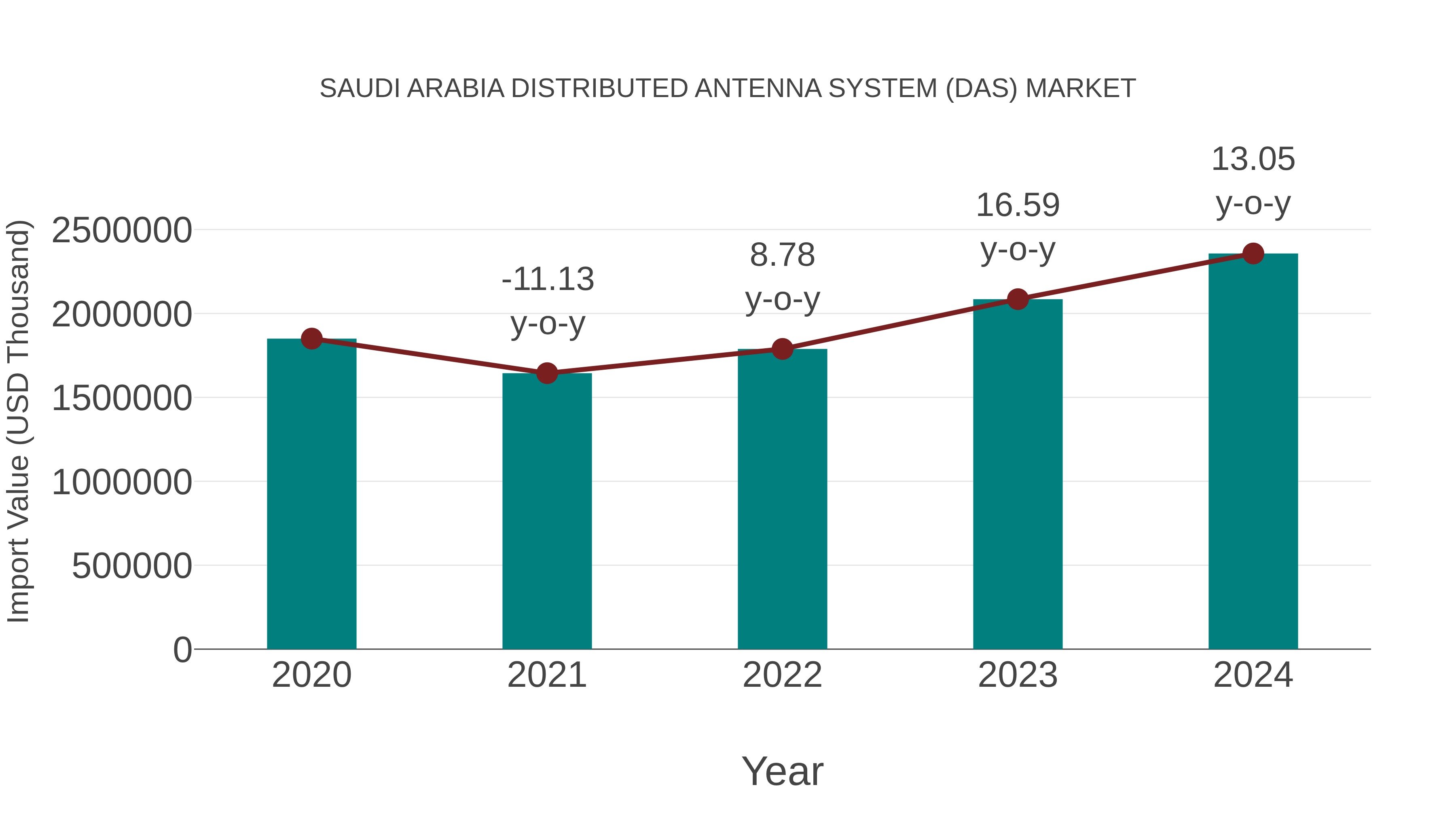
Saudi Arabia Distributed Antenna System (DAS) Market Growth Rate
According to 6Wresearch internal database and industry insights, the Saudi Arabia Distributed Antenna System (DAS) Market is projected to grow at a compound annual growth rate (CAGR) of 7.5% during the forecast period (2026-2032).
Topics Covered in the Saudi Arabia DAS Market Report
The Saudi Arabia DAS Market report thoroughly covers the market by offering, network type, coverage, frequency protocol, ownership model, signal source, user facility area and verticals. The report provides an unbiased and detailed analysis of ongoing market trends, opportunities/high-growth areas, and market drivers, which help stakeholders devise and align their market strategies according to the current and future market dynamics.
Saudi Arabia DAS Market Highlights
| Report Name | Saudi Arabia Distributed Antenna System (DAS) Market |
| Forecast Period | 2026-2032 |
| CAGR | 7.5% |
| Growing Sector | Commercial & Public Safety |
Saudi Arabia DAS Market Synopsis
Saudi Arabia DAS Market is experiencing major growth due to the rising need for high-performance connectivity solutions across various applications. The increasing need for distributed antenna system installations at stadiums and airports results from the expanding mobile data networks which currently operate with their 5G technology. The expanding smart city infrastructure together with the development of public safety systems increases market demand.
Evaluation of Growth Drivers in the Saudi Arabia DAS Market
Below mentioned are some prominent drivers and their influence on market dynamics:
| Drivers | Primary Segments Affected | Why it Matters (Evidence) |
| 5G Network Expansion | Public LTE/CBRS, Indoor Coverage | 5G rollout boosts demand for high-performance DAS systems to support high-speed data transmission. |
| Growth of Smart Cities | Outdoor Coverage, Enterprise Ownership | Urban development projects drive the need for DAS solutions to improve connectivity in city areas. |
| Increased Mobile Data Usage | Public Network, All Coverage Types | Growing mobile internet traffic necessitates enhanced coverage for uninterrupted service. |
| Public Safety Requirements | Neutral-host Ownership, Indoor/Outdoor | DAS ensures reliable communications for emergency and public safety operations. |
| Rising Commercial Infrastructure | Commercial, Enterprise Ownership | Commercial buildings require DAS to meet the needs of tenants for consistent mobile coverage. |
The Saudi Arabia DAS Market is anticipated to witness major growth at a CAGR of 7.5% during the forecast period (2026-2032). fueled by several key factors. The deployment of 5G networks across the country will greatly contribute to this growth, as DAS systems are important for ensuring high-speed, low-latency coverage, especially in high-density urban areas, stadiums, airports and other large venues. The rollout of 5G will require advanced DAS solutions to support the increased demand for mobile data and to provide efficient service in complex environments.
Evaluation of Restraints in the Saudi Arabia DAS Market
Below mentioned are some major restraints and their influence on market dynamics:
| Restraints | Primary Segments Affected | What This Means (Evidence) |
| High Installation Costs | Indoor/Outdoor Coverage, Carrier Ownership | High upfront installation costs may limit DAS adoption, especially in smaller facilities. |
| Complex Regulatory Environment | Private LTE/CBRS | Strict regulatory approvals and standards could cause delays in DAS deployments, which could create a barrier to the growth of the market. |
| Integration Challenges | Neutral-host Ownership, Enterprise Ownership | Complex integration with existing network infrastructure can cause delays. |
| Availability of Alternative Solutions | All Segments | Alternative technologies like Wi-Fi may reduce reliance on DAS. |
| Maintenance and Operational Costs | All Segments | High maintenance and operational costs can deter widespread DAS adoption. |
Saudi Arabia DAS Market Challenges
At the same time, the Saudi Arabia DAS Market share may be affected due to the major challenges. The market faces its main obstacle as it requires high capital investment for initial installation of DAS systems particularly for its large-scale implementations. The process of obtaining regulatory approvals together with the need to integrate new systems into existing network infrastructure leads to deployment delays. The market growth in specific sectors will face restrictions because alternative solutions such as Wi-Fi and small cells compete with existing technologies.
Saudi Arabia DAS Market Trends
The Saudi Arabia DAS Market is experiencing key trends, including:
- Cloud-Based DAS Solutions: Cloud-based DAS technologies are gaining traction due to their ability to offer scalable, centralized management and remote monitoring. This trend is influenced by the increasing demand for flexible solutions that minimize on-site maintenance and increase system performance.
- Integration with Public Safety Networks: DAS is increasingly being adopted in public safety communication networks, providing reliable and uninterrupted service during emergencies. This trend is growing as cities and government agencies prioritize network resilience and the ability to manage communications during critical events.
- Wireless Network Expansion in Commercial Real Estate: Commercial properties such as office buildings, shopping malls, and hotels are increasingly adopting DAS solutions to ensure seamless coverage for mobile users. This trend reflects the need for businesses to offer reliable connectivity for both tenants and visitors.
Investment Opportunities in the Saudi Arabia DAS Market
The following ae the major investment opportunities that are expected to increase the revenue of the market:
- Expansion of 5G Network Deployments: Additional investment into DAS solutions that are compatible with the 5th generation of wireless technology have the potential to provide significant growth for service providers.
- Smart City Infrastructure Integration: Investment in DAS solutions for smart cities will enhance wireless connectivity and communication networks for urban developments.
- Neutral-Host DAS Models: The implementation of neutral host DAS systems where multiple service providers can share the same physical infrastructure has great potential for growth in commercial properties.
Top 5 Leading Players in the Saudi Arabia DAS Market
Below is a comprehensive list of leading players operating in the Saudi Arabia DAS Market:
1. CommScope
| Company Name | CommScope |
| Established Year | 1976 |
| Headquarters | USA |
| Official Website | Click Here |
A global leader in infrastructure solutions for communications networks. CommScope is a dominant player in the Saudi market, providing high-performance active and hybrid DAS solutions that support multi-operator environments in large-scale venues like stadiums and airports.
2. Ericsson
| Company Name | Ericsson |
| Established Year | 1876 |
| Headquarters | Sweden |
| Official Website | Click Here |
A major provider of telecommunications equipment and services in Saudi Arabia. Ericsson offers advanced in-building wireless solutions and DAS technology specifically designed to integrate seamlessly with 5G network expansions across the Kingdom's urban centers.
3. Corning Incorporated
| Company Name | Corning Incorporated |
| Established Year | 1851 |
| Headquarters | USA |
| Official Website | Click Here |
Specializing in glass science and optical physics, Corning provides cutting-edge all-fiber DAS solutions. Their technology is widely utilized in Saudi Arabia for high-density environments, offering scalable and future-ready connectivity for commercial and healthcare facilities.
4. SOLiD
| Company Name | SOLiD |
| Established Year | 2004 |
| Headquarters | South Korea |
| Official Website | Click Here |
A prominent player known for its modular and high-power DAS platforms. SOLiD provides robust indoor and outdoor coverage solutions in the Saudi market, catering to public safety networks and enterprise clients requiring reliable, high-capacity wireless signals.
5. Huawei Technologies Co., Ltd.
| Company Name | Huawei Technologies Co., Ltd. |
| Established Year | 1987 |
| Headquarters | China |
| Official Website | Click Here |
A leading global ICT provider with a massive footprint in Saudi Arabia. Huawei offers innovative DAS and digital indoor systems (DIS) that are instrumental in the Kingdom's smart city initiatives and the rapid rollout of 5G infrastructure.
Government Regulations in the Saudi Arabia DAS Market
As per Saudi Arabia data, many regulations have been established to ensure the quality, safety and environmental compliance of Distributed Antenna Systems. The Communications and Information Technology Commission act as the primary authority overseeing the deployment and operation of DAS networks. The government has put regulations in place to ensure DAS systems, comply with security standards, especially as smart city infrastructure becomes increasingly important.
Future Insights of the Saudi Arabia DAS Market
The Saudi Arabia DAS Market is expected to witness major growth due to the rising demand for high-performance and scalable connectivity solutions in urban areas, commercial buildings and public safety infrastructures. The adoption of 5G networks and smart city projects is expected to provide a boost to the DAS market, with growing emphasis on neutral-host models and cloud-based solutions. The need for robust mobile coverage in public venues and critical infrastructures will continue to drive demand for DAS systems in the long run.
Market Segmentation Analysis
This report provides an inclusive study of the following market segments and their leading categories:
By Offering – Component to Dominate
According to Sarthi, Senior Research Analyst, 6Wresearch, components are anticipated to dominate the Saudi Arabia DAS Market due to the ongoing demand for hardware, antennas, and repeaters required for DAS installations.
By Network Type – Public Network to Dominate
Public networks are expected to dominate the market as DAS systems are increasingly used to enhance connectivity in high-density areas like stadiums, airports, and malls.
By Coverage – Indoor Coverage to Dominate
Indoor Coverage Will Be Leading The indoor DAS market is expected to be the market leader as these types of systems are widely used in commercial buildings, public venues, and enterprises.
By Frequency Protocol – Cellular to Dominate
Cellular Frequency to Lead The cellular frequency is projected to be the leading protocol due in part to the growing need for both voice and data services in various mobile applications.
By Ownership Model – Carrier Ownership to Dominate
Carrier Ownership Will Be Leading The carrier ownership model is expected to be the leading ownership type because telecom network operators are continuing to invest in DAS systems to improve their overall performance in large metropolitan areas.
By Signal Source – On-site BTS to Dominate
On-site base transceiver stations (BTS) will dominate the market as they provide direct coverage for large-scale commercial and public facilities.
By Vertical – Commercial to Dominate
The commercial sector is expected to dominate the market as high-rise buildings, shopping malls, and office complexes increasingly demand reliable wireless coverage solutions.
Key Attractiveness of the Report
- 10 Years of Market Numbers.
- Historical Data Starting from 2022 to 2025.
- Base Year: 2025.
- Forecast Data until 2032.
- Key Performance Indicators Impacting the Market.
- Major Upcoming Developments and Projects.
Key Highlights of the Report:
- Saudi Arabia Distributed Antenna System (DAS) Market Outlook
- Market Size of Saudi Arabia Distributed Antenna System (DAS) Market, 2025
- Forecast of Saudi Arabia Distributed Antenna System (DAS) Market, 2032
- Historical Data and Forecast of Saudi Arabia Distributed Antenna System (DAS) Revenues & Volume for the Period 2022-2032F
- Saudi Arabia Distributed Antenna System (DAS) Market Trend Evolution
- Saudi Arabia Distributed Antenna System (DAS) Market Drivers and Challenges
- Saudi Arabia Distributed Antenna System (DAS) Price Trends
- Saudi Arabia Distributed Antenna System (DAS) Porter's Five Forces
- Saudi Arabia Distributed Antenna System (DAS) Industry Life Cycle
- Historical Data and Forecast of Saudi Arabia Distributed Antenna System (DAS) Market Revenues & Volume By Offering for the Period 2022-2032F
- Historical Data and Forecast of Saudi Arabia Distributed Antenna System (DAS) Market Revenues & Volume By Component for the Period 2022-2032F
- Historical Data and Forecast of Saudi Arabia Distributed Antenna System (DAS) Market Revenues & Volume By Services for the Period 2022-2032F
- Historical Data and Forecast of Saudi Arabia Distributed Antenna System (DAS) Market Revenues & Volume By Network Type for the Period 2022-2032F
- Historical Data and Forecast of Saudi Arabia Distributed Antenna System (DAS) Market Revenues & Volume By Public network for the Period 2022-2032F
- Historical Data and Forecast of Saudi Arabia Distributed Antenna System (DAS) Market Revenues & Volume By Private LTE/CBRS for the Period 2022-2032F
- Historical Data and Forecast of Saudi Arabia Distributed Antenna System (DAS) Market Revenues & Volume By Coverage for the Period 2022-2032F
- Historical Data and Forecast of Saudi Arabia Distributed Antenna System (DAS) Market Revenues & Volume By Indoor for the Period 2022-2032F
- Historical Data and Forecast of Saudi Arabia Distributed Antenna System (DAS) Market Revenues & Volume By Outdoor for the Period 2022-2032F
- Historical Data and Forecast of Saudi Arabia Distributed Antenna System (DAS) Market Revenues & Volume By Frequency Protocol for the Period 2022-2032F
- Historical Data and Forecast of Saudi Arabia Distributed Antenna System (DAS) Market Revenues & Volume By Cellular for the Period 2022-2032F
- Historical Data and Forecast of Saudi Arabia Distributed Antenna System (DAS) Market Revenues & Volume By VHF/UHF for the Period 2022-2032F
- Historical Data and Forecast of Saudi Arabia Distributed Antenna System (DAS) Market Revenues & Volume By Others for the Period 2022-2032F
- Historical Data and Forecast of Saudi Arabia Distributed Antenna System (DAS) Market Revenues & Volume By Ownership Model for the Period 2022-2032F
- Historical Data and Forecast of Saudi Arabia Distributed Antenna System (DAS) Market Revenues & Volume By Carrier ownership for the Period 2022-2032F
- Historical Data and Forecast of Saudi Arabia Distributed Antenna System (DAS) Market Revenues & Volume By Neutral-host ownership for the Period 2022-2032F
- Historical Data and Forecast of Saudi Arabia Distributed Antenna System (DAS) Market Revenues & Volume By Enterprise ownership for the Period 2022-2032F
- Historical Data and Forecast of Saudi Arabia Distributed Antenna System (DAS) Market Revenues & Volume By Signal Source for the Period 2022-2032F
- Historical Data and Forecast of Saudi Arabia Distributed Antenna System (DAS) Market Revenues & Volume By Off-air antennas (repeaters) for the Period 2022-2032F
- Historical Data and Forecast of Saudi Arabia Distributed Antenna System (DAS) Market Revenues & Volume By On-site base transceiver station (BTS) for the Period 2022-2032F
- Historical Data and Forecast of Saudi Arabia Distributed Antenna System (DAS) Market Revenues & Volume By Small cells for the Period 2022-2032F
- Historical Data and Forecast of Saudi Arabia Distributed Antenna System (DAS) Market Revenues & Volume By User Facility Area for the Period 2022-2032F
- Historical Data and Forecast of Saudi Arabia Distributed Antenna System (DAS) Market Revenues & Volume By >500 K SQ. FT. for the Period 2022-2032F
- Historical Data and Forecast of Saudi Arabia Distributed Antenna System (DAS) Market Revenues & Volume By 200??500 K SQ. FT. for the Period 2022-2032F
- Historical Data and Forecast of Saudi Arabia Distributed Antenna System (DAS) Market Revenues & Volume By <200 K SQ. FT. for the Period 2022-2032F
- Historical Data and Forecast of Saudi Arabia Distributed Antenna System (DAS) Market Revenues & Volume By Vertical for the Period 2022-2032F
- Historical Data and Forecast of Saudi Arabia Distributed Antenna System (DAS) Market Revenues & Volume By Commercial for the Period 2022-2032F
- Historical Data and Forecast of Saudi Arabia Distributed Antenna System (DAS) Market Revenues & Volume By Public Safety for the Period 2022-2032F
- Saudi Arabia Distributed Antenna System (DAS) Import Export Trade Statistics
- Market Opportunity Assessment By Offering
- Market Opportunity Assessment By Network Type
- Market Opportunity Assessment By Coverage
- Market Opportunity Assessment By Frequency Protocol
- Market Opportunity Assessment By Ownership Model
- Market Opportunity Assessment By Signal Source
- Market Opportunity Assessment By User Facility Area
- Market Opportunity Assessment By Vertical
- Saudi Arabia Distributed Antenna System (DAS) Top Companies Market Share
- Saudi Arabia Distributed Antenna System (DAS) Competitive Benchmarking By Technical and Operational Parameters
- Saudi Arabia Distributed Antenna System (DAS) Company Profiles
- Saudi Arabia Distributed Antenna System (DAS) Key Strategic Recommendations
Markets Covered
The market report for the Saudi Arabia Distributed Antenna System (DAS) Market has been segmented and sub-segmented into the following categories:
By Offering
- Component
- Services
By Network Type
- Public Network
- Private LTE/CBRS
By Coverage
- Indoor
- Outdoor
By Frequency Protocol
- Cellular
- VHF/UHF
- Others
By Ownership Model
- Carrier Ownership
- Neutral-host Ownership
- Enterprise Ownership
By Signal Source
- Off-air Antennas (Repeaters)
- On-site Base Transceiver Station (BTS)
- Small Cells
By User Facility Area
- >500 K SQ. FT.
- 200K–500K SQ. FT.
- <200 K SQ. FT.
By Vertical
- Commercial
- Public Safety






































