Saudi Arabia It Market: Import Trend Analysis
Saudi Arabia`s IT market experienced a -13.63% decline in import growth from 2023 to 2024, following a 27.86% compound annual growth rate from 2020 to 2024. This shift may be attributed to evolving demand patterns or changes in trade policies impacting market stability.
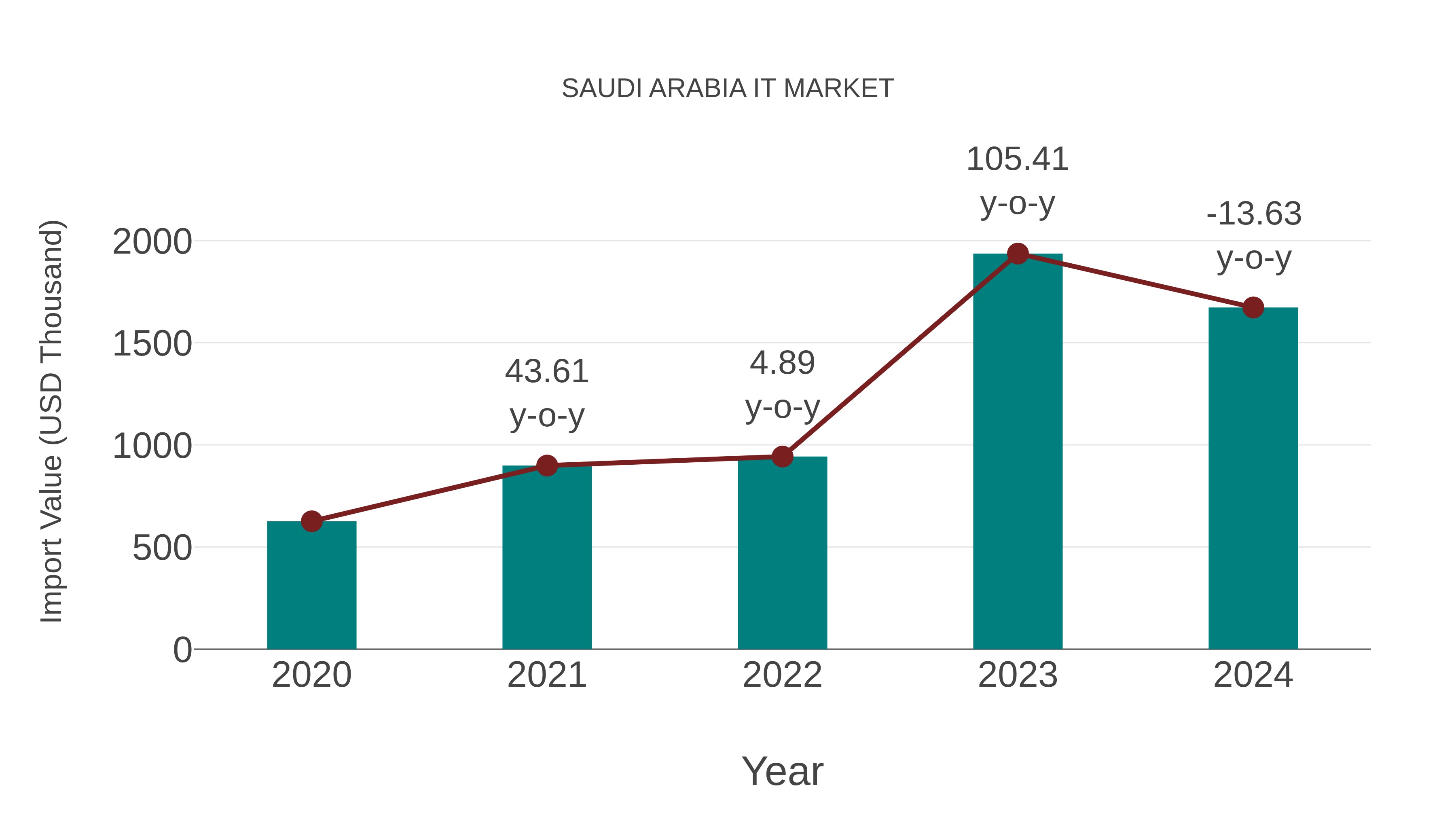
Saudi Arabia IT Market Growth Rate
According to 6Wresearch internal database and industry insights, the Saudi Arabia IT Market is projected to grow at a compound annual growth rate (CAGR) of 8.9% during the forecast period 2026–2032.
Five-Year Growth Trajectory of the Saudi Arabia IT Market with Core Drivers
Below mentioned are the evaluation of year-wise growth rate along with key drivers:
| Year | Est. Annual Growth (%) | Growth Drivers |
| 2021 | 5.1 | Increasing use of digital payments and automation across private sector. |
| 2022 | 5.6 | Expansion of data centres and high demand for cloud-based business applications. |
| 2023 | 6.3 | Growth of Vision 2030 digital programs and smart government programs. |
| 2024 | 7.2 | Strong investments in cybersecurity, fintech platforms, and e-government services. |
| 2025 | 8.1 | Increased cloud migration, adoption of AI, and large-scale smart city projects. |
Topics Covered in the Saudi Arabia IT Market Report
The Saudi Arabia IT Market report thoroughly covers the market by enterprise size, end-user. It provides an unbiased and detailed analysis of ongoing market trends, opportunities, challenges, and market drivers, helping stakeholders align their strategies with current and future market dynamics.
Saudi Arabia IT Market Highlights
| Report Name | Saudi Arabia IT Market |
| Forecast Period | 2026–2032 |
| CAGR | 8.90% |
| Growing Sector | Cloud Computing, Cybersecurity, and Digital Government Solutions |
Saudi Arabia IT Market Synopsis
Saudi Arabia IT Market is expected to grow rapidly due to massive digital transformation under Vision 2030, high demand for cloud and cybersecurity solutions, and strong government investments in smart infrastructure. Large-scale projects such as NEOM, Red Sea Project, and Digital Government Authority programs are increasing adoption of IT across sectors. The expansion of fintech, e-commerce, and AI-based platforms also strengthens the market’s demand. With increasing participation of private sector in the IT industry and high foreign investments, Saudi Arabia also presents a highly attractive IT ecosystem.
Evaluation of Growth Drivers in the Saudi Arabia IT Market
Below mentioned are some prominent drivers and their influence on the Saudi Arabia IT Market dynamics:
| Drivers | Primary Segment Affected | Why It Matters (Evidence) |
| Vision 2030 Digital Transformation | All Segments | Government-backed digital programs are increasing large-scale usage of IT solutions in both public and private sectors. |
| Cloud Computing Expansion | All Segments | Enterprises are moving heavy workloads to cloud for scalability, resilience, and operational efficiency. |
| Cybersecurity Investments | BFSI, Government | Rising cyber threats are pushing organizations to use advanced security frameworks. |
| Smart City & Mega Projects | Government, IT and Telecom | Smart cities such as NEOM and Red Sea Project also need advanced IT infrastructure. |
| Fintech & Digital Payments Growth | BFSI | Rapid usage of digital banking and cashless payments increases IT demand. |
Saudi Arabia IT Market Size is projected to grow at a compound annual growth rate (CAGR) of 8.9% from 2026 to 2032. The market growth is driven by massive investments in digital infrastructure, rising cloud usage, and high spending on cybersecurity. Government-backed digital policies under Vision 2030 are increasing demand for e-government platforms, data centres, and national digital identity systems. Large-scale projects such as NEOM, Red Sea Project, and Digital Government Authority programs are increasing adoption of IT across sectors Increased use of AI, automation, and smart technologies in different enterprises and public institutions are also promoting Saudi Arabia IT Market Growth.
Evaluation of Restraints in the Saudi Arabia IT Market
Below mentioned are some major restraints and their influence on the Saudi Arabia IT Market dynamics:
| Restraints | Primary Segment Affected | What This Means (Evidence) |
| High Implementation Costs | IT Providers | New infrastructure development increases project prices for SMEs. |
| Cybersecurity Skill Gap | All Segments | Shortage of trained cybersecurity professionals also delays secure deployments. |
| Vendor Dependency | IT Solutions | Heavy dependence on global IT vendors increases long-term operational prices. |
| Data Localization Regulations | IT Providers | Compliance of laws regarding data adds difficulties to operations. |
| Change Management Issues | All Segments | Resistance to digital change affects transformation speed in old sectors. |
Saudi Arabia IT Market Challenges
Saudi Arabia IT Market faces many challenges such as high implementation prices, cybersecurity talent shortages, regulatory compliance needs, and major dependency on global vendors for new and advanced technologies. Organizations must invest heavily in digital skills, secure infrastructure, and proper compliance frameworks to remain competitive in the Saudi Arabia IT Industry. Rapid technology usage also increases integration and system migration difficulties for traditional enterprises.
Saudi Arabia IT Market Trends
Several notable trends are shaping the Saudi Arabia IT Market dynamics:
- Cloud Adoption: Enterprises are rapidly shifting workloads to public and hybrid cloud platforms to support digital operations and scalability.
- Cybersecurity Demand: Increasing cyber threats and digital transactions are pushing investments in SOCs, encryption, and identity access management.
- Government-Led Digital Services: Platforms such as Absher and G-Cloud are changing public service delivery.
- AI & Data Analytics Integration: AI is being used across healthcare, retail, and government for predictive analytics and operational ease.
- Smart City IT Deployment: Smart infrastructure projects are creating new demand for IoT, networking, and real-time data platforms.
Investment Opportunities in the Saudi Arabia IT Industry
Some notable investment opportunities in the Saudi Arabia IT Industry are:
- Cloud Computing: Investments in hyperscale data centres and enterprise cloud platforms to meet rising digital demand.
- Cybersecurity Solutions: Growth in threat detection, SOC platforms, and compliance-ready security systems.
- AI & Automation: Investment in AI-powered analytics, robotics, and business automation platforms.
- 5G, IoT & Smart Cities: Infrastructure needed for smart transportation, utilities, and digital city services.
- Government Digitalization Projects: Partnerships in national platforms, digital identity, and smart governance solutions.
Top 5 Leading Players in the Saudi Arabia IT Market
Below is the list of prominent companies leading in the Saudi Arabia IT Market:
1. Saudi Aramco Digital
| Company Name | Saudi Aramco Digital |
| Headquarters | Dhahran, Saudi Arabia |
| Established | 2022 |
| Website | Click Here |
Saudi Aramco Digital plays a major role in providing industrial IT, cloud infrastructure, data analytics, and cybersecurity solutions supporting energy and industrial digital transformation.
2. STC Solutions
| Company Name | STC Solutions |
| Headquarters | Riyadh, Saudi Arabia |
| Established | 2008 |
| Website | Click Here |
STC Solutions delivers enterprise cloud, cybersecurity, networking, and managed IT services to government and private enterprises.
3. Oracle Saudi Arabia
| Company Name | Oracle Saudi Arabia |
| Headquarters | Riyadh, Saudi Arabia |
| Established | 1987 |
| Website | Click Here |
Oracle Saudi Arabia supports enterprises with cloud infrastructure, database solutions, ERP systems, and government digital platforms.
4. Microsoft Saudi Arabia
| Company Name | Microsoft Saudi Arabia |
| Headquarters | Riyadh, Saudi Arabia |
| Established | 1999 |
| Website | Click Here |
Microsoft Saudi Arabia provides Azure cloud, enterprise productivity solutions, cybersecurity platforms, and digital transformation tools supporting Vision 2030 initiatives.
5. IBM Saudi Arabia
| Company Name | IBM Saudi Arabia |
| Headquarters | Riyadh, Saudi Arabia |
| Established | 1947 |
| Website | Click Here |
IBM Saudi Arabia offers hybrid cloud, AI, enterprise integration, and cybersecurity services to large enterprises and government entities.
Government Regulations Introduced in the Saudi Arabia IT Market
According to Saudi Arabian government data, multiple digital rules and regulations and policies support the IT sector such as Vision 2030 digital transformation strategy, the Saudi Data & AI Authority (SDAIA) programs, and the National Digital Transformation Unit (NDU). The government also promotes cloud-first policies, smart government platforms, national’s improved digital identity, and giga projects like NEOM and the Red Sea Project. Foreign investment reforms, tax prizes in technology zones, and public-private digital partnerships also further strengthen IT sector demand. Government-backed digital policies under Vision 2030 are increasing demand for e-government platforms, data centres, and national digital identity systems.
Future Insights of the Saudi Arabia IT Market
Saudi Arabia IT Market is expected to grow strongly with major investments in cloud, cybersecurity, AI, and smart infrastructure. Government digital transformation programs will also continue to attract global IT players and new and better investment in advanced technology. Expansion of fintech, e-commerce, and smart city projects will also push and stimulate demand in IT sector. The country’s diverse and improved strategy and Digital Vision 2030 will also position Saudi Arabia as a leading IT hub in the Middle East. With increasing participation of private sector in the IT industry and high foreign investments, Saudi Arabia also presents a highly attractive IT ecosystem.
Market Segmentation Analysis
The report offers a comprehensive study of the following market segments and their leading categories:
By Enterprise Size - Large Enterprises to dominate the market
According to Lakshita, Senior Research Analyst, 6Wresearch, Large enterprises are expected to dominate the Saudi Arabia IT Market Share due to their strong capital capabilities, large-scale digital transformation programs, and participation in national giga projects. These organizations invest heavily in cloud platforms, cybersecurity frameworks, enterprise software, and AI-driven infrastructure to improve operational efficiency and global competitiveness.
By End-user - Government to dominate the market
The government sector is expected to dominate the Saudi Arabia IT Market due to large-scale digital governance projects, national digital identity platforms, smart city developments, and e-government service modernization under Vision 2030.
Key Attractiveness of the Report
- 10 Years of Market Numbers.
- Historical Data Starting from 2022 to 2025.
- Base Year: 2025.
- Forecast Data until 2032.
- Key Performance Indicators Impacting the Market.
- Major Upcoming Developments and Projects.
Key Highlights of the Report:
- Saudi Arabia IT Market Outlook
- Market Size of Saudi Arabia IT Market, 2025
- Forecast of Saudi Arabia IT Market, 2032
- Historical Data and Forecast of Saudi Arabia IT Revenues & Volume for the Period 2022- 2032F
- Saudi Arabia IT Market Trend Evolution
- Saudi Arabia IT Market Drivers and Challenges
- Saudi Arabia IT Price Trends
- Saudi Arabia IT Porter's Five Forces
- Saudi Arabia IT Industry Life Cycle
- Historical Data and Forecast of Saudi Arabia IT Market Revenues & Volume By Enterprise Size for the Period 2022- 2032F
- Historical Data and Forecast of Saudi Arabia IT Market Revenues & Volume By Small and Medium Enterprises for the Period 2022- 2032F
- Historical Data and Forecast of Saudi Arabia IT Market Revenues & Volume By Large Enterprises for the Period 2022- 2032F
- Historical Data and Forecast of Saudi Arabia IT Market Revenues & Volume By End-user for the Period 2022- 2032F
- Historical Data and Forecast of Saudi Arabia IT Market Revenues & Volume By Retail for the Period 2022- 2032F
- Historical Data and Forecast of Saudi Arabia IT Market Revenues & Volume By Manufacturing for the Period 2022- 2032F
- Historical Data and Forecast of Saudi Arabia IT Market Revenues & Volume By BFSI for the Period 2022- 2032F
- Historical Data and Forecast of Saudi Arabia IT Market Revenues & Volume By Government for the Period 2022- 2032F
- Historical Data and Forecast of Saudi Arabia IT Market Revenues & Volume By IT and Telecom for the Period 2022- 2032F
- Historical Data and Forecast of Saudi Arabia IT Market Revenues & Volume By Other for the Period 2022- 2032F
- Saudi Arabia IT Import Export Trade Statistics
- Market Opportunity Assessment By Enterprise Size
- Market Opportunity Assessment By End-user
- Saudi Arabia IT Top Companies Market Share
- Saudi Arabia IT Competitive Benchmarking By Technical and Operational Parameters
- Saudi Arabia IT Company Profiles
- Saudi Arabia IT Key Strategic Recommendations
Market Covered
The report offers a comprehensive study of the following Saudi Arabia IT Market segments:
By Enterprise Size
- Small and Medium Enterprises
- Large Enterprises
By End-user
- Retail
- Manufacturing
- BFSI
- Government
- IT and Telecom
- Other Distribution Channels






































